

Learning how to learn helps you improve in subjects you find difficult by giving you practical ways to study, remember, and use what you learn. Students, kids, teens, and lifelong learners can all make better use of their time with small changes to how they practice. Rereading can feel productive, but it does not show whether you can recall or apply an idea. Retrieval practice means trying to recall information from memory before checking your notes or the answer.
The book offers practical ways to work with your attention, build memory, and make study time count. You can try one method, notice what helps, and adjust your routine without turning homework into a marathon. Progress comes from practice, not from being born with a knack for every subject.
You do not need to be a “natural” at a subject to make progress; you need a better way to practice.
Key Takeaways
- Rereading may feel easy without testing what you can recall.
- Retrieval practice starts with remembering before checking your notes.
- Small changes can make study time more useful.
- Try one method at a time and keep what works for you.
- Practice can help you tackle subjects that feel difficult.
What Does the Learning How to Learn Book Teach?
The book turns ideas about memory and the brain into practical lessons for kids and teens. Its full title is Learning How to Learn: How to Succeed in School Without Spending All Your Time Studying, by Barbara Oakley, Terrence Sejnowski, and Alistair McConville.
The book connects how the brain works with choices students make during real study sessions. Its topics include mind wandering, avoiding rut thinking, memory, metaphors, and procrastination. Those ideas can help explain why you get stuck on a problem or put off starting homework.
Try an idea in your own study session instead of collecting tips you never use.
Illustrations make unfamiliar ideas easier to picture, while application questions and exercises give you a way to try them. The book is not just a set of study rules to memorize. It asks you to notice what happens when you use an idea.
A learning how to learn summary is simple: the book looks at study habits, memory, and problem-solving, then offers ways to put them into practice. It suits readers who want an approachable start, not a technical tour of the brain.
Look for an idea you can test in your next homework session, rather than trying to adopt every method at once.
How Focus and Mind-Wandering Work Together
A tricky homework problem can feel different after you step away from it for a few minutes. The brain uses focused mode for close attention and diffuse mode for relaxed, less-directed thinking.
Focused work helps you learn the basics; a break can help your mind connect them. Neither kind of attention does the whole job alone.
Focused mode lays the groundwork
Focused mode means paying close attention to one task. Start by reading an explanation or working through the basic steps of a problem.
Then try a harder question while the key details are fresh. If you reach a snag, mark the point where your thinking stopped instead of staring at the page.
Diffuse mode helps connect ideas
Diffuse mode is relaxed thinking with less direction. A walk, doodling, or another low-demand break can give your attention a chance to reset.
When you return, you may notice a fresh angle on the part that felt stuck. Letting your mind wander is an important part of learning, but it is a break from focused work, not a replacement for it.
The table shows how each mode can fit into one study session. Keep the break simple enough that returning to the task feels easy.
| Situation | What your attention is doing | A useful study move |
|---|---|---|
| Focused work | Stays on one lesson or problem | Read the steps, then try a question |
| Diffuse break | Moves freely without a hard task | Walk or doodle for a few minutes |
| Recall check | Searches memory for the main idea | Close notes and explain the idea |
Give a hard question a focused first attempt before you take a break and come back to it.
Which Study Techniques Have the Strongest Evidence?
Testing what you can recall and spacing practice across time are stronger starting points than relying on highlighting alone. A 2022 summary of Dunlosky et al. (2013) ranks practice testing and distributed practice as high impact.
Spread practice across sessions, and use recall checks instead of only marking the page. The same summary rates interleaved practice, elaborative interrogation, and self-explanation as moderate impact. It rates summarization, highlighting or underlining, and the keyword mnemonic as low impact.
Here, practice testing means trying to remember material before checking it. The table gives a simple way to choose how to spend study time.
| Technique category | Named methods | Practical takeaway |
|---|---|---|
| High impact | Practice testing; distributed practice | Recall ideas and spread study sessions |
| Moderate impact | Interleaved practice; elaborative interrogation; self-explanation | Mix problems and explain your thinking |
| Low impact | Summarization; highlighting or underlining; keyword mnemonic | Use these as support, not your only method |
A 2025 study found that retrieval practice improved delayed retention and transfer of complex research-methods concepts compared with restudy and quiz study. Results differed across experiments, so the details matter.
In Experiment 1, 309 people took one short-answer quiz with feedback, one multiple-choice quiz with feedback, restudied, or used quiz study. A final test came eight minutes later. Retrieval practice beat restudy on repeated questions, but not quiz study or recognition, and it did not improve application questions.
In Experiment 2, 158 people completed three rounds of retrieval practice, restudy, or quiz study before a final test one week later. Retrieval practice led to better results on repeated questions. In Experiment 3, 255 people completed the same three study conditions, then took a test one week later. Retrieval practice led to better results on application questions.
Use notes to check and correct your recall, not as a substitute for trying to remember.
How Can You Make Memory Tricks Stick?
A memory hook works best when it gives a new idea somewhere familiar to land. Chunks and metaphors can make unfamiliar material easier to hold and use.
Connect a new idea to something you already know, then practise bringing it back. A metaphor is useful when it helps explain a concept, not just decorate it.
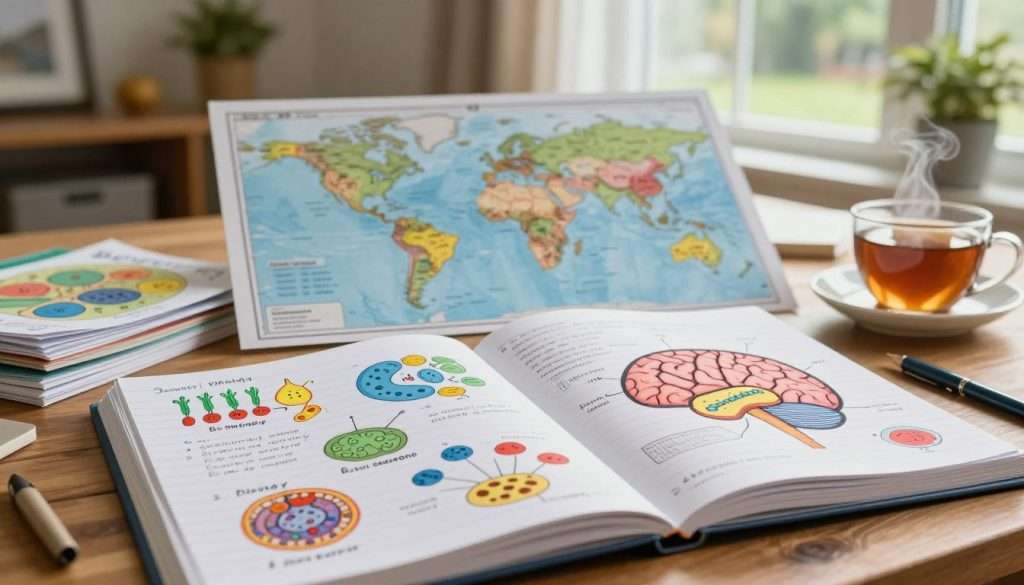
Build useful chunks and metaphors
A chunk groups related details into one larger idea. Instead of trying to remember every step separately, group steps that work together, then name the group.
Metaphors can also give an unfamiliar idea a familiar shape. You might picture a biology process as a journey, with each stage acting like a stop along the way.
The value of metaphors developing in your own notes comes from the links they help you make. A picture that works for one person may not work for another, so choose one that makes sense to you.
Practise recall with vivid cues
Five memory tips offer a handy path from first attention to later recall. Try them as actions, rather than as five more words to memorize.
- Focus: Give the idea your attention before you move on.
- Practice: Work with the material more than once.
- Picture: Make a clear mental image of the idea.
- Store: Link the idea to something you already know.
- Recall: Try to bring it back before checking your notes.
A memory palace uses spatial memory by placing ideas in familiar locations in your mind. You could picture each stage of a process in a different room along a route you know.
That route gives the images an order, while the images act as cues. If a picture or metaphor confuses the idea instead of clarifying it, choose a simpler cue.
Who Can Benefit From Learning These Skills?
You do not have to be a struggling student to benefit from a better way to learn. These methods suit kids, teens, and adults who want study time to feel more manageable.
Extra practice can help whether you learn quickly or need more time with a subject. Being a “fast” thinker is not a requirement for building skills or making progress.
Future Problem Solving uses the 5Cs as a framework for skills people can practise. The five Cs are critical thinking, creativity, communication, collaboration, and caring.
Future Problem Solving’s 5Cs connect learning with more than remembering facts. For example, communication helps you explain an idea, while collaboration lets you work through a task with others.
- Critical thinking: Check ideas and judge how well they fit.
- Creativity: Find fresh ways to approach a problem.
- Communication: Share an idea so others can follow it.
- Collaboration: Work with others toward a shared goal.
- Caring: Notice how your choices affect other people.
In January 2026, ETS and the Carnegie Foundation released skills progressions focused on collaboration, communication, and critical thinking. Those three skills can grow through practice, just like subject knowledge.
Treat the framework as a set of skills to practise, not a label for who is or is not naturally gifted.
Would a Book or Online Course Fit You Better?
Choose a book for flexible reading and a course when you want lessons and checkpoints arranged in sequence. A book lets you pause, reread, and practise at your own pace.
A MOOC, or massive open online course, usually offers a more structured path through lessons and assessments. Self-paced online courses commonly arrange those parts into modules.

The Learning How to Learn MOOC search points to a course format, not one set course with fixed terms. A course can suit you if you like a planned sequence and clear checkpoints.
A learning how to learn free course may have different terms for lesson access and certificates. Check what each part includes before enrolling, since free access does not always cover every option.
Barbara Oakley and Terrence Sejnowski are names tied to the book, but an instructor’s name alone does not confirm a specific course is currently free. Course details can change, so read the terms shown for the course you choose.
A book gives you room to pause wherever you need, while a course can set a steadier pace. Think about whether you prefer to choose your next topic or follow a ready-made order.
Before enrolling in any free course, check whether the lessons, assessments, and certificate are covered by the same access terms.
How Can You Put the Ideas Into Practice This Week?
Pick one lesson you have been putting off and make the first study block small enough to start. A 25-minute Pomodoro interval gives you a clear stretch of focus, followed by a reward break.
Three short sessions on separate days make a practical starting routine, not a rule or a promise. Adjust the task and break to fit your attention.
A routine is a tool, not a test of character. Change the task size or break when your attention needs it.
- Choose one small topic and focus on it for a 25-minute Pomodoro interval.
- Close your notes and retrieve the main ideas from memory, then check and correct them.
- Return on another day to recall the ideas again and try one application question.
You might use a single science concept, one history event, or a math skill for the first session. A small target makes it easier to begin than a vague plan to study an entire subject.
Take a reward break after the timed focus interval, then choose an activity that helps you reset. A quick stretch or a drink of water can work better than opening an app that keeps you scrolling.
Three sessions across separate days are a useful template, but your schedule may call for a different pace. Keep the task short enough to finish, and make the break fit your attention.
Keep the first session focused on one topic, then use your next spaced session to see what you can still bring back from memory.
Conclusion
You do not need a perfect study system; start with one method you can repeat and improve. Learning tools work best when you test them, notice what helps, and adjust the parts that do not fit.
We offer “How to Become the Smartest Student in the Classroom” as a full system for memory techniques, study routines, and strategies that stick. It is free. No cost, no catch.
Grab your free copy here: https://www.studyingmachine.com/free-books/.