
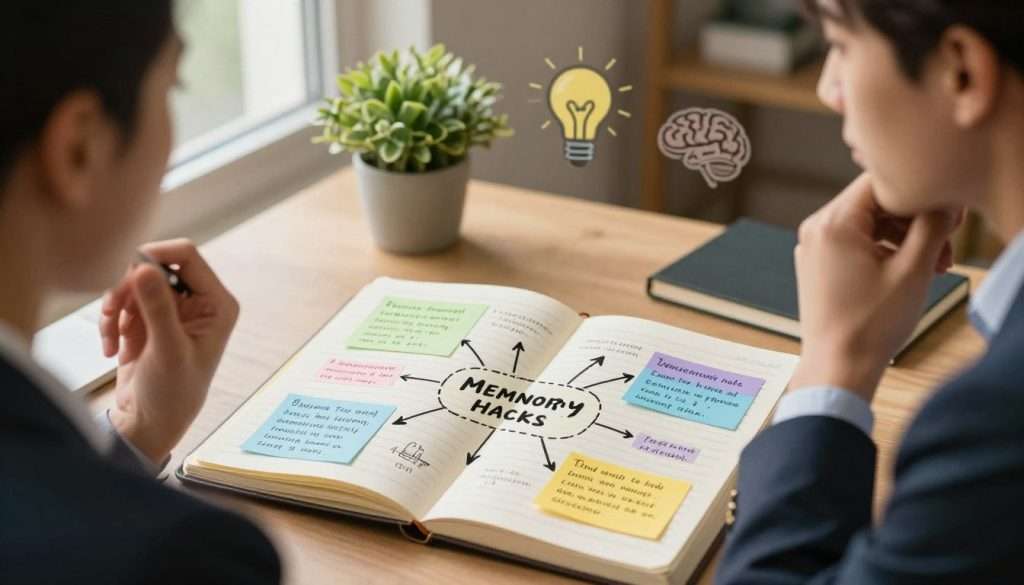
Ever struggled to remember something important or a face you know? It’s really frustrating. But, there are ways to make your memory better.
We all forget things sometimes, whether it’s during exams or in everyday life. Using tricks like visualization can really help. It makes our working memory bigger and helps us remember things for a long time.
With these science-backed memory hacks, you can get better at remembering things. You won’t feel like you’re losing your mind over important details anymore.
Key Takeaways
- Discover effective memory improvement tips to enhance your recall abilities.
- Learn how to utilize memory hacks that are backed by science.
- Understand how to apply these techniques in your daily life for better memory retention.
- Explore the benefits of visualization and memory tricks in expanding your working memory.
- Improve your ability to access long-term memory with simple, proven methods.
The Memory Crisis: Why We Keep Forgetting
Our memory faces a big challenge from all the data and distractions around us. Remembering important things has become hard. We need good memory retention strategies to fight this.
Modern Lifestyle and Memory Challenges
The modern world is full of distractions that mess with our memory. Let’s look at what’s causing this problem.
Digital Distractions and Attention Fragmentation
Notifications and social media break our focus. This attention fragmentation really hurts our memory.
Stress and Sleep Deprivation Effects
Stress and not getting enough sleep also hurt our memory. When we’re stressed or tired, our brain can’t store memories well.
| Factor | Impact on Memory |
|---|---|
| Digital Distractions | Fragmented attention |
| Stress | Impaired memory consolidation |
| Sleep Deprivation | Reduced memory retention |
Knowing these challenges helps us find ways to improve memory skills. Techniques like the memory palace work well because our brains are good at remembering places.
Understanding How Memory Works
The human brain can form, store, and recall memories in complex ways. We can improve this process. To understand how memory works, we must look at its basic stages.
The Three Stages of Memory Formation
Memory formation has three key stages: encoding, storage, and retrieval. Encoding is the first step. Here, we take in information through our senses and process it for storage.
Encoding: Getting Information In
In encoding, the brain picks what info to keep and how to store it. This stage is vital because it decides what we remember and forget.
Storage: Keeping Information Available
After encoding, info moves to storage. Here, it stays for a while. Our brain holds lots of info, but how it’s stored affects recall.
Retrieval: Accessing Stored Information
The last stage is retrieval. This is when we recall stored info. How well we can recall depends on encoding and storage.
Why Some Memories Stick While Others Fade
Memories vary in how long they last. Some stay with us forever, while others fade. This difference comes from the memory’s emotional value and brain processes.
The Role of Emotion in Memory Formation
Emotion greatly affects memory. Strong emotions make us more likely to remember events. This is because emotions boost the encoding process.
Neurological Basis of Memory Consolidation
Memory consolidation involves the brain’s hippocampus and other areas. Knowing this helps us find ways to improve memory. This includes effective memory enhancement strategies and memory boosting methods.
Common Memory Challenges and Their Solutions
Memory lapses happen to everyone. But, there are ways to beat them. We forget names, lose things, and can’t remember tasks. Luckily, cognitive enhancement techniques can boost our memory and daily life.
Forgetting Names and Faces
Forgetting names and faces is a common worry. To tackle this, association techniques for social memory can help.
Association Techniques for Social Memory
When you meet someone new, link their name to something unique. For example, if it’s “Rose,” think of a rose flower or someone else with that name.
Practice Exercises for Name Recall
Practice remembering names by recalling those of people you’ve met. Writing down names and faces in a journal can also help.
Misplacing Items and Losing Track of Tasks
Misplacing things and forgetting tasks can be annoying. Creating memory triggers and organizing your space can solve this.
Creating Memory Triggers
Use visual or sound cues to remind you of tasks or where you put things. For example, always put your keys in the same spot near the door.
Environmental Organization Strategies
Keep your living and work areas tidy to find things easily. Label storage and keep often-used items in easy spots.
Stop Forgetting Everything: 5 Science-Backed Memory Hacks That Actually Stick
Forgetting important stuff can be really frustrating. But, what if you could boost your memory with science-backed methods? The memory hacks we’ll look at are based on real science. They help improve long-term memory and are backed by neuroscience and cognitive psychology.
What Makes These Techniques Different
These memory hacks are not just tricks. They’re based on how our brains function. Let’s explore what makes them unique.
Beyond Simple Mnemonics
Mnemonics can be useful, but these techniques are more powerful. They use multiple brain processes, making them better for keeping information in your memory for a long time.
Long-term Memory Enhancement
We’re focusing on methods that improve long-term memory, not just short-term recall. This means you’ll remember things for a longer period.
How Science Validates These Approaches
The success of these memory hacks is proven by science. Let’s examine the evidence.
Neuroscience Research Highlights
Neuroscience studies have found that some techniques can make your memory stronger by connecting brain cells better.
Cognitive Psychology Findings
Cognitive psychology research has found strategies that help keep information in your memory better and recall it more easily.
| Memory Hack | Description | Benefit |
|---|---|---|
| Method of Loci | Uses spatial memory to recall information | Improves recall of complex information |
| Spaced Repetition | Reviews information at optimal intervals | Enhances long-term retention |
| Dual Coding Theory | Combines visual and verbal information | Boosts memory by engaging multiple senses |
Memory Hack #1: The Method of Loci (Spatial Memory Technique)
Imagine remembering complex info easily with a technique that uses your brain’s spatial memory. The method of loci, or memory palace technique, is a strong memory enhancement strategy used for centuries. It works by linking info to places you know well, making it easier to recall.
The Science Behind Spatial Memory
The method of loci works because our brains are wired to remember places. Studies show that spatial memory is linked to the hippocampus, a key part of the brain for memory.
Hippocampal Activation and Spatial Navigation
When we move through places we know, our hippocampus gets active. This creates a mental map of the area. This process is key to the method of loci, helping us link new info to places for easier recall.
Evolutionary Advantages of Location Memory
Our brains are good at remembering places and navigating, a skill important for survival. The method of loci uses this natural ability, making it a great tool for improving memory.
How to Build Your Memory Palace
To create a memory palace, start by picking a place you know well. It could be your home, school, or work. Choose a place you can picture clearly.
Selecting Familiar Locations
First, pick a place you know really well. It might be your house layout or your commute to work. The more you know the place, the better you’ll remember it.
Creating Vivid Mental Markers
After picking your place, link the info you want to remember to specific spots or objects. For example, you could place each item on a list in a different room in your house.
Practice Routines for Beginners
To start, practice your memory palace often. Begin with simple tasks like remembering a shopping list by linking each item to a room in your house. As you get better, you can tackle more complex info.
Real-World Applications
The method of loci is not just a theory; it’s very useful in real life. It helps with remembering presentations, speeches, and complex sequences of info, making it a game-changer.
Memorizing Presentations and Speeches
By linking key points of your speech to spots in your memory palace, you can deliver confidently without notes.
Learning Complex Sequences of Information
Whether you’re a student or a professional, the method of loci can help. It makes complex info easier to remember and recall by visualizing it in space.
| Technique | Application | Benefit |
|---|---|---|
| Method of Loci | Memorizing speeches, presentations | Improved recall, confidence |
| Method of Loci | Learning complex information | Better retention, easier recall |
“The art of memory is the art of attention.” – Samuel Johnson
Mastering the method of loci boosts your memory and learning skills. This technique, backed by science, is a powerful tool for anyone wanting to improve their memory.
Memory Hack #2: Spaced Repetition Systems
Let’s explore our second memory hack: Spaced Repetition Systems. It’s a game-changer for keeping information. This method uses the psychological spacing effect. It shows that learning in spaced sessions helps retain information better than a single session.
The Forgetting Curve and How to Beat It
The forgetting curve is a key concept in memory research. It shows how our memory for new info decays over time. Spaced repetition is a powerful tool to fight this natural process.
Ebbinghaus’s Research on Memory Decay
Hermann Ebbinghaus discovered the forgetting curve in the late 19th century. His work helped us understand how we forget and how to fight it.
Optimal Timing for Review Sessions
Reviewing material at the right times can greatly improve retention. Finding the optimal timing is crucial for spaced repetition to work well.

Digital Tools for Implementing Spaced Repetition
In today’s digital world, using spaced repetition is easier than ever. Many apps and software are designed to help optimize your review sessions.
Flashcard Apps and Software
Apps like Anki and Quizlet are popular for spaced repetition. They let you create digital flashcards and schedule review sessions automatically.
Setting Up Your First Spaced Repetition System
To start, create a deck or list of info you want to remember. Let the app schedule your reviews. You can adjust the intervals based on your performance.
Optimal Intervals for Different Types of Information
The type of info you’re trying to remember affects the best review timing. Simple facts might need less frequent reviews than complex concepts.
Short-term vs. Long-term Memory Goals
Your goals also affect the best intervals. Are you aiming for a short-term test or long-term retention?
Adjusting Intervals Based on Difficulty
Adjust the intervals based on how hard the info is for you to recall. This personalized approach maximizes retention.
By adding spaced repetition to your learning routine, you’ll retain info better. This technique, backed by science, is a valuable tool for improving your memory.
Memory Hack #3: Dual Coding Theory in Practice
The dual coding theory is a great way to improve memory. It uses both visual and verbal pathways in the brain. By mixing images and words, you can remember things better. This method works because our brains handle visual and verbal info differently.
Combining Visual and Verbal Information
Using both visual and verbal info creates more paths in the brain for remembering. This makes recalling information easier because there are more cues.
How Multiple Neural Pathways Strengthen Memory
Engaging both visual and verbal processing activates more brain areas. This makes memories stronger. For example, learning a new language is easier when you link words with images.
Techniques for Verbal-Visual Integration
Create mental images to remember info. For example, picture each item on a list and link it to a word or phrase. This helps solidify the memory.
Creating Effective Mental Images
Making vivid mental images is key for dual coding theory. The more unusual or emotional the image, the better it sticks in your memory.
The Bizarreness Effect in Memory
Research shows that weird or emotional images are more memorable. This “bizarreness effect” helps make your mental images stickier.
Using Emotion to Enhance Visual Memory
Linking info to emotional experiences or personal stories makes it more memorable. This emotional connection strengthens memory.
Using Mind Maps and Visual Notes
Mind maps and visual notes are great for dual coding theory. They organize info visually while keeping a verbal component.
Structuring Information Visually
Mind maps connect ideas with a visual structure. This makes reviewing and recalling info easier. Using colors, symbols, and images enriches the visual landscape, boosting memory.
Color Coding and Symbol Systems
Color coding and symbol systems in mind maps or notes enhance memory. For example, different colors for categories help distinguish them quickly.
Using dual coding theory daily can greatly improve memory. Techniques like mental images, mind maps, or visual notes combine visual and verbal info. This is a strong memory hack for studying or managing daily tasks.
As “The more you know, the more you realize how much you don’t know.” This quote shows the value of improving memory and learning. Dual coding theory helps us better absorb and recall info, making us more effective learners and individuals.
Memory Hack #4: The Chunking Technique
Ever had trouble remembering a long list of numbers or a complex process? Chunking can help. It breaks down information into smaller, easier-to-remember chunks.

Working Memory Limitations and How to Overcome Them
Our working memory has limits. Knowing these can boost our memory skills. A big limit is how much info we can hold at once.
The Magic Number Seven Plus or Minus Two
Studies show we can hold about seven chunks of info in our working memory. This “magic number” varies, but it’s a good starting point for understanding our memory.
Expanding Capacity Through Organization
Organizing info into meaningful chunks can expand our working memory. This is where chunking shines as a memory booster.
Strategic Grouping of Information
Chunking is more than just breaking down info. It’s about doing it in a way that makes sense. We aim to create chunks that are easy to remember.
Meaningful vs. Arbitrary Chunking
Meaningful chunks are more effective than random ones. For example, breaking a phone number into area code, prefix, and line number is better than random groups.
Creating Hierarchical Information Structures
Creating hierarchical structures is another strategy. This means grouping info into categories and subcategories. It makes complex info easier to remember.
Examples of Chunking in Everyday Life
Chunking is used in many parts of our daily lives. It helps us remember phone numbers, passwords, and learn new skills.
Phone Numbers and Passwords
Breaking down a phone number into smaller parts (area code, prefix, line number) is chunking. It makes it easier to remember. Creating strong, memorable passwords also uses chunking, grouping letters, numbers, and symbols together.
Learning Complex Skills and Procedures
Chunking is key when learning new skills or procedures. Breaking down complex tasks into smaller steps improves learning and retention.
Using the chunking technique can greatly improve your memory. It helps you remember important info more effectively.
Memory Hack #5: Physical Exercise and Cognitive Enhancement
Exercise is more than just for your body; it’s great for your brain too. Regular workouts can make your brain work better, improve memory, and even grow new brain cells.
How Exercise Affects Brain Structure and Function
Exercise isn’t just about losing weight; it’s also good for your brain. It boosts BDNF production and neurogenesis, and improves blood flow and oxygen delivery to your brain.
BDNF Production and Neurogenesis
Exercise makes your brain produce more Brain-Derived Neurotrophic Factor (BDNF). This protein is key for brain cell growth and function. Higher BDNF levels mean better memory and brain function. Exercise also helps grow new brain cells, which is good for learning and memory.
Improved Blood Flow and Oxygen Delivery
Working out makes your heart healthier, improving blood flow to your brain. This means your brain gets more oxygen, helping it work better and protecting it from age-related decline.
Optimal Exercise Routines for Memory Improvement
Not all workouts are equal when it comes to brain benefits. Aerobic exercise and resistance training both have their perks. The best routine might mix both.
Aerobic vs. Resistance Training Effects
Aerobic activities like running or cycling boost heart health and BDNF levels. Resistance training, on the other hand, strengthens muscles and may also improve brain function, best when done with aerobic exercise.
Timing Exercise for Maximum Cognitive Benefit
When you exercise can affect its brain benefits. Some studies say exercising in the morning can help regulate your body clock and improve brain function all day.
Combining Physical and Mental Exercise
Physical exercise is good for your brain, but adding mental challenges can make it even better. Techniques like learning while moving and using post-exercise learning windows can boost memory and brain function.
Learning While Moving
Activities that mix physical and mental challenges, like dance or sports, are very effective. They challenge your brain and offer physical benefits.
Post-Exercise Learning Windows
Studies show that after exercise, your brain is more open to learning. Using these “learning windows” for mental activities can help solidify memories and improve learning.
By adding physical exercise to your daily life and mixing it with mental challenges, you can unlock the full potential of this memory hack. It can significantly improve your cognitive abilities and memory.
Integrating Memory Techniques into Daily Life
To really benefit from memory techniques, we need to make them a part of our daily routine. We should create a plan that works for us and stick to it.
Creating a Personalized Memory Enhancement Plan
First, we need to assess our memory strengths and weaknesses. Knowing where we stand helps us set realistic goals for improvement.
Assessing Your Memory Strengths and Weaknesses
Reflect on your memory in different areas, like remembering names, faces, or tasks. Find out where you struggle and where you do well.
Setting Realistic Improvement Goals
After assessing your memory, set specific, achievable goals. For example, aim to remember a certain number of new faces each week. Or, try to recall tasks without writing them down.
Tracking Progress and Adjusting Your Approach
Tracking your progress is key to understanding what works and what doesn’t. By monitoring your memory, you can adjust your techniques as needed.
Memory Performance Metrics
Keep a journal or use an app to track your memory over time. You might track the number of names remembered or tasks completed without reminders.
Overcoming Plateaus and Setbacks
It’s normal to hit plateaus or setbacks. If this happens, reassess your techniques and make changes. Sometimes, a small tweak can make a big difference.
By following these steps and staying committed, you can integrate memory techniques into your daily life. Enjoy the benefits of improved memory.
| Memory Technique | Daily Application | Expected Outcome |
|---|---|---|
| Method of Loci | Practice daily, using a memory palace to store information | Improved recall of complex information |
| Spaced Repetition | Use flashcards or apps to review material at optimal intervals | Better retention of learned information |
| Chunking | Group information into chunks when learning new data | Easier recall of large amounts of information |
Conclusion: Your Path to an Unforgettable Memory
Improving our memory is a journey. It starts with understanding how our memory works and facing common challenges. We can use science-backed memory hacks to help.
Techniques like the method of loci and spaced repetition can make a big difference. Adding physical exercise to our routine also boosts memory. By using these methods daily, we can improve our memory a lot.
We can start by picking one or two tips that appeal to us. Then, we can gradually add more techniques. Being consistent and open to learning is crucial for a better memory.
As we keep improving, we should track our progress. We might need to change our approach sometimes. Exploring new brain challenges helps us reach our memory’s full potential.
So, let’s begin our journey to a better memory! With the right strategies and practice, we can see amazing results. We’ll learn and interact with the world in new and exciting ways.