
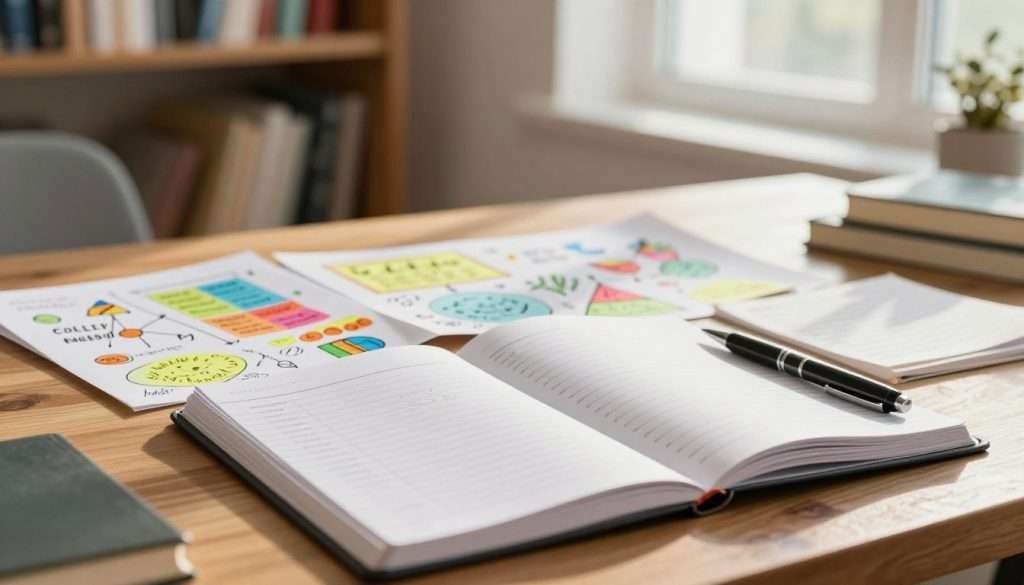
Effective note-taking techniques can change the game for students and lifelong learners. With many methods out there, it’s easy to feel lost. That’s where we come in!
We’re excited to explore visual note-taking and introduce you to popular methods like the Cornell note-taking method and sketchnotes. The goal is to find a system that fits you, making it easier to review and remember information.
By picking the right note-taking technique, you can change how you learn and stay organized. Let’s explore and find your perfect system!
Key Takeaways
- Discover the variety of note-taking methods available, including the Cornell method and sketchnotes.
- Learn how to choose a note-taking system that suits your individual learning style.
- Understand the importance of effective note-taking for students and lifelong learners.
- Explore the benefits of visual note-taking and its impact on learning.
- Find the perfect note-taking system to enhance your learning experience.
The Science Behind Effective Note-Taking
Effective note-taking is more than just writing down notes. It’s about using the science of learning to improve retention and understanding. By knowing how our brains process information, we can develop effective study habits that greatly improve our learning.
How Note-Taking Enhances Learning and Memory
Studies show that active note-taking boosts memory recall and deepens understanding. When we take notes, we’re not just recording info; we’re processing, summarizing, and questioning it. This active engagement solidifies the info in our long-term memory, making it easier to recall.
For example, students who take notes regularly do better in exams. They can review and reflect on the material more effectively.
The Cognitive Benefits of Handwritten vs. Digital Notes
The debate between handwritten and digital notes is ongoing. Each has its own cognitive benefits. Handwritten notes improve retention by engaging the brain’s motor cortex, enhancing memory.
On the other hand, digital notes are convenient for organization and quick access. The best efficient notes are those that work best for the individual, whether handwritten or typed. Some note-taking tips include trying different methods to find what works best for you.
The Cornell Method: Structure Meets Efficiency
The Cornell method is known for its organized way of taking notes. It was created in the 1950s by Walter Pauk, a professor at Cornell University. This method has helped many students and professionals for decades.
Origins and Core Principles
The Cornell method helps you organize your notes better. It divides your paper into three parts. The left column is for keywords and questions, the right column for notes, and the bottom for summaries.
This setup makes you engage more with the material. It encourages you to find key concepts, ask questions, and summarize the main points.
The 5-R Technique: Record, Reduce, Recite, Reflect, Review
The Cornell method uses the 5-R technique to improve learning and retention:
- Record: Take notes in the right-hand column during lectures or while reading.
- Reduce: Summarize the main ideas in the left-hand column after the lecture.
- Recite: Cover the right-hand column and use the keywords in the left-hand column to recall the information.
- Reflect: Think about the material, making connections to other relevant information.
- Review: Regularly review your notes to reinforce learning.
Paper Setup Guidelines
To set up the Cornell method on paper, follow these steps:
- Draw a vertical line about 2.5 inches from the left edge of the paper.
- Draw a horizontal line about 2 inches from the bottom of the paper.
- Take notes in the right-hand column.
- Summarize the main ideas in the left-hand column after the lecture.
- Write a summary of the entire page in the bottom section.
Digital Cornell Templates
If you prefer digital note-taking, many templates and apps are available. You can find digital Cornell templates in apps like Evernote, OneNote, or even create your own using a word processor.
Using the Cornell note-taking method can greatly improve your ability to organize and review information. This leads to better learning and retention.
Visual Power: Mastering Sketchnotes
Discover the power of sketchnotes and turn study sessions into fun, interactive experiences. Sketchnotes mix drawing with note-taking, making learning and remembering easier.
The Psychology of Visual Learning
Visual learning is a strong way to learn and remember. Our brains handle images and diagrams better than text. This makes visual elements great for understanding and remembering complex ideas.
“The act of creating visual notes can significantly improve memory recall and engagement, as it involves both visual and textual processing.”
Basic Visual Elements Anyone Can Draw
You don’t need to be an artist to make great sketchnotes. Simple icons, shapes, and arrows can share complex ideas. Here are some easy-to-draw elements to start with:
- Simple icons like stars, checkmarks, and flags
- Arrows and connectors to show relationships
- Basic shapes like circles, squares, and triangles
Combining Text and Visuals Effectively
The secret to great sketchnotes is mixing text and visuals well. Here are some tips to do it right:
Color Coding Strategies
Using different colors can organize info, highlight key points, and make it look good. Try these:
- Different colors for different topics or categories
- Bright colors to draw attention to key information
- Pastel colors for background or less important details
Layout Techniques for Visual Hierarchy
A good layout is key for effective sketchnotes. Use these methods:
- Creating a clear title or header
- Using headings and subheadings to structure content
- Employing white space to avoid clutter
By learning these techniques, you can make sketchnotes that are informative, engaging, and easy to review.
The Outline Method: Hierarchical Organization
The outline method is great for organizing complex information. It’s perfect for subjects with lots of structured data, like lecture notes or study materials.

Creating Clear Information Hierarchies
This method breaks down info into main topics and subtopics. It makes a clear structure that’s easy to follow. Here’s how to make a good outline:
- Start with main headings or topics
- Indent subtopics under their respective main headings
- Use a consistent formatting style to differentiate between levels
When to Use the Outline Method
The outline method works well for:
- Lecture notes: Organizing info in a structured way
- Study materials: Breaking down complex topics into sections
- Meeting notes: Capturing key points and action items clearly
Using the outline method helps you make efficient notes that are easy to study.
Digital Tools for Outline Notes
Today, many digital tools help with outline notes. Some popular ones are:
- Evernote: Has a strong outlining feature with easy organization and tagging
- Microsoft OneNote: Offers hierarchical note-taking with flexible formatting
- Workflowy: A list-making app great for creating outlines
These tools improve your note-taking techniques. They offer syncing, easy editing, and collaboration. This makes your notes more organized and accessible.
Mind Mapping: Radiant Thinking for Complex Topics
Imagine a tool that makes complex topics easy to understand. That’s what mind mapping is all about. It’s a visual way to organize information in a non-linear way. This makes it great for brainstorming, note-taking, and studying tough subjects.
Structuring Non-Linear Information
Mind mapping is perfect for information that doesn’t follow a straight line. It lets you see how different pieces are connected. This makes complex topics easier to grasp and remember.
Hand-Drawn vs. Digital Mind Maps
Hand-drawn and digital mind maps both have their benefits. Hand-drawn maps are fun and creative, while digital ones are easy to edit and share. Your choice depends on what you like best.
| Feature | Hand-Drawn | Digital |
|---|---|---|
| Creativity | High | Variable |
| Editability | Low | High |
| Sharing | Difficult | Easy |
Subject-Specific Mind Mapping Strategies
Each subject needs its own mind mapping approach. For science, focus on processes and connections. In literature, explore themes and character arcs.
Trying out different mind mapping styles can help you learn in new ways. It can make studying more fun and effective.
Your Note-Taking Arsenal: From Cornell to Sketchnotes, Find Your Perfect System
Being flexible with note-taking is crucial. You need a variety of techniques for different subjects and situations. Knowing various note-taking techniques helps you choose the right one for each task.
Matching Methods to Learning Styles
Knowing your learning style is key to picking the best note-taking method. Are you better at seeing things or organizing them? Choose a method that fits your strengths. For example, Sketchnotes work well for visual learners, while the Cornell Method suits those who like structure.
Hybrid Approaches for Maximum Effectiveness
Why limit yourself to one method? Mixing different techniques can make your note-taking more effective. For instance, use the Cornell Method for lectures and Sketchnotes for brainstorming. This way, you create a system that’s uniquely yours.
Adapting Systems for Different Subjects and Scenarios
Each subject and situation needs its own note-taking approach. Let’s look at how to adjust your system for different needs.
Lecture Notes vs. Meeting Notes
Lecture notes need to be structured, capturing information in order. Meeting notes, though, should be more flexible, as discussions can be unpredictable. Adjusting your method to the situation helps you capture the most important information.
Research and Reading Notes
For research and reading, you aim to combine information from different sources. Techniques like mind mapping or outlining work well here. They help you see connections and patterns, leading to a deeper understanding.
| Note-Taking Method | Ideal Use Case | Key Benefits |
|---|---|---|
| Cornell Method | Structured lectures, organized study sessions | Promotes active recall, easy review |
| Sketchnotes | Visual brainstorming, creative meetings | Enhances creativity, improves memory retention |
| Mind Mapping | Research synthesis, project planning | Facilitates connections between ideas, encourages holistic thinking |
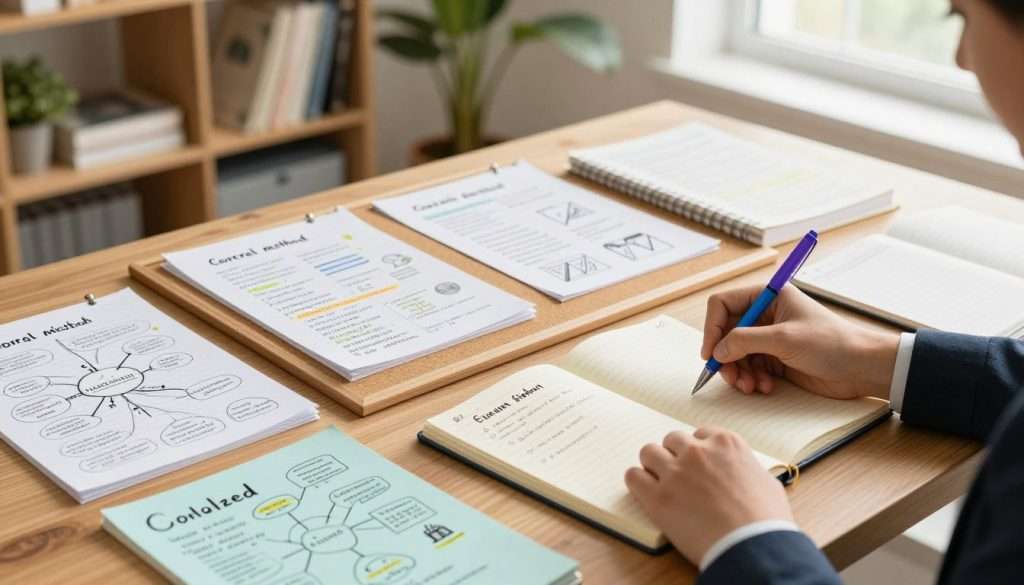
Being flexible and adapting your note-taking to different situations makes you a better learner. The secret to great note-taking is trying new methods and tailoring them to your needs.
Digital Note-Taking Revolution
The digital note-taking revolution is changing how we take notes. It makes taking notes more efficient and easy to access. Now, we have many apps to choose from, each fitting different learning styles and needs.
Top Apps and Their Unique Features
Apps like Evernote, OneNote, and Notion have special features. Evernote’s search function helps us find notes fast. OneNote’s way of organizing notes makes reviewing them simple.
Syncing Across Devices: The Seamless Workflow
Digital note-taking lets us sync notes across devices. We can start notes on a tablet and then check them on a phone or laptop.
Digital Tools for Traditional Methods
Digital tools can also improve traditional note-taking. Using a stylus with a tablet feels like handwriting but keeps notes digital.
Stylus and Tablet Techniques
Apps like GoodNotes and Notability let us write with a stylus on tablets. This mixes the feel of writing with digital notes’ flexibility.
Text-to-Speech and Voice Notes
Features like text-to-speech and voice notes also help. We can record talks or meetings and turn them into written notes later.
Implementing Your System: From Theory to Practice
Choosing a note-taking system is just the start. The real challenge is making it a consistent habit. To do this, you need a practical workflow.
Creating Templates and Workflows
Begin by making templates for your notes. If you’re using the Cornell method, create a template with the right sections. For Sketchnotes, prepare basic visual elements. This prep saves time and makes note-taking easier.
Overcoming Common Obstacles
You might find it hard to stick to your system or understand some topics. To beat these hurdles, set aside a specific time each day for note-taking. Also, review your notes often. If a subject is tough, try studying in a different place or join a study group.
Building Consistent Habits
Consistency is crucial for making note-taking a habit. Start a 30-Day Note System Challenge to stick to your system. This challenge helps you build a routine and spot areas for betterment.
30-Day Note System Challenge
For 30 days, use your chosen note-taking system for all study sessions. Reflect on your progress weekly and tweak your method as needed.
Reviewing and Refining Your Process
After the 30-day challenge, review your notes and evaluate your progress. Ask yourself: What’s working? What can be improved? Use these insights to refine your system and boost its effectiveness.
Conclusion
Finding the right note-taking technique is a personal journey. You now have many methods to choose from. This includes the structured Cornell method and the visually engaging Sketchnotes.
The secret to good note-taking is being consistent and trying new things. We suggest you keep trying different methods until you find what works best for you. Whether you’re in school or just learning for fun, the right method can make learning more fun and effective.
Your note-taking system should fit you, not the other way around. There are many digital and traditional tools out there. You can create a system that really helps you learn and remember things better.
So, start exploring and experimenting with your note-taking. Your perfect system is waiting for you to find it!