

Imagine learning like a supercomputer. John von Neumann was a genius in math and computer science. He was known for his amazing learning skills.
Von Neumann’s learning methods can make learning easier and fun. By using his strategies, you can learn smarter. We’ll show you how to make learning fun and easy.
Key Takeaways
- Discover how to apply John von Neumann’s learning strategies to your daily life.
- Learn cognitive enhancement techniques to boost your brainpower.
- Understand how to make learning more efficient and enjoyable.
- Unlock your potential for smarter learning.
- Explore the benefits of adopting a von Neumann-inspired approach.
The Extraordinary Mind of John von Neumann
Imagine a mind that could change fields like mathematics, computer science, and economics. Welcome to John von Neumann’s world. We’ll explore his life, achievements, and how his learning methods can boost our skills.
Who Was John von Neumann?
John von Neumann was a Hungarian-American genius in mathematics, physics, and computer science. Born in 1903, he showed incredible talent early on. He could remember entire books and solve complex math problems.
His early work was just the start of his groundbreaking contributions.
The Scope of His Intellectual Achievements
Von Neumann’s work touched many areas, from quantum mechanics to computer science. He was key in the Manhattan Project and game theory. His work on self-replicating machines and cellular automata is still foundational.
Why His Learning Methods Matter for Everyday Learners
Why should we care about von Neumann’s learning methods? His principles are accessible and can change how we learn. They can improve our memory, thinking skills, and learning efficiency.
| Von Neumann’s Principles | Application in Learning |
|---|---|
| Interdisciplinary Approach | Combining subjects for deeper understanding |
| Spaced Repetition | Reviewing material at longer intervals to retain it |
| Mental Visualization | Using visuals and imagination to remember and understand |
By using von Neumann’s learning strategies, we can reach new heights. These methods are for students, professionals, and anyone who loves to learn. They can lead to better learning and self-improvement.
The Von Neumann Approach to Learning
Imagine learning like John von Neumann. It’s not just for geniuses. You can improve your learning skills by using his strategies.
Core Principles of Von Neumann’s Learning Process
Von Neumann’s learning method had key principles. These helped him understand complex info well. Two main principles were:
Parallel Processing of Information
Von Neumann’s brain could handle many info streams at once. This parallel processing helped him link unrelated ideas. It deepened his understanding of tough subjects.
Deep Conceptual Understanding
Von Neumann didn’t just memorize. He grasped the big ideas. This deep conceptual understanding let him solve tough problems in new ways.
How His Brain Processed Information Differently
Von Neumann’s brain was great at pattern recognition. It connected different studies. This skill was key to his success.
Debunking Genius Myths: What We Can Actually Adopt
We can’t be von Neumann exactly, but we can use parts of his learning style. Here’s what we can do:
- Use cognitive enhancement techniques to boost memory and speed.
- Focus on deep understanding of what we study, not just memorizing.
- Use neuroplasticity by trying new things and learning new info.
By using these methods, we can all learn better, no matter our natural talents.
Developing a Von Neumann Memory System
Creating a memory system like John von Neumann’s can change how you learn. His memory was not just natural but also the result of a systematic approach. By using his strategies, you can improve your memory and thinking skills.
Building Your First Memory Palace
A memory palace, or method of loci, is a powerful tool. It was used by von Neumann and others. You imagine a place you know well and link items to remember with spots in that place.
Step-by-Step Memory Palace Construction
- Choose a Familiar Location: Pick a place you know well, like your home or school.
- Visualize the Space: Imagine walking through this location, noting distinct areas or objects.
- Associate Items to Remember: Link the information you want to recall with these locations.
- Practice Navigation: Mentally walk through your memory palace several times, recalling the associated information.
Common Mistakes to Avoid
- Overcomplicating the Space: Keep your memory palace simple and familiar.
- Not Practicing Regularly: Consistency is key to making this technique effective.
Implementing Spaced Repetition in Daily Practice
Spaced repetition boosts your memory. It means reviewing material at longer intervals to solidify it in your long-term memory.
| Day | Review Material |
|---|---|
| 1 | Initial Learning |
| 3 | First Review |
| 7 | Second Review |
| 14 | Third Review |
5-Minute Memory Exercises for Busy People
Here are quick exercises for busy people to improve memory:
- Memory Matrix: Create a grid and fill it with random words. Try to recall the words in order.
- Link System: Connect new information to something you already know.
By adding these techniques to your daily routine, you’ll build a strong memory system. Start with one and add more as you get better. The most important thing is to practice regularly and be patient.
Think Like John von Neumann: Smarter Learning for Mere Mortals
John von Neumann’s learning approach is not just for geniuses. It’s about using practical methods to grasp complex ideas. By using his strategies, you can make learning easier and understand tough topics better.
How to Break Down Any Complex Concept
Breaking down complex ideas into smaller parts is key for learning well. There are two main ways to do this: the Chunking Method and Progressive Learning Sequence.
The Chunking Method
The Chunking Method divides information into smaller chunks. This makes it easier to remember and understand. For example, when learning a new language, break down grammar rules into smaller sections. Focus on one section at a time.
- Identify the main concept you want to learn.
- Break it down into smaller subtopics.
- Focus on one subtopic at a time.
Progressive Learning Sequence
A Progressive Learning Sequence teaches concepts in a sequence that builds on what you already know. This method is great for subjects like math, where each concept builds on the last.
- Start with the basics.
- Gradually move to more complex topics.
- Review previous concepts regularly.
Mastering Mental Visualization Techniques
Mental visualization is a powerful tool for learning. By creating mental images, you can better understand and remember information. For example, visualizing a historical event or a scientific process can make it more engaging and easier to recall.
To master mental visualization, practice creating vivid mental images. Start with simple objects or scenes and then move to more complex concepts.
Creating Your Personal Knowledge Framework
A personal knowledge framework is a mental structure that organizes your knowledge. It makes it easier to access and apply. To create your framework, start by identifying key concepts in your area of interest. Then, connect them to related ideas.
By developing a personal knowledge framework, you can improve your ability to learn and apply new information. This makes your learning process more efficient and effective.
Connecting Ideas: The Von Neumann Web Approach
Imagine weaving together different pieces of knowledge into a single, strong web. That’s what the Von Neumann approach to learning is all about. It’s not just about collecting facts. It’s about linking them together to deepen your understanding and solve problems better.
Identifying Patterns Across Different Subjects
Von Neumann was great at spotting patterns that others didn’t see. To do this, you need to be curious and explore different subjects. When learning something new, try to connect it to what you already know.
Ask yourself, “What are the underlying principles here?” or “How does this concept apply to other areas of my life?” For example, physics can help us understand complex systems in biology or economics. Seeing these connections can give you a deeper understanding of different subjects.
Building Mental Models for Problem-Solving
Mental models are like frameworks that help us understand complex systems. Von Neumann was a pro at creating these models. They let him solve problems from different angles. To make your own mental models, start by identifying key concepts in a subject area.
Then, create a visual or conceptual map of how these ideas are connected. For instance, you might make a mental model for complex systems by thinking about feedback loops, causal relationships, and system boundaries. This model can be used in many areas, from ecology to finance.
3 Exercises to Strengthen Your Conceptual Connections
To get better at linking ideas, try these exercises:
- Concept Mapping: Make a visual map of how different concepts are connected in a subject area.
- Cross-Disciplinary Analogies: Find analogies between concepts in different fields. For example, how does natural selection in biology relate to competitive markets in economics?
- Interdisciplinary Project: Work on a project that uses knowledge from multiple subjects. This could be writing a research paper or creating art that uses scientific principles.
By doing these exercises, you’ll get better at seeing connections between ideas, just like Von Neumann. This skill will not only make you a better learner but also help you solve complex problems.
Accelerated Learning Techniques Inspired by Von Neumann
Let’s explore some groundbreaking learning methods inspired by John von Neumann. These strategies can boost your learning speed and brain power.
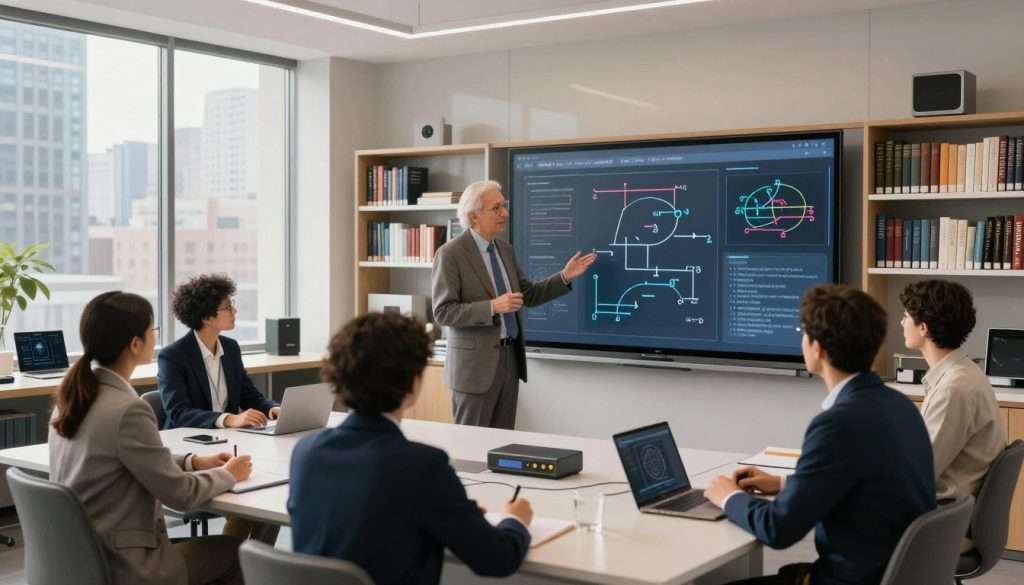
Implementing the Feynman Technique Today
The Feynman Technique is a great way to grasp tough subjects. It’s about teaching what you’ve learned in easy terms.
Selecting Topics to Teach
Pick a subject you’re studying and find the main ideas. Make these ideas simple so anyone can get them.
Simplifying Without Losing Accuracy
Divide hard info into easy-to-handle bits. Use analogies and metaphors to make it stick and be easy to remember.
Structuring Deliberate Practice Sessions
Deliberate practice means focused training to get better at something. Here’s how to set up your practice:
- Know what you want to achieve.
- Break it down into smaller steps.
- Stay focused, avoiding distractions.
- Get feedback and adjust your approach.
Focus Management: The 25-5 Method
Good focus is key for learning well. The 25-5 method works like this:
- Work in 25-minute blocks.
- Take a 5-minute break to refresh.
- Keep this cycle up to stay productive.
Using these methods in your study routine can improve your memory and brain skills. You’ll make the most of your study time.
Applying Von Neumann Principles to Modern Education
Exploring modern education, we can boost our learning by using John von Neumann’s ideas. This makes learning fun, effective, and fits our unique needs.
Transforming How You Approach Course Material
Von Neumann’s learning method breaks down hard topics into easy parts. We can start by finding key concepts in a course. Then, we build mental models to link these ideas. This way, we grasp and remember info better.
- Break down complex topics into manageable chunks
- Create concept maps to visualize relationships between ideas
- Use analogies to make abstract concepts more concrete
Digital Tools That Enhance Von Neumann-Style Learning
Today, many digital tools support Von Neumann-style learning. For example, mind mapping software makes complex info easy to see. Spaced repetition apps help us remember better. Using these tools, we can learn more efficiently.
Creating Learning Environments That Support Deep Understanding
To really get it, we need a learning space that encourages active learning. This means cutting down on distractions, setting clear goals, and practicing with purpose. By organizing our learning space this way, we can study smarter and get better results.
By using Von Neumann’s ideas and modern learning tools, we can improve our learning journey. It’s about finding a personal approach that suits us best.
Real-World Applications: Von Neumann Methods in Action
Von Neumann’s learning strategies have changed lives in many ways. People from different fields have seen big improvements in their learning and thinking skills. This shows how powerful his methods can be.
Case Studies: From Average to Exceptional Learners
Many studies show Von Neumann’s techniques work wonders. Medical students who used his memory palace method remembered things 30% better. Professionals also saw big improvements in solving problems thanks to his mental visualization.
Field-Specific Applications
Von Neumann’s methods work in many areas. Here are some examples:
For Technical and Scientific Fields
In tech and science, his methods make hard stuff easier to remember. Engineers, for example, grasp complex math better with his help.
For Humanities and Social Sciences
In the humanities and social sciences, his techniques boost critical thinking and memory. Historians, for instance, recall dates and events better with his methods.
For Professional Skills Development
Professionals can also grow with Von Neumann’s methods. They improve in public speaking, leadership, and strategic thinking. This boosts their confidence and performance.

Tracking and Measuring Your Learning Progress
To make the most of Von Neumann’s methods, track your progress. Set goals, keep a learning journal, and check your understanding often. This helps you see what you need to work on and adjust your learning plan.
Conclusion: Becoming a Smarter Learner Through Von Neumann’s Legacy
John von Neumann’s learning methods can change the game for anyone wanting to get better at learning. By using the techniques from this article, you can learn like von Neumann. This means smarter, more efficient learning.
Von Neumann’s strategies are key to improving your learning skills. They include building a strong memory, breaking down hard concepts, and linking ideas from different subjects. These tools help you handle tough material and connect different knowledge areas.
Keep going on your learning path, and remember von Neumann’s true power. It’s not just his achievements, but how his methods can help anyone. So, start using these strategies to reach your goals. Think like John von Neumann: smarter learning for everyone.