
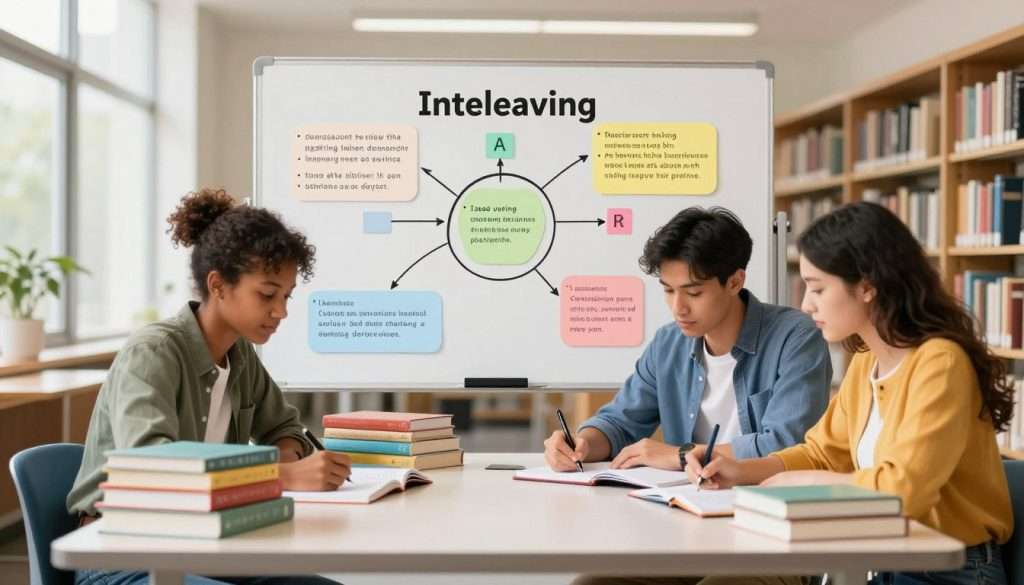
Are you tired of studying the same material over and over again without seeing any significant improvement in memory retention? We have some exciting news for you! There’s a powerful learning technique that can change how you study and remember information. It’s called interleaving, and it’s been proven by many studies to be very effective.
By mixing up your study materials, you can get better at recalling information and using it in different ways. This technique is not just about improving memory. It also boosts cognitive skills that are key for learning and solving problems.
Key Takeaways
- Interleaving is a proven technique to improve memory and cognitive skills.
- Mixing study materials can enhance information recall and application.
- This technique can be applied to various study routines for better learning outcomes.
- Interleaving helps in developing a deeper understanding of the subject matter.
- It’s a simple yet effective method to boost learning and retention.
What is Interleaving and Why It Matters
Have you heard of interleaving? It’s a study technique that switches between different topics to boost learning. This method is getting more attention for its benefits in memory and cognitive skills. Let’s explore what interleaving is and why it’s important.
Definition and Basic Concept
Interleaving means mixing up different topics or problems in your study sessions. Unlike the usual way of studying one topic at a time, interleaving combines them. This makes your study sessions more challenging and fun.
The Science Behind Interleaving
The science of interleaving comes from cognitive psychology. It makes your brain work harder to connect different pieces of information. This strengthens your memory and ability to apply what you’ve learned.
Studies show interleaving helps you tell different problems or concepts apart. By constantly switching between them, you improve at recognizing differences. This skill is crucial for learning and doing things correctly.
| Study Technique | Description | Benefits |
|---|---|---|
| Blocked Studying | Focusing on one topic at a time | Initial mastery of individual topics |
| Interleaving | Switching between different topics | Improved discrimination and recall |
The Problem with Traditional Blocked Study Methods
Many of us stick to blocked practice when studying. But is it the best way? Traditional blocked study methods mean focusing on one topic for a long time. It might make you feel more confident at first, but it has big drawbacks.
Limitations of Massed Practice
Massed practice, or repeating the same thing over and over, can make you feel like you know it all. Blocked practice feels easy and rewarding because you’re exercising the same rules again and again, but it doesn’t help you learn in a flexible way. For example, studying for a math test by solving the same problem many times might get you a good score. But, when faced with different problems, you might find it tough.
Why Cramming Fails Long-Term
Cramming is a form of massed practice, where you try to learn a lot in a short time. It might help you pass a test, but cramming rarely leads to long-term retention. The information doesn’t stick in your long-term memory, so you might forget it soon after the test. Here’s a table showing the difference between massed and spaced practice:
| Study Method | Short-Term Results | Long-Term Retention |
|---|---|---|
| Massed Practice | Good test scores | Poor retention |
| Spaced Practice | Gradual improvement | Excellent retention |
Interleaving: Why Mixing Your Study Topics Improves Memory Retention
Interleaving is a study method that mixes different study topics. It’s different from studying one topic at a time. This method makes your brain work harder to connect different information.
Cognitive Benefits of Varied Practice
Varied practice, like interleaving, boosts your brain in many ways. It sharpens problem-solving skills by tackling different problems. It also boosts creativity by introducing new ideas.
For example, in math, mixing up problem types can deepen your understanding. It keeps you alert and enhances your grasp of math concepts.
Research Evidence Supporting Interleaving
Studies prove interleaving boosts learning outcomes. Students who use it do better in exams than those who don’t. A math study showed interleaving improved performance significantly.
| Study Technique | Exam Performance |
|---|---|
| Interleaving | 85% |
| Blocked Study | 65% |
Adding interleaving to your study routine can enhance memory and cognitive skills. It’s a simple yet effective way to improve your learning.
The Neuroscience of Interleaving
Interleaving your study materials is more than just mixing things up. It’s a way to boost your brain’s power. This method uses your brain’s knack for spotting patterns and linking different info together.
How Your Brain Processes Mixed Information
Interleaving makes your brain work harder to understand different types of info. This effort helps you remember and use what you’ve learned better. By switching up what you study, you make learning more engaging and complex.
Key benefits include:
- Increased ability to tell similar concepts apart
- Better skill in using what you’ve learned in new ways
- Longer-lasting memory of the material

Neural Pathways and Memory Formation
Interleaving changes how your brain forms memories. By mixing up your study topics, you help create new connections between brain cells. This boosts your brain’s memory and application skills.
| Study Technique | Effect on Neural Pathways | Impact on Memory |
|---|---|---|
| Blocked Practice | Limited pathway development | Short-term retention |
| Interleaving | Enhanced pathway growth | Long-term retention and application |
Learning how interleaving affects your brain can help you learn better. As Robert Bjork, a renowned expert in human learning, says, “The key to better learning is not to make it easier, but to make it more challenging in the right ways.”
Step-by-Step Guide to Implementing Interleaving
Let’s break down the process of interleaving into manageable steps. By following this guide, you’ll be able to harness the power of interleaving to improve your learning outcomes.
Identify Suitable Topics for Interleaving
The first step in implementing interleaving is to identify topics or subjects that can be mixed together. Look for related subjects or tasks that can be interleaved to create a more complex learning experience. For example, if you’re studying different types of mathematical problems, you can interleave them to improve your problem-solving skills.
- Identify related subjects or topics that can be mixed together.
- Consider the complexity of the material and how it can be interleaved.
- Start with topics that are similar but distinct, such as different mathematical operations.
Create a Structured Study Schedule
A well-planned study schedule is crucial for effective interleaving. Plan out your study sessions to ensure you’re switching between different topics or tasks regularly. You can use a planner, calendar, or app to stay organized.
- Set specific times for studying each topic or task.
- Alternate between different topics or tasks during each study session.
- Review your schedule regularly to ensure it’s working for you.
Implement Topic Rotation Techniques
Topic rotation is at the heart of interleaving. Mix up your study materials to keep your brain engaged. For instance, you can switch between different types of problems or topics during a single study session.
- Use flashcards to quiz yourself on different topics.
- Create a “mixed” practice set that includes a variety of problems or questions.
- Switch between different study materials, such as textbooks, videos, or online resources.
Monitor and Adjust Your Approach
As with any learning technique, it’s essential to monitor your progress and adjust your approach as needed. Pay attention to how you’re performing and make changes to your study schedule or topic rotation techniques.
- Track your performance on quizzes or tests.
- Adjust your study schedule to focus on areas where you’re struggling.
- Be patient and persistent – interleaving can take time to show its benefits.
By following these steps and being consistent, you can make interleaving a powerful tool in your learning arsenal. Remember, the key is to be flexible and adapt your approach as needed to achieve the best results.
Practical Examples of Interleaving in Different Subjects
Let’s explore how interleaving works in different subjects. It makes studying more fun and effective. Interleaving can change how you learn by making study sessions more engaging.

Mathematics and Problem-Solving
In math, interleaving means mixing different problem types. This helps deepen your understanding and boosts problem-solving skills. For example, instead of just doing algebra, mix it with geometry and statistics.
Example Study Plan for Math
- Spend 20 minutes solving algebra equations.
- Switch to geometry problems for the next 20 minutes.
- Then, dedicate 20 minutes to statistical analysis.
This method keeps your brain active. You’re always switching between different math concepts.
Language Learning
Interleaving is also great for language learners. It mixes reading, writing, and speaking. This creates a balanced and comprehensive learning experience.
Example Study Plan for Languages
- Start with 20 minutes of reading comprehension.
- Then, do 20 minutes of writing exercises.
- End with 20 minutes of conversational practice.
This way, you’re not just focusing on one skill. You’re developing a well-rounded set of language skills.
Science Subjects
In science, interleaving means mixing different topics. For example, in biology, mix cell biology, genetics, and ecology.
Benefits of Interleaving in Science:
- It enhances understanding of complex concepts.
- It improves applying knowledge in different contexts.
- It helps retain information better over time.
By using interleaving in various subjects, you make studying more fun and effective. It encourages deeper learning and a more nuanced understanding of the material.
Overcoming Challenges When Using Interleaving
Interleaving has many benefits, but it also comes with challenges. Knowing these challenges is crucial for success. When you start using interleaving, you might face some hurdles. But, with the right strategies, you can overcome them and get the most out of interleaving.
Managing Initial Difficulty and Frustration
Starting with interleaving can be frustrating. It’s more challenging than traditional study methods and may take time to see results. To handle this, be patient and keep trying. Begin with small pieces of information and slowly add more complexity as you get better at it.
Adapting for Different Learning Styles
Everyone learns in their own way, and interleaving can be adjusted for different styles. Visual learners can use diagrams and charts. Auditory learners might prefer listening to different topics in rotation. Kinesthetic learners can do hands-on activities that mix subjects. By matching interleaving to your learning style, you can make it more effective and fun.
Solutions for Common Obstacles
Some common hurdles with interleaving include finding it hard to switch between topics and feeling overwhelmed. To tackle these, make a study plan that shows when and how you’ll mix different subjects. Also, breaking down big topics into smaller parts can make it less overwhelming.
| Challenge | Solution |
|---|---|
| Initial Difficulty | Start with small chunks, be patient |
| Different Learning Styles | Adapt interleaving to your style (visual, auditory, kinesthetic) |
| Feeling Overwhelmed | Create a structured study schedule, break down complex topics |
Combining Interleaving with Other Effective Learning Techniques
To get the most out of learning, mix interleaving with other good learning methods. Interleaving alone isn’t enough. It works best when you use it with other ways to keep information in your memory.
By mixing interleaving with other learning styles, you build a strong learning system. This system uses the best parts of each method. Let’s see how interleaving pairs up with retrieval practice and spaced repetition.
Interleaving and Retrieval Practice
Retrieval practice means actively recalling what you’ve learned. It makes remembering and using what you know better. When you mix retrieval practice with interleaving, your learning gets even better.
For example, try mixing different problem types or topics. Then, test yourself on what you’ve learned. This mix helps you remember and use what you’ve learned in new ways.
Interleaving and Spaced Repetition
Spaced repetition means reviewing material at longer and longer intervals. It helps make the information stick in your long-term memory. When you mix different topics and use spaced repetition, your learning gets stronger.
This mix is great for remembering things like vocabulary or historical dates. It helps you avoid forgetting.
Creating a Comprehensive Learning System
To make a complete learning system, use interleaving with retrieval practice, spaced repetition, and other good learning methods. First, pick the main topics or skills you want to learn. Then, make a study plan that includes interleaving and other strategies.
Keep track of how you’re doing and change your plan if needed. This will help you learn better and faster.
Real-World Success Stories and Case Studies
Interleaving has changed how we learn and remember things. It has made a big difference in classrooms and corporate training. Many success stories show how interleaving has improved learning and development for individuals and organizations.
Academic Achievement Improvements
Students who use interleaving do better in school. For example, a math study showed that mixing problem types led to better test scores. This method helps students understand and apply what they learn in different ways.
Key benefits include:
- Improved problem-solving skills
- Better retention of material
- Enhanced ability to apply concepts to new situations
Professional Skill Development
Interleaving is also used in professional training. A tech company mixed skills like coding and customer service in their training. This made employees more versatile and ready for complex projects.
Personal Learning Transformations
Interleaving helps people learn new things outside of school and work. It’s used for learning languages, improving music skills, or starting new hobbies. Mixing up learning keeps people interested and moving forward.
These stories show how effective interleaving is in many areas. As more people use it, we’ll see even more creative ways to apply it in the future.
Conclusion: Making Interleaving a Part of Your Learning Routine
We’ve looked into the powerful method of interleaving and how it can change your learning. By adding interleaving to your daily learning routine, you make studying more fun and effective. It helps you remember and use what you’ve learned better.
To make interleaving a regular part of your study, first pick the subjects or topics you want to mix. Then, plan out a study schedule that switches between these topics. It might take some time to get used to this new study technique.
By facing challenges and tailoring it to your needs, you can fully benefit from interleaving. As you keep at it, you’ll see your memory and application skills grow. This is how you can make interleaving a key part of your learning routine and improve your learning journey.