

Hey there! Remember when high school was a breeze for you? But college is different. It requires new study habits.
College coursework is tough. It needs a fresh approach. Your old study habits might not be enough anymore.
We’ve got new ideas for you! We’re moving from just memorizing to active learning. This way, you’ll remember more.
Science backs up these methods. They make studying fun and effective. Let’s make these study habits work for you and help you ace every exam!
Key Takeaways
- Active recall is a great way to strengthen your long-term memory.
- College life demands more intensive preparation than your past school years.
- Strategic planning helps you avoid those stressful last-minute cramming sessions.
- Group discussions provide helpful new views on very complex topics.
- Watching your mental health ensures you reach your peak performance.
Discover Your Personal Learning Style
Discovering your personal learning style can change how you study. We all learn in different ways. Knowing your unique learning style can really boost your grades. Experts say, “active engagement is the process of constructing meaning from text that involves making connections to lectures, forming examples, and regulating your own learning” (Davis, 2007).
Identify Whether You’re a Visual, Auditory, or Kinesthetic Learner
Most people have a main learning style: visual, auditory, or kinesthetic. Visual learners get information best from images, diagrams, and videos. Auditory learners do well with listening to lectures, discussions, or audio recordings. Kinesthetic learners learn by doing, through hands-on experiments or real-world applications.
To find out your learning style, think about your past experiences. Do you remember things better when you see them in a diagram or chart? Or do you prefer listening to a lecture? You might be a mix of styles, and that’s okay. The important thing is to know what works best for you.
Adapt Study Techniques to Match Your Learning Preferences
Once you know your learning style, you can adjust your study methods. For example, if you’re a visual learner, use mind maps, diagrams, and infographics. Auditory learners can record lectures or make audio summaries. Kinesthetic learners can do hands-on activities or projects related to the subject.
As Edwards (2014) points out, “reading is an important part of pre-studying, but learning information requires actively engaging in the material.” By matching your study techniques to your learning style, you can learn more effectively and enjoyably.
Combine Multiple Learning Modalities for Maximum Retention
Knowing your main learning style is helpful, but using multiple learning modalities can help you remember more. This is called multimodal learning. Using different senses and techniques can help you understand and remember better.
For instance, watch a video (visual) on a topic, then talk about it with a friend (auditory), and lastly, do a practical project (kinesthetic). This mix of approaches can make your learning stick and improve your grades.
“The more you engage with the material, the more likely you are to remember it.” This simple yet powerful principle shows how important active learning and matching your study techniques to your learning style are.
Design Your Perfect Study Environment
Your study environment is key to your academic success. A well-designed study space can improve your concentration and productivity. This makes it easier to reach your academic goals.
Select a Distraction-Free Study Location
Finding the right study spot is important. Think about what environment helps you focus best. Some prefer a quiet library, while others like a cozy home corner or a café.
The goal is to find a place with fewer distractions.
Optimize Lighting, Temperature, and Seating Arrangements
The physical setup of your study area affects your focus. Make sure the lighting is right, not too bright or too dim. The room should be at a comfortable temperature.
Choose a comfy chair and a desk that supports good posture.
Organize Study Materials for Easy Access
Keeping your study materials organized is crucial. Have everything you need within reach to avoid distractions. Use shelves, drawers, or file organizers to keep things tidy.
Use Technology to Block Digital Distractions
In today’s world, technology can help or hinder your studying. Use apps and tools to stay focused. For example, website blockers can keep you away from distracting sites. Apps that follow the Pomodoro Technique can also help you stay on track.
| Tool | Description | Platform |
|---|---|---|
| Freedom | Blocks distracting websites and apps across all your devices | iOS, Android, Windows, Mac |
| StayFocusd | A Chrome extension that limits time spent on distracting websites | Chrome |
| Cold Turkey | Blocks distracting websites and apps, with customizable block schedules | Windows, Mac, Android |
By using these tips, you can make a study environment that supports your goals. It will also boost your concentration.
Set Achievable Academic Goals
Setting goals for studying is more than just aiming for high grades. It’s about creating a path to success. By setting clear goals, you stay motivated and focused in your studies.
As we talked about earlier, managing your time and distractions is key. Now, let’s explore how to set effective academic goals. “Setting goals is the first step in turning the invisible into the visible.” This quote by Tony Robbins shows the power of goal setting.
Apply the SMART Framework to Your Study Objectives
The SMART framework is a great tool for setting goals. SMART means Specific, Measurable, Achievable, Relevant, and Time-bound. It helps you make study goals that are clear and reachable.
For example, instead of saying “I want to study more,” a SMART goal is “I will study for 2 hours every day for the next week to improve my understanding of algebra.” This goal is specific, measurable, achievable, relevant, and time-bound.
Break Down Large Projects into Manageable Tasks
Big projects can feel overwhelming. But breaking them down into smaller tasks makes them easier to handle. This is called task segmentation. It helps you focus on one task at a time, making the project less scary and more doable.
For example, if you’re working on a research paper, you can break it down into tasks like researching, outlining, drafting, and editing. Each task can be split into smaller subtasks, helping you stay on track.
Create Both Short-Term and Long-Term Academic Targets
It’s important to have both short-term and long-term goals. Short-term goals give you immediate focus and satisfaction. Long-term goals give you direction and purpose.
A short-term goal might be to finish a weekly reading assignment. A long-term goal could be to get a certain GPA by the end of the semester. Having both types of goals keeps you motivated and on track.
Track Progress and Adjust Goals as Needed
Tracking your progress is key to reaching your goals. Regularly checking your progress helps you see what needs work and make changes.
Use a planner, spreadsheet, or app to track your progress. Celebrate your wins and don’t hesitate to adjust your goals if needed. As you get closer to your goals, you might need to tweak them to stay challenging yet achievable.
Master Time Management Skills for Studying
Learning to manage your time well can change your academic life. It helps you balance studying, activities, and personal life. This leads to better grades and less stress.
Let’s look at some ways to improve your time management. First, create a realistic weekly study schedule. Plan your day, week, or month ahead. Set aside time for studying and stick to it.
Build a Realistic Weekly Study Schedule
Creating a study schedule that fits you means knowing your commitments and likes. List your fixed commitments like classes or work. Then, plan study times for each subject, being realistic about how much time you have.
For example, study in the morning if you’re alert then. Or study in the evening if you’re more focused then. Don’t forget breaks to stay productive and avoid burnout.
Use Time Blocking to Allocate Study Sessions
Time blocking means setting fixed times for specific tasks or subjects. It keeps you focused and stops multitasking. This way, you make steady progress on your goals.
To use time blocking, first, find your most challenging subjects. Use your best hours for these. For example, spend two hours in the morning on math and an hour in the evening on reading.
Prioritize Tasks Using the Eisenhower Matrix
The Eisenhower Matrix helps you sort tasks by urgency and importance. It has four areas: urgent & important, important but not urgent, urgent but not important, and not urgent or important. This helps you focus on what’s most important.
For students, this means doing urgent & important tasks first, like assignments due soon. Also, make time for long-term projects. This avoids last-minute stress.
Overcome Procrastination with the Two-Minute Rule
Many students struggle with procrastination. The Two-Minute Rule is a simple way to beat it. If a task takes less than two minutes, do it right away. This builds momentum and fights procrastination.
For bigger tasks, break them into smaller steps that take less than two minutes. This makes them less scary and more doable. It helps you stay on track with your study plan.
By using these strategies, you can make a study routine that works well. The key is to be consistent and flexible, adjusting as needed.
Build Effective Study Habits That Last
Creating lasting study habits needs the right methods and regular practice. To succeed academically, it’s key to use effective study methods that improve learning and retention. We’ll look at four strong techniques to make studying more efficient.
Implement the Pomodoro Technique for Focused Study Sessions
The Pomodoro Technique means studying in 25-minute focused blocks, then taking a 5-minute break. This method keeps you focused and prevents burnout. After four blocks, take a 15-30 minute break. This way, you can boost your productivity and remember things better.
Apply Spaced Repetition for Long-Term Memory Retention
Spaced repetition is great for keeping information in your long-term memory. It involves reviewing material at longer intervals to solidify it in your memory. Studies show that distributed practice, like spaced repetition, is very effective (Newport, 2007).
| Study Technique | Description | Benefits |
|---|---|---|
| Spaced Repetition | Review material at increasingly longer intervals | Enhances long-term retention |
| Active Recall | Actively recall information from memory | Strengthens memory and improves understanding |
| Interleaving | Switch between different types of material | Improves deep understanding and application |
Practice Active Recall Instead of Passive Reading
Active recall means actively recalling information from memory, not just re-reading it. Use flashcards, practice quizzes, or summarize notes in your own words. This way, you can improve your understanding and remember things better.
Use Interleaving to Study Multiple Subjects Effectively
Interleaving means switching between different subjects to deepen your understanding. This technique helps you develop a more nuanced understanding and tackle complex problems better.
By adding these techniques to your study routine, you can build effective study habits that last. The key is to stay consistent and patient, as it takes time to see results.
Choose the Right Note-Taking Method
Finding the right note-taking method can really boost your grades. It’s important to pick a system that fits you and stick with it. We’ll look at various techniques and help you choose the best one for your learning style.
Master the Cornell Note-Taking System
The Cornell Note-Taking System is a favorite among students. It divides your paper into two parts. The smaller side is for keywords and questions, and the bigger side is for your notes. This method makes reviewing your notes quick and easy.
To use the Cornell system, split your paper into three parts: a header, a cue column, and a notes column. Write down the main ideas and key concepts in the notes column. Use the cue column for questions or keywords.
Benefits of the Cornell Note-Taking System:
- Organizes notes in a structured format
- Encourages active recall and review
- Helps in identifying key concepts and questions
Create Mind Maps for Visual Concept Organization
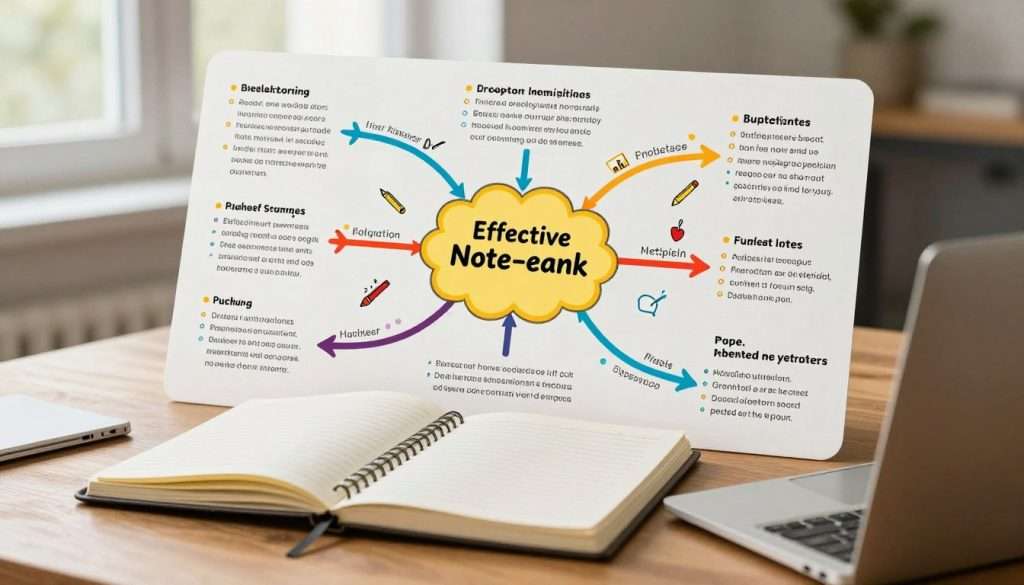
Mind maps are a visual way to organize your notes. They’re great for subjects that need lots of memorization and understanding complex relationships.
To make a mind map, start with a central idea. Then, branch out to related ideas and subtopics. Use colors, symbols, and images to make it more engaging and memorable.
Decide Between Digital and Handwritten Notes
There’s a long debate about digital versus handwritten notes. Handwritten notes help with retention and understanding complex material. Digital notes are easier to organize and access.
| Note-Taking Method | Advantages | Disadvantages |
|---|---|---|
| Handwritten Notes | Better retention, improved understanding of complex material | Difficult to organize, prone to damage or loss |
| Digital Notes | Easy to organize, accessible from anywhere | Distractions from digital devices, potential for data loss |
Review and Revise Notes Within 24 Hours
Reviewing your notes within 24 hours is key to reinforcing your learning. It helps fill in gaps, clarify misunderstandings, and solidify information in your long-term memory.
“The key to effective note-taking is not just in capturing information, but in reviewing and revising it regularly.”
By using these note-taking strategies, you’ll be better at mastering your study materials and achieving academic success.
Improve Your Concentration and Focus
In today’s world, staying focused is harder than ever. But, with the right techniques, you can boost your concentration. Studies show that multi-tasking doesn’t make you more efficient. It can actually make your work worse (Junco, 2012). So, it’s key to find ways to focus better for school success.
Mindfulness and Meditation
Mindfulness and meditation are great for improving focus. They teach your mind to stay in the moment. Start with short exercises like deep breathing or guided meditation. As you get better, you can do them for longer.
“Mindfulness is being fully present and engaged in the moment,” which helps you focus better. Regular meditation also makes your brain better at ignoring distractions.
Minimizing Distractions
To focus better, you need to get rid of distractions, like smartphones and social media. Use apps that block social media or track your study time. Also, make sure your study area is free from distractions. This might mean turning off notifications or studying in a quiet spot.
Building Mental Stamina
Another way to improve focus is to build mental stamina through study sessions. Start with short study times and increase them as you get better. This is like exercising your brain, just like you would your body.
Start with 25-minute study sessions and take a 5-minute break. As you get more comfortable, you can study for 45 or 60 minutes, with breaks in between.
Using Background Music and White Noise
Background music and white noise can also help you focus. Some people find classical music or nature sounds helpful. Try different sounds to see what works for you. But, make sure the volume isn’t too loud.
By using these strategies, you can improve your focus and do better in school. The important thing is to stick with it and be patient with yourself as you develop these habits.
Apply Proven Memory Enhancement Techniques
Let’s look at some effective ways to boost your memory and study better. Remembering information well is key when you’re studying for exams. We’ll explore methods to help you do just that.
Create Mnemonic Devices and Memory Palaces
Mnemonic devices are tools to help you remember new stuff by linking it to something familiar. For example, you can use acronyms to recall lists. Memory palaces work by using a place you know and linking new info to spots in that place. This method is great for remembering sequences or lists.
To make a mnemonic device, first, identify what you want to remember. Then, think of a word, phrase, or image that connects to it. For instance, “ROY G BIV” helps you remember the rainbow colors: Red, Orange, Yellow, Green, Blue, Indigo, Violet.
Chunk Complex Information into Smaller Units
Chunking means breaking down big info into smaller bits. This makes remembering things like phone numbers or passwords easier. For example, instead of remembering 1234567890, break it into 123-456-7890.
Chunking is super helpful for complex info. It lets you focus on one piece at a time, making it simpler to grasp and remember.
Teach Concepts to Others for Deeper Understanding
Teaching what you’ve learned to others is a great way to strengthen your own memory. When you teach, you organize the info in a way that makes sense to others. This helps solidify it in your mind too.
Try explaining a new concept to a friend or family member. This not only helps you remember but also shows you any gaps in your knowledge.
Visualize Abstract Concepts for Better Recall
Visualizing information makes it stickier in your memory. Linking abstract ideas to images creates a visual anchor for recall. For example, linking a historical date to an image of the event can help you remember it.
Studies, like Wissman and Rawson’s in 2012, show flashcards and spaced repetition are effective for memorizing. This method helps solidify info in your long-term memory.
Maintain Your Physical and Mental Health
When you’re getting ready for exams, remember that your brain works best when you’re healthy. Taking care of your body and mind helps you study better and do well on tests.
Sleep: The Foundation of Memory Consolidation
Good sleep is key for memory. It helps your brain turn short-term memories into long-term ones. Sleep strengthens what you’ve learned, making it easier to remember on test day. Try to sleep 7-9 hours each night.
Tip: Keep a regular sleep schedule. It helps your body and sleep quality.
Nourishing Your Brain
Eating right is important for your brain. A diet full of fruits, veggies, whole grains, lean proteins, and healthy fats fuels your brain. Stay away from too much sugar and caffeine, as they can make you tired and unfocused.
| Food Group | Examples | Benefits for the Brain |
|---|---|---|
| Fruits and Vegetables | Blueberries, Spinach, Broccoli | Rich in antioxidants, supporting cognitive function |
| Whole Grains | Oatmeal, Brown Rice, Quinoa | Provides sustained energy and fiber |
| Lean Proteins | Chicken, Fish, Legumes | Supports neurotransmitter production |
Exercise for Enhanced Cognitive Function
Exercise is great for your brain and body. It boosts blood flow to the brain, improving thinking and memory. It also lowers stress and anxiety, which can hurt your grades.
Try to do at least 30 minutes of moderate exercise every day.
Managing Test Anxiety and Academic Stress
Many students struggle with test anxiety and stress. Relaxation techniques like deep breathing, meditation, or yoga can help. Stay organized, break study into smaller parts, and keep a positive attitude.

Prepare Strategically for Upcoming Exams
To do well, you need a good plan for your exams. Having the right study habits and environment is key. But, you also need a solid plan for exam prep.
Let’s look at some key strategies for effective prep. First, make a detailed study timeline for all the material you need to review.
Develop a Comprehensive Exam Study Timeline
A study timeline is more than just marking days. It’s about planning each study session carefully. Start by focusing on the toughest subjects first.
For example, if you’re studying for a math exam, spend more time on hard problems. Use a planner or app to organize your study schedule. This ensures you cover all the material before the exam.
| Study Topic | Allocated Time | Study Method |
|---|---|---|
| Mathematics | 4 hours/day | Practice Problems |
| History | 2 hours/day | Flashcards, Summarization |
| Science | 3 hours/day | Concept Maps, Past Papers |
Take Practice Tests Under Real Exam Conditions
Practice tests are a great way to get ready for exams. They help you check your knowledge and get used to the exam format and time limits.
Try to take practice tests in a quiet place, following the time limits. This helps you see where you need to work on time management.
Identify and Fill Knowledge Gaps Early
As you study and take practice tests, watch for any gaps in your knowledge. Don’t wait until it’s too late to see you’re struggling with something.
Keep an eye on how you do on practice tests and adjust your study plan. Focus on improving weak areas and get help if you need it.
Execute Effective Last-Minute Review Strategies
The day before the exam, review your material one last time. Don’t try to cram new info. Instead, focus on reinforcing key concepts and checking your readiness.
Also, get everything you need for the test ready the night before. This includes your ID, pens, and any other required items.
By following these strategies, you’ll be well-prepared for your exams. Remember, good exam prep is about having a clear plan, practicing regularly, and staying focused on your goals.
Execute Winning Test-Taking Strategies
When you sit down for your exam, having a solid plan is key. You’ve worked hard to learn the material. Now, it’s time to use smart strategies to show what you know.
Read All Instructions Thoroughly Before Starting
First, take a few minutes to read all the instructions carefully. This simple step can help you avoid mistakes. Make sure you understand the format, timing, and any special rules.
Allocate Time Wisely Across Different Sections
Managing your time well is crucial. Plan how much time to spend on each section. If a section is harder or worth more points, give it more time.
| Section | Time Allocation | Tips |
|---|---|---|
| Multiple Choice | 30 minutes | Quickly go through the questions, mark difficult ones, and return to them later. |
| Essay Questions | 45 minutes | Plan your essay before you start writing, and allocate time for reviewing your answer. |
| Short Answer | 20 minutes | Be concise and to the point. Allocate your time based on the marks allocated to each question. |
Apply Specific Techniques for Multiple Choice, Essay, and Short Answer Questions
Different questions need different approaches. For multiple-choice, start by eliminating wrong answers. For essays, plan your answer and stay focused. For short answers, be brief and clear.
Review Your Answers Before Submitting
Always check your answers before you submit. Look for mistakes, make sure you’ve answered everything, and correct any errors. This last check can greatly improve your score.
By using these strategies, you’ll feel more ready for your exam. It’s not just about knowing the material. It’s also about showing it well.
Conclusion
As we finish our look at effective study habits and test-taking strategies, it’s clear that the right approach matters a lot. Understanding how you learn best, creating a good study space, and using techniques like the Pomodoro Technique can really help. These steps can make you feel more confident and do better on tests.
We’ve talked about many academic success strategies that fit your needs. From setting goals and managing time to improving focus and memory, these study habits can help. By making these habits part of your daily life, you’ll be ready to handle tough schoolwork and do well on tests.
Now, it’s time to try out these strategies. Start by figuring out where you need to get better and try different methods to see what works for you. With dedication and the right attitude, you can turn studying into something productive and even fun.