

Ever felt that spark of curiosity that never fades? We often look at history’s greatest minds and wonder if we can be as brilliant. Well, good news!
By exploring self-learning strategies inspired by Leonardo, we can transform our lives. Michael J. Gelb’s book offers incredible lifelong learning tips that unlock our hidden creativity.
It’s not just about collecting facts. It’s about building a thriving mind. We use these timeless habits today for sharper focus and consistent personal growth.
Many ask how to educate yourself like leonard da vinci in today’s digital world. This journey involves asking deep questions and seeing the world with fresh eyes. We believe everyone has a hidden genius waiting to be discovered.
Key Takeaways
- Fuel curiosity by asking big questions.
- Test ideas through personal experience.
- Sharpen senses for better awareness.
- Handle ambiguity with a calm mind.
- Unite logic and imagination daily.
- Maintain physical fitness for mental clarity.
The Genius Behind the Renaissance Mind
Leonardo da Vinci is known for his genius. But what can we learn from his education and self-improvement? To grasp his learning methods, we must first understand who he was and why he’s a true Renaissance man.
Who Was Leonardo da Vinci?
Leonardo da Vinci was born in 1452 in Vinci, Italy. He was a master in many areas, like art, science, engineering, math, and anatomy. His curiosity and love for learning made him excel in many fields, making him a legendary figure.
Robert E. Grant, an expert, says geometry is like a divine language. Da Vinci saw patterns in everything, showing his unique learning approach.
Why His Learning Methods Still Matter Today
Da Vinci’s learning methods are still important today. They focus on curiosity, observation, and experimentation. In today’s world, where information is easy to find, his approach helps us understand the world deeply.
The Self-Taught Path to Mastery
Da Vinci’s journey to mastery is truly inspiring. He learned many things on his own, without formal education. His self-taught path shows the value of personal effort and persistence.
By following da Vinci’s learning methods, we can reach our full potential. His legacy reminds us that true mastery is possible with a lifelong commitment to learning.
How to Educate Yourself Like Leonardo da Vinci
To learn like Leonardo, you must understand his curiosity and creativity. You need to know the basics that fueled his self-education.
Understanding the Foundation of Renaissance Self-Education
Renaissance learning was all about seeing art and science as one. Leonardo da Vinci showed this by combining his art with science.
Michael J. Gelb shares seven Leonardo-inspired principles. These include Curiosità (curiosity), Dimostrazione (demonstration), and Connessione (connection). These are key to a Renaissance learning style.
The Core Principles That Defined His Approach
Leonardo’s learning was based on several key principles. These are still important today. Let’s look at these principles and how they apply to learning now.
| Principle | Description | Modern Application |
|---|---|---|
| Curiosità | Embracing a curiosity-driven approach to life. | Ask questions, seek out new experiences. |
| Dimostrazione | Testing knowledge through experimentation. | Conduct experiments, prototype ideas. |
| Connessione | Recognizing connections between different fields. | Interdisciplinary learning, mind mapping. |
Setting Up Your Personal Learning Framework
To learn like Leonardo, create a personal learning plan. Start by being curious. Then, test your knowledge through experiments. Lastly, link different subjects together.
By doing this, you can make a strong self-education plan. It will help you grow creatively and understand more.
Cultivate Insatiable Curiosity
Curiosity is the spark that ignites innovation and learning. It’s a skill that grows with practice. Discover how to nurture this valuable trait and boost your lifelong learning. Embracing curiosity not only widens your knowledge but also deepens your understanding of the world.
Ask Questions About Everything You Encounter
Starting to be curious begins with asking questions. It’s about being inquisitive and seeking answers to things you don’t get. This habit keeps you engaged and helps you grasp subjects better.
For example, when you read a book or article, don’t just read passively. Question the author’s points, think of other views, and ponder how it relates to your life.
Keep a Daily Question Journal
Keeping a daily question journal is a great way to grow curiosity. It involves jotting down questions that pop up during the day. Michael Gelb suggests making a list of 100 questions to boost your Curiosità.
This habit not only gives you a list of questions but also sharpens your inquiry skills. It can open up new insights and broaden your view on many subjects.
Challenge Accepted Assumptions and Common Wisdom
Another key part of growing curiosity is questioning what’s commonly accepted. It’s about critically looking at information and being open to different views.
Practical Exercises to Develop Your Curiosity Muscle
Here are some exercises to boost your curiosity:
| Exercise | Description | Benefit |
|---|---|---|
| Question Everything | Ask questions about everything you read, see, or experience. | Develops critical thinking and inquiry skills. |
| Daily Question Journal | Write down questions that come to mind daily. | Enhances curiosity and generates new insights. |
| Challenge Assumptions | Critically evaluate common wisdom and accepted assumptions. | Fosters open-mindedness and deeper understanding. |
By making these practices a part of your daily life, you’ll grow your curiosity. This is a crucial trait for your lifelong learning journey.
Master the Art of Observation
Observation is key to learning, and Leonardo da Vinci was a pro at it. To learn like him, you must improve your observation skills. It’s not just about seeing things; it’s about noticing details, understanding the big picture, and linking what you see to what you already know.
Leonardo da Vinci was known for his sharp observation skills. He studied everything from water flow to bird flight. These studies inspired his art and inventions. By following his example, you can discover new ideas and insights.
Practice Active Seeing Instead of Passive Looking
Active seeing means engaging with what you observe, asking questions, and trying to understand. It’s the difference between just looking at a tree versus really seeing its structure, branch patterns, and how light passes through its leaves. To practice active seeing, focus on one thing at a time and try to spot details you might miss.
“The noblest pleasure is the joy of understanding.” – Leonardo da Vinci
Document Your Observations in Multiple Formats
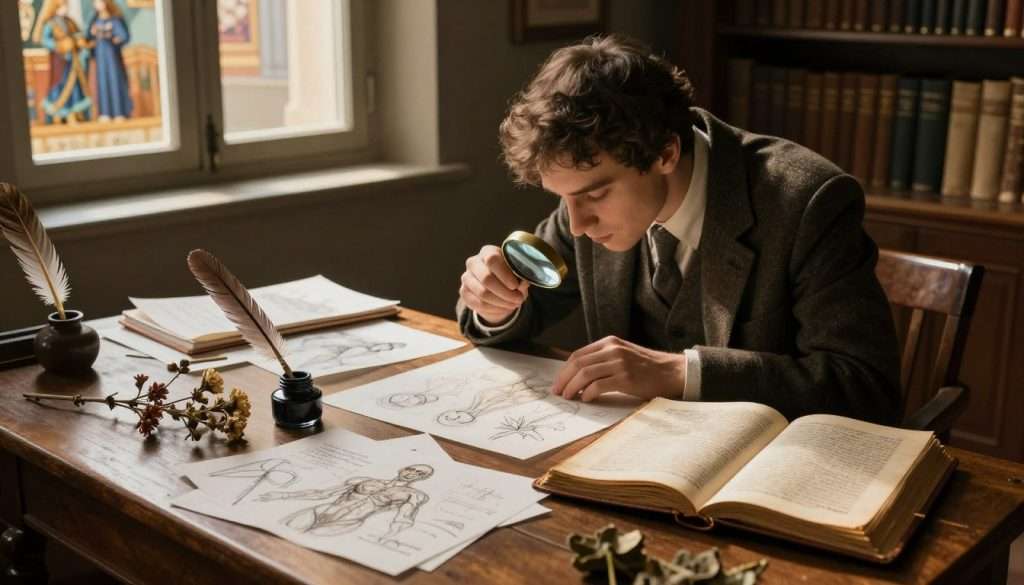
Writing down your observations helps you reflect and remember what you’ve seen. Leonardo da Vinci kept detailed notebooks with sketches, notes, and observations. You can do the same, using writing, drawing, or photography. The important thing is to find a method that works for you.
Study Nature as Your Primary Teacher
Nature was Leonardo da Vinci’s main teacher, and it can be yours too. By studying the natural world, you can learn about its underlying principles. From leaf patterns to river flow, nature is full of lessons.
Daily Observation Exercises You Can Start Today
- Spend 10 minutes each day observing something in nature, like a plant or an animal.
- Keep a journal to record your observations, using both words and sketches.
- Practice drawing what you see to improve your observation skills.
By making these practices a part of your daily routine, you’ll be well on your way to mastering observation, just like Leonardo da Vinci.
Embrace Interdisciplinary Learning
Imagine your education as a canvas where art, science, and math blend into a masterpiece. Leonardo da Vinci’s genius wasn’t just about mastering one field. It was about connecting many dots. To educate yourself like Leonardo, you need to embrace interdisciplinary learning.
Connect Disparate Fields of Knowledge
Leonardo’s work shows how different disciplines can come together to create something extraordinary. He saw the world as an interconnected web. Art, science, mathematics, and engineering were not separate but complementary ways of understanding reality.
Robert E. Grant notes that Leonardo’s approach to learning was about the interconnectedness of art, mathematics, and spirituality.
To follow in his footsteps, you should:
- Explore different subjects without limiting yourself to one area.
- Look for common principles and patterns that apply across various disciplines.
- Use insights from one field to inform and enrich your understanding of others.
Study Art, Science, and Everything in Between
Leonardo da Vinci was as comfortable in the studio as he was in the laboratory. He studied anatomy to improve his art, and his art informed his scientific observations. This cross-pollination of ideas made his work groundbreaking.
“The noblest pleasure is the joy of understanding.”
Find Patterns and Principles Across Disciplines
One of the key benefits of interdisciplinary learning is finding patterns and principles that are universally applicable. By studying various subjects, you can develop a deeper understanding of the underlying structures that govern our world.
Building Your Own Renaissance Curriculum
To create your own interdisciplinary learning path, start by identifying areas that interest you. Then, look for connections between them. For example, if you’re interested in both biology and art, explore how the principles of biology can inform your art, or how artistic techniques can enhance your understanding of biological concepts.
| Subject | Interdisciplinary Connection | Potential Outcome |
|---|---|---|
| Art & Anatomy | Understanding human structure through drawing | More accurate and detailed artwork |
| Science & Mathematics | Applying mathematical principles to scientific inquiry | Deeper understanding of natural phenomena |
| Engineering & Art | Using artistic creativity in engineering design | Innovative solutions and designs |
By embracing interdisciplinary learning, you’ll not only expand your knowledge but also develop a more nuanced understanding of the world. So, start exploring, connecting, and creating – your inner Renaissance awaits!
Learn Through Hands-On Experience
To learn like Leonardo, we must try things out ourselves. Leonardo da Vinci learned by doing, a method we can use today. It helps us understand and remember things better.
Move Beyond Theoretical Knowledge
Theory is important, but doing things is where we really get it. Da Vinci didn’t just read about machines; he made them. He didn’t just talk about the body; he studied it by dissecting corpses.
By doing things ourselves, we learn more and become better problem solvers. We also get more creative.
Practical experimentation lets us test ideas and find new ones. It’s a creative learning approach that makes learning more meaningful.
Design Your Own Experiments and Projects
Find what you’re interested in and make your own projects. This could be building a model, doing a science experiment, or making art. The important thing is to take charge of your learning.
- Identify a topic or area of interest
- Formulate a hypothesis or question
- Design an experiment or project to test your hypothesis
- Execute your plan and observe the results
- Reflect on what you’ve learned and how you can apply it
Embrace Failure as a Learning Opportunity
Not every project will work out, and that’s okay. Da Vinci’s many failed designs show his dedication to learning from mistakes.
Starting Your First Da Vinci-Inspired Project
Not sure where to begin? Try building a bridge with common materials. It’s a great way to learn about physics in a hands-on way.
| Project Idea | Skills Learned | Educational Technique |
|---|---|---|
| Building a Bridge | Understanding tension and compression, problem-solving | Practical application of physics principles |
| Creating a Botanical Drawing | Observation, detail-oriented work | Combining art and science |
| Designing a Simple Machine | Understanding mechanical advantage, creativity | Applying principles of mechanics |
By trying things out and seeing failures as chances to learn, we can learn better. So, let’s start our own Da Vinci-inspired projects and enjoy learning by doing!
Maintain Detailed Notebooks
To learn like Leonardo da Vinci, keeping detailed notebooks is key. Da Vinci’s notebooks mixed words, sketches, and diagrams. This shows his all-in-one approach to learning.
Start Your Personal Codex Today
Start a notebook for your observations, ideas, and insights. It can be a physical notebook or a digital one. The important thing is to write down your thoughts and findings often.
Da Vinci began with simple nature observations. You can start with what you find most interesting.
Combine Words, Sketches, and Diagrams
Da Vinci’s notebooks were special because they mixed different ways of learning. He wrote, sketched, and experimented all in one place. This mix helps you understand and remember better.
For example, when studying a complex system, draw a diagram. If you’re observing nature, sketch what you see and add notes.
Review and Reflect on Your Notes Regularly
It’s important to regularly review your notebooks. This helps you see your progress, find patterns, and connect new ideas.
Organizing Your Notebooks for Maximum Learning
To get the most from your notebooks, organize them in a way that works for you. You might use an index, tabs, or digital tags.
| Method | Description | Benefit |
|---|---|---|
| Indexing | Create an index to quickly locate specific notes or topics. | Saves time and enhances navigation. |
| Tabbing | Use tabs to categorize different types of content within your notebook. | Facilitates quick access to different sections. |
| Digital Tagging | Use digital tags to categorize and link related content across your notes. | Enhances searchability and connection-making. |
By keeping detailed notebooks and using these tips, you’ll be on your way to learning like da Vinci.
Develop Your Visual Thinking Skills
Visual thinking is a powerful tool that can change how you learn and interact with information. It’s like what Leonardo da Vinci did centuries ago. This skill can improve your understanding, boost creativity, and help you see problems in new ways.
Practice Drawing to Deepen Understanding
Drawing is more than just making art; it’s a way to observe and understand the world. Leonardo da Vinci used drawing to learn and discover. By drawing, you can better grasp complex ideas and remember them longer.
Start simple by drawing everyday objects or scenes. As you get better, try drawing more complex subjects that interest you.
Visual Thinking Exercises for Non-Artists
- Draw an object from memory without looking at it.
- Sketch a concept or idea you’re trying to understand.
- Create a visual journal to record your observations and insights.
Use Mind Maps and Visual Connections
Mind maps are a great tool for visual thinking. They help organize information, show connections between ideas, and spark new ideas.
To make a mind map, start with a central idea and add related topics. Use colors, symbols, and images to make it more engaging and memorable.

Think in Systems and Relationships
Visual thinking lets you see the big picture and understand how parts work together in a system. This skill is very useful in science, engineering, and design.
| Visual Thinking Technique | Description | Benefits |
|---|---|---|
| Mind Mapping | A visual representation of ideas and concepts | Improves organization and creativity |
| Drawing | Creating visual representations of objects or concepts | Enhances understanding and retention |
| Systems Diagrams | Visualizing the relationships within complex systems | Fosters a deeper understanding of complex interactions |
By using these visual thinking techniques every day, you can gain a deeper understanding of the world. It will also help you in your creative learning approaches.
Conclusion
As we wrap up our exploration of Leonardo da Vinci, we see his learning approach is timeless. It’s not just a piece of history. It’s a guide for anyone wanting to learn like a genius.
By following da Vinci’s lifelong learning tips, you open up new ways of seeing things. You learn from the educational model of historical geniuses. This approach encourages curiosity and creativity, leading to endless discovery.
Remember, the Renaissance mindset is about more than just knowing facts. It’s about linking different subjects together. It helps you understand the world in a deeper way. So, start today. Grab a notebook, ask questions, and see the world with new eyes.