
Ever spent hours reading textbooks only to forget everything by sunrise? We all know that feeling. It’s like all your hard work just vanishes into thin air.
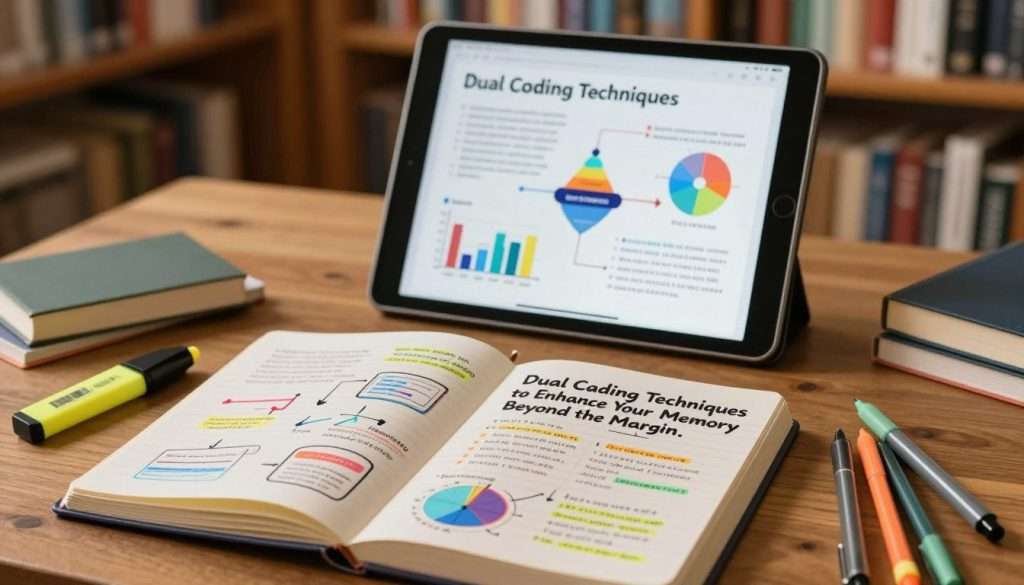
Is there a smarter way? By linking images with text, we turn dull notes into sticky ideas. This is about how our brains handle complex info.
Our brains process sights and sounds in different ways. When we combine both, we create a stronger mental connection. This boosts retention and makes recalling facts easier. And, let’s be honest, brains love pictures!
These methods can change how we study, making it more exciting. Let’s dive in! Let’s explore these clever tricks together. We want every learner to feel confident. Success begins here. Start building better habits today.
Key Takeaways
- Combine visuals and text for better focus.
- Activate separate brain channels naturally.
- Improve recall speed during exams.
- Keep notes organized and interactive.
- Make learning fun instead of a chore.
The Cognitive Science Behind Dual Coding
Learning how our brains handle information is key to using dual coding. It’s about using both visual and verbal information. This idea comes from cognitive psychology and neuroscience, which study how we see, process, and remember things.
Understanding the Dual Coding Theory
In 1970, Allan Paivio introduced the dual coding theory. He said our brains have two systems: one for words and one for pictures. He believed using both systems together boosts memory by giving more ways to recall information. This is because the brain has more cues to remember something when it’s seen and heard.
For example, remembering a phone number is easier if you see it written down or picture it in your mind. This uses both your verbal and visual memory, making it simpler to recall later.
How the Brain Processes Verbal and Visual Stimuli
Verbal information, like text or speech, is processed in the brain’s language centers. This involves understanding the words and their connections. Visual information, like images or diagrams, is processed differently, focusing on spatial and visual details.
The brain’s ability to mix these two types of information makes dual coding powerful. By combining words and pictures, we create mental images that are easier to remember.
| Type of Information | Brain Processing | Example |
|---|---|---|
| Verbal | Processed in language centers | Reading a textbook |
| Visual | Processed in visual cortex | Viewing a diagram |
| Dual Coding | Integrated processing of both | Watching a video with narration and animation |
By knowing how the brain handles different information, we can use dual coding to improve learning and memory. This is important for education, training, and any situation where remembering information is key.
Beyond the Margin: Using Dual Coding to Hack Your Memory
Ditching old ways of note-taking can open up new paths to remembering things. Dual coding mixes text and images to boost memory. It helps move info from short-term to long-term memory better.
Breaking Free from Linear Note-Taking
Old note-taking methods are often just writing down info in a straight line. Linear note-taking makes learning feel passive, like just copying down stuff. But dual coding makes learning active by adding pictures and words together.
- Create mind maps that visually organize information
- Use diagrams to illustrate complex concepts
- Incorporate icons and symbols to add visual interest
The Synergy of Text and Imagery
Text and pictures together make learning stick better. The brain handles visual and text info differently. Dual coding uses both to make learning fun and keep it in your memory.
For instance, linking new words to pictures can help you remember them better.
Using dual coding, you can find memory hacks that make learning fun and easy.
Visualizing Abstract Concepts for Better Retention
Visualizing complex information can change the game for memory. When we picture abstract concepts, we encode them better in our memory. Our brains love visual stuff more than just text.
Using visualization boosts your memory for complex info. You make mental pictures or images to help remember abstract ideas.
Transforming Complex Data into Infographics
Turning complex data into infographics is a great way to visualize. Infographics make data easy to see and remember. Start by picking out the key parts of the info you want to show.
Key steps in creating an infographic include:
- Identifying the main message or data you want to convey
- Selecting relevant visual elements such as charts, graphs, or icons
- Organizing the information in a clear and logical manner
- Using color and design to make the infographic visually appealing
For example, to remember stats, make a bar chart or pie chart. It makes data fun and helps you remember it better.
Using Mental Imagery to Anchor Information
Mental imagery is another strong tool. It’s about making vivid mental pictures linked to the info you want to recall. The weirder or more memorable the image, the better it sticks.
Let’s say you’re trying to remember a complex theory. Make a mental picture that simplifies or exaggerates the theory. You could picture key parts or link it to a memorable event or person.
“The mind is not a vessel to be filled, but a fire to be kindled.” This quote shows how sparking imagination and creativity is key in learning. Visualizing abstract concepts does just that.
By adding these visualization methods to your learning, you’ll remember complex info better. It will also boost your memory overall.
Effective Sketching Techniques for Non-Artists
Sketching is not just for artists. It’s a great way to improve your memory and understanding. You don’t need to be artistic to use simple icons, symbols, and doodles. These can make learning easier and more fun.
Simple Icons and Symbols for Quick Recall
Start by using simple icons and symbols in your learning. They help you remember information by linking it to a visual. For example, a clock can mean a deadline, and a lightbulb can mean an idea. Keep your drawings simple and use them the same way each time.
Creating Meaningful Connections Through Doodles
Doodles are more than random marks. They help you connect different pieces of information. By doodling, you make it easier to remember complex ideas. Try doodling a mind map to see how ideas are related.
| Visual Element | Description | Benefit |
|---|---|---|
| Simple Icons | Basic drawings like clocks, lightbulbs, or checkmarks | Quick recall of information |
| Symbols | Symbols like arrows, stars, or flags | Highlighting important information |
| Doodles | Mind maps, simple shapes, or patterns | Creating connections between ideas |
Adding these simple sketching techniques to your study routine can really help. It makes remembering information and understanding complex ideas easier. So, grab a pen and start sketching your way to better memory and retention!
Integrating Diagrams into Your Study Routine
Diagrams like flowcharts, process maps, and Venn diagrams can change how you study. They’re not just pictures; they’re tools that help you learn better through dual coding.
Using diagrams with text gives your brain two ways to learn. This makes it easier to remember and recall information. Let’s explore how different diagrams can improve your memory.
Flowcharts and Process Mapping
Flowcharts and process maps are great for showing complex steps or events. They make it easier to see how things flow, helping you understand and remember. For example, you can use them to study historical events, scientific processes, or literary plots.
To start with flowcharts, pick a process you want to learn. Break it down into steps. Then, use symbols and arrows to show how the process works. This visual approach helps you see the big picture and remember details better.
Venn Diagrams for Comparative Analysis
Venn diagrams are also very useful for learning. They let you see the similarities and differences between ideas visually. By using overlapping circles, you can easily spot what’s the same and what’s different.
For instance, when studying literature, Venn diagrams can help you compare characters, themes, or plot structures. This makes understanding and remembering these details easier.
| Diagram Type | Best Use | Benefits |
|---|---|---|
| Flowcharts | Illustrating processes or sequences | Enhances understanding of complex processes |
| Process Maps | Visualizing workflows or systems | Improves comprehension of how components interact |
| Venn Diagrams | Comparing and contrasting concepts | Facilitates identification of similarities and differences |
By using diagrams in your studies, you’re not just reading notes. You’re actively working with the material. This active engagement is crucial for improving your memory and making studying more effective.
Leveraging Digital Tools for Dual Coding
Digital tools are key in the world of dual coding. They help make learning better and more fun. Today, technology is a big part of how we learn, making things more accessible and interesting.
These tools help with dual coding by mixing pictures and words in new ways. This meets different learning styles and uses cognitive psychology to help remember things better.
Mind Mapping Software
Mind mapping software lets you create visual maps of information. It’s great for organizing ideas and data in a way that’s easy to see. With it, learners can:
- Make detailed diagrams that show how different things are connected.
- Use colors, symbols, and images to make the maps more fun and easy to remember.
- Work together with others in real-time, making learning a team effort.
Tools like MindMeister, Coggle, and XMind are popular for this. They have lots of features that help with dual coding.

Digital Whiteboarding for Collaborative Learning
Digital whiteboarding is great for dual coding, too, and works well when people work together. It lets everyone add to a shared space, making learning more fun and interactive.
Digital whiteboards are good for many things, like:
- Brainstorming where ideas can flow freely and be organized.
- Creating interactive lessons that mix pictures and text.
- Helping with group projects by providing a place to plan and organize together.
Microsoft Whiteboard, Google Jamboard, and Mural are popular in schools because they’re flexible and great for working together.
Using these digital tools can make dual coding even more powerful. It can really improve how you learn.
Applying Dual Coding to Language Acquisition
Dual coding combines visual and verbal information to change how we learn new languages. It uses both visual and auditory brain pathways. This helps us remember new words and grammar rules better.
Learning a new language gets easier when we link new words to images. Our brains remember pictures better than text. So, making mental images for new words helps us remember them.
Associating Vocabulary with Visual Context
Linking new words to pictures is a great way to use dual coding. For example, imagine a scene or object that shows what a word means. This makes it easier to remember the word later.
Tips for Effective Visualization:
- Choose vivid and memorable images for new words.
- Make a story that connects the word to something you know.
- Practice remembering the word by thinking of the image.
Using Picture-Word Association Cards
Picture-word association cards are also very helpful. They have an image on one side and the word on the other. By flipping through them, you can practice and improve your vocabulary.
| Language Learning Tool | Description | Benefits |
|---|---|---|
| Picture-Word Association Cards | Cards with images on one side and corresponding words on the other. | Enhances vocabulary retention, improves recall. |
| Flashcards with Images | Digital or physical cards that use images to represent vocabulary. | Boosts memory, supports visual learning. |
| Mind Mapping Software | Digital tools that create visual maps of vocabulary and concepts. | Organizes knowledge, facilitates connections between ideas. |
Using dual coding in your language learning can make it more fun and effective. It works for both beginners and advanced learners. These methods help you reach your language goals and understand different cultures better.
Enhancing Professional Presentations with Dual Coding
We’ve all been in presentations that were boring and hard to remember. But with dual coding, you can make yours unforgettable. It combines words and pictures to make your message strong and easy to recall.
Reducing Cognitive Load for Your Audience
Presenting complex info can overwhelm your audience. Dual coding spreads the info across words and pictures, making it easier to understand. This way, your audience can grasp and remember more of what you say.
To make this work, try these tips:
- Use clear and simple language
- Include relevant images or diagrams
- Keep your slides text-light
Designing Slides That Reinforce Verbal Messages
Your slides should enhance your message, not take over. By mixing text and images, you create a compelling story that connects with your audience.
Here are some good strategies:
- Use icons or simple graphics to highlight important points
- Add charts or graphs to show data clearly
- Stick to a consistent visual theme in your presentation
As cognitive neuroscience shows, dual coding boosts audience engagement and memory. By using these methods, you can elevate your presentations and make a lasting impact on your audience.
Overcoming Common Challenges in Dual Coding
Dual coding can really boost your memory, but it comes with its own set of hurdles. As you begin to use this method, you might face some obstacles. We’ll look at common challenges and share ways to overcome them. This way, you can get the most out of dual coding.
Avoiding Cognitive Overload
One big challenge is avoiding cognitive overload. Too much information can overwhelm your brain, making it tough to remember things. It’s key to find the right balance between visual and verbal information.
Here are some tips to help you avoid cognitive overload:
- Break down complex information into smaller, manageable chunks.
- Use simple and clear visuals that support your verbal information.
- Prioritize key information and focus on the most critical details.
By following these tips, you can avoid cognitive overload and create a better learning space.
Balancing Detail with Simplicity
Finding the right balance between detail and simplicity is another challenge. You need enough detail to make your visuals informative but not so much that it’s overwhelming. On the other hand, visuals that are too simple might not be as effective.
To achieve the right balance, consider the following:
- Identify your learning goals and tailor your visuals to meet them.
- Use a mix of simple and detailed visuals to meet different learning needs.
- Review and refine your visuals regularly to ensure they’re effective.
By finding the right balance, you can create visuals that support your learning and improve your memory.

The Role of Metacognition in Memory Improvement
Metacognition is a key player in improving memory, and it works well with dual coding. It helps you understand how you learn best. This knowledge can greatly improve how you absorb and keep information.
Metacognition means knowing how you learn best and adjusting your methods. It’s about being in tune with your thoughts and controlling them. With dual coding, metacognition helps you find what works best for you and tweak your learning.
Monitoring Your Learning Progress
Metacognition is also about checking how you’re doing. It’s about regularly looking at what’s working and what’s not. This lets you focus more on areas that need it and adjust your dual coding strategies.
To check your progress, set time to reflect on your learning. Ask yourself: “What am I doing well?” “Where am I struggling?” “What can I change to improve?” Reflecting helps you refine your dual coding approach.
“The mind is not a vessel to be filled, but a fire to be kindled.”
Refining Your Visual-Verbal Strategy
Metacognition also helps you improve your visual-verbal strategy. It lets you adjust your dual coding to fit your learning style better. You might try different visuals, balance text and images, or find new ways to connect words and pictures.
| Strategy | Description | Benefits |
|---|---|---|
| Mixing Media | Combining different types of media, such as text, images, and diagrams, to convey information. | Enhances engagement and retention by providing multiple pathways for information to be encoded. |
| Self-Questioning | Regularly asking yourself questions about the material you’re trying to learn. | Promotes active learning and helps identify areas where more focus is needed. |
| Reflective Practice | Taking time to reflect on what you’ve learned and how you’ve learned it. | Helps solidify learning and identify strategies that work best for you. |
By adding metacognition to your dual coding, you can improve your learning even more. It’s not just about using the right methods. It’s about knowing how to use them in a way that works best for you.
Practical Exercises to Master Dual Coding
Mastering dual coding needs hands-on practice. Let’s explore exercises to boost your skills. These activities challenge you to mix visual and verbal info. This way, you’ll not only sharpen your memory but also learn better.
The Rapid Sketching Challenge
The Rapid Sketching Challenge helps you quickly turn info into pictures. Pick a topic or text, set a timer for 5-10 minutes, and sketch the main ideas. It’s not about drawing skills but capturing the info’s essence visually. This exercise sharpens your skill to spot and show key info, key for dual coding.
To make it fun, get a friend or family member to join. Compete to see who sketches the most informative and creative picture in time. This adds fun and keeps you on track.
Summarizing Textual Content into Visual Maps
Summarizing text into visual maps is another great exercise. Take a text, like an article or book chapter, and make a visual map. Use colors, symbols, and images to show different ideas and how they connect. This breaks down complex info into easy-to-see parts.
Begin by finding the main ideas and supporting details in the text. Then, use mind maps or concept maps to organize this info visually. Turning text into pictures helps you understand and remember it better.
By doing these exercises daily, you’ll get better at dual coding. This will help you learn and remember more. The goal is to make dual coding a regular part of learning. With regular practice, you’ll see big improvements in your memory and learning.
Conclusion
Dual coding can really change the game for improving memory and studying. We’ve looked into the science behind it. You’ve also learned how to mix visuals and words into your learning.
When you start using these methods, you’ll see big improvements in remembering and recalling info. It’s great for students wanting better grades or professionals wanting to improve their presentations. Dual coding can help you reach your goals.
Try out different ways of dual coding, like drawing or using digital tools. With regular practice, you’ll find a method that works best for you.
So, start using dual coding today to boost your memory and studying skills. You can do it!