
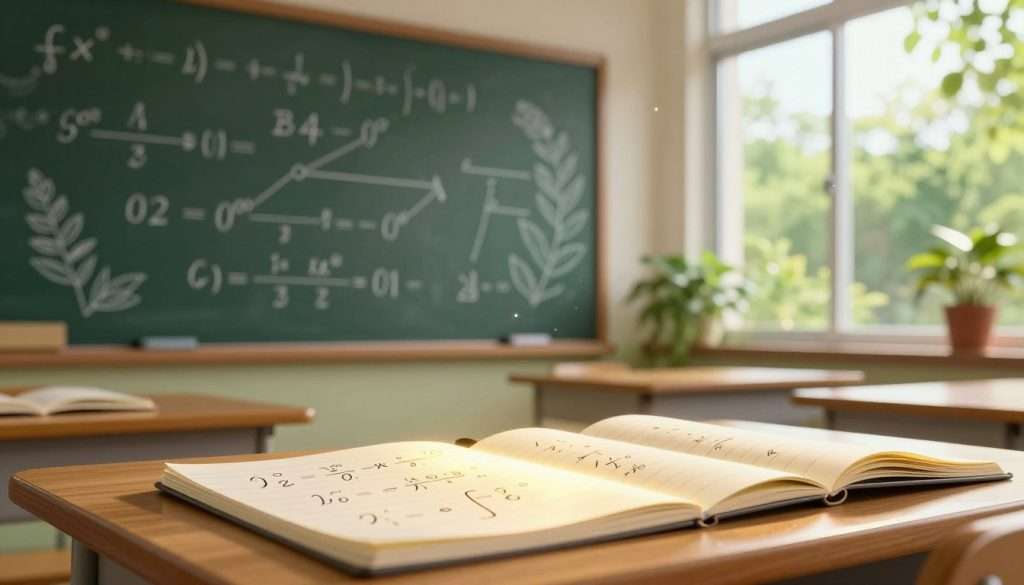
Growing up in a house on a Connecticut boarding school campus, we learned early on that learning is rarely confined to four walls. We often viewed school as a place for testing, but it is truly a space for discovery. It is time to step away from the stress of exams and look at numbers with fresh eyes.
We want to help you shift your perspective to see the elegance that exists within math. By changing how you approach your work, you can turn a standard study routine into a journey of genuine curiosity. Let us explore how to uncover the wonder waiting for you on the page.
Key Takeaways
- Learning happens everywhere, not just at a desk.
- Shifting your mindset turns stress into artistic discovery.
- Math holds a quiet elegance that rewards a curious mind.
- You can transform study sessions into moments of wonder.
- Personal perspective changes how you interact with complex problems.
The Philosophy of Mathematical Aesthetics
Do you think math is just about solving for X? You’re missing a world of abstract elegance. Many believe numbers are only for balancing checkbooks or exams. But, there’s a deep mathematical beauty beyond the usual worksheets.
Defining Beauty in Abstract Logic
Theoretical mathematicians see their work as high art. They explore the inner harmony of ideas, not just for practical use. A well-constructed proof is as satisfying as a musical chord.
This view changes how we see math. It’s not just about numbers. It’s about the beauty of logical structures. This abstract logic makes math timeless.
Why We Often Miss the Elegance in School
Modern math education often hides this beauty. We’re pushed to solve problems fast for grades. This turns math into a chore, losing the joy of discovery.
When we focus on solving problems, we forget why. By changing our mindset, we can find that curiosity again. Learning to see the elegance in math changes everything.
Beyond the Classroom: Finding the Hidden Beauty in Every Equation
Stepping away from the textbook can reveal the hidden beauty in every equation. We often get stuck in a loop of solving for X, forgetting that math is actually a vibrant language of patterns. By shifting our focus, we can start beyond the classroom: finding the hidden beauty in every equation that governs our world.
Shifting from Calculation to Conceptual Appreciation
When you stop racing toward a final answer, you have space to breathe. Using a simple tool like a chalkboard can change everything. It forces you to slow down and watch your ideas unfold in real time.
This tactile experience helps you move past rote memorization. Instead of just crunching numbers, you start exploring math concepts as if they were pieces of a puzzle. This shift turns a stressful assignment into a creative session where you are the architect of your own understanding.
| Feature | Traditional Calculation | Conceptual Appreciation |
|---|---|---|
| Primary Goal | Finding the answer | Understanding the logic |
| Mental State | Anxious and rushed | Curious and relaxed |
| Tool Usage | Calculator reliance | Chalkboard or pen/paper |
| Outcome | Short-term memory | Deep, lasting insight |
The Role of Curiosity in Mathematical Discovery
Curiosity is the secret ingredient that turns a student into a discoverer. When you ask “what if” instead of “what is,” you open doors that standard lessons often keep locked. We encourage you to treat your study time as a creative exploration rather than a race to the finish line.
Allow yourself to make mistakes and follow the threads of logic wherever they lead. You might be surprised by the elegance you find when you stop worrying about being wrong. Embracing this mindset makes the entire process of exploring math concepts feel less like a chore and more like a journey of discovery.
The Geometry of Nature and the Golden Ratio
Nature is the ultimate artist, and math is its favorite brush. When you start looking for the hidden logic behind the world, you develop a deeper math appreciation. This makes abstract concepts feel incredibly tangible.
The Golden Ratio, often represented by the Greek letter phi, is a special proportion that appears everywhere. It is not just a dry number; it is a universal signature of beauty and efficiency.
Patterns in Flora and Fauna
Have you ever wondered why a sunflower looks so perfectly balanced? It is not an accident! Plants use this ratio to pack seeds or leaves in the most efficient way possible to capture sunlight.
You can find these stunning mathematical sequences in many places if you know where to look:
- The spiral arrangement of seeds in a sunflower head.
- The growth patterns of pinecones and pineapples.
- The elegant curves of a nautilus shell.
Observing these natural designs helps you realize that math is alive. It is not just something you do in a workbook; it is the very language of growth and survival.
Architectural Marvels and Mathematical Proportions
Humans have long been obsessed with the same proportions found in nature. By mimicking these ratios, architects have created structures that feel inherently harmonious and pleasing to the eye.
From the ancient Parthenon in Greece to modern skyscrapers, builders use these proportions to create stability and grace. When you walk past a historic building, try to spot the balance in its design.
Building this kind of math appreciation changes how you see your environment. You stop seeing just bricks and mortar and start seeing the geometry of the universe reflected in the objects you pass every day.
Symmetry as a Universal Language
Did you know that the same logic that makes a musical chord also supports a skyscraper? Math is more than just numbers; it’s a universal language that ties everything together. By grasping mathematical understanding, you can spot these hidden patterns in everyday life.
The Physics of Balance and Stability
Ever wonder how a bridge stays up or why a tall building doesn’t fall in the wind? These structures use balance and symmetry to spread out weight evenly. It’s amazing to see how teaching tools, like the first big chalkboard in 1801, have a rich history.
Looking at a stable structure shows applied geometry at work. Stability isn’t just luck; it’s the outcome of careful math that ensures forces are balanced. This balance keeps our world stable.
Symmetry in Art and Music Theory
Symmetry isn’t just for engineers; it’s the core of great art and music. Imagine a painting where the left side mirrors the right, or a song with a melody that repeats in a perfect loop. These patterns feel naturally satisfying to us.
When you listen to a symphony, you’re hearing math in action. The rhythm and harmony depend on repeating patterns that bring order. Understanding mathematical understanding lets you enjoy these creative works more deeply, turning a simple listen into a deep experience.
The Unreasonable Effectiveness of Mathematics in Science
It’s amazing how math, seen as just abstract scribbles, powers our modern world. We often see math as dry, but it’s the engine behind our tech. From your car’s GPS to your phone’s image processing, math is everywhere.
Predicting the Unseen with Equations
Ever wondered how scientists predict solar eclipses decades ahead? It’s not magic; it’s math. By using equations, they map out celestial movements with great accuracy.
This skill to forecast the future is truly stunning. We can trust these predictions because they follow the universe’s fundamental rules. Here’s how these predictions impact our lives:
- Weather forecasting: Complex models help us prepare for storms before they arrive.
- Space exploration: Math ensures that rovers land safely on distant planets.
- Financial stability: Algorithms help banks manage risk in a global economy.
How Calculus Describes the Motion of the Universe
Calculus might scare students, but it’s just the language of change. It helps us understand how things move and change over time. Calculus is key to describing the real-world applications of math in dynamic systems.
Without calculus, our modern tech wouldn’t exist. It helps engineers design everything from car engines to streaming animations. Calculus breaks down complex motion into manageable parts, making the universe feel approachable.
These theoretical ideas are the backbone of our society. Seeing math in action shows that numbers are more than symbols. They are the foundation of our daily reality.
Fractals and the Infinite Complexity of Simple Rules
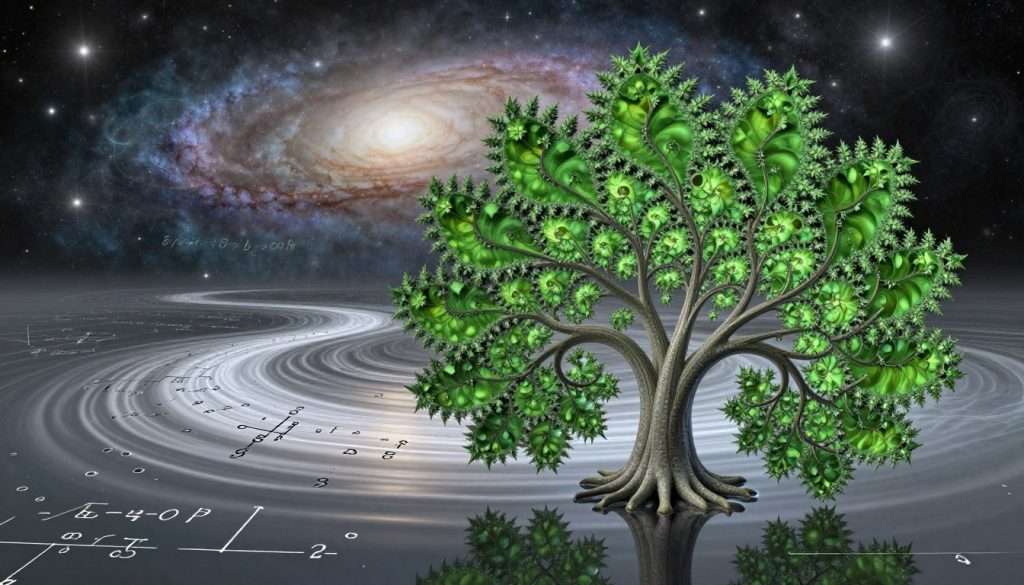
Imagine finding endless detail in the simplest rules. It’s not magic, but fractal geometry. These patterns help us understand the world better.
Fractals show that simple rules can create amazing structures. This changes how we see the world, moving beyond school shapes.
Visualizing Chaos Theory
Chaos theory might seem scary, but it’s about finding order in messy systems. There’s always a hidden logic, waiting to be uncovered.
“Mathematics is the language with which God has written the universe.”
Looking at chaotic systems, we see they’re not random. They follow sensitive rules that react to small changes. This shows the balance in our world.
The Self-Similarity of Natural Landscapes
Ever looked at a mountain range or coastline? Zoom in, and you’ll see it’s like the whole. This is self-similarity, nature’s design.
Nature uses these patterns for efficiency and beauty. From river branches to leaf veins, the same logic applies. Seeing these patterns helps us understand nature better.
- Clouds are not spheres, and mountains are not cones.
- Coastlines are not circles, and bark is not smooth.
- Lightning travels in a path that mimics the branching of trees.
By embracing these shapes, we see math in the world’s wild edges. It’s not just about squares and circles.
Cryptography and the Hidden Beauty of Prime Numbers
Prime numbers are more than just math homework. They protect our digital lives. They seem simple but are key to internet security. This shows how mathematical beauty turns into something useful in our daily lives.
The Building Blocks of Digital Security
When you shop online or send messages, prime numbers keep your data safe. This is called encryption. It’s easy to multiply large prime numbers but hard to reverse. Your private information stays locked from prying eyes.
Think of prime numbers as digital keys. Without them, the internet would be insecure. We depend on this mathematical beauty every time we’re online.
| Application | Role of Primes | Security Level |
|---|---|---|
| Online Banking | Encryption Keys | Very High |
| Email Privacy | Data Scrambling | High |
| Digital Signatures | Identity Verification | High |
The Mystery and Allure of Number Theory
Number theory has fascinated thinkers for centuries. It’s like uncovering the universe’s hidden rules. The beauty of these seemingly random numbers is captivating.
“Mathematics is the queen of the sciences and number theory is the queen of mathematics.”
Studying these sequences reveals their mathematical beauty. It’s not just solving equations. It’s about understanding the logic of the universe. Seeing the world through this lens changes how we view digital tools.
Transformative Math Experiences Through Technology
Have you ever wondered how a screen can make a complex equation feel alive? Many of us still love the tactile, slow-paced tradition of chalkboards. But technology has opened new doors. Now, transformative math experiences are available to anyone with a laptop or tablet.
Interactive Software for Visualizing Equations
Math is no longer just static symbols on a page. Tools like Desmos or GeoGebra let you change variables in real-time. You see how curves and shapes change as you adjust numbers.
These tools turn math into a visual playground. It’s not just about solving problems. It’s about seeing the beauty in the process. These transformative math experiences help us understand math better.
Using Data Science to Tell Human Stories
Math is a powerful tool for storytelling. It helps us understand human behavior, from migration to music trends. By visualizing data, we make invisible forces visible.
This way, we connect with the human side of statistics. Whether it’s climate change or economic shifts, math tells important stories. Here’s a quick look at how different tools help us engage with these concepts.
| Tool Type | Primary Benefit | Best For |
|---|---|---|
| Graphing Software | Real-time visualization | Exploring geometry |
| Data Dashboards | Pattern recognition | Social science trends |
| Physical Chalkboards | Deep, slow focus | Conceptual brainstorming |
Bridging the Gap Between Theory and Real-World Application
Ever wondered how math on a page turns into real-life stuff? It’s not just numbers; it’s the engine of our society. We’ll show you how math goes from the classroom to the world.
Seeing math in action changes how you see things. It’s not just solving problems. It’s about understanding the logic that keeps our world moving.
Mathematics in Economics and Social Systems
Economics is about making choices under pressure. Math helps predict how people react to changes. This leads to better decisions in finance and trade.
Think of these systems as big puzzles. Math helps find the key pieces. This lets us:
- Analyze market trends to predict future growth.
- Optimize resource distribution to reduce waste.
- Model social behavior to improve public services.

Engineering Solutions for Global Challenges
Math is key to solving global problems. Engineers use it to design green energy grids. This is crucial for a sustainable future.
In public health, math saves lives every day. It helps track diseases and develop safety strategies. It’s amazing to see how math helps solve big problems.
Mathematics is the language with which God has written the universe.
You can make a difference with math. Whether it’s climate change, urban planning, or healthcare, your math skills are powerful. Keep exploring and applying math to the world!
Cultivating a Mathematical Mindset in Daily Life
Getting a mathematical mindset is like getting a new way to see the world. Many see math education as just formulas. But it’s really a flexible way to see life’s challenges as puzzles to solve.
Recognizing Patterns in Everyday Decision Making
Our brains are wired to find patterns, even if we don’t notice it. When you plan your day or budget, you’re using logical reasoning. You’re figuring out what will happen based on what’s happened before.
Think of your choices as experiments. When you notice a pattern, like feeling tired after a certain lunch, you’re using math education in your life. This helps you make better choices without getting lost in details.
Developing Patience Through Problem Solving
Growth comes from facing challenges head-on. Solving tough math problems teaches you the value of persistence. This patience helps you tackle real-life problems with confidence.
Instead of looking for a quick answer, break down big problems into smaller ones. This is a key part of math education that helps in work and personal projects. The joy of solving a problem is worth the hard work.
| Feature | Standard Thinking | Mathematical Mindset |
|---|---|---|
| Approach to Failure | Avoidance | Data gathering |
| Decision Making | Impulsive | Pattern-based |
| Problem Solving | Frustration | Step-by-step analysis |
| Goal Setting | Vague | Measurable outcomes |
Recommended Resources for Lifelong Mathematical Exploration
You don’t have to stop exploring numbers just because you’ve left school. We think math appreciation is a lifelong journey. There are many ways to keep your curiosity alive.
Curated Books for the Math Enthusiast
Want to see logic in a new way? Check out Jessica Wynne’s work. Her photography shows the soul of math. It’s in the Morgan Library & Museum and the San Francisco Museum of Modern Art.
Books like hers show that math is art. Reading about the beauty of numbers can deepen your math appreciation in amazing ways.
Online Platforms and Communities for Continued Learning
The internet is full of educational resources for math. You can connect with learners worldwide. There are forums and video lessons for everyone.
Join online communities to ask and share. Talking with others who love math keeps you motivated. Using these educational resources for math helps you grow continuously.
You’re part of a global community of learners. Keep asking, exploring, and finding beauty in every calculation.
Conclusion
We hope this journey shows you that math is more than just formulas. It’s a vibrant language that shows the universe’s pulse.
By being curious and finding beauty in every equation, you make learning fun. You can see math as more than just numbers.
You have many resources to help you grow in math. Sites like Khan Academy or Brilliant keep your mind active.
Always ask questions about the patterns in nature or the tech you love. Your journey to mastering math is exciting and full of wonder.
Look at the world with new eyes. You’ll find beauty in unexpected places.
## FAQ
### Q: How can I start seeing math as more than just a chore for exams?
Start by changing how you see math. Instead of seeing it as just a hurdle for grades, explore it as a creative outlet. Numbers are like a language that describes our world.
Focus on the “why” behind math, not just the “how.” This can turn studying into a moment of discovery and wonder.
### Q: Why is mathematical beauty often compared to art or music?
Theoretical mathematicians find beauty in the way logic fits together. It’s like a symphony or a painting. Symmetry is a universal language found in bridges, music, and the stars.
It’s about seeing the elegance in the patterns that hold our world together.
### Q: What are some real-world applications of math that don’t feel like “school work”?
Math is everywhere! It’s in the security of your iPhone and the movie suggestions on Netflix. Calculus helps scientists describe change, like a seedling growing or a planet orbiting.
Seeing these connections helps us understand math better in our world.
### Q: How can technology provide more transformative math experiences?
Technology isn’t just for numbers; it’s for visualizing. Tools like Desmos or GeoGebra let you see equations as shapes on your screen. These experiences make learning math more engaging and intuitive.
### Q: Are there any educational resources for math that keep the learning journey fun?
Yes! There are many resources that make math fun. Jessica Wynne’s photography shows the beauty of math on chalkboards. Khan Academy and Brilliant.org use puzzles and stories to teach math.
### Q: Why is math education changing to focus more on conceptual appreciation?
Math education used to focus on speed and memorization, causing “math anxiety.” Now, it focuses on appreciation and understanding. This helps students develop patience and problem-solving skills for life.
When we see math as a journey of curiosity, it becomes enjoyable, not stressful.