
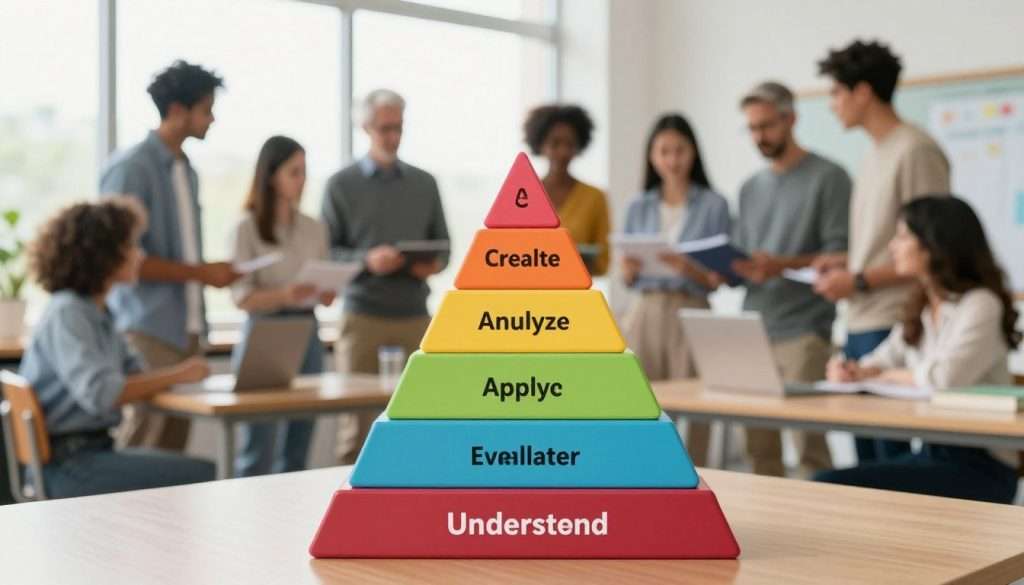
Ever felt like your students just memorize facts without really getting it? We’ve all been there, looking at blank faces in class. It’s time to make lessons into engaging adventures that spark curiosity.
With bloom’s taxonomy, you can move from simple recall to deep understanding. This education framework organizes learning goals by complexity. It helps students go beyond basic facts to master critical thinking.
Changing how you teach can change the whole classroom for the better. Let’s see how to make your classroom a place where students enjoy learning.
Key Takeaways
- Move beyond rote memorization to foster deep student understanding.
- Use a hierarchical model to structure your lesson objectives effectively.
- Increase student engagement by challenging them with complex tasks.
- Transform your classroom dynamic by shifting your teaching focus.
- Create a learning environment where students feel excited to explore new ideas.
Understanding the Foundations of Bloom´s Taxonomy
Think of teaching as a climb, with each step built on solid cognitive science. In 1956, Benjamin Bloom and other psychologists organized learning. They created bloom’s taxonomy to classify educational objectives in a clear way.
The Evolution of Educational Objectives
For years, this education framework was unchanged. But in 2001, Anderson and Krathwohl updated it. They changed it from static nouns to active verbs, making it more practical for today’s classrooms.
This change was huge. It turned abstract goals into actionable tasks. Students now do more than just “know” things. They “create,” “evaluate,” or “analyze.” This makes the model feel more alive and useful in today’s classrooms.
Mapping Cognitive Levels to Student Growth
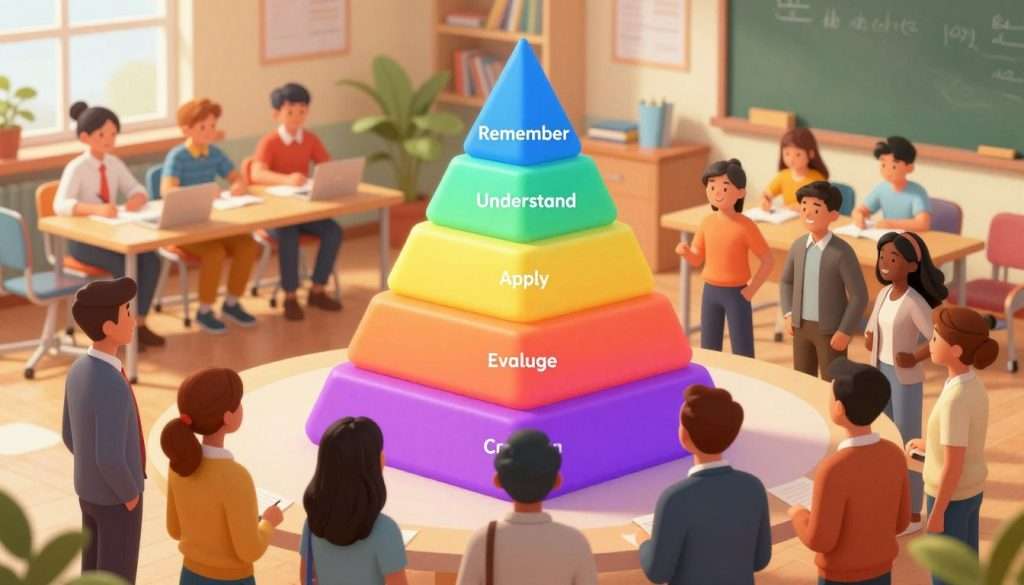
The cognitive levels are like a ladder students climb all year. We start with basic recall and move up to complex thought. It’s a beautiful, logical path that supports growth.
Here’s how we see the progression of these cognitive levels:
- Remembering: The base where students recall facts and basic concepts.
- Understanding: Explaining ideas or concepts in their own words.
- Applying: Using information in new or different situations.
- Analyzing: Drawing connections among various ideas.
- Evaluating: Justifying a stand or a decision.
- Creating: Producing new or original work.
By using this education framework, you give students a clear path. Aligning educational objectives with these stages helps everyone. It builds confidence as they move from simple memory to true mastery.
Assessing Your Current Classroom Environment
Let’s take a closer look at your classroom. It’s easy to fall into a routine. But stepping back lets you see if your teaching sparks curiosity. We aim to make sure your education framework goes beyond the surface.
Identifying Gaps in Higher Order Thinking Skills
Many classrooms focus on simple recall. Students just memorize facts for tests. But remembering is just the beginning. It leaves a big gap in higher order thinking skills.
If students can repeat a definition but can’t explain its importance, they’re missing out. They’re not making the deeper connection.
“The goal of education is not to fill a bucket, but to light a fire.”
Students might struggle with new problems or original ideas. This shows they need to move up the cognitive levels. By spotting these gaps early, you can challenge them in meaningful ways.
Evaluating Existing Learning Outcomes
Look at your learning outcomes to see if they aim for mastery. Are you asking students to “list” and “define,” or to “analyze” and “evaluate”? Using bloom’s taxonomy helps balance these goals.
The table below shows how to move from basic recall to deeper thought:
| Learning Level | Common Task | Goal |
|---|---|---|
| Remembering | Listing facts | Basic recall |
| Applying | Using a formula | Practical use |
| Analyzing | Comparing ideas | Deep understanding |
| Creating | Building a project | Original thought |
Aligning your learning outcomes with higher cognitive levels changes the classroom. It’s not just about finishing the curriculum. It’s about mastering higher order thinking skills. By using bloom’s taxonomy, you empower students to think for themselves.
Designing Lessons Using the Bloom´s Framework
Let’s make lesson planning a smooth and rewarding journey for you and your students. Using bloom’s taxonomy can guide you through the process. It helps keep everyone on track and excited to learn.
Step One: Defining Clear Learning Objectives
The key to a great lesson is knowing where you want students to end up. Writing clear learning outcomes gives them a target. This clarity makes their work feel more meaningful.
Think of these objectives as the destination on a map. You want to describe what students will do by the end of class. Whether it’s solving math problems or writing stories, learning outcomes should be specific and measurable.
Step Two: Scaffolding Content from Recall to Creation
After setting your goals, it’s time to build the path to get there. We use cognitive levels to scaffold our lessons. This starts with the basics and moves to deeper thinking.
Begin by helping students remember and understand the core facts. Then, guide them to apply what they know, analyze details, and evaluate different ideas. Give them space to create something new.
By moving through these cognitive levels, you support students’ success. This step-by-step approach makes bloom’s taxonomy a powerful classroom tool. It turns teaching into a series of small, manageable wins for your students.
Implementing Lower Order Thinking Skills Effectively
Let’s explore how to make learning’s foundational steps fun. We often rush into complex projects, but we must build a strong classroom foundation first. Mastering these early stages sets the stage for long-term success.
Remember, bloom’s taxonomy is about building a solid base. Focusing on these early educational objectives boosts students’ confidence and readiness for harder tasks.
Strategies for Remembering and Understanding
Students need more than just memorization to grasp new concepts. When they connect new info to their interests, they remember it better. This approach aligns with the affective domain, showing how students’ attitudes and values affect their learning.
Techniques for Knowledge Retention
Make memorization fun with clever tools. Mnemonics and spaced repetition keep info fresh. These methods make student assessment feel like a natural check-in, not a high-stakes test.
- Spaced Repetition: Reviewing material at increasing intervals to boost memory.
- Mnemonics: Using catchy acronyms to recall complex lists or facts.
- Visual Mapping: Drawing connections between ideas to see the big picture.
Active Listening and Comprehension Exercises
Active listening is a powerful skill for processing information. Ask students to summarize what they heard to ensure they understand. This simple habit prevents confusion and fosters clear communication.
| Technique | Primary Benefit | Ease of Use |
|---|---|---|
| Summarizing | Checks comprehension | High |
| Peer Teaching | Reinforces memory | Medium |
| Flashcards | Quick recall | High |
| Concept Mapping | Deepens logic | Medium |
By using these strategies, you create a classroom where educational objectives are met with enthusiasm. Every great thinker started with the basics. Keep your student assessment supportive, and watch your learners thrive as they move through bloom’s taxonomy.
Transitioning Students to Higher Order Thinking Skills
Let’s dive into making everyday lessons into deep, meaningful adventures. We’ve laid a solid foundation. Now, it’s time to challenge your students to think more deeply. By using bloom’s taxonomy, we can help them move beyond simple memorization to true mastery.
Applying Concepts in Real-World Scenarios
Learning sticks when it connects to the real world. We encourage you to give students problems with no single right answer. This makes them think critically and apply what they’ve learned to real-life situations.
“The goal of education is not to increase the amount of knowledge but to create the possibilities for a child to invent and discover.” — Jean Piaget
Analyzing Data and Evaluating Arguments
To become lifelong learners, students need to understand the information they get. Give them datasets or conflicting articles to analyze. This turns them into active investigators who can evaluate arguments based on facts.
Encouraging Critical Peer Review
Collaboration sharpens thought processes. Set up peer review sessions for students to give each other feedback. This helps them improve their higher order thinking skills and value different viewpoints. Learning from each other, they grasp bloom’s taxonomy better than lectures can.
Creating Opportunities for Synthesis and Innovation
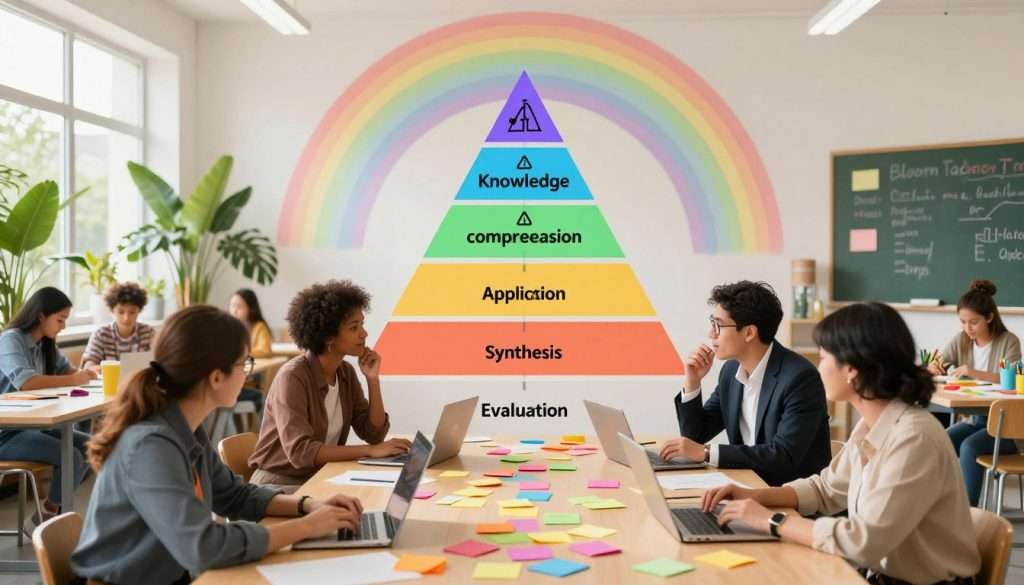
Imagine a classroom where students don’t just memorize facts. They create their own unique things. Instead of just testing, we can teach in a more exciting way. By focusing on higher order thinking skills, students can mix information to make something new.
Designing Projects That Require Original Thought
To really challenge students, design projects that ask for more than just remembering facts. By using the psychomotor domain, students can turn their ideas into action. This way, educational objectives are met through doing, not just listening.
“The goal of education is not to increase the amount of knowledge but to create the possibilities for a child to invent and discover.”
When students reach origination, they create something new. This is the top of learning. It turns the classroom into a place where everyone can show their talents.
Moving Beyond Standardized Testing
Standardized tests often show only a part of what students can do. By focusing on bloom’s taxonomy, we can make tests that value depth over speed. The table below shows how we can move from old ways to new, creative tests.
| Assessment Type | Focus Area | Student Outcome |
|---|---|---|
| Standardized Test | Recall and Memorization | Correct Answer Selection |
| Project-Based Learning | Synthesis and Creation | Original Product Development |
| Performance Task | Application and Analysis | Real-World Problem Solving |
Promoting Student Agency in Creative Tasks
Letting students take charge of their work is key to keeping them interested. When you give them a framework but let them choose, they feel responsible and proud. This freedom is crucial for mastering higher order thinking skills and reaching educational objectives.
Your job is to guide while they explore their creativity. Using bloom’s taxonomy helps keep projects challenging but fun. Let your students lead, and watch as they turn simple lessons into amazing creations.
Integrating Educational Psychology for Better Engagement
Ever wondered why some lessons stick while others fade away? The answer often lies in how we connect information to our brains’ natural processing. By mixing educational psychology with your teaching, you can make your classroom supportive, smart, and engaging.
Aligning Taxonomy with Student Motivation
Using bloom’s taxonomy is more than just checking boxes. It’s about how students build knowledge. The knowledge dimension helps keep students curious. Matching the right challenge to a student’s level sparks a desire to learn more.
“The art of teaching is the art of assisting discovery.”
To keep students motivated, our learning outcomes must be relevant and achievable. When students understand the “why” behind a task, they are more likely to invest their energy. Here’s a table showing how different cognitive levels relate to engagement strategies.
| Cognitive Level | Motivation Strategy | Knowledge Type |
|---|---|---|
| Remembering | Gamified Quizzes | Factual |
| Applying | Real-world Projects | Procedural |
| Creating | Student Choice Boards | Metacognitive |
Managing Cognitive Load During Complex Tasks
Even the best lesson can fail if it’s too hard for students. Managing cognitive load is key when introducing complex bloom’s taxonomy tasks. If a task is too heavy, students get overwhelmed; if it’s too light, they get bored.
We can help by breaking down big projects into smaller steps. This lets students focus on one cognitive level at a time. By scaffolding your learning outcomes, you create a safe space for students to take risks and think deeply. Remember, educational psychology is your ally in creating a classroom where every student can succeed.
Overcoming Common Challenges in Implementation
Change is hard, and shaking up your classroom can be tough. It’s normal to face resistance when you ask more from your students. Growth often happens just outside of our comfort zones, but it takes patience and a steady hand to get there.
Addressing Resistance to Rigorous Thinking
Introducing higher order thinking skills can overwhelm some students. They’re used to simple recall, not analysis or creation. Interestingly, 64% of teachers found that using bloom’s taxonomy helped challenge their students and build confidence.
To overcome this, view these tasks as exciting puzzles, not chores. Show students that their ideas matter, and they’ll be more eager to take on the challenge. Remember, educational psychology shows that motivation comes after competence, so start small and celebrate every success.
Balancing Curriculum Requirements with Deep Learning
Many worry there’s not enough time to cover everything and go deep. It’s a constant battle between checking boxes and fostering real understanding. The key is to integrate higher order thinking skills into your lessons, not add them as an extra task.
Use student assessment to bridge this gap. Design assessments that measure how well students apply what they know. This way, you meet curriculum goals while pushing students further with bloom’s taxonomy.
| Challenge | Traditional Approach | Bloom-Focused Strategy |
|---|---|---|
| Student Pushback | Ignore and move on | Scaffold tasks to build confidence |
| Time Constraints | Rushing through content | Integrating depth into core topics |
| Assessment | Focus on rote memorization | Focus on application and creation |
Conclusion
You now have the tools to make your classroom more engaging. By using bloom’s taxonomy, you move from simple memorization to real learning.
We hope you’re excited to use these tools in your lessons. Every student should find learning exciting, not a chore.
Clear learning outcomes guide your journey. They give students a goal that’s both achievable and fulfilling.
Improving how you assess students shows their progress clearly. It focuses on the skills they’re gaining daily, not just grades.
You can make your lessons memorable long after class ends. Keep trying new approaches to see what works best.
What lesson will you first update with these strategies? Share your efforts with others and grow a community of curious learners.