

Ever felt like you’re drowning in schoolwork? It’s like a huge mountain of homework staring you down. You are not alone in this struggle. Many students have felt the same way, wondering how to keep up with all the schoolwork.
This guide is here to help you get through those tough times. We’ll show you how to break down big tasks into simple, actionable steps that really help. By taking back your time and energy, you can start enjoying college instead of just getting by.
You should feel confident and capable in your studies. Let’s look at how to turn your daily routine into a path to real academic success.
Key Takeaways
- Acknowledge that academic stress is a common experience.
- Break large projects into smaller, manageable tasks.
- Prioritize your mental energy to avoid burnout.
- Implement simple habits to regain control of your schedule.
- Focus on progress rather than perfection to boost confidence.
Understanding the Psychology of Academic Overwhelm
School pressure can feel like trying to drink from a firehose. It’s normal to feel overwhelmed when starting a new school. You might think everyone else knows what they’re doing, but that’s not true.
Academic stress is common. A report found that 69% of students considered quitting school. Emotional stress was the main reason for this.
Your feelings are completely valid. You’re not alone in this struggle. By recognizing these patterns early, you can build resilience. Using academic success strategies helps protect your mental health.
When you feel stressed, remember these truths about your mind:
- Stress is a signal: It shows your workload is too much for you.
- You are adaptable: Your brain can learn, but it needs the right environment.
- Proactive care matters: Good stress management for students comes from small, daily habits.
Changing your view can turn overwhelming feelings into a challenge you can handle. You have the power to regain your focus and enjoy studying again.
The 5 Best Learning Hacks for Students Who Feel Overwhelmed
It’s time to trade in that constant worry for a study plan that really works. We know school stress can feel like a heavy backpack. But you can make it lighter. By changing how you study, you can avoid cramming and feel ready for exams.
Good stress management for students begins with small, thoughtful changes in how you learn. We’ve collected the top strategies to make your study sessions efficient. These methods help you take back control and focus again.
Using these techniques, your schoolwork will seem easier. Consistency is key to making learning fun. See how these hacks beat old study habits in the table below.
| Strategy | Old Approach | New Hack | Benefit |
|---|---|---|---|
| Time Management | Cramming | Intervals | Less Anxiety |
| Memory | Passive Reading | Active Recall | Better Retention |
| Complexity | Memorizing | Feynman Method | Deep Clarity |
| Organization | Linear Notes | Mind Mapping | Visual Flow |
These The 5 Best Learning Hacks for Students Who Feel Overwhelmed are about smart work, not just hard work. By focusing on your mental health, you pave a lasting path to success. Begin with small steps, be patient, and see your confidence soar as you learn these valuable tools.
Implementing the Pomodoro Technique for Sustainable Focus
Let’s explore a method that changes how you study. It turns long study sessions into short, focused sprints. If you get tired after an hour of reading, this technique is for you. It’s a top student studying tip for those with a lot to do.
Breaking Down Study Sessions into Manageable Intervals
The technique is simple: work in 25-minute focused bursts. Stay away from your phone and ignore distractions during these times. This short time makes big tasks seem completely achievable.
When the timer goes off, stop right away. Breaking your day into segments prevents mental exhaustion. You’ll be surprised at how much you can do with a break coming up.
Optimizing Break Times to Prevent Mental Fatigue
After 25 minutes of work, take a 5-minute break. This break is crucial for improving focus and concentration. Use this time to stretch, get a drink, or step away from screens.
Think of these breaks as a mini-workout for your brain. They help your mind reset, so you come back to your desk feeling refreshed. Taking breaks is key to staying energized all day.
Utilizing Active Recall to Boost Information Retention
Ever finish reading a chapter and remember nothing? It’s a common problem. We often use methods that don’t really challenge our brains. To improve your grades, you need to use study smart techniques that make your brain work harder.
Moving Beyond Passive Reading and Highlighting
Many of us spend hours highlighting and re-reading, thinking we’re making progress. But this is just a trick to make our brains feel busy without really learning. Passive review gives us a false sense of confidence that disappears when we take a test.
Try to engage with the material by summarizing it in your own words without looking at your book. This simple change is one of the best student studying tips out there. When you make your brain recall information, you strengthen the pathways that help you remember.
“The act of retrieving information is not just a way to measure learning; it is the very process that creates it.”
Creating Self-Testing Systems for Complex Subjects
For tough topics, you need more than just memorization. Create your own practice quizzes or use flashcards to test your understanding. This turns studying into a dynamic challenge instead of a chore.
By testing yourself often, you find out where you need to improve. This lets you focus on the areas that really need work. Here’s a comparison of different methods:
| Method | Effort Level | Retention Rate |
|---|---|---|
| Passive Reading | Low | Poor |
| Highlighting | Low | Low |
| Active Recall | High | Excellent |
| Practice Quizzes | High | High |
Using these study smart techniques makes complex subjects easier. Remember, these student studying tips are designed to make your brain do the hard work. Once you start testing yourself, you’ll see a big difference in what you remember.
Mastering Spaced Repetition for Long-Term Memory
Ever felt like your brain is a sieve, losing all that hard-earned knowledge? We’ve all been there, studying all night only to forget it all the next day. Using academic success strategies can help keep your learning in your long-term memory.
The Science of Forgetting and How to Combat It
The human brain tends to forget what it thinks is unimportant. This is called the forgetting curve. To fight this, review material at specific, increasing intervals.
Reviewing a concept just before you forget it makes your brain work harder. This strengthens the neural pathways, turning short-term cramming into long-term retention. It’s a simple change that can greatly improve your study habits.
Tools and Apps for Scheduling Review Sessions
You don’t have to track intervals manually. Technology can do it for you. Digital tools are a smart way to study, automating your review schedule.
Here are a few popular tools to keep you on track:
- Anki: A powerful flashcard app that uses a sophisticated algorithm to determine your next review date.
- Quizlet: Great for creating custom sets and using built-in study modes to test your knowledge.
- RemNote: Combines note-taking with built-in flashcards to keep your study materials organized.
Consistency is the secret ingredient to making these tools work for you. Even ten minutes of daily review can prevent the frustration of relearning the same material. Start small, stay consistent, and watch your confidence grow as you master your subjects.
Applying the Feynman Technique to Simplify Difficult Concepts
Ever felt like you got a topic until you tried to explain it? It’s a common feeling where we see our knowledge is thin. The Feynman Technique is a game-changer for time management for learners who want to learn smarter, not harder.
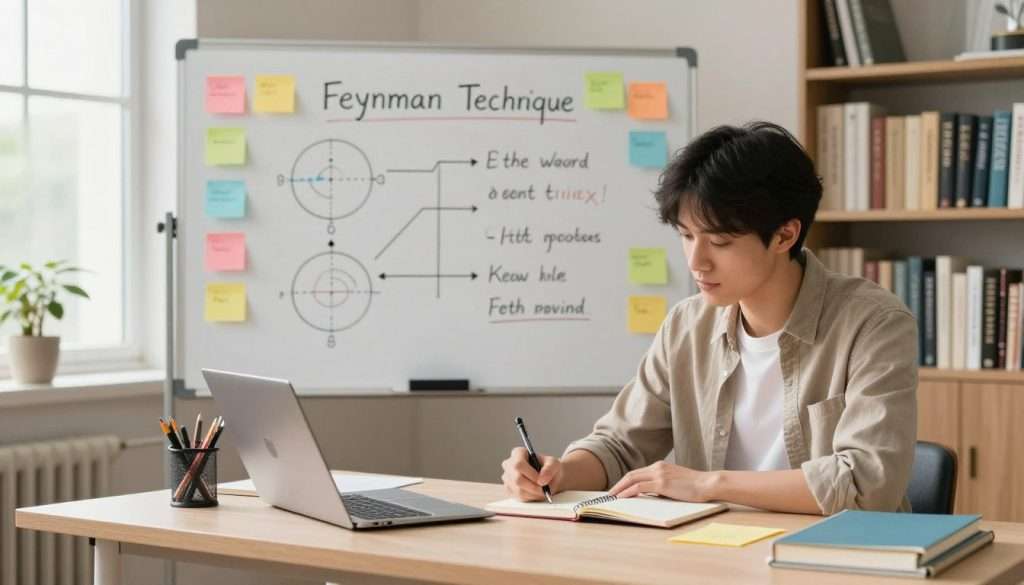
Teaching Material to Identify Knowledge Gaps
The idea is simple: explain a concept as if to a beginner or your pet goldfish. When you hit a wall or use complex jargon, you’ve found a knowledge gap. This is when real learning starts.
Don’t gloss over these spots. Go back to your source material. By pinpointing what you don’t understand, you save hours. This targeted approach is key to effective time management for learners.
Refining Explanations for Better Conceptual Clarity
Once you find those gaps, simplify your language. If you can’t explain it in plain English, you don’t get it yet. Use analogies and metaphors to connect abstract ideas to your life.
This process organizes information logically. When you can describe a complex process simply, you’ve mastered it. This method makes your study sessions productive and impactful.
| Study Method | Focus Area | Outcome |
|---|---|---|
| Passive Reading | Memorizing terms | Surface-level recall |
| Feynman Technique | Conceptual understanding | Long-term retention |
| Group Review | Social learning | Peer feedback |
By using this technique, your time management for learners will improve. You’ll spend less time confused and more time building lasting knowledge.
Leveraging Mind Mapping for Visual Organization
Turning complex topics into a visual map is a top effective study technique for keeping your sanity. Mind mapping helps you see the connections between ideas when you feel overwhelmed. It’s a creative way to organize your thoughts before you start writing or studying for a big test.
Structuring Information to See the Big Picture
These diagrams let you see the big picture without getting lost in details. Instead of reading page after page, you create a central hub for your main topic. Then, you branch out into sub-topics and supporting details.
This method helps you focus on what’s truly important. By cutting out the unnecessary, you get a clearer understanding of key concepts. It’s easier to remember a structure you built yourself than a list you memorized.
Connecting Related Ideas to Reduce Cognitive Load
Using keywords and branches reduces your cognitive load. Your brain processes information better through associations than linear lists. When you map out these relationships, you make it easier for your mind to store and retrieve complex data later.
Think of it as building a mental roadmap for your subject matter. As you draw lines between related ideas, you reinforce your memory and uncover gaps in your knowledge. Using these effective study techniques means you’re working smarter, not just harder.
Developing a Realistic Study Schedule That Prioritizes Well-being
Learning to manage your time starts with making a plan that values your well-being as much as your grades. Looking at a blank planner can be daunting. But, creating a schedule that works is simple if you don’t try to be a robot.

Balancing Academic Demands with Personal Health
A good schedule isn’t about filling every moment with books. It’s about protecting your energy so you can learn better. Aim for two to three hours of study for each credit hour you’re taking.
This approach gives you a clear view of your weekly tasks without setting you up to fail. Your brain needs rest and food to learn well. Prioritizing sleep and healthy meals is essential, not a luxury.
Identifying Peak Productivity Hours
Everyone’s energy levels vary. Some are morning people, while others shine at night. Find when you’re most productive to tackle tough tasks.
Be open to trying different schedules to find what works for you. Flexibility is key to lasting success. If your week changes, adjust your plan instead of giving up. A flexible schedule keeps you moving without burnout.
Creating an Environment Conducive to Deep Work
Creating a space for deep work is a key effective study technique. Your surroundings can either help or hinder your progress. By designing your space, you pave the way for success.
Minimizing Digital and Physical Distractions
A clean, organized workspace is crucial. It saves time and mental energy by reducing clutter. A tidy desk truly leads to a tidy mind.
Digital distractions are as harmful as physical ones. Turn off non-essential notifications or use apps to block social media. This creates a focused space for deep work.
The Role of Ergonomics and Lighting in Concentration
Physical comfort is vital for improving focus and concentration during long study sessions. A supportive chair and proper monitor height are essential. They help keep your brain sharp.
Good lighting is also important. Natural light is best, but a quality desk lamp can prevent eye strain. When your body is comfortable, your mind can focus better.
Overcoming Procrastination Through Micro-Goal Setting
Ever felt overwhelmed by a big project? It’s normal to feel stuck when faced with a lot of work. But, you can change how you feel today. By breaking down your tasks, you can find some top student productivity tips to reduce stress.
The Power of Starting with Five-Minute Tasks
Beating procrastination starts with starting. Commit to working for just five minutes. This makes the task less scary.
After starting, you might want to keep going. The hardest part is starting. Here’s how to get going:
- Set a timer for exactly five minutes.
- Focus on one tiny, specific action, like opening your document or writing a single sentence.
- Allow yourself to stop when the timer goes off, though you will probably choose to continue.
Celebrating Small Wins to Maintain Momentum
Staying motivated all semester takes more than hard work. You need to celebrate your small wins. This is a key part of our favorite student productivity tips.
When you finish a micro-goal, take a moment to celebrate. A quick stretch, a healthy snack, or a mental high-five can help. Consistency is built on these small victories, so don’t overlook the power of a job well done!
Conclusion
You now have the tools to reach your full academic potential. These tips will help you manage your work without stress.
Success is a long journey, not a quick race. It’s okay to ask for help or change your plan when needed. You can handle any challenge that comes your way.
We hope these strategies make you feel in charge of your time. Using these tips, you can achieve your goals while keeping your health first. You have all you need to excel in school and beyond.
Now, go out there and show everyone what you can do. Your best work is just waiting for you!