
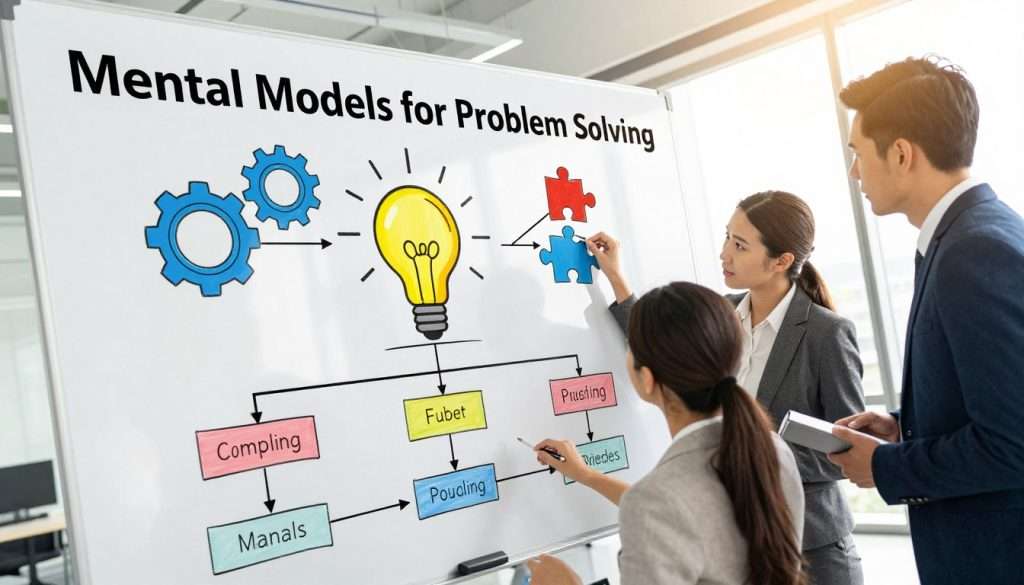
Ever felt like life is a huge, messy puzzle? We’ve all been there. Sometimes, the challenges we face seem too big to handle alone. That’s where mental models come in as your secret weapon.
Think of these frameworks as a personal toolkit for your brain. They help break down big, confusing ideas into smaller, easier pieces. By using them, you can see the world more clearly.
We want to help you go beyond simple guessing. It’s time to stop guessing and start thinking like the world’s best experts. By mastering these simple concepts, you’ll change how you solve problems forever.
Are you ready to sharpen your mind and make better decisions? Let’s explore how these tools can improve your life!
Key Takeaways
- These frameworks act as a personal toolkit for navigating life’s complexities.
- You can simplify big, overwhelming ideas into manageable pieces.
- Moving beyond intuition helps you become a more effective thinker.
- Learning these concepts allows you to approach challenges like an expert.
- You will gain the clarity needed to make smarter decisions every day.
The Foundation of Mental Models
Think of your mind as a toolbox with special tools for every challenge. These tools, called mental models, help us understand the world. They are like apps on your phone, ready for when you need them.
Defining the Framework of Thought
At their heart, these frameworks are mental representations of reality. They help us sort through complex information, focusing on what’s important. With a good understanding of these concepts, life becomes clearer.
We use these structures to make sense of the world. By having a strong set of mental models, learning becomes easy. You don’t start from scratch with every problem; you just grab the right tool.
Why Your Brain Needs Cognitive Shortcuts
Your brain is always looking for ways to save energy. It loves cognitive shortcuts because they help you make quick decisions. Without them, even simple tasks like choosing lunch would be too much.
These shortcuts are key for survival and growth in today’s fast world. They help you spot patterns and predict outcomes based on what you’ve learned before. By improving your mental models, you can go from reacting to life to shaping your own success.
Understanding Mental Models for Better Decision Making
When life gets messy, just relying on your instincts isn’t enough. Our brains are wired for quick survival, not long-term success. To make better decisions, you need to see the bigger picture.
Moving Beyond Intuition
Intuition is good for simple choices, like picking a snack. But it’s not enough for complex problems. Our brains love shortcuts, which can hide important details. It’s time to stop guessing and think more clearly.
By moving away from instinct, you can analyze situations better. This change lets you avoid common traps. When you stop relying only on your gut, you make more reliable choices.
The Role of Logic Models in Complex Environments
Logic models are your best ally in complex situations. They guide your thoughts, helping you feel confident in uncertain times. Instead of just focusing on immediate results, you start thinking about the future.
Using these tools helps you play the long game. You can see how your choices today will affect tomorrow. Here are some key benefits of using a structured approach:
- Clarity: You cut through the noise to find the problem’s core.
- Consistency: You make choices based on proven logic models, not just your mood.
- Foresight: You spot potential risks before they become big problems.
Improving your decision making is about building a useful toolkit. When you use these frameworks, you start designing your future instead of just reacting. This simple change can lead to much better results over time.
Overcoming Cognitive Biases
We all think we’re perfectly logical, but our minds have hidden shortcuts. These shortcuts help us process info fast but lead to cognitive biases. They cloud our judgment and make us miss the real world.
Identifying Common Mental Traps
Your brain is like a busy office using pre-made templates to save time. But these templates can be outdated or wrong. These mental traps filter out new info, only letting in what confirms our beliefs.
Not spotting these patterns can lead to poor choices. Knowing your brain aims for efficiency, not perfection, is key. By staying alert, you can catch biases before they harm your progress.
Strategies to Mitigate Confirmation Bias
Confirmation bias is a big cognitive bias, where we look for evidence that proves us right. Use Hanlon’s razor to fight this. It says to not assume malice when mistakes or ignorance are possible.
This mindset helps you see frustrating situations with empathy instead of judgment. Assuming others are doing their best opens up for better communication. Staying curious and seeking out different opinions keeps your mind open and ready for challenges.
Applying Strategic Thinking in Daily Life
High-level planning isn’t just for CEOs. Strategic thinking can change your daily life. It’s not about complex spreadsheets or boardroom meetings. It’s about making better choices by seeing the world more clearly.
When we stop living on autopilot, we notice hidden patterns in our routines. This change lets us design our lives instead of just reacting to it. By improving this skill, you can turn daily challenges into chances for growth.
The First Principles Thinking Approach
Ever felt stuck doing things because “that’s how they’ve always been done?” First principles thinking can help. It means finding the absolute root cause of a problem by stripping away assumptions.
Instead of following others, you create your own solutions from scratch. This is true strategic thinking. It means questioning the usual ways until you find the basic truths of your situation.
Second-Order Thinking for Long-Term Impact
Most people focus on immediate results, but that’s often a mistake. Second-order thinking looks ahead. It considers the effects of your actions.
When deciding, ask yourself: “And then what?” This question helps you avoid quick fixes that might cause problems later. By using this strategic thinking method, your choices lead to lasting success, not just a temporary win.
The Intersection of Behavioral Economics and Logic
Understanding the hidden forces behind human decisions is like having a secret map for social navigation. When we look at behavioral economics, we stop seeing people as simple calculators. Instead, we see them as complex, emotional beings. This shift in perspective allows us to predict reactions and communicate with much greater clarity.
How Incentives Shape Human Behavior
We often assume that people respond only to money or clear rules. But behavioral economics shows us that social pressure, convenience, and even the way a choice is presented matter just as much. When you understand what truly drives someone, you can design environments that encourage better outcomes.
Think about how a simple change in a cafeteria layout can lead people to choose fruit over cake. By adjusting the incentive structure, you nudge behavior without forcing a decision. This is a powerful tool for anyone looking to improve their team dynamics or personal habits.
Applying Game Theory to Everyday Negotiations
Negotiation is not just about winning; it is about finding a path where both sides feel heard. By using game theory, you can move away from aggressive tactics and toward building long-term trust. It is all about anticipating the other person’s moves while keeping your own goals in sight.
When you approach a conversation as a cooperative game, you create space for creative solutions. You might find that giving a little on a minor point helps you secure a major win elsewhere. This strategic thinking turns potential conflicts into productive partnerships.
| Concept | Traditional Logic | Behavioral Reality |
|---|---|---|
| Decision Making | Purely rational | Influenced by context |
| Incentives | Financial gain only | Social and emotional |
| Negotiation | Zero-sum game | Collaborative potential |
| Goal Setting | Rigid targets | Adaptive adjustments |
Essential Frameworks for Critical Thinking
Building strong critical thinking skills is like upgrading your brain’s software. It helps you sort out what’s true from what’s not. With a few key mental tools, solving complex problems becomes much easier.

Occam’s Razor and Simplicity
When you’re stuck on a tough problem, you might want a complex solution. But Occam’s Razor says the simplest answer is usually the best. It tells you to remove extra assumptions to find the heart of the issue.
“Everything should be made as simple as possible, but not simpler.”
Choosing simplicity saves time and mental effort. It helps you focus on what really matters. This is a key part of critical thinking in any area.
The Map Is Not the Territory
We often mix up our mental models with reality. Our thoughts and plans are just abstractions—they’re not the real world. Reality is much more complex than any model can show.
Remembering this helps you stay open to new information. It keeps you from being too set in your ways. This flexibility is crucial for improving your critical thinking skills.
Building Your Personal Toolkit of Mental Models
We aim to help you create a latticework of ideas for when you’re stuck. By collecting different mental models, you get a flexible way to solve tough problems. It’s like having a mental Swiss Army knife.
Curating a Diverse Mental Library
To build a great library, step out of your comfort zone. Read widely, from history to biology to art. Learning the basics of different subjects gives you unique perspectives that make your mental models sharper.
This approach is about gathering liquid knowledge. It’s not about memorizing facts. It’s about understanding how different systems work. This lets you adjust your thinking to any situation you face.
The Importance of Multidisciplinary Learning
Take Richard Feynman, the famous physicist. He solved problems others couldn’t just because his approach was different. He used insights from various fields to see the world in a broader lens.
By learning across disciplines, you can connect dots others miss. Using these diverse mental models in your life turns problems into puzzles ready to be solved.
Common Pitfalls When Using Mental Models
Using mental models is like having a toolbox. But sometimes, we pick the wrong tool for the job. You might have heard of the “Man With a Hammer” syndrome, where every problem looks like a nail. Relying too much on one way of seeing the world can hurt your critical thinking.

Avoiding Over-Simplification
It’s tempting to make complex life events simple. Models help us understand, but they’re simplifications, not reality. Ignoring the messy details can make you miss what’s unique about a situation.
Remember, a map is not the territory. Look for the nuances that your favorite model might hide. True critical thinking means embracing gray areas, not forcing everything into black-and-white.
“To a man with a hammer, everything looks like a nail.”
The Danger of Rigid Application
The biggest mistake is sticking to a model when it’s not working. Flexibility is key to success. If a strategy fails, don’t keep trying it—pivot to a new view.
Rigidity turns a helpful guide into a mental cage. Stay open to new data to keep your critical thinking strong. Keep your mind agile and change your tools when needed.
| Approach | Result | Mindset |
|---|---|---|
| Rigid Application | Missed Opportunities | Closed |
| Flexible Thinking | Better Solutions | Open |
| Over-Simplification | Flawed Logic | Narrow |
Integrating Models into Professional Problem Solving
Dealing with work challenges needs more than just instinct and caffeine. When you hit a tough spot, you need structured frameworks for decision making. This way, you can tackle the complex world of work with confidence.
Systems Thinking in Organizational Management
Most office problems aren’t just one thing; they’re part of a bigger picture. Systems thinking lets you see how different parts of the office affect each other. It helps you tackle the root cause of issues, not just symptoms.
Think of your office as a living thing. If one part has trouble, the whole office feels it. This approach makes problem solving better because you can see how changes affect the whole company.
“The essence of systems thinking is seeing the forest and the trees, rather than just the leaves.”
Using Inversion to Solve Difficult Challenges
Looking at problems from the opposite side can be the best strategy. Inversion asks, “What would make this project fail?” By finding these failure points, you can prevent them.
This method is great for decision making because it points out risks you might miss. It flips your usual problem solving approach, keeping you safe from big problems.
| Strategy | Primary Goal | Best Used For |
|---|---|---|
| Systems Thinking | Understand connections | Complex team dynamics |
| Inversion | Identify risks | Preventing project failure |
| First Principles | Break down logic | Innovation and design |
By learning these professional models, you become a strategic thinker. Keep using these methods, and even the toughest challenges will seem easy.
Conclusion
We’ve looked at many ideas, from basic thinking to advanced methods like inversion and first principles. You now have many tools to tackle tough challenges.
Don’t aim for perfect decisions every time. Just try to be a bit better each day. Small steps in thinking can lead to big wins over time.
Begin building your own collection of models today. Keep wondering about the world and testing your ideas. You’re preparing for a life of smarter learning.
What framework do you want to try this week? Choose one and use it to solve a problem you’re facing. We’d love to hear how these ideas change your view of life!