
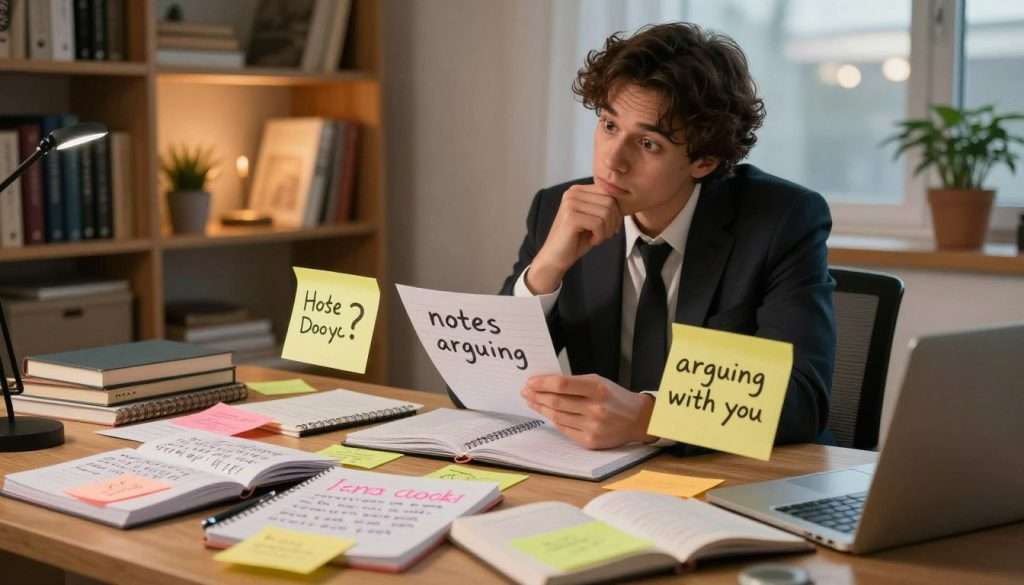
Most people see a notebook as a place to store facts. They write down what they learn and hope it sticks. But this way, we often feel bored and uninspired.
What if we changed how we use our notebooks? Adversarial engagement makes them a partner for our brain. By questioning what we write, we become active thinkers.
Improving study habits means questioning what we learn. When we make our notes defend their logic, we learn more. This makes studying feel like a lively debate, not a chore.
Key Takeaways
- Treating records as passive storage limits intellectual growth.
- Adversarial engagement transforms study sessions into dynamic experiences.
- Questioning information helps solidify long-term memory retention.
- Active thinking turns boring desk time into a space for discovery.
- Changing how we interact with data is the secret to better learning.
The Passive Trap: Why Traditional Note-Taking Fails
Ever feel like you remember nothing after a lecture? We often treat our notebooks like a stenographer’s pad. This passive approach rarely helps us remember deeply.
True effective note taking is more than just copying words. It requires critical thinking to truly understand the information.
The Illusion of Competence in Transcription
It’s easy to think you know a lot just because you have a lot of notes. This is called the illusion of competence. You might see a page full of notes and think you’ve got it all down.
But, your brain just copied the data. It didn’t really process the information. That’s why enhancing learning through notes can feel like a chore.
Why Highlighting and Summarizing Often Lead to Shallow Understanding
Many of us spend hours highlighting and summarizing. These methods might look organized, but they’re just intellectual window dressing. They make us feel like we’re working hard without really understanding the material.
Highlighting and summarizing alone miss the point. They don’t create the friction needed for long-term memory. Here are some common pitfalls:
- Surface-level focus: You focus on keywords but ignore the deeper logic.
- Lack of challenge: You accept what’s written without questioning it.
- False confidence: You recognize the text, but think you really get the concept.
To do better, we need to see our notes as a place for debate. By enhancing learning through notes, we can turn passive review into a mental challenge.
Why Your Notes Should Argue With You
Most of us see our notes as a graveyard for facts. But what if they were meant to be a sparring partner? Imagine if your notebook could talk back to you when you write down a half-baked idea. By treating your notes as a challenger, you turn studying into a lively conversation.
Moving from Passive Consumption to Active Engagement
When you just write down what a professor says, your brain goes on autopilot. This is the opposite of active note taking, which makes you think deeply. You should stop being a stenographer and start being a detective.
To make this change, see your notes as a place to test your logic. If you write down a concept, ask if it really makes sense or if you’re just repeating words. This habit keeps you alert and engaged with the material.
The Role of Conflict in Deep Memory Encoding
Your brain loves a good fight. When you add intellectual conflict to your study routine, you create critical thinking notes that stay in your memory longer. This friction is what your mind needs to remember new information.
Think of your notebook as a place for debate. You should look for ways to challenge the claims you’re reading. Here’s why this works well for your brain:
- It forces retrieval: You have to pull information from your memory to build a counter-argument.
- It highlights gaps: You quickly see what you don’t understand when you try to defend a point.
- It builds connections: You start linking new ideas to what you already know, making a stronger defense.
By arguing with your own writing, you stop being a passive observer. You become an active participant in your own learning. Embrace the struggle, because that’s where real learning happens.
The Psychology of Cognitive Dissonance in Learning
That annoying mental itch you feel during a tough debate is actually your brain leveling up. We often mistake this feeling of mental friction for a sign that we are failing to understand a topic. In reality, this state—known as cognitive dissonance—is the exact moment where real learning begins.
When we encounter information that contradicts our existing beliefs, our brains naturally want to resolve the tension. By actively leaning into this discomfort rather than running from it, you open the door to a much more sophisticated way of thinking. This is the perfect time for challenging your thoughts and testing the limits of your current knowledge.
How Discomfort Signals Intellectual Growth
Research shows that students who engage in structured debate perform significantly better at creating balanced arguments. These individuals learn to hold two opposing viewpoints in their minds simultaneously without feeling overwhelmed. This ability is a direct result of pushing through the initial discomfort of being wrong.
When you feel that internal resistance, consider it a green light for growth. It means your brain is busy reorganizing its internal map to accommodate new, complex data. Here is why this process is so vital for your development:
- It forces you to move beyond simple memorization.
- It helps you identify gaps in your own logic.
- It builds the mental stamina needed for high-level critical thinking.
Reframing Mental Friction as a Learning Tool
You can transform every study session into a powerful exercise by intentionally challenging your thoughts. Instead of viewing a counter-argument as a personal attack, try to see it as a valuable data point. This shift in perspective turns a frustrating experience into a productive brainstorming session.
Try these simple steps to make the most of your mental friction:
- Pause when you feel defensive about a new idea.
- Ask yourself, “What if the opposite of my belief is actually true?”
- Write down the strongest argument against your current position.
By consistently practicing this, you stop fearing the friction and start using it as a tool. You will find that your understanding of complex topics becomes much deeper and more resilient over time. Embracing the struggle is the fastest way to become a sharper, more thoughtful learner.
Techniques for Implementing Adversarial Note-Taking
It’s time to change how you study by making your notes a place of debate. Instead of just copying, use note taking techniques that make you think deeply. By seeing your notebook as a place for debate, you become more than just a listener.

The Devil’s Advocate Method
Remember how teachers reviewed transcripts to find mistakes? You can do the same in your studies. When you hear a strong claim, argue the opposite, even if you agree.
This active note taking method helps you find biases and weak points. By arguing against the claim, you make sure you understand it well, not just accept it.
Using Marginalia to Question Authoritative Claims
Your margins are for more than just notes or doodles. They’re great for questioning your notes and the material. If something seems too perfect, write a question mark or a doubt next to it.
Ask yourself, “Is this always true?” or “What evidence is missing?” This habit stops you from accepting information without questioning it. It turns reading into a dialogue where you can challenge what you read.
Creating Counter-Arguments for Every Key Point
To really get a topic, try to argue against every main point. If a book says an event happened for one reason, think of another reason.
This method makes you look for evidence that goes against the main story. By defending your ideas against your own arguments, you strengthen your understanding. It’s a great way to think, not just memorize.
Developing a Dialectical Relationship with Your Sources
Think of your notes as a conversation, not just a list of facts. By not seeing every source as absolute truth, you open up to deeper understanding. This change lets you engage with the material, not just copy it.
Synthesizing Opposing Viewpoints
Consider at least two sides of every argument, like in a debate. Recording only one side keeps you in an echo chamber. Seeking out opposing views helps you make a more balanced judgment.
When you synthesize, you’re not just summarizing. You’re building a bridge between different ideas. This reveals the nuance that many miss when reading passively.
“It is the mark of an educated mind to be able to entertain a thought without accepting it.”
Identifying Logical Fallacies in Your Own Notes
Looking back at your notes is key to growth. Ask if your logic is sound. Are you using emotional appeals or generalizations? Questioning your notes helps catch these mistakes early.
When you start questioning your notes, you might find biases. This is normal! Through self-reflection, you improve at spotting fallacies, becoming a better thinker.
| Feature | Passive Note-Taking | Dialectical Note-Taking |
|---|---|---|
| Primary Goal | Transcription | Synthesis |
| Perspective | Single-sided | Multi-faceted |
| Outcome | Shallow recall | Deep understanding |
| Mindset | Acceptance | Critical inquiry |
Overcoming the Fear of Being Wrong
What if I told you that being wrong is the secret to getting smarter? Most of us think mistakes are failures. But in deep learning, they are golden opportunities. When you let go of your ego, you open up to curiosity.
Using self-reflection notes helps you track your growth. It shows you where you were wrong and how you learned from it.
Embracing Intellectual Humility
Intellectual humility is knowing you don’t have all the answers. It’s being open to change when new evidence comes up. Students often worry their grades depend on being right from the start.
But the smartest thinkers focus on evidence over their first thoughts. This mindset has many benefits:
- You become less defensive in debates.
- You learn to spot weak arguments in your own thinking.
- You develop a more flexible and resilient mind.
Why Your Notes Are a Sandbox, Not a Final Draft
Think of your notebook as a sandbox, not a finished book. A sandbox is for play and building, where you can always start over. If you see every entry as final, you won’t dare question your ideas.
By seeing your self-reflection notes as an ongoing experiment, you allow yourself to be wrong. You’re writing for yourself, not others. Celebrate mistakes! They show you’ve grown and learned more about the world.
Tools and Systems to Facilitate Critical Thinking Notes
Discover how the right tools can make your study sessions more powerful. You need a good system to keep your notes organized. Without it, even great ideas can get lost.
Utilizing Zettelkasten for Interconnected Ideas
The Zettelkasten method is a game-changer for effective note taking. It helps you link ideas together like a web. Each note builds on or challenges your knowledge.
This method makes you see patterns you might have missed. It turns your notes into a dialogue with yourself. This is how you go beyond memorization to true understanding.
Digital Tools for Annotating and Debating
Choose from high-tech apps or traditional pen and paper. The goal is to create critical thinking notes that grow. Many use digital platforms to debate and leave comments on their notes.
Try different software to find what works best for you. The best note taking techniques are those you enjoy using daily. When your tools feel like part of your mind, you’ll engage more with your studies.
The Power of Periodic Review and Self-Correction
Even the best systems need regular checks. Set aside time for reviewing your notes. This helps you correct any mistakes or outdated beliefs.
Think of this as a regular check-up for your brain. By revisiting your arguments, you can refine your views. This simple habit greatly improves your mental growth.
Long-Term Benefits of Challenging Your Own Beliefs
Think of your brain as a muscle that grows stronger every time you challenge your own beliefs. When you move past the comfort of accepting your first thoughts, you start to see the world with much more clarity. This shift in perspective is exactly what turns a simple student into a lifelong critical thinker.

Building a More Robust Mental Model
By consistently challenging your thoughts, you stop building your knowledge on shaky ground. Instead, you create a framework that can withstand new information and complex problems. This process turns your notes into a living, breathing map of your understanding.
When you actively look for flaws in your logic, you are basically stress-testing your ideas. This practice ensures that your mental model is not just a collection of facts, but a dynamic system that evolves. You will find that your ideas become more flexible and reliable over time.
Enhancing Decision-Making Through Critical Analysis
The real magic happens when you apply this rigor to your daily choices. Research shows that students trained in debate are significantly better at identifying exactly what new data is needed to resolve a controversy. They don’t just guess; they analyze the gaps in their current knowledge.
By enhancing learning through notes, you prepare yourself to navigate life’s toughest questions with confidence. You will stop feeling overwhelmed by conflicting information and start seeing it as a puzzle to be solved. Consider these long-term advantages of this approach:
- Increased objectivity: You learn to separate your ego from your ideas.
- Better problem-solving: You can spot logical fallacies before they derail your plans.
- Faster adaptation: You become comfortable changing your mind when presented with better evidence.
- Greater confidence: You trust your conclusions because you have already tested them against tough counter-arguments.
Ultimately, this habit makes you a more rational and informed person. You are no longer just a passive observer of your own life. You are an active participant who knows how to think for yourself in any situation.
Conclusion
You’ve seen how studying has changed from just recording to actively debating ideas. This change is not just about jotting down facts. It’s about making your brain think, question, and grow with every new idea.
Getting better at studying is a long-term effort, not a quick fix. Your notes are like a playground for your brain. They’re not just copies of what others say. They show your own thoughts and how you’re learning.
Begin by questioning just one thing in your next study session. Ask why someone believes a certain fact or where their reasoning might be weak. This approach makes studying feel like a fun mystery to solve.
We encourage you to see your notebook as a place for debate, learning, and growth. Pick up your pen or open apps like Obsidian or Notion. Your most creative ideas are hidden in the debate of new ideas.