
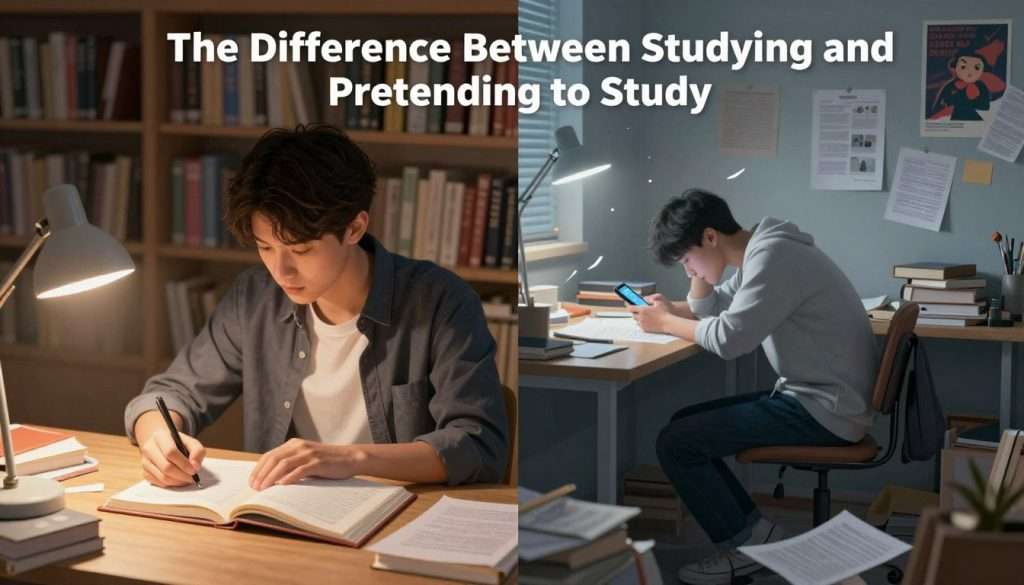
Ever spent hours at your desk and felt like you learned nothing? We’ve all been there. It’s easy to think you’re being productive when you’re not really paying attention. You should use your time wisely, so let’s see if you’re actually learning or just going through the motions.
Figuring out the difference between studying and pretending to study is key to true learning. We aim to help you move from just doing the work to really mastering your subjects. Let’s start changing how you learn so it actually sticks!
Key Takeaways
- Identify the signs of passive learning versus active engagement.
- Learn how to stop busywork that drains your mental energy.
- Discover techniques to ensure your brain stays fully present.
- Master methods that turn complex topics into long-term knowledge.
- Gain confidence by making every minute of your session count.
Defining the Core Distinction Between Studying and Pretending to Study
Knowing the difference between studying and pretending to study is key to doing well in school. Many think just sitting at a desk means they’re learning. But, there’s a big difference between going through the motions and really getting it.
Just looking at a page without really understanding it is busywork. Real learning means changing how you use your study materials. We aim to help you move from feeling like you’re doing nothing to genuine cognitive growth.
The Psychology of Cognitive Engagement
True engagement happens when your brain works hard to understand new info. When you’re really into it, your mind links new ideas to what you already know. This is not just sitting there; it’s an active, dynamic process that builds your brain.
If you find yourself zoning out or needing to read the same thing over and over, your brain is not engaged. You’re technically “studying,” but not really learning. By noticing these moments, you can switch to methods that require more effort and focus.
Passive Consumption Versus Active Construction
Passive consumption is like watching a movie; you see the story but don’t have to create it. On the other hand, active construction is like writing the script. You have to organize, synthesize, and test your own understanding to really get it.
The following table shows how these two approaches differ in daily practice:
| Feature | Passive Consumption | Active Construction |
|---|---|---|
| Mental Effort | Low (Automatic) | High (Intentional) |
| Primary Goal | Finishing the chapter | Mastering the concept |
| Outcome | Temporary recognition | Long-term retention |
| Strategy | Re-reading notes | Self-testing and recall |
By choosing active construction, you turn study sessions into a powerful tool for success. Knowing the difference between studying and pretending to study lets you use your time better and get better results with less stress.
The Illusion of Competence in Academic Performance
We’ve all been there: reading the same page over and over, thinking we get it. You finish a chapter and feel proud. But when the test comes, your mind goes blank. This is called the illusion of competence, a common trap in education.
Students often use bad study techniques because they feel good in the moment. Seeing familiar words tricks your brain into thinking you know it all. It’s like confusing knowing the words with really understanding them.
Why Re-reading Feels Like Learning
Re-reading is a comfort for stressed students. The familiar text makes your brain relax. You’re just scanning, not really learning.
Real learning needs active effort, not just looking at the text. Re-reading doesn’t test your memory; it just confirms you recognize the words. That’s why you struggle to apply what you’ve read in tests.
The Trap of Highlighting and Underlining
Highlighting and underlining make you feel like you’re studying. It’s easy to think you’re learning because you’re touching the book. But these study techniques can be misleading.
Highlighting just marks the text, not makes you remember it. You might have a colorful book, but your brain doesn’t really store the info. To learn better, you need to use methods that make your brain work harder.
Identifying the Signs of Pretending to Study
Let’s uncover the sneaky habits that make you feel like you’re working hard when you’re not. It’s easy to think you’re doing a lot, even when your mind is on vacation. To really learn, we must be honest about when we’re truly focused and when we’re just pretending.
The Multitasking Myth
Many students think they can handle a textbook, phone, and laptop at once. You might think you’re being diligent by looking at the blackboard in class. But if your mind is elsewhere, you’re just pretending to learn. True focus means giving your full attention, not trying to do everything at once.
The Comfort Zone of Familiar Material
It’s tempting to review notes you already get, isn’t it? We often stick to easy topics for a quick confidence boost. But staying in your comfort zone is a sign you’re avoiding real growth and effective study habits.
Procrastination Disguised as Preparation
Ever spent hours color-coding your notes or organizing your desk instead of solving problems? This is procrastination in disguise. Those late nights might feel like hard work, but they often just delay the real learning.
| Habit Type | Common Behavior | Result |
|---|---|---|
| Pretending | Multitasking | Surface-level recall |
| Pretending | Reviewing easy notes | False confidence |
| Effective | Active problem solving | Deep understanding |
| Effective | Spaced repetition | Long-term retention |
By spotting these habits, you can switch to effective study habits that really help. It’s time to stop pretending and start mastering your material with purpose.
The Science of Active Recall and Spaced Repetition
Your brain gets stronger when you make it work hard. Many study tips for students suggest reading notes over and over. But, that’s not the best way to learn.
True learning happens when you challenge your mind. You need to recall facts without looking at your book.

How Active Recall Forces Brain Plasticity
When you make your brain remember without looking at your book, you’re doing more than just testing yourself. You’re actually rewiring your neural pathways. This process, known as active recall, makes your brain build new, stronger connections.
Think of it like lifting weights at the gym. The hard work to remember a concept makes your memory stronger. By not re-reading, you make sure the knowledge lasts.
Optimizing Retention Through Spaced Intervals
Cramming might help you pass a test tomorrow, but it doesn’t lead to real understanding. Instead, use spaced intervals to lock in what you learn. Review material at increasing gaps of time, like one day, three days, and then a week later.
This method works because it fights the natural forgetting curve. By revisiting topics just before you forget them, you tell your brain they’re essential for survival. These study tips for students are the secret to becoming a more efficient and confident learner who enjoys learning.
Comparing Passive Review to Active Problem Solving
Have you ever spent hours making your notes look perfect, only to blank out during an exam? It’s easy to confuse the satisfaction of a tidy notebook with actual learning. We often think being busy means we’re productive.
But, the benefits of active studying show up when you face real challenges. If you can’t solve mock exam questions, your study time was likely just for show. It’s time to focus on results, not just how your notes look.
The Limitations of Passive Note-Taking
Taking beautiful notes feels great, but it’s often passive. Copying from a textbook doesn’t challenge your brain much. You’re more like a human photocopier than a critical thinker.
This method creates an illusion of competence. You might recognize words, but that’s not the same as remembering them. When the test comes, you’ll struggle because you never really learned the material.
The Benefits of Self-Testing and Retrieval Practice
Active problem solving shows if you really know your stuff. Using mock exams or flashcards forces your brain to find answers. This effort is where the benefits of active studying shine.
Self-testing helps you see what you don’t know. You can then focus on improving those areas. This approach is the fastest way to boost your grades.
| Study Method | Primary Action | Effectiveness |
|---|---|---|
| Passive Note-Taking | Copying/Highlighting | Low Retention |
| Active Problem Solving | Retrieval/Testing | High Retention |
| Mock Exams | Simulated Application | Maximum Mastery |
Environmental Factors That Influence Study Quality
Ever wondered why studying at the library is easier than at home? Your surroundings play a big role in your learning success. Learning how to improve study skills means understanding how your environment affects your focus.

Digital Distractions and the Pretend Study Environment
Having your phone nearby can make you feel like you’re studying, but you’re not. Every alert is a cognitive speed bump that distracts you. Keeping your phone on your desk invites interruptions and shallow work.
To really get better at how to improve study skills, fight digital distractions. Leave your phone in another room or use apps that block social media. This lets you focus deeply on your studies without interruptions.
Creating a Dedicated Space for Deep Work
Your brain likes patterns and cues. Sitting in the same spot for studying signals it’s time to focus. This space doesn’t have to be fancy, but it should be free from clutter and only for studying.
Controlling your environment helps you learn better. A clean desk and good lighting improve your focus. Use the table below to see how your environment affects your daily work.
| Feature | Distraction-Heavy Space | Deep Work Environment |
|---|---|---|
| Phone Access | Always visible | Stored away |
| Desk Clutter | High (non-study items) | Minimal (study tools only) |
| Mental Association | Relaxation/Gaming | Focused learning |
| Focus Level | Fragmented | Sustained |
Building a sanctuary for your brain is key to how to improve study skills. Respect your workspace, and your brain will reward you with better retention and less fatigue. Start by clearing your desk today and see the difference.
The Role of Metacognition in Effective Learning
Metacognition might seem complex, but it’s your key to mastering any subject. It’s about thinking about how you think. By doing this with your schoolwork, you unlock the benefits of active studying and become your own brain pilot.
Monitoring Your Own Understanding
To succeed, you must be your own toughest critic. Instead of just reading, pause and ask if you can explain a concept to a friend. If you struggle or can’t find the right words, it means you don’t get it yet.
Honesty is vital here. It’s better to admit you’re confused now than to realize it during a big exam. By checking your progress, you turn passive reading into a productive learning experience.
Adjusting Strategies When Progress Stalls
Sometimes, you might hit a wall, even with the best plans. If you’ve been stuck on the same paragraph for a while, your current method isn’t working. It’s okay to pivot quickly to a new approach.
If reading isn’t working, try drawing a diagram or teaching the concept out loud. Knowing when to switch strategies is a big benefit of active studying. By staying flexible and changing your methods, you control your learning journey and make sure your time is well spent.
Time Management and the Quality of Study Sessions
If you’re working hard but not seeing results, it’s time to change how you study. Many think more hours studying means better grades. But, it’s not about how long you study; it’s about how focused you are.
The Pomodoro Technique for Sustained Focus
The Pomodoro Technique is great for keeping your mind sharp. You work for twenty-five minutes without distractions, then take a five-minute break. This keeps your mind fresh, avoiding the tired feeling after an hour of studying.
Breaking your study into short, focused chunks keeps your energy up. You’ll get more done in shorter, quality sessions than in long, slow ones. It’s a simple way to build lasting study habits.
Avoiding the Busywork Trap
We often do tasks that seem like work but don’t really help us learn. For example, spending hours on fancy notes or organizing your desk might feel productive. But, these tasks are often just disguised procrastination.
Real learning happens when you challenge your brain, not when you do easy, repetitive tasks. To develop effective study habits, focus on active learning, not just busywork. Ask yourself if what you’re doing now is helping you learn or just wasting time.
By focusing on quality, you have more time for your personal life. You won’t feel guilty about taking breaks because you know you’re using your study time well. Mastering your time is key to success without burnout.
Overcoming the Fear of Difficult Material
Ever felt the urge to clean your room when faced with a tough textbook? It’s a common way to avoid feeling not good enough. We often seek study tips for students that promise easy fixes. But real growth comes from facing the hard stuff head-on.
Why We Pretend to Study Easy Topics
It’s nice to review what we already know. Our brain gets a dopamine boost, making us feel smart and productive. But this is just a trick to keep us comfortable.
Studying only what’s easy doesn’t really teach us. It’s more like rehearsing. This can make us feel secure, but it fails when it counts. To really learn, we must choose growth over comfort.
Embracing Productive Struggle
When you feel confused or frustrated, see it as a good sign. That feeling means your brain is working hard. Productive struggle is key to mastering any subject.
By tackling tough material, you build resilience. Here are ways to embrace this:
- Reframe confusion: See it as a sign of learning something new.
- Break it down: Tackle the hardest part first when you’re most energetic.
- Stay curious: Wonder why a concept is hard instead of giving up.
Changing your mindset makes every study session a chance to grow. The best study tips for students challenge you to go beyond your limits. Keep pushing, even when it’s hard, because that’s where the real learning happens.
Tools and Techniques to Improve Study Skills
Feeling stuck? It’s time to upgrade your study tools. We all know staring at a book for hours can be a waste of time. But, with the right study techniques, you can turn that time into real progress.
Improving study skills isn’t about being a genius. It’s about using effective methods to help your brain learn. Let’s look at two strategies that can help you conquer even the toughest subjects.
Implementing the Feynman Technique
The Feynman Technique is a smart way to check if you really get a topic. The idea is simple: try to explain a complex concept to someone else, like a child, using simple words. If you struggle or use complicated terms, you know you need to learn more.
When you simplify your explanation, your brain organizes the info better. This shows you what you know and what you need to review. It’s a top study technique for mastering subjects deeply.
Using Concept Mapping for Synthesis
It’s easy to get lost in details and forget the big picture. Concept mapping helps you see how everything connects. By drawing connections between ideas, you create a mental map that makes learning easier.
Begin with your main topic in the center of a page. Then, add related concepts and draw lines to show their connections. This method is great for turning abstract notes into a clear, visual structure.
| Method | Primary Benefit | Best Used For |
|---|---|---|
| Feynman Technique | Identifies knowledge gaps | Complex theories |
| Concept Mapping | Visualizes relationships | Connecting big ideas |
| Active Recall | Strengthens memory | Fact-based learning |
Conclusion
You’ve started changing how you study. Now, you’re moving from just going through the motions to really learning. This is where real growth begins.
Studying is not just about reading notes. It’s about making your brain work hard every day. Choose to actively recall information instead of just re-reading. This simple change can greatly improve your learning.
We hope these tips make studying more fun and effective for you. Try them out next time you study. See how your memory gets better. Keep exploring your learning abilities.
Your hard work will show in your grades and confidence. We’re excited to see you achieve your goals. What new study technique will you try this week?