

Do you ever sit down to work and immediately crave a notification? Our world is full of digital noise. Our minds are always looking for quick dopamine hits from social media.
When you try to focus, silence can feel hurt. You might think you’re failing because you feel restless or uninspired. But, you’re really just experiencing withdrawal from fast stimulation.
Adopting the study habit that feels boring but rewires your brain is a strong move. It’s not a sign of weakness; it’s the start of brain rewiring. By staying with the discomfort, you’re training your focus to calm down naturally.
We want to help you take back your attention. Bettering your study habits doesn’t need fancy apps or complex systems. Sometimes, the best way is to learn to sit quietly until your mind settles.
Key Takeaways
- Modern digital life makes deep focus feel uncomfortable.
- Boredom is a sign of your mind adjusting to slower, deeper work.
- Intentional focus acts as a workout for your mental endurance.
- You can reclaim your attention by embracing quiet moments.
- Simple, consistent practice leads to lasting cognitive changes.
The Science of Cognitive Friction
If your brain seems to be pushing back during study sessions, you’re on the right path. This mental resistance is called cognitive friction. It’s a natural part of learning, showing your brain is building stronger connections.
We often seek the easiest way, but our brains prefer novelty over deep focus. By using effective study techniques, you can turn frustration into a sign of growth. Embracing this friction helps you move from just memorizing to truly mastering the material.
Defining the Discomfort of Deep Learning
Deep learning is hard and feels uncomfortable. When you tackle complex problems, your brain works harder. This creates a sense of resistance, but it’s not a failure. It’s your brain firing in new ways.
Many think this discomfort means they’re not good enough. But it’s the moment your brain is rewiring itself. Using effective study techniques means embracing this discomfort, not avoiding it.
Why Easy Learning Often Leads to Forgetting
It’s tempting to use easy methods like re-reading notes or highlighting. These feel smooth but don’t stick in your memory. Your brain thinks the info isn’t worth keeping if it’s easy to get.
Choosing the easy way makes you think you’ve learned something. But this illusion of competence can lead to struggles in exams. To really learn, your brain needs to work hard.
| Learning Method | Mental Effort | Retention Rate |
|---|---|---|
| Passive Reading | Low | Very Low |
| Highlighting Text | Low | Low |
| Active Recall | High | High |
| Practice Testing | High | Very High |
By focusing on effective study techniques, you avoid wasting time on methods that don’t work. The goal is to embrace the struggle, where real learning happens.
Why The Study Habit That Feels Boring but Rewires Your Brain Works
We often think reading is easy learning. But, reading familiar text just makes our brain feel good, not really learn. To truly learn, we need to adopt the study habit that feels boring but rewires your brain.
The Illusion of Competence in Passive Review
Have you ever read a page three times and felt like you “got it”? This is called the illusion of competence. Our brain thinks we’ve learned something just because the words look familiar.
In truth, we’re just recognizing the words’ shapes. This passive reading is a major productivity killer. It makes us feel secure without actually learning.
Shifting from Passive Consumption to Active Engagement
To really learn, we must stop just watching our own education. We need to make our brain work hard to remember information. This is why the study habit that feels boring but rewires your brain is so good for keeping information.
Instead of re-reading, try explaining what you’ve read out loud. It might feel hard at first, but that’s where the real learning happens. See how your learning changes when you switch to active methods in the table below.
| Study Method | Brain Activity | Retention Level |
|---|---|---|
| Passive Re-reading | Low (Recognition) | Very Short-term |
| Active Recall | High (Retrieval) | Long-term Mastery |
| Highlighting Text | Minimal (Visual) | Low |
| Self-Testing | Maximum (Synthesis) | High |
Choosing the harder path trains our mind to remember better. It might not be as easy as reading, but it’s the best way to make sure we really learn.
Understanding Active Recall and Its Mental Demands
Why does your brain fight the very thing that makes you smarter? Switching from just reading to actively testing yourself can feel exhausting. This isn’t a failure sign; it shows you’re doing the heavy lifting for deep learning. Getting improved focus in these moments is key to mastering complex topics.
The Mechanics of Retrieving Information
Active recall means making your brain recreate information from memory. It’s not just about scanning a textbook. You’re digging deep into your memory to recall specific facts. This effort strengthens neural pathways because it’s hard work for your brain.
It’s like weightlifting. You don’t get stronger by watching others work out. You get stronger by exercising your own muscles. Your brain gets cognitive endurance every time you remember something without notes.
Why Your Brain Prefers the Path of Least Resistance
Your brain is wired to save energy. It sees active recall as a drain, pushing you toward passive review. That’s why you might want to just re-read your notes instead of testing yourself.
To beat this, choose the harder path. By pushing through the initial discomfort, you train your mind to stay sharp. Remember, the resistance is your brain leveling up to the challenge.
The Role of Neuroplasticity in Long-Term Retention
Your brain is not fixed; it changes with every new thing you learn. This amazing ability to change itself is called neuroplasticity. By doing brain training on purpose, you’re shaping your own mind.
When you tackle a tough idea, you’re doing more than just learning. You’re literally creating new paths in your brain that make it easier to remember things later. It’s like making a path through a dense forest; the more you use it, the clearer it gets.
Strengthening Synaptic Connections Through Effort
When you face a hard problem, your brain sends strong signals across synapses. This effort tells your brain that this info is vital for survival. Your neurons then get stronger, making it easier to recall this info next time.
But if you take the easy way out, these connections stay weak. By pushing through the hard stuff, you’re making your brain work harder. This is the heart of brain training that sticks with you for life.
How Repetition Physically Alters Brain Structure
Repeating things isn’t just for memorizing for a test. It’s a real process that makes your neural pathways stronger. Think of myelin as the insulation on an electrical wire; it helps signals move faster and clearer.
Regular practice changes your brain’s structure over time. This change turns hard tasks into easy habits. Through brain training, you’re upgrading your brain’s tools.
| Learning Method | Neural Impact | Retention Level |
|---|---|---|
| Passive Reading | Minimal activation | Low |
| Active Recall | High synaptic firing | High |
| Spaced Repetition | Structural reinforcement | Very High |
Overcoming the Resistance to Monotonous Learning
If you find yourself yawning during a study session, you might be closer to a breakthrough than you think. It’s common to think feeling bored means you’re doing something wrong. But, keeping your study motivation up often means seeing these quiet, repetitive moments in a new light.
Managing Boredom as a Signal of Growth
When the material feels dry, your brain is working hard to connect what you know with what you’re trying to learn. This struggle is not a sign to stop; it’s a clear indicator that your brain is growing. Instead of fighting the monotony, try to see it as the hard work of mental growth.
Think of this feeling like the burn you get during a tough workout at the gym. Just as your muscles need that stress to grow stronger, your brain needs this challenge to get improved focus. When you lean into the boredom, you’re training your mind to stay present, even when the task is not exciting.
Psychological Strategies to Sustain Motivation
To keep your study motivation up, try breaking your work into smaller, easier-to-handle chunks. Setting a timer for just twenty minutes can make a big task feel doable. This trick helps you stay focused without feeling overwhelmed by too much information.
Another good strategy is to make your progress feel like a game. Reward yourself with a short break or a small treat after finishing a tough section. By creating these positive feedback loops, you can improve your focus and turn a dull study session into a productive habit you actually enjoy.
Integrating Spaced Repetition into Your Daily Routine
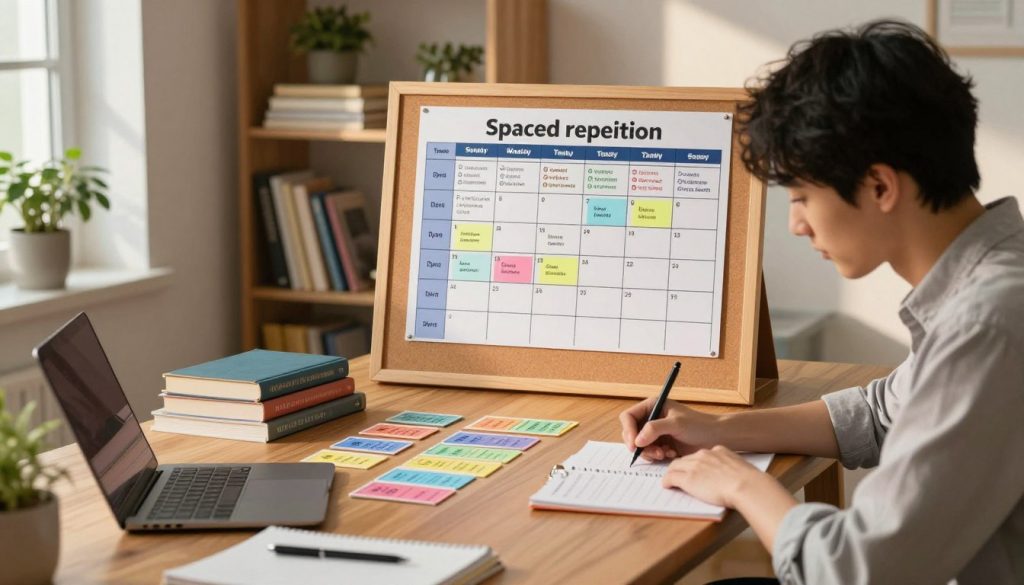
Let’s explore how to add smart review habits to your busy day. By creating a solid study routine, you make learning easier and more consistent. You won’t have to guess what to review or when.
Structuring Your Study Sessions for Maximum Impact
The key to learning well is timing. Instead of long, tiring sessions, break your study into short, focused periods. This keeps your mind sharp and boosts your study motivation.
Review new material soon after learning it, then at longer intervals. This method helps move info from short-term to long-term memory. Consistency is more important than how much you study.
Tools and Systems for Consistent Practice
You don’t need fancy software to start, but some tools can help a lot. The best system is one you use every day. Here are ways to keep your study on track:
- Digital Flashcard Apps: Apps like Anki or Quizlet schedule reviews for you, when you’re about to forget.
- Physical Index Cards: Use the Leitner system with boxes to sort cards by how well you know them.
- Simple Checklists: Keep a paper tracker on your desk to mark off daily review sessions and keep your study routine.
The aim is to keep your study motivation up by making it easy. Seeing your progress helps you stay on track. Start small, stay consistent, and watch your retention improve!
Measuring Cognitive Enhancement and Productivity Boosts
How do you know if your brain is getting sharper? Letter grades don’t always show the full story of your mental growth. We want to help you see your personal growth more clearly.
True productivity boost signs often show up in your daily routine. You might find you’re reading complex material faster than before. Or, you’re connecting dots between subjects that used to confuse you.
Tracking Progress Beyond Grades
Pay attention to how your brain handles cognitive friction. When you struggle less with a tough concept, that’s a big win. You’re training your mind to handle more with ease.
Keep a simple log of these small victories. Did you finish a chapter in half the time? Did you explain a tough theory to a friend without stumbling? These are real signs of a big productivity boost that tests can’t measure.
The Long-Term Benefits of Disciplined Study Habits
This approach builds a foundation for cognitive enhancement that lasts a lifetime. You’re not just memorizing for a test; you’re rewiring your brain. This discipline improves other areas of your life too.
Your patience will grow as you learn to sit with tough ideas. Your problem-solving skills will get sharper because you’ve practiced pushing through. By embracing the grind, you’re investing in a sharper, more capable version of yourself for years to come.
Common Pitfalls When Adopting New Study Habits
We’ve all been there: starting a new study routine with big dreams, only to hit a wall. It’s easy to get excited about self-improvement. But changing everything at once can lead to frustration. Recognizing these common traps early helps keep your momentum going and avoids burnout.

Avoiding Burnout During Intensive Training
The biggest mistake is treating your brain like a machine that never needs a break. Pushing yourself too hard without rest can make your focus crumble. Multitasking is a major culprit, as it drains your mental energy and hinders deep work.
Instead of cramming for hours, pace your sessions. Take short, intentional breaks to let your mind process new information. Protecting your focus from constant interruptions is key to making your new study habits last.
“The capacity to learn is a gift; the ability to learn is a skill; the willingness to learn is a choice.”
The Danger of Over-Simplifying Complex Concepts
It’s tempting to find the “easy way” to understand difficult material. But over-simplifying complex ideas can miss the deep connections that make knowledge stick. If a concept feels uncomfortable or confusing, it’s a sign your brain is working hard.
Don’t shy away from the hard stuff just because it feels slow. Embracing the challenge in your study routine rewires your brain. By staying patient and avoiding skipping the difficult parts, you build a strong foundation for future learning.
| Strategy | Common Pitfall | Better Approach |
|---|---|---|
| Pacing | Cramming for hours | Spaced intervals |
| Focus | Multitasking | Deep work sessions |
| Complexity | Over-simplifying | Embracing struggle |
| Consistency | All-or-nothing | Small, daily wins |
Building better study habits is a journey that requires kindness toward yourself. If you stumble, just adjust your pace and keep moving forward with confidence.
Advanced Techniques for Deep Focus and Brain Training
You’ve laid a solid base, but now it’s time to explore more. Moving past the basics means changing how you see study time. By using effective study techniques, you can turn your study sessions into intense brain training workouts.
Combining Active Recall with Interleaving
Most people focus on one subject for hours, hitting a mental wall. Try mixing different topics or problems in one session. This method, called interleaving, keeps your brain on its toes.
Pairing this with active recall boosts your productivity. You’re not just reading; you’re actively recalling and switching between topics. This keeps your mind sharp and stops boredom from taking over.
Creating an Environment Conducive to Cognitive Load
Your surroundings greatly affect how you handle complex info. For real cognitive enhancement, create a space that’s free from distractions but encourages deep thinking. Clear your desk of anything not related to your task.
Online, use tools to block notifications or limit access to distracting sites. By increasing cognitive load in a controlled way, you train your brain to focus longer. This disciplined method makes every study minute count toward your goals.
| Strategy | Basic Approach | Advanced Approach |
|---|---|---|
| Subject Focus | Single topic block | Interleaved practice |
| Environment | Casual/Distracted | Curated/Deep focus |
| Mental Effort | Passive review | Active retrieval |
| Outcome | Short-term memory | Long-term mastery |
Conclusion
Building a sharper brain is a long-term effort, not a quick fix. You now have the tools to start building your cognitive strength slowly but surely.
Every focused study session helps build your long-term memory. You’re making your mind stronger with each effort.
Be patient with your progress. True growth often happens when you face the biggest challenges.
Keep up these habits to see the best results. You can change how you learn and remember every day.
Enjoy the journey to becoming a better learner. Your brain will thank you with clarity and focus.
What’s the first thing you want to master with these strategies? Share your goals and keep pushing yourself.