
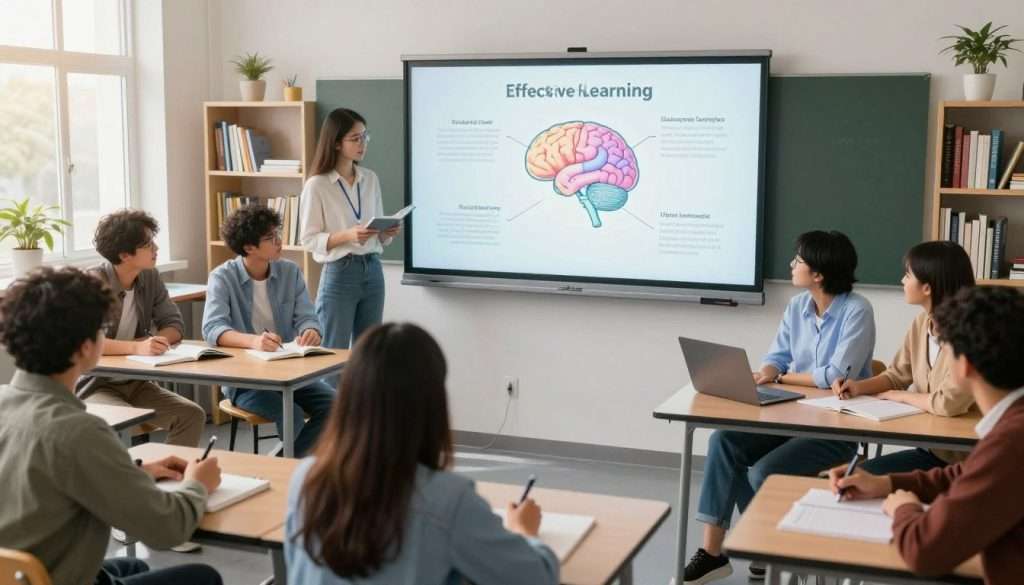
Ever felt like your brain is a sieve, losing all that hard-earned info? We’ve all been there, staring at textbooks until our eyes get tired. But here’s a secret: mastery isn’t a gift you’re born with; it’s a skill you build.
By exploring the science behind effective learning: what every student should know, we can understand how your mind takes in data. Once you get this, studying won’t seem so hard anymore.
We aim to make studying a fun, productive part of your day. Let’s change how you see studying and make your academic journey a series of wins. Ready to improve your mental skills?
Key Takeaways
- Academic success is a skill you can develop, not just a natural talent.
- Understanding brain mechanics makes studying feel less like a chore.
- Small shifts in your daily routine lead to massive improvements in retention.
- You can turn dreaded study sessions into engaging, high-impact experiences.
- Mastering your own mind is the ultimate shortcut to better grades.
The Neuroscience of Learning
Your brain is not fixed; it changes to help you learn. This ability to adapt is key to effective learning strategies. By knowing how your mind works, you can work with it, not against it.
Understanding Neuroplasticity
At the heart of your growth is neuroplasticity. Every time you learn something new, your brain changes. It’s like building a new road; the more you use it, the better it gets.
If you’re a student, your brain is still growing. The part of your brain that controls decisions is still connecting with emotions. This makes staying focused a big challenge. But, knowing about educational neuroscience helps you see this as a normal part of growing.
How Synaptic Connections Form
When you learn something new, your brain’s messengers start firing in new ways. These messengers create connections that help you remember things. The more you practice, the stronger these connections get.
Think of these connections as paths for your memories. If you don’t use a path often, it gets hard to find. But, with regular use, it becomes easier to follow.
| Brain State | Synaptic Activity | Learning Outcome |
|---|---|---|
| Passive Reading | Weak, scattered firing | Low retention |
| Active Practice | Strong, repeated firing | High retention |
| Deep Reflection | Complex, integrated firing | Long-term mastery |
Learning about the neuroscience of learning teaches us to be patient. Your brain needs time to make these connections. Keep practicing, and trust that your brain is working hard for you.
The Science Behind Effective Learning: What Every Student Should Know
We’ve all been there, staring at a textbook for hours but remembering nothing. It’s a cycle that makes us feel like we’re not good at certain subjects. But the truth is, your brain is working just fine. You’re just using the wrong tools.
Learning the science behind effective learning: what every student should know can change your academic life. By changing how you study, you can stop wasting time and start learning for real.
The Difference Between Passive and Active Learning
Most students fall into passive learning. This includes activities like highlighting sentences, reading notes, or watching lectures without thinking. These tasks seem productive but require little brain effort.
Active learning, on the other hand, is key to mastering a subject. It makes your brain work harder to retrieve information. Feeling a bit of mental strain during study is a good sign. It means your brain is building stronger connections.
Why Traditional Rereading Fails
Rereading your textbook might feel safe, but it’s not very effective. This is a fact in cognitive psychology in education. Rereading just makes the text seem familiar, creating an “illusion of competence.”
Your brain thinks you know the material because you recognize the words. But recognition and recall are different. If you can’t explain something without the book, you haven’t really learned it.
| Study Method | Effort Level | Retention Quality | Best For |
|---|---|---|---|
| Passive Rereading | Low | Poor | Initial Overview |
| Highlighting | Low | Low | Organizing Notes |
| Active Recall | High | Excellent | Long-term Mastery |
| Practice Testing | High | Excellent | Exam Preparation |
Cognitive Load Theory and Information Processing
Ever felt like your brain is too busy? It’s a common feeling. But knowing how your mind handles information is key to success. Your brain can only process so much at once.
When you go beyond that limit, learning becomes harder. By managing your mental energy, studying can become easier and more efficient.
Managing Intrinsic and Extrinsic Load
To avoid mental overload, you must understand two types of cognitive load. Intrinsic load is the natural difficulty of a subject. Some topics are just harder to understand.
Extrinsic load comes from your surroundings. This includes things like:
- Background noise or loud music.
- Constant phone notifications.
- Disorganized study materials.
“The brain is not a vessel to be filled, but a fire to be kindled.” — Plutarch
Strategies for Reducing Cognitive Overload
To improve your learning, simplify your approach. One great tip is to focus on one idea at a time. This lets you process and remember information better.
Here are some easy ways to keep your mind clear:
- Break down complex topics into smaller pieces.
- Clear your workspace to reduce distractions.
- Use a timer for focused study sessions.
By reducing distractions and organizing your study space, you can avoid feeling overwhelmed. The goal is to study smarter, not longer. These tips will help you stay focused and keep your mind sharp all semester.
The Power of Active Recall and Spaced Repetition
If you want to stop wasting hours rereading notes, it’s time for a change. Many students see studying as a passive task. But effective learning strategies need you to be active. Retrieval practice means pulling information out of your brain, not just looking at it.
Remember, retrieval practice is for learning, not testing. Don’t grade yourself during these sessions. The goal is to strengthen your brain connections, not to judge your skills. By changing your mindset, you can make studying work for you.

Implementing Active Recall in Daily Study
To start, close your textbook after reading a paragraph and try to recall what you learned. If you can’t explain it, you don’t know it yet. This simple habit makes your brain work harder, helping memories stick.
- Use blank sheets of paper to write down everything you remember about a topic.
- Create questions for yourself while you read, then answer them later.
- Teach the concept to a friend or even an imaginary audience to test your grasp.
The Forgetting Curve and Spaced Repetition Intervals
Your brain naturally forgets information it doesn’t think is important, known as the “forgetting curve.” If you learn something and never review it, you’ll likely forget it in a few days. Spaced repetition helps fight this decline.
By reviewing material at set intervals, you keep it fresh in your mind. This method is better than cramming, helping you prepare for exams without stress.
| Study Method | Effort Level | Retention Quality |
|---|---|---|
| Passive Rereading | Low | Poor |
| Highlighting Text | Low | Low |
| Active Recall | High | Excellent |
| Spaced Repetition | Medium | Superior |
Metacognition: Thinking About How You Think
Most people study without much thought, but the best learners take charge. This is where metacognition comes in. It’s the skill of thinking about your thinking to better your study habits.
By stepping back, you can see what you really learn and what you just glance over. It’s a key tool for moving from just reading to truly mastering material.
Self-Monitoring and Reflection
Self-monitoring is like a mental check-in. Ask yourself if you really get the material or just see the words. If you can’t explain it simply, you haven’t got it yet.
“Learning is not a spectator sport. It requires active engagement and constant self-reflection to truly transform information into knowledge.”
Reflecting after studying is just as crucial as the study time itself. Think about what worked and what didn’t. This turns every mistake into a valuable lesson instead of a frustration.
Adjusting Strategies Based on Performance
If your current method isn’t working, it’s time to try something new. Many students stick to old ways because they’re comfortable. But, top learners know flexibility is essential.
If your scores or quiz results aren’t improving, it’s time to change. You might need to switch from reading notes to flashcards or teaching a friend. Adjusting your study habits based on how you’re doing keeps you moving forward.
The Role of Sleep, Nutrition, and Physical Exercise
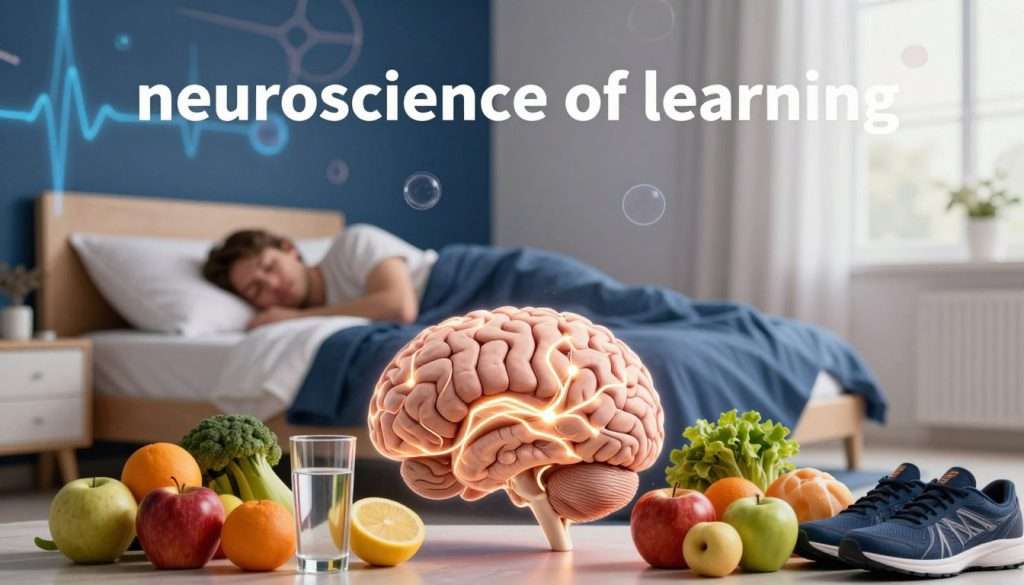
Your brain is like a car engine that needs the right fuel and care to run well. We often focus on study tips, but the neuroscience of learning tells us our body state affects our mind. If you neglect your body, it’s like trying to drive without gas.
Distractions cost a lot. It takes about 25 minutes to get back on track after a break. Keeping your body in top shape helps you stay focused and avoid distractions.
Sleep as a Memory Consolidation Tool
Sleep is not just downtime for your brain; it’s when it does its best work. During deep sleep, your brain moves information from short-term to long-term memory. This is key in educational neuroscience.
“Sleep is the best meditation.”
Without enough sleep, your brain can’t solidify what you learned. You might study hard, but without sleep, it doesn’t stick. Getting enough rest is the best study strategy.
The Impact of Diet on Cognitive Function
Your diet affects your thinking and problem-solving skills. Your brain uses a lot of energy, so choosing the right food is crucial for educational neuroscience success. Healthy fats, complex carbs, and proteins are what your brain needs.
Snacking on sugary foods can lead to a quick energy boost followed by a crash. This makes it hard to focus on tough tasks. Staying energized is key to keeping your brain sharp.
Exercise and Brain-Derived Neurotrophic Factor
Exercise does more than keep you fit; it changes your brain chemistry. It releases a protein called Brain-Derived Neurotrophic Factor, or BDNF. This protein helps your brain cells grow and connect.
Adding regular exercise to your routine is a key part of the neuroscience of learning. Even a short walk can clear your mind and prepare you for studying. Exercise builds a stronger, more resilient brain.
Overcoming Common Learning Myths
Ever thought you were a visual or auditory learner? Science might surprise you. These labels feel right, but they don’t match how our brains work. Cognitive psychology in education shows these labels don’t stand up to close look.
Debunking Learning Styles
The idea that you must match your study method to a specific “style” is a total myth. Your brain is much more flexible than that. Instead of worrying about whether you are a visual learner, focus on dual coding.
Dual coding combines words and images to help your brain store data better. By using both, you create more ways to remember. This method is supported by cognitive psychology in education and is more effective than sticking to one category.
The Truth About Multitasking
Many students believe they’re good at multitasking. You might think checking your phone while reading is productive, but it’s not. Your brain pays a “switching cost” each time you switch tasks, wasting mental energy.
This constant switching stops you from deep learning. Your brain can’t encode information well when interrupted. To improve your study sessions, focus on one task at a time and give it your full attention.
Optimizing Your Study Environment for Focus
Creating the perfect study environment is key to your success. Your surroundings can either boost or hinder your learning. By setting up a space that signals it’s time to work, you can reach new heights of focus.
Minimizing Digital and Physical Distractions
Clutter can mess with your mind. Studies show students focus better in structured spaces than flexible ones. An organized desk and a comfy chair help your brain stay on task.
Digital distractions are just as bad. That phone notification can steal your focus. Try turning off notifications or leaving your phone in another room to stay focused.
The Importance of Deep Work Sessions
Deep work means focusing without distractions on tough tasks. Setting aside time for this practice trains your brain to focus quickly. It’s a crucial tip for mastering complex subjects fast.
Try studying for 50 minutes without breaks, then take 10 minutes to stretch or drink water. By following these tips, your study area becomes a place for deep learning.
Leveraging Digital Tools and Educational Technology
Mastering your study habits in the digital age needs strategy and the right tools. We often get lost in screens, intending to work but end up scrolling for hours. But, with purpose, technology can make learning easier and more efficient.
Using Flashcard Apps Effectively
Flashcard apps are a big help for memorization. Apps like Anki or Quizlet make reviewing easier by using spaced repetition. They automatically show you what you need to work on.
To use these apps well, keep your cards simple. Focus on one concept per card to really understand the material. Using these apps daily can turn small breaks into learning opportunities.
Digital Note-Taking vs. Handwritten Notes
The debate between typing and writing is ongoing. Typing is fast, but handwritten notes help you remember better. Writing helps your brain process and summarize information, which strengthens your study habits.
- Digital Notes: Great for organizing lots of data and quick searches.
- Handwritten Notes: Better for understanding concepts and remembering them.
- Hybrid Approach: Use digital tools for storage and pen-and-paper for brainstorming.
The best method keeps you focused without distracting you. If typing distracts you, try writing for deep work. Your goal is to use technology to support your focus, not to distract you from learning.
Mastering Advanced Memory Techniques
Are you ready to make your brain super powerful? Once you know the basics, you can use advanced memory retention techniques to hold a lot of information. These methods are like a secret power, turning hard facts into clear, memorable pictures in your mind.
The Method of Loci and Visualization
The “Method of Loci,” or memory palace, is a top trick for remembering lots of things. You just imagine a place you know well, like your childhood home. Then, you place things you need to remember in different rooms. When you need to recall, just walk through that space in your mind.
Visualization is key here. Instead of just reading, make funny or big mental pictures for each idea. The crazier the picture, the better your brain will remember it.
Chunking Information for Better Retention
Feeling overwhelmed by too much data? It’s time to chunk. This means breaking down big topics into smaller parts that are easy to handle. Grouping related facts together makes learning easier and less stressful.
When you’re optimizing study techniques, remember your brain can only hold so much. Chunking helps by turning random data into patterns. This is a top way to remember more during busy exam times.
| Technique | Best Used For | Primary Benefit |
|---|---|---|
| Method of Loci | Lists and sequences | Spatial recall |
| Visualization | Abstract concepts | Emotional connection |
| Chunking | Complex data sets | Reduced cognitive load |
By mixing these memory retention techniques, studying becomes fun and creative. Keep trying different methods to find what works best for you.
Conclusion
You now have the tools to unlock your brain’s full potential. We explored how your neurons work and the daily habits that can change your learning. Learning is a lifelong journey, and you have the right tools to enjoy it.
Learning new things every day becomes easier with effective strategies. You don’t have to struggle with old study habits anymore. By using these techniques, you make complex topics stick in your memory.
Want to dive deeper into these ideas? If this guide spoke to you, check out our book “How to Become the Smartest Student in the Classroom”. It offers advanced memory techniques, study routines, and proven methods for success.
There’s no cost or catch. Get your free copy at https://www.studyingmachine.com/free-books/ to start your journey today. We’re excited to see you improve your study habits and achieve your academic goals!