
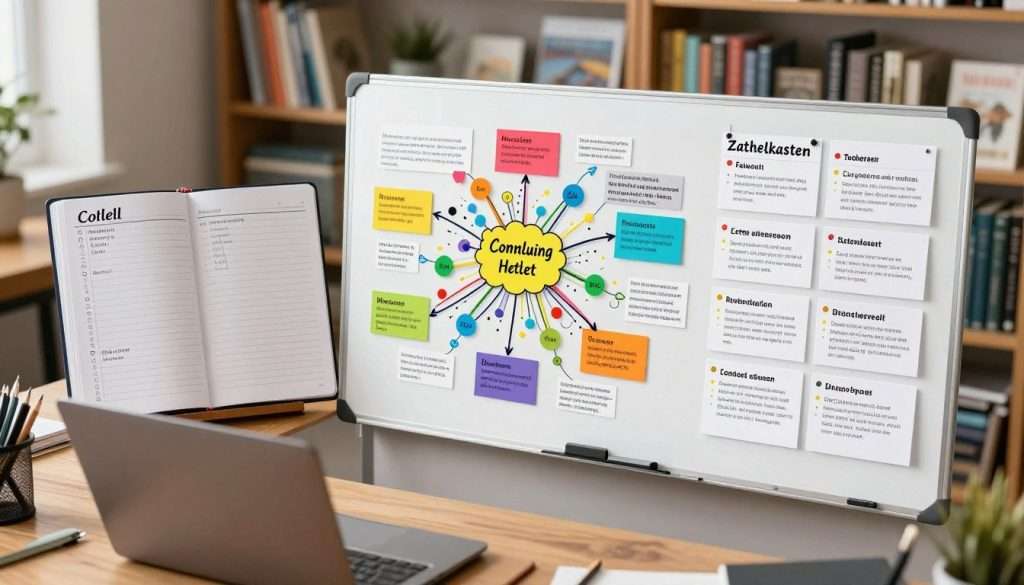
Ever stared at a blank page, feeling overwhelmed by too much information? We’ve all been there. It doesn’t have to be a chore. You can turn your study sessions into a total superpower with the right system.
We aim to help you capture, organize, and remember what you learn. By exploring different styles, you’ll find the perfect fit for your brain. Let’s explore these strategies to see which one works best for you!
Key Takeaways
- Identify which organizational style aligns with your personal learning habits.
- Transform study sessions from stressful tasks into efficient learning experiences.
- Master the art of capturing information without feeling overwhelmed.
- Discover how to retain knowledge longer using proven structural frameworks.
- Build a custom roadmap to boost your academic or professional productivity.
The Importance of Choosing the Right Note-Taking System
Ever felt like your notes are just a bunch of words, but your brain is empty? Many of us spend hours writing down everything our professors say. But then, we realize we haven’t actually learned anything. Finding effective note-taking techniques is more than just keeping a neat notebook. It’s about picking a method that matches your brain and the subject you’re studying.
So, you might wonder, which note-taking method is best for you? The truth is, there’s no one method for everyone. Some subjects need visual maps to show connections, while others require a structured, linear approach to organize complex data.
Why Passive Note-Taking Fails
Trying to write down everything can trap you in passive transcription. Your hand moves, but your mind is on autopilot. This method often leads to several problems:
- Lack of synthesis: You capture data without understanding its meaning.
- Information overload: Your notes become a wall of text that’s hard to review.
- Poor retention: Since you didn’t engage with the material, it fades quickly.
The Cognitive Benefits of Active Engagement
Active engagement turns a dull lecture into a deep learning experience. When you summarize, question, and organize information as you go, you strengthen your brain’s pathways. This is why effective note-taking techniques are key for remembering things long-term.
By picking a method that makes you think critically, you turn study time into mental exercise. You’re not just recording information; you’re creating your own understanding. Choosing the right note-taking method changes how you approach every class. It makes studying less of a chore and more of a journey to mastery.
The Cornell Note-Taking Method: Structure and Clarity
Let’s explore a classic method that makes chaotic lectures organized: the cornell note-taking method. It’s great for students who want to engage with their material deeply.
The Three-Section Layout Explained
This system is simple. You split your page into three parts: a narrow left column for cues, a wide right column for main notes, and a bottom section for a summary.
In class, write down key points in the main area. Use the cue column for questions or keywords that help you remember. The summary section helps you distill the entire page into a few sentences, which aids in long-term retention.
When to Use Cornell for Academic Success
This method is best in fast-paced lectures where you need to capture lots of info quickly. It’s also great for reviewing textbooks before a big exam.
If you feel overwhelmed by your notes, the cornell note-taking method offers the structure you need. It makes studying proactive, not a chore.
Pros and Cons of the Cornell System
Like any tool, it has its advantages and disadvantages. Here’s a quick overview to help you decide if it’s for you:
- Pros: It encourages active recall, keeps notes organized, and speeds up review sessions.
- Cons: It takes a bit of extra time to set up your page and summarize your thoughts after class.
While setting up takes a moment, the clarity you gain is worth it. By using the cornell note-taking method, your notes become a powerful tool for success.
Mind Maps Note-Taking Method: Visualizing Connections
If you’re overwhelmed by linear notes, it’s time for a change. The mind maps note-taking method is perfect for visual learners. It lets you create a colorful, flowing map from a central point.
This method highlights connections you might miss in outlines. It turns complex lectures into clear, radial diagrams. It simplifies tough subjects, making them easier to understand.
The Science Behind Radial Thinking
Our brains don’t organize info in straight lines. We think in webs, jumping from idea to idea. Mind maps reflect this by starting with a central idea.
From there, you add subtopics and details. This structure mirrors how our neurons connect. It engages both sides of your brain, leading to better memory retention than writing.
Creating Effective Mind Maps for Complex Topics
Start with a blank sheet of paper, turned sideways. Write your main topic in the middle and circle it. Then, draw thick branches for your main categories.
Use thinner branches for smaller details and don’t be afraid to use colors or simple sketches. Adding images helps solidify the information in your mind. Keep your branches short and use keywords only.
Pros and Cons of Mind Mapping
Mind mapping has its advantages and disadvantages. It’s great for brainstorming and seeing connections. But, it might not capture every word in a fast-paced lecture.
- Pros: Excellent for visual learners, boosts creativity, and makes reviewing notes faster.
- Cons: Can get cluttered with too much info, and needs more space than a notebook.
The mind maps note-taking method is a valuable tool for studying. Try it for complex topics to make them fun and manageable!
Zettelkasten Note-Taking Method: Building a Knowledge Base
The zettelkasten note-taking method turns studying into a creative conversation with your future self. It’s like building your own personal wiki. Every note is a building block for future insights.
It’s not just storing information. It’s creating a living web of knowledge that gets smarter with use.
The Philosophy of Atomic Notes
The core idea is atomic notes. Each note should have only one idea or concept. This makes notes easy to organize and find later.
Writing an atomic note forces you to simplify complex information. This helps you go beyond memorization to true synthesis. It keeps your notes clear and organized.
Linking Ideas for Long-Term Retention
Connecting your notes is where the magic happens. By linking ideas, you create a network of thought. This interconnectedness is key to deep learning.
Revisiting a note is not just reading a fact. It’s exploring a path of related concepts. This constant reinforcement helps you retain information and sparks new ideas.
Pros and Cons of the Zettelkasten Approach
This system is rewarding but requires discipline. You must be consistent with tagging and linking. Here’s what you can expect.
| Feature | Advantage | Challenge |
|---|---|---|
| Knowledge Growth | Builds a cumulative database | Requires regular maintenance |
| Idea Synthesis | Connects disparate topics | Steep initial learning curve |
| Retrieval | Easy to find related concepts | Needs consistent tagging |
The zettelkasten method is great for building a robust knowledge base. It might take time to set up. But seeing patterns across your studies is worth it.
The Best Note-Taking Methods Compared: Cornell, Mind Maps, and Zettelkasten
Finding the right way to take notes is key to doing well in school. Looking at The Best Note-Taking Methods Compared: Cornell, Mind Maps, and Zettelkasten can be overwhelming. We aim to simplify this so you can focus more on learning.
Comparison Table of Key Features
We’ve broken down the main features of each method. This comparison of note-taking methods shows how they work in a study setting.
| Method | Primary Strength | Best For | Complexity |
|---|---|---|---|
| Cornell | Structured Review | Classroom Lectures | Low |
| Mind Maps | Visual Connections | Brainstorming | Medium |
| Zettelkasten | Knowledge Linking | Long-term Research | High |
Which Method Suits Your Specific Goals
For exams, the cornell note-taking method is great. It organizes your notes and makes reviewing easy. You get a summary that helps you remember important facts.
For creative projects, the mind maps note-taking method is better. It lets you see how ideas connect visually. It’s perfect when you need to see the big picture.
For building a knowledge base, the zettelkasten note-taking method is top-notch. It turns your notes into a network of ideas. It’s great for thesis writers or those who want to link ideas across subjects.
Efficiency vs. Depth: A Comparative Analysis
Finding the right balance between speed and depth is crucial. You might prefer the efficiency of Cornell for quick notes. But for depth and long-term retention, Zettelkasten is better.
You don’t have to stick to one method. Many students mix and match for the best results. Try each for a week to see what works best for you.
Evaluating Your Personal Learning Style
Ever wondered why some study methods are easy while others are hard? It’s because everyone learns differently. When you match your study style to your brain, picking the right method becomes easier.
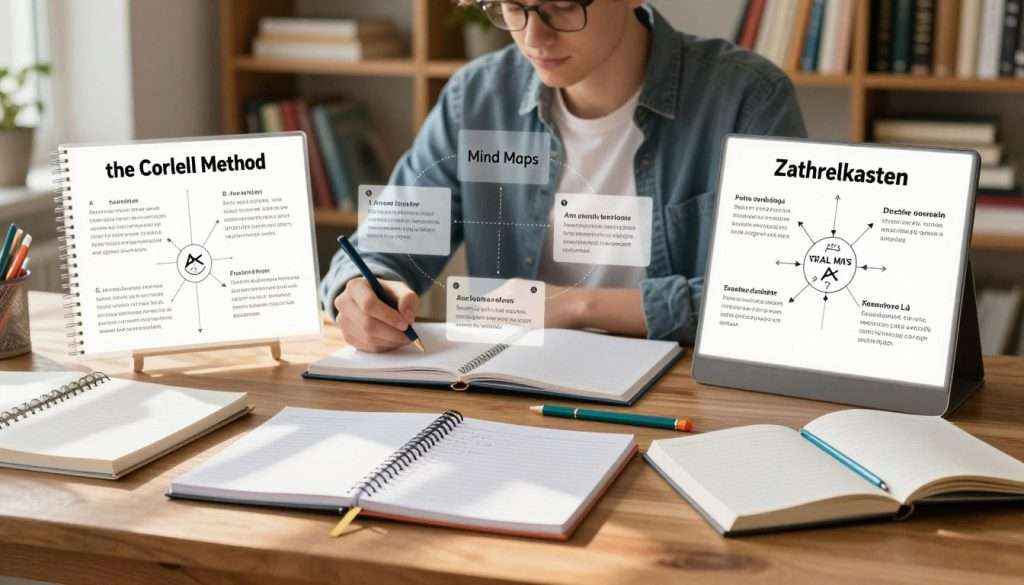
Wondering which note-taking method is best? It’s all about your habits. We’re here to help you find out if you’re a visual, structured, or research-based learner. By knowing your style, you’ll find a system that’s easy to keep up with.
Identifying Your Strengths as a Learner
Start by looking at how you naturally process new info. Do you doodle in your notebook or keep lists? Your natural tendencies are your greatest assets.
“The secret to success is learning how to use your mind, not just how to fill it.”
Think about your study sessions. If you love making colorful maps, you’re a visual learner. If you prefer organized notes, you might like a structured approach.
Matching Note-Taking Techniques to Subject Matter
The best method can change with each class. Science and literature need different strategies. Being flexible is key to success.
Complex topics need a system that lets you think freely. Fast-paced lectures might need a quick, structured outline. Trying different styles will show you which method works best for you.
There’s no one “right” way to take notes. The goal is to create a personalized toolkit that fits your needs. By matching your method to the subject, studying becomes enjoyable and effective.
Digital Tools for Implementing Note-Taking Strategies
Let’s look at the top digital tools to master your note-taking systems. The right tech can be a huge help. You don’t need expensive software to succeed. Just find a tool that feels natural and keeps your ideas organized.
Software for Cornell Notes
The cornell note-taking method needs a clean layout. Apps like Microsoft OneNote or Notion are great. They let you make custom templates and keep your notes organized.
Best Applications for Mind Mapping
The mind maps note-taking method is great for visual learners. Tools like MindMeister or XMind make it easy to create diagrams. You can zoom in or out to see your ideas clearly.
Tools for Managing a Zettelkasten System
The zettelkasten note-taking method needs a tool that links ideas well. Obsidian or Roam Research are perfect. They help you create a network of knowledge.
| Method | Primary Strength | Recommended Tool | Best For |
|---|---|---|---|
| Cornell | Structured Review | Notion | Lectures |
| Mind Maps | Visual Connections | MindMeister | Brainstorming |
| Zettelkasten | Long-term Retention | Obsidian | Research |
Choosing a digital note-taking method depends on your style and needs. Try one tool for a week to see if it works for you. The best app is the one you enjoy using every day!
Overcoming Common Challenges in Note-Taking
Ever feel like your brain is a browser with too many tabs open while you try to study? We’ve all been there, staring at a mountain of scribbles and feeling like we’re not learning anything. It’s perfectly normal to feel overwhelmed when information piles up.

Dealing with Information Overload
The secret to staying afloat is learning to filter the noise. Instead of writing down every word, focus on the core concepts and big ideas. Many students find digital note-taking methods helpful, as they make organizing thoughts easier.
Use bullet points or shorthand to keep things simple. If you’re drowning in data, take a step back. Ask yourself: “What’s the one thing I need to remember from this?” Simplifying your process keeps your focus sharp.
Maintaining Consistency in Your Study Routine
Consistency is key to academic success. You don’t need to spend hours daily to see results. Instead, build small, sustainable habits that fit into your daily life.
Effective note-taking strategies become natural when they’re part of your routine. Review your notes within twenty-four hours of a lecture to keep information fresh. This habit prevents cramming and helps your knowledge grow steadily.
Remember, being consistent is better than being perfect. Stick to your digital note-taking methods, and studying will become less of a chore and more rewarding.
Integrating Multiple Methods for Maximum Retention
Why stick to just one method? Mixing and matching can be the best way. This approach makes your system as flexible as your brain.
Mastering effective note-taking techniques means you can use many formats. Layering these strategies helps you understand and remember better. It’s about finding what works for you.
Combining Visual and Linear Note-Taking
Linear notes, like the Cornell method, are great for lectures. They help you keep up with fast speakers. But, adding visuals can make your notes even better.
Use a mind map to review your notes. This visual synthesis helps you see the big picture. It’s a great way to improve study skills with note-taking by using both sides of your brain.
The Hybrid Approach to Complex Research
Deep research needs a layered strategy. Start with an outline to organize your sources. Then, use atomic notes for individual concepts.
This method helps connect complex ideas without feeling overwhelmed. By combining these tools, you build a growing knowledge base. Improving study skills with note-taking gets easier when you mix methods.
The goal is to make studying feel natural. Don’t be afraid to try different combinations. Your brain will appreciate the clarity!
How to Become the Smartest Student in the Classroom
Becoming the smartest student is not just about being naturally good at things. It’s about having the right system. Good note-taking strategies are a great start, but they’re just one part. To really shine, you need a complete plan that connects everything.
Beyond Note-Taking: The Full Study System
Think of your education as a top-notch engine. Your notes are the fuel, but you also need the right parts to keep it running well. Improving study skills with note-taking is key, but you also need memory tricks and daily routines to keep learning fresh.
We think learning should be fun and effective, not a chore. By creating a complete study system, you avoid cramming and master your subjects with confidence. When your study habits match how your brain learns, even tough topics become easier.
Accessing Your Free Resource for Academic Mastery
Ready to level up your learning? We’ve got something amazing for you. Our free book, How to Become the Smartest Student in the Classroom, has everything you need. It includes memory hacks and daily routines of top performers.
There’s no cost and no catch—just real advice to change your study habits. Get your free copy here: https://www.studyingmachine.com/free-books/. Start your journey to academic mastery today and see how much more you can do with the right tools.
Conclusion
You now have the tools to change how you take notes. We looked at the Cornell method, mind maps, and Zettelkasten. This guide is your roadmap to success in school.
The best method is the one you use every day. Don’t stress about finding the perfect method at first. Try out these techniques to see what works for you.
Your study habits should make life easier, not harder. We hope you’re ready to mix and match these strategies for your goals. Finding the right method for your subjects is key.
Make studying enjoyable. You have the tools to learn better, starting today. Grab your pen or open your app and start building your knowledge today!