
Have you ever sat through a lecture, scribbling down every word, only to realize later that you didn’t actually learn a thing? We have all been there. It is time to stop the cycle of passive transcription and start learning with intention.
We are diving into the age-old debate of how to capture information effectively during your studies. By exploring the Cornell Notes vs. Mind Maps: Which One Is Better? question, we want to help you find a system that actually boosts your academic performance.
Think of this guide as your personal roadmap. Whether you need structure for dense history lectures or creative freedom for brainstorming sessions, we will help you pick the right tool for every single one of your classes. Let’s turn your study sessions into an enjoyable and effective experience together!
Key Takeaways
- Move away from mindless transcription toward active engagement.
- Understand the unique strengths of structured versus visual learning.
- Learn how to match your study method to specific course requirements.
- Boost your long-term retention with proven organizational techniques.
- Discover how to customize these systems to fit your personal learning style.
The Core Philosophy of Note-Taking
Most of us still use the same note-taking methods from middle school. This might be holding us back. It’s time to change how we capture information because our brains need a better strategy than just writing down every word.
Why Note-Taking Matters for Academic Success
Your notes are the foundation of your academic journey. When you see note-taking as a mindful practice, you change how you process lectures. The right note-taking methods can make a huge difference in your grades.
Many students fall into the trap of passive transcription. They try to write down everything the professor says. But this rarely leads to deep understanding. Instead, focus on capturing the core concepts that matter for your success.
The Evolution of Information Retention
Learning has changed a lot over the years. We’ve moved away from simple rote memorization. Today, we focus on active synthesis of ideas, connecting new information with what we already know.
By updating your note-taking methods, you can make your study habits better. This shift helps you go from just remembering facts to applying them in real-world scenarios. Here’s how these approaches differ:
| Approach | Primary Goal | Cognitive Effort |
|---|---|---|
| Rote Memorization | Short-term recall | Low |
| Active Synthesis | Deep understanding | High |
| Modern Note-Taking | Long-term retention | Moderate |
Understanding the Cornell Notes System
Ever felt overwhelmed by too many lecture notes? The cornell notes system could be your new ally. It’s a classic for a reason, offering a structured way to organize your thoughts during lectures. By using these organizational techniques, you can turn a chaotic classroom into a clear roadmap for success.
The Three-Section Layout Explained
This method is simple yet effective. You divide your page into three areas to keep your thoughts organized.
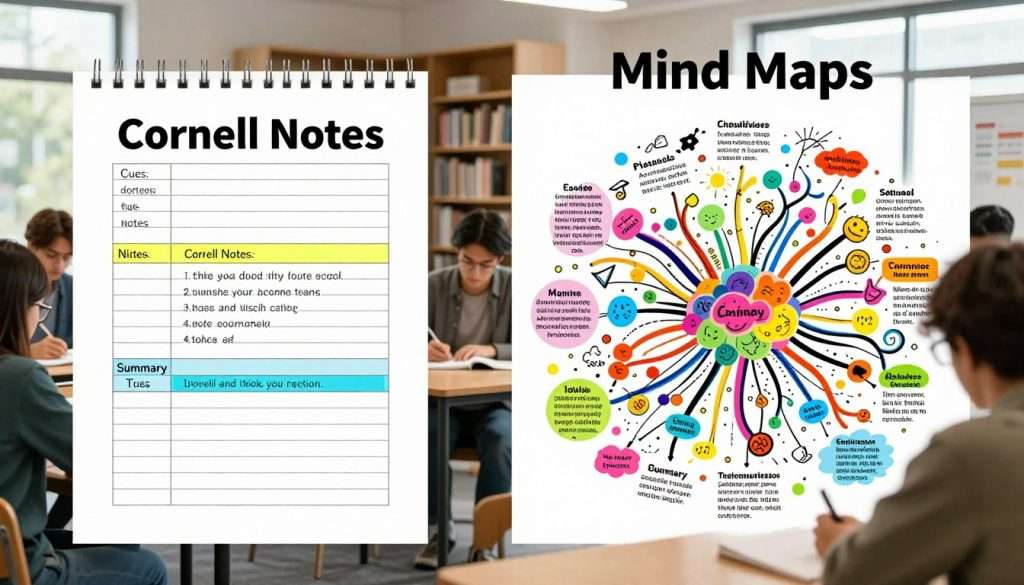
The largest area, about 70% of the page on the right, is for your main notes. The narrow left column is for cues. The bottom strip is for a summary. This layout helps you focus on what’s important.
| Section | Purpose | Size |
|---|---|---|
| Main Notes | Detailed lecture content | 70% |
| Cue Column | Keywords and questions | 30% |
| Summary | Big picture synthesis | Bottom strip |
The Process of Cueing and Summarizing
After taking notes, the real magic happens during review. You write down key terms or questions in the cue column. This turns your page into a personal quiz bank for later.
“The secret of getting ahead is getting started, and the secret of getting started is breaking your complex tasks into manageable, organized pieces.”
Then, fill in the summary section after the lecture. This helps you synthesize the information in your own words. It’s a reliable organizational technique for managing a lot of information.
Exploring the Mind Mapping Technique
Standard note-taking can get dull. It’s time to try something new. Mind maps are a creative way to organize your thoughts. They keep your brain active and engaged.
Visualizing Connections and Hierarchies
This method starts with a central idea. Then, you branch out to related topics. It’s a clear way to see how everything connects.
By mapping your ideas, you see how they relate. This layout helps you grasp complex information easily. It’s a visual way to understand complex ideas.
The Role of Radiant Thinking
Radiant thinking is key to this technique. It mirrors how our brains work. When you use mind maps, you’re reflecting your own thought process.
Make your study sessions creative by adding colors and symbols. These visual learning tools help you remember information better. Your brain loves patterns and images. Try it and see how your notes come alive!
Cornell Notes vs. Mind Maps: Which One Is Better?
Many people wonder about the Cornell Notes vs. Mind Maps: Which One Is Better? debate. The answer is not simple. It depends on what your course needs. A comparison of cornell notes and mind maps shows that your choice should match your learning goals.
Direct Comparison of Methodologies
The Cornell method uses a structured layout to organize information. A 2024 study showed that students using it scored 28% higher on exams. It’s great for remembering specific facts and details from lectures.
Mind maps, on the other hand, focus on radiant thinking and visual connections. They start with a central idea and branch out. This method is better for showing how different ideas are connected in a web.
When to Choose Linear vs. Non-Linear
Use Cornell notes for dense, lecture-heavy material. They help you stay organized when your professor covers a lot of ground quickly. They’re perfect for fact-heavy subjects where order is key.
But, choose mind maps for brainstorming or understanding complex relationships. They’re great for seeing the “big picture.” By knowing the strengths of each, you can study more effectively.
Comparing Structural Approaches
Choosing the right way to organize your notes is like picking the perfect tool for a DIY project. You wouldn’t use a hammer to paint a wall, and you shouldn’t use a structure that fights against your natural learning style. By looking at a comparison of cornell notes and mind maps, we can help you find the system that makes your brain feel most at ease.
The Rigidity of Cornell Notes
The Cornell Method is famous for its strict, hierarchical layout. It acts as a reliable framework for students who need to capture specific dates, complex formulas, or legal cases in a logical order. This level of structure is a huge asset when you are preparing for fact-heavy examinations.
“Structure is not a cage; it is a scaffold that allows your thoughts to climb higher.”
Because it forces you to categorize information into cues and summaries, it keeps your study sessions focused. These organizational techniques are perfect for those who thrive on clarity and want to ensure no detail gets lost in the shuffle.
The Flexibility of Mind Maps
On the flip side, mind maps offer a refreshing sense of freedom. Instead of moving from top to bottom, you start in the center and branch out in every direction. This non-linear approach allows you to reorganize your thoughts as you discover new connections between concepts.
If you are a visual learner, you will love how this method lets you see the “big picture” at a glance. It is the ultimate tool for brainstorming and creative problem-solving. When you need to synthesize complex relationships, the flexibility of a mind map helps you map out your own unique understanding of the material.
Cognitive Benefits and Learning Styles
Your brain absorbs knowledge in its own special way. Knowing your learning styles is key to a better study routine. When you match your note-taking to how your mind works, studying becomes fun.
It’s better to work with your brain than against it. The right method makes studying more effective and less stressful.
Processing Information for Auditory and Verbal Learners
If you learn best by hearing or reading, the Cornell system is for you. It’s designed like lectures, making it great for capturing and organizing spoken words.
“The secret of getting ahead is getting started,” Mark Twain said. A structured layout helps your brain break down complex information into easy-to-digest pieces.

Engaging Visual and Spatial Intelligence
Mind mapping is a game-changer for those who think in pictures. These visual learning tools let you map out ideas freely. This helps your brain grasp the big picture, not just facts.
Students who use mind mapping for complex subjects remember 35% more. They also understand complex relationships 40% better.
By drawing connections and using colors, you create strong memory paths. This spatial approach makes abstract ideas easy to follow.
Best Use Cases for Cornell Notes
Ever felt overwhelmed by a fast-talking professor? You’re not alone. Capturing every word in a lecture is a surefire way to burn out. That’s why cornell notes are a top choice for students aiming to stay on top.
Lecture-Based Learning Environments
In a packed auditorium, speed is key. Cornell notes let you record info in a structured, linear way. You can write down key ideas on the right side while listening.
This method keeps your brain active, not just recording like a tape. By focusing on main points, you create a useful record for later. It’s ideal for organizing thoughts during long, fast-paced lectures.
Preparing for Fact-Heavy Examinations
When exams are near, you need more than just reading notes. The cue column in your cornell notes serves as a study guide. Cover your main notes and use cues to quiz yourself on facts, dates, or definitions.
This active recall is incredibly effective for memorizing dense material. If you can answer your cue column questions, you’re likely exam-ready. It turns reviewing into a practice session that boosts confidence.
| Study Scenario | Primary Benefit | Best Method |
|---|---|---|
| Fast-paced Lectures | Efficiency | Cornell Notes |
| Creative Brainstorming | Flexibility | Mind Mapping |
| Fact-Heavy Exams | Self-Testing | Cornell Notes |
| Complex Relationships | Visualization | Mind Mapping |
Best Use Cases for Mind Maps
Ever felt like your brain is a giant web of ideas? Sometimes, looking at the big picture helps. That’s where mind maps come in as a creative tool for studying.
Brainstorming and Creative Problem Solving
Stuck on a tough topic? Linear lists can feel confining. Mind maps let your thoughts flow freely, perfect for brainstorming. Start with a central idea and explore new areas.
This method is incredibly effective for coming up with new ideas without worrying about order. It focuses on connections, making studying a fun, visual journey.
Synthesizing Complex Concepts and Relationships
Some subjects are too complex for neat columns. Mind maps offer clarity when understanding relationships between theories or events. They show the hierarchy of information at a glance.
We find this technique great for mapping complex relationships. Drawing lines between related concepts creates a mental roadmap for easier recall during exams. It’s a top strategy for mastering big-picture thinking.
Digital Tools for Modern Note-Taking
It’s easier than you think to bring your study game into the digital age. You don’t have to stick to physical notebooks. Technology can save you time and make studying more efficient and easy to access.

Software for Structured Cornell Notes
If you like the classic cornell notes setup, many apps can help you keep it tidy. These tools let you search your notes quickly, saving you time.
- Notion: Offers flexible templates that mimic the traditional three-section layout perfectly.
- Microsoft OneNote: Provides a digital canvas where you can easily organize notes into notebooks and sections.
- Evernote: Great for tagging and searching through your lecture notes across all your devices.
Applications for Dynamic Mind Mapping
Digital mind maps are perfect for those who love to see connections. They offer more freedom than paper, letting you easily change your ideas as they grow.
Apps like MindMeister, XMind, and Coggle are great for this. They let you quickly reorganize complex ideas, keeping your study space neat and organized. Here’s why they’re so useful:
- Instant Reorganization: Move entire branches without needing to erase or redraw your work.
- Multimedia Integration: Add images, links, and files directly into your nodes for a richer experience.
- Cloud Syncing: Access your creative brainstorming sessions from your phone, tablet, or laptop anywhere you go.
Overcoming Common Note-Taking Challenges
Ever felt like your notes are just a mess of words? You look at them, but they make no sense. It’s frustrating, but you’re not alone.
Good news: you can change your study habits with better effective note-taking strategies. Focus on quality over quantity. This makes learning easier and less tiring.
Avoiding the Trap of Passive Transcription
Passive transcription means writing down every word from a lecture. Your hand moves, but your mind is on autopilot. This method doesn’t help you remember things well.
Instead, try to summarize what you hear in your own words. This helps your brain create stronger connections. It’s a simple but powerful effective note-taking strategy.
Managing Information Overload
When a teacher talks fast, it’s easy to feel overwhelmed. You don’t need to write down every detail. Focus on the main points and evidence.
Use bullet points or shorthand to keep your notes short and organized. If you’re struggling, focus on the most important ideas. Learning these effective note-taking strategies will help you stay calm and focused.
Remember, your notes are for your future self. Keep them clear, prioritize what’s important, and don’t be afraid of empty space. You can do it!
How to Master Your Study Routine
Creating a good study routine is about using the right tools and strategies. It’s not just about the pen or app you choose. It’s about finding a rhythm that makes learning easy.
By improving your study techniques, you can turn hard study times into clear moments. This makes learning more enjoyable and effective.
Integrating Advanced Memory Techniques
To keep your knowledge, you need more than just reading. Use active recall and spaced repetition to challenge your brain. These methods help you remember information better.
Adding effective note-taking strategies to these habits makes learning easier. Your brain gets better at recognizing patterns. This makes hard topics seem simpler over time.
Being consistent is key. It turns small efforts into big academic wins.
Accessing Professional Study Resources
At times, you need extra help to start your study routine. High-quality resources can save you a lot of time. Workshops or guides can be a big help.
| Study Habit | Impact Level | Time Required |
|---|---|---|
| Active Recall | High | Low |
| Spaced Repetition | High | Medium |
| Passive Reading | Low | High |
Grab Your Free Copy of How to Become the Smartest Student in the Classroom
Want to learn more? Our free book, How to Become the Smartest Student in the Classroom, is a complete guide. It covers memory techniques and study routines that work. There’s no cost or catch.
Get your free copy here to change your academic life. We believe you can master any subject and enjoy learning!
Conclusion
Choosing the right path for your education is a personal journey. You don’t have to stick to one way of taking notes. Mixing up your methods keeps your brain sharp and ready for new challenges.
We encourage you to try these strategies in your next lecture. You might find that combining visual maps with structured summaries works best for you. It’s all about finding what makes the material stick.
Your success in school depends on adapting your study techniques. Use tools like Notion or MindMeister to try different formats. Every session is a chance to improve your approach and make learning less of a chore.
What will you try in your next class? Share your favorite setup with a study buddy or try a new digital tool today. We’re excited to see how you make your habits a powerful engine for growth!