
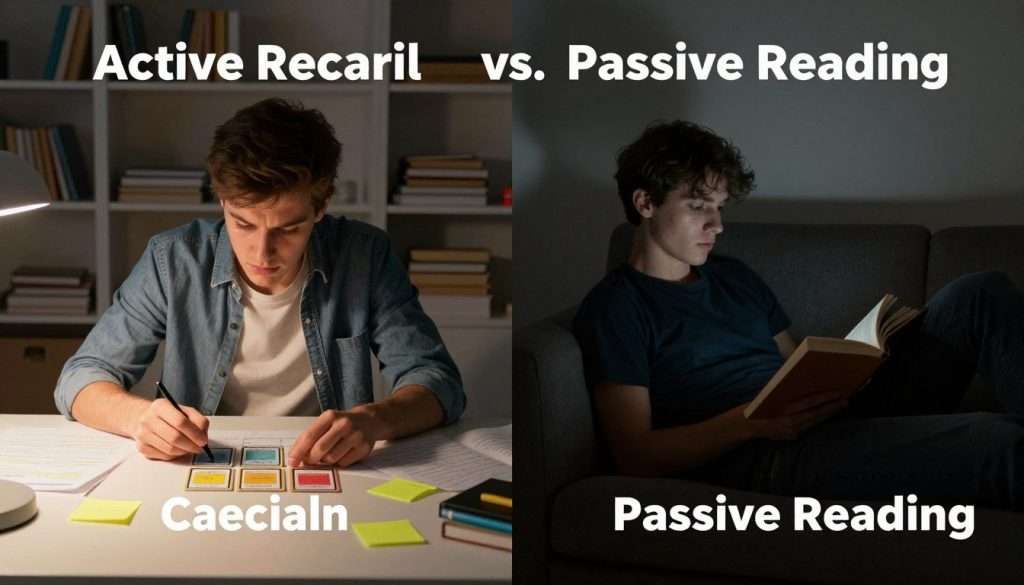
Ever spent hours over a textbook and forgot most of it? It’s a common problem. Just looking at words doesn’t really teach you.
We often think we know something just because we’ve seen it before. But that’s not true learning. This is the main difference between active recall vs. passive reading.
Studies show a big difference in how well we remember things. Students who actively recall information remember 57% of it. Those who just review it remember only 29%. That’s a big win for your brain!
To really learn, you need to change how you study. We’ve got the best study tips to help you. Want to learn more? My free book How to Become the Smartest Student in the Classroom has all you need. No cost, no catch. Get your free copy here.
Key Takeaways
- Passive review creates an illusion of competence rather than true mastery.
- Retrieval practice significantly boosts long-term information retention.
- The 57% retention rate proves that testing yourself outperforms simple re-reading.
- Small changes in daily routines lead to massive improvements in exam performance.
- Focusing on output rather than input transforms how you process complex topics.
Why Active Recall vs. Passive Reading: Why Your Current Study Method is Failing Matters
We’ve all been there: staring at a page that seems clear, yet we can’t recall anything during an exam. It’s a frustrating experience that makes us doubt our intelligence. But, the issue is often not our brains; it’s our study methods.
The difference between exposure and retrieval
Many students mix up exposure with learning. Reading a textbook is just exposing your brain to info. It looks like you’re doing something, but it’s not really learning.
True learning happens through retrieval. This means pulling info out of your memory without looking at the source. If you can’t explain something without the book, you haven’t learned it yet.
Why familiar material can create false confidence
When you read a chapter again, it feels familiar. Your brain recognizes the words, making you think you understand it well. This is called the illusion of competence.
This false confidence makes you stop trying. You think you’ve got it, but you’re just recognizing patterns. This is why many students feel ready for a test, only to freeze when they see the questions.
How inefficient study methods waste time
Using passive learning strategies wastes a lot of time. You might spend hours highlighting and rereading, but you’re not really retaining info. It’s like running on a treadmill—lots of effort, but no real progress.
Switching to active recall vs. passive reading can cut your study time in half. You’ll get better results by working smarter, not harder.
| Feature | Passive Reading | Active Recall |
|---|---|---|
| Primary Goal | Information Exposure | Information Retrieval |
| Mental Effort | Low (Comfortable) | High (Challenging) |
| Retention Rate | Low (Short-term) | High (Long-term) |
| Confidence Level | False (Illusion) | Accurate (Evidence-based) |
If this article hit home, check out my free book How to Become the Smartest Student in the Classroom. It offers memory techniques, study routines, and strategies that work. No cost, no catch. Get your free copy here.
What Passive Reading Actually Does to Your Memory
We often think we learn by reading the same thing over and over. But, our brains might be tricking us. When we read the same page many times, it starts to feel familiar. We think we’ve learned it because we recognize the words. But, this is a common trap that can hurt our memory improvement.
How rereading creates a feeling of fluency
Rereading makes the material seem easier to understand. Your brain gets better at recognizing words, not really learning the content. This is a big problem for memory improvement.
It’s like knowing a catchy song by heart. You might remember the lyrics, but you don’t really get the music. True retention techniques need you to step away and really think about the material.
Why highlighting and underlining rarely prove understanding
Many of us highlight our textbooks with colorful markers. It seems like we’re doing something important. But, it’s often just busy work.
Highlighting and underlining are just ways to mark information. They don’t really test your understanding. To really learn, you need to actively engage with the material.
When passive reading can still support learning
Passive reading isn’t completely useless. It’s best as a quick introduction to a new topic. It helps you get a sense of the chapter before you dive in.
Think of passive reading as a warm-up before you really study. Once you have a basic idea, close the book and start practicing what you’ve learned. For more tips, check out my free book How to Become the Smartest Student in the Classroom. You can get it here.
| Study Method | Mental Effort | Result |
|---|---|---|
| Passive Reading | Low | Temporary Recognition |
| Highlighting | Low | False Confidence |
| Active Recall | High | Deep Retention |
How Active Recall Strengthens Cognitive Recall
Your brain is like a muscle that needs a heavy workout to grow stronger. Just reading a page doesn’t do much for your brain. To really improve your memory, you need to actively pull information out of your head.
Retrieving information instead of recognizing it
There’s a big difference between recognizing a fact and truly knowing it. When you reread a textbook, you might feel like you know it. But this feeling can be misleading and prevent true cognitive recall.
Instead, try to explain concepts from memory. This is the heart of active learning. By testing yourself, you move from just looking to actively learning.
How effortful recall improves long-term retention
The harder your brain works to remember something, the stronger that memory gets. This is a top retention technique for students. Struggling to remember something is actually building a stronger neural pathway.
Think of it like clearing a path through a dense forest. The first time, it’s hard and slow. But every time you try to remember, the path gets wider and easier.
The role of forgetting and correction in memory improvement
Many students fear forgetting, but it’s crucial for learning. When you try to recall something and fail, you find a gap in your knowledge. This is when your brain is most ready to learn.
After checking your notes and correcting your mistake, you solidify the correct information. This cycle of trying, forgetting, and correcting is key to active learning. For more on this, check out my free book How to Become the Smartest Student in the Classroom at https://www.studyingmachine.com/free-books/.
| Feature | Passive Reading | Active Recall |
|---|---|---|
| Mental Effort | Low | High |
| Memory Trace | Weak | Strong |
| Feedback Loop | None | Immediate |
| Outcome | False Confidence | Mastery |
Active Recall vs. Passive Reading: The Key Differences
Many students get confused between the comfort of passive reading and the effort of cognitive recall. Reading might seem like you’re learning, but it doesn’t stick when you need it most. Knowing the difference between active recall vs. passive reading is key to making your study time count.
Retention and long-term memory
Research shows a big difference in how these methods affect your brain. Students who actively recall information can remember up to 57% of it. This is compared to just 29% for those who only reread passively.
Your brain treats information differently when you have to recall it. Long-term memory is built through the effort of recalling, not just recognizing.
Study time and mental effort
It might feel like you’re going slower when you try to recall without notes. That’s okay! Passive reading might be easy, but it doesn’t really teach you much.
- Active Recall: Needs a lot of mental effort but leads to deep understanding.
- Passive Reading: Feels easy but results in shallow memory.
Feedback, accuracy, and identifying knowledge gaps
Active methods offer immediate feedback. When you try to explain something from memory, you quickly see where you’re unsure.
Passive reading hides these gaps, making the text seem familiar. By actively recalling, you get a clear picture of what you really know versus what you just recognize.
Why difficult recall is not a sign that the method is failing
It’s tempting to give up when recalling is hard. But, that struggle is your brain getting stronger.
About 30% of the effort in studying is actually the most productive part. If you want to dive deeper, my free book How to Become the Smartest Student in the Classroom offers a full system. It includes memory techniques, study routines, and strategies that work. No cost, no catch. Get your free copy here.
| Feature | Passive Reading | Active Recall |
|---|---|---|
| Mental Effort | Low | High |
| Retention Rate | Low (~29%) | High (~57%) |
| Knowledge Gaps | Hidden | Exposed |
Signs Your Current Study Method Is Not Working
Ever feel like you’re running on a treadmill while studying? You’re putting in all the effort but not moving forward. This is a common problem when our study methods are too comfortable. We often think we know something just because it feels familiar, but this can be a trap.
Needing to reread the same pages repeatedly
If you keep reading the same paragraph over and over, you’re stuck. Your eyes might be moving, but your brain is not. It’s time to switch to effective study habits that really challenge your mind.
Recognizing answers but failing to produce them independently
Ever thought you knew an answer but couldn’t write it down? This is because you’re relying on recognition instead of recall. Recognition is easy, but it doesn’t mean you can remember the information when it counts.
Forgetting material during quizzes and exams
It’s tough to study for hours and then forget everything when you see the test. This usually means your brain didn’t have to work hard to remember the information. To do better, practice recalling information without looking at your notes.
Spending hours studying without measurable progress
If you’re studying a lot but not seeing any improvement, your method isn’t working. You might be busy, but you’re not learning. Using better study tips can make your study time more effective.
| Indicator | Passive Approach | Active Mastery |
|---|---|---|
| Confidence Level | High (due to familiarity) | Measured (based on results) |
| Memory Retention | Short-term only | Long-term storage |
| Study Methods | Rereading and highlighting | Retrieval and testing |
If this article hit home, check out my free book How to Become the Smartest Student in the Classroom. It offers memory techniques, study routines, and strategies that really work. No cost, no catch. Get your free copy here.
How to Turn Class Notes and Textbooks Into Active Recall Prompts
Your class notes are more than just facts. They can be your path to mastering any subject. By changing how you view them, you can turn them into learning strategies that challenge your brain. This shift is the essence of active learning.

Converting headings into questions
Most students see textbook headings as labels. But, try making each heading into a question before reading the next section. For instance, “Photosynthesis” becomes “How does photosynthesis convert light energy, and why does each stage matter?”
This method makes reading a quest to find answers. It turns a passive activity into an active search for information.
Writing prompts that require explanation rather than recognition
Understanding is better than just recognizing facts. When writing prompts, avoid simple “yes” or “no” questions. Instead, use “how” and “why” questions that need detailed answers.
Explaining a concept in your own words shows you truly understand it. This is a key part of learning strategies that sets top students apart.
Creating application and comparison questions
To really test your knowledge, make prompts that apply what you’ve learned to new situations. Ask how different concepts are alike or different. This active learning strengthens your brain connections more than memorization.
Weak prompts to avoid and stronger alternatives to use
- Weak: What is the definition of mitosis? (This only tests basic recognition).
- Strong: How does mitosis differ from meiosis, and in what specific biological contexts does each occur?
- Weak: Who won the Battle of Gettysburg? (This is just a trivia fact).
- Strong: Why was the Battle of Gettysburg considered a turning point in the Civil War, and what were the strategic consequences?
Want to dive deeper? My free book How to Become the Smartest Student in the Classroom offers a complete system. It includes memory techniques, study routines, and effective strategies. No cost, no catch. Get your free copy here.
Effective Active Recall Techniques for Different Subjects
Mastering your coursework needs a variety of study techniques. Each subject challenges your brain differently. So, it’s best to use methods that match the material. This way, you can make your study time more efficient and effective.
Flashcards for definitions, vocabulary, and formulas
Flashcards are great for memorizing small facts. They work well for language, science terms, or math formulas. Make them simple by writing a question on one side and the answer on the other.
Blank-page recall for concepts and chapter summaries
For complex topics, use the blank-page method. Write down everything you remember about a topic on a clean sheet of paper. This active learning method helps you see what you know and where you need to improve.
“The art of teaching is the art of assisting discovery.”
Practice problems for math, science, and technical courses
Technical subjects need more than just reading. They require practice. Try solving problems on your own, then check your answers. This helps you understand where you went wrong.
Teaching the material aloud for history, writing, and social sciences
For essays or historical topics, explain the material out loud. Imagine you’re teaching a friend. If you can explain it simply, you really get it. This is a powerful study technique for learning narratives and arguments.
Want to learn more about these methods? My free book How to Become the Smartest Student in the Classroom offers a full system of active learning strategies. It’s free, with no catch. Get your free copy here → https://www.studyingmachine.com/free-books/.
How Spaced Repetition Makes Active Recall More Effective
Spaced repetition is the key to making active recall last. It’s not about cramming for hours. Instead, you spread out your practice to keep your brain sharp. This method helps move information from short-term to long-term memory.
Why reviewing at expanding intervals improves retention
Reviewing material just before you forget it makes your brain work harder. This effortful retrieval strengthens neural pathways. By spacing out reviews, you keep your memory improvement on track without wasting time.
Building a realistic review schedule
You don’t need a fancy app to keep up. A simple, doable schedule is best. Try reviewing new notes the next day, then three days later, and a week after that. These study tips help you stay on track without feeling overwhelmed.
Combining new material with previously learned content
Mixing old and new topics keeps your brain interested. Start by quickly reviewing older concepts before diving into new material. This reinforces your knowledge while adding new layers of understanding. For more tips, check out my free book How to Become the Smartest Student in the Classroom. It’s free, with no catch. Get your copy here.
What to do when a flashcard keeps being forgotten
Some facts just won’t stick. If you keep missing the same flashcard, it might be too broad. Break that card down into smaller, more specific prompts. Reviewing these smaller pieces more often will help you master the material without making studying a chore.
How to Use Passive Reading Without Letting It Replace Retrieval
You don’t have to get rid of your books to study well. Active recall vs. passive reading is a debate, but you can use both. The key is to make reading a tool for learning, not a way to avoid thinking.

Previewing material before a study session
Before diving into a chapter, quickly scan headings, images, and summaries. This mental map helps organize new info. Previewing makes your study sessions more effective.
Reading briefly before closing the book and recalling
Instead of reading for hours, read just a few paragraphs. Close the book and recall what you learned. This change in study techniques helps your brain process info right away.
Using highlighting to mark future recall targets
Highlighting should be a signpost, not a finish line. Mark concepts for later questions. This keeps your focus on testing yourself, not just coloring.
Checking explanations after attempting an answer
One of the best effective study habits is to try to answer before checking the solution. Even if unsure, explain the concept in your words first. Then, check the text to see how you did.
This feedback loop is key for mastering complex learning strategies. For more, get my free book How to Become the Smartest Student in the Classroom. It’s full of memory techniques, study routines, and strategies that work. No cost, no catch. Get your free copy here.
A Practical Active Learning Study Session
Creating a better study routine is easier than you think. You can turn your daily tasks into high-impact wins with the right learning strategies. Start with a short ten-minute retrieval block to keep things simple and stress-free.
Set a specific learning objective
Before diving into your studies, decide what you want to learn. Instead of saying “I will study history,” aim to “explain the three main causes of the Industrial Revolution.” This focus helps keep your mind sharp and avoids getting lost.
Study a manageable portion of the material
Don’t try to tackle an entire chapter in one go. Break your study material into small, easy-to-digest chunks. This approach is one of the most effective study habits because it prevents burnout and keeps you motivated.
Close your resources and retrieve what you remember
After studying a section, close your book or turn off your screen. Make your brain recall the information without any help. This effortful retrieval is key to active learning and strengthens your brain connections more than just re-reading.
Check your answers and correct errors
Wait until you’ve tried to remember everything before checking your notes. Compare what you recalled to the original material to find any gaps. Correcting mistakes right away is crucial for keeping information in your long-term memory and improving your study methods.
Schedule the next review before ending the session
Always plan when you’ll review the material again before ending your study session. A quick calendar entry helps keep the information fresh in your mind and ensures you don’t forget what you learned.
| Step | Action | Goal |
|---|---|---|
| Preparation | Define objective | Focus |
| Execution | Active retrieval | Memory |
| Feedback | Correct errors | Accuracy |
| Planning | Schedule review | Retention |
If this article struck a chord with you, my free book How to Become the Smartest Student in the Classroom offers a complete system. It includes memory techniques, study routines, and strategies that really work. No cost, no catch. Get your free copy here → https://www.studyingmachine.com/free-books/.
Common Active Recall Mistakes That Limit Results
If your grades aren’t showing your hard work, you might be making common mistakes. Even with effective study habits, small mistakes can slow you down. Let’s find ways to improve your study time.
Looking at answers too quickly
The biggest mistake is looking at answers too soon. This makes you think you know the material without really understanding it. Always write or say your answer before checking it.
Making flashcards too broad or too vague
Students often try to cram too much on one flashcard. This makes it hard to answer clearly. Make your cards focus on single, specific concepts. If you can’t explain it in a few sentences, it’s too broad.
Memorizing isolated facts without understanding context
Just memorizing facts isn’t enough for deep learning. You need to know why and how. Focusing only on isolated facts makes it hard to apply when questions change.
Skipping review because the first attempt feels difficult
Feeling tired is normal when studying deeply. It means your brain is making stronger connections. Don’t give up on a topic just because it’s hard; that’s where the real learning happens.
Using active recall without enough corrective feedback
Always check your answers to make sure you’re right. If you’re getting over 81% right, your material is too easy. If you’re scoring below 46%, break it down into smaller pieces.
To improve your study techniques, here’s a quick guide. Use these study tips to stay focused.
| Habit Type | Ineffective Approach | Effective Approach |
|---|---|---|
| Flashcard Design | Entire paragraphs | One concept per card |
| Retrieval Timing | Peeking immediately | Forcing recall first |
| Difficulty Level | Avoiding hard topics | Targeting the “struggle zone” |
| Feedback Loop | Ignoring errors | Correcting and re-testing |
If this article hit home, check out my free book How to Become the Smartest Student in the Classroom. It has memory techniques, study routines, and strategies that work. No cost, no catch. Get your free copy here → https://www.studyingmachine.com/free-books/.
Conclusion
You now have the power to change how you learn. Passive reading might feel easy, but active recall is where true learning happens. It’s the effort to remember that makes you truly understand.
Studies show active recall boosts your memory by 57%, while passive reading only gets you 29%. These methods make studying a powerful exercise for your brain. You should get more out of your study time.
Begin improving your memory today. Close your notes and write down what you remember from this article. Look for areas where you need more practice. These tips can transform your studying.
For more, check out my free book, How to Become the Smartest Student in the Classroom. It’s packed with memory tips, study plans, and effective strategies. It’s free and no strings attached. Get your copy here at Studying Machine to build a strong study routine.