
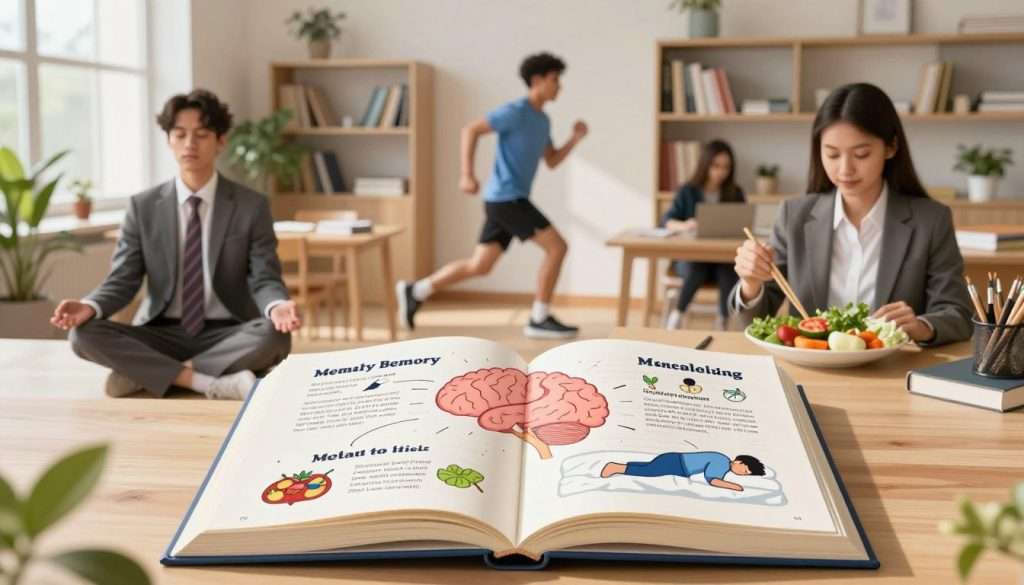
Do you ever feel like your brain is a sieve? You’re not alone. Many students think they need a magical talent to ace tests. But the truth is more encouraging. Better retention comes from simple, repeatable actions, not endless cramming.
Your brain is always changing thanks to neuroplasticity. This means you can rewire your mind to learn faster and remember longer. You can start adapting your study style today.
We’re going to look at 5 habits to boost your memory for exams. We’ll talk about deep sleep, active recall, spaced repetition, mnemonics, and the right nutrients. For more, check out my free book How to Become the Smartest Student in the Classroom. It has study routines and strategies that work. Get your free copy here: https://www.studyingmachine.com/free-books/.
Key Takeaways
- Success in testing relies on consistent habits rather than innate talent.
- Neuroplasticity allows your brain to form new pathways throughout your life.
- Prioritizing sleep and proper nutrition is essential for cognitive performance.
- Active recall and spaced repetition are the gold standards for long-term retention.
- Using mnemonics helps turn complex data into easy-to-remember patterns.
5 Brain-Boosting Habits to Supercharge Your Memory for Exams
Building a strong memory isn’t about being a genius. It’s about the small memory boosting habits you do every day. Breaking your study routine into small, repeated actions helps your brain thrive.
Why memory improves through consistent daily habits
Your brain is like a garden that needs regular watering, not a flood. By studying in short, frequent bursts, you tell your mind that the info is truly important.
Being consistent makes abstract concepts feel familiar. When you study every day, you work with your brain, not against it.
“Success is the sum of small efforts, repeated day in and day out.”
How learning, recall, and long-term retention work together
Learning is just the first step. To keep information in your long-term memory, you must recall it.
For example, studying a complex biology process like cellular respiration. Reading it once might help for an hour. But reviewing it in short, active sessions over days makes it stick in your mind.
This cycle of learning and recalling strengthens neural pathways. The more you do this, the easier it is to access the info during exams.
How to measure progress without relying only on grades
Grades are just a sign of your hard work. Instead, track your memory boosting habits to see your progress:
- Recall Accuracy: How much can you explain without notes?
- Speed: Are you getting facts faster than before?
- Confidence: Do you feel less nervous about tough topics?
- Consistency: Did you stick to your review plan?
Want more? My free book How to Become the Smartest Student in the Classroom offers a full system. It includes memory techniques, study routines, and strategies that work. There’s no cost and no catch. Get your free copy here.
Habit One: Protect Your Sleep Before Studying and Exam Day
Sleep is not a luxury, but a powerful tool for learning. When looking for exam preparation tips, start with your bedroom, not your desk. Your brain works best when you’re sleeping.
How sleep strengthens memory consolidation
Your brain is like a busy office during the day. It files away new information, but it’s disorganized. Deep sleep organizes this information for long-term storage.
“Sleep is the best meditation.”
Without enough sleep, this information stays disorganized. It’s harder to recall facts during exams.
Build a reliable sleep schedule during exam preparation
Consistency is key for a sharp mind. Treat your sleep schedule as seriously as your class schedule for exam preparation tips.
Set a consistent bedtime and wake-up time
Go to bed and wake up at the same time every day. This keeps your body’s internal clock in sync. You’ll fall asleep faster and wake up refreshed.
Reduce late-night screen use and cramming
Blue light from screens tricks your brain into thinking it’s daytime. Avoid screens an hour before bed. Instead, relax and let your mind process what you learned.
Use a short review session before bed
Do a light review of what you’ve studied before bed. Spend ten minutes on notes or flashcards. This helps your brain focus on the information while you sleep.
What to do after a poor night of sleep
We’ve all had nights when we couldn’t sleep. If you had a bad night, don’t worry. Lower your expectations and focus on brief, high-quality recall sessions.
Take breaks to stay energized and try again the next evening. For more tips, check out my free book How to Become the Smartest Student in the Classroom. It’s full of strategies that work. No cost, no catch. Get your free copy here.
Habit Two: Use Active Recall Instead of Passive Review
Ever felt like you knew your stuff until test time? That’s because just reading notes isn’t enough. You need to use cognitive enhancement strategies that make your brain work harder.
Turn notes and textbooks into memory questions
Don’t just highlight in your book. Turn headings, formulas, and lists into questions. For history, ask yourself, “What were the main causes of this war?”
This way, studying becomes a dynamic challenge that keeps you engaged.
Practice recalling information without looking at the answer
Close your book and try to remember the info. It might be tough at first, but that’s where learning happens.
Use flashcards strategically
Flashcards are great for quick facts. Drill vocabulary or dates, but always say the answer out loud before checking.
Write a blank-page summary from memory
Write down everything you remember about a topic on a blank sheet. This shows what you know and what you’ve forgotten.
Explain difficult concepts aloud
Explain a tough idea to a friend. If you struggle, you’ve found a weak spot in your understanding.
“The brain is not a vessel to be filled, but a fire to be kindled.”
Check your answers and correct knowledge gaps
Always check your answers right after. If you got something wrong, don’t worry! Mistakes show where to focus next.
Apply active recall to formulas, vocabulary, and essay topics
Use this method for anything. For math, solve problems without looking at the steps. For essays, outline your arguments from memory first.
If this article hit home, check out my free book How to Become the Smartest Student in the Classroom. It’s packed with memory techniques, study routines, and strategies that work. No cost, no catch. Get your free copy here.
Habit Three: Schedule Spaced Repetition Across Your Study Routine
Creating a strong study routine for better memory starts with a simple change. Instead of trying to learn everything in one night, review your material just before it fades from your mind.
This method, called spaced repetition, makes your brain work harder. This effort helps the information stay with you longer.

Why spacing study sessions beats one-night cramming
Cramming might make you think you know a lot, but you don’t really remember. You might recognize words, but you haven’t made the deep connections needed for long-term memory.
Spreading out your study time lets your brain process and organize new information. This strategic pacing avoids the burnout that comes with cramming.
Create a practical review schedule for each subject
Being consistent is key to success. You can organize your review sessions with a clear, manageable timeline. This keeps your brain sharp.
Review new material the same day
End your day by summarizing what you learned. This quick recap acts as a mental anchor for the day’s lessons.
Revisit it after one day, one week, and one month
Following a structured plan helps you stay on track. Use the table below to keep your study routine for better memory on track.
| Review Stage | Timing | Goal |
|---|---|---|
| Initial | Same Day | Solidify concepts |
| First Follow-up | Next Day | Check retention |
| Deep Review | One Week | Identify weak spots |
| Final Polish | One Month | Ensure mastery |
Adjust review intervals based on difficulty
Not every topic needs the same amount of time. If something is hard, review it sooner.
If it’s easy, you can wait longer. This dynamic approach makes your study time more efficient.
Combine spaced repetition with practice questions
Don’t just read your notes. Make every review session active by answering practice questions or explaining the topic to someone.
This active recall strengthens your memory. It’s the best way to ensure you understand the material.
Avoid confusing repeated reading with effective repetition
Reading the same chapter many times is not effective. It feels like you’re learning, but you’re not really.
True repetition requires effort. For more tips, check out my free book How to Become the Smartest Student in the Classroom. It offers memory techniques, study routines, and strategies that work. No cost, no catch. Get your free copy here.
Habit Four: Use Mnemonic Techniques to Make Information Stick
Top students turn boring study notes into memorable mental movies. By using mnemonic techniques for exams, they engage their brain’s love for stories and images. This makes learning more fun and effective.
Connect unfamiliar facts to vivid mental images
Your brain loves to remember the strange and colorful. Instead of just reading, try to see it as a bizarre scene. The sillier the image, the more it will stick.
Build acronyms, acrostics, and memorable phrases
A simple word can unlock complex lists. Create an acronym with the first letter of each item. For longer sequences, use an acrostic where each word represents a piece of data.
Use the method of loci for ordered information
The method of loci, or “memory palace,” is a classic trick. Visualize a familiar place and “place” items in specific spots. Recall information by mentally walking through your room.
Create stories for sequences, processes, and lists
Turn long processes into short, silly stories. Our brains love narratives, making sequences easier to remember than lists.
Match mnemonic techniques to the material you need to learn
Not every tool works for every subject. Choose the method that fits the information you’re learning.
Use associations for vocabulary and definitions
For new vocabulary, find a similar-sounding word and link it to a visual. For “mitochondria,” imagine a “mighty” power plant inside a cell.
Use chunking for numbers and complex formulas
Break long strings of numbers or formulas into smaller groups. This is called chunking and helps avoid feeling overwhelmed.
“Memory is not a gift; it is a skill that you can sharpen with the right tools and a bit of creativity.”
Test whether a mnemonic helps you recall information independently
The true test of a memory trick is recalling the answer without prompts. If you need the mnemonic, keep practicing until it becomes second nature.
If this article resonated with you, my free book How to Become the Smartest Student in the Classroom offers a full system. It includes memory techniques, study routines, and strategies that stick. There’s no cost and no catch. Get your free copy here.
Habit Five: Combine Movement, Breaks, and Brain-Friendly Fuel
To stay focused, treat your body like a high-performance engine. Many students think study breaks are weak, but they’re key cognitive enhancement strategies. Stepping away from your desk lets your brain reset and process info better.
Use physical activity to support attention and cognitive performance
Physical movement is like a reset button for your focus. Light activity boosts blood flow to the brain, clearing mental fog. This habit keeps your cognitive enhancement strategies working well during long study times.

Plan brief movement breaks during long study blocks
See movement as a tool for memory, not a distraction. Short activity bursts keep your energy and mind sharp.
Try walking, stretching, or light aerobic exercise
You don’t need a gym to get your blood flowing. Simple actions like stretching, walking, or jumping jacks can greatly help. These activities release tension and prepare your brain for more focus.
Prevent breaks from turning into extended distractions
Boundaries are key to a successful break. Use a timer to keep your five-minute stretch from becoming an hour of social media. When the timer ends, it’s time to get back to studying with a fresh mind.
Choose meals and snacks that support steady energy
Your diet affects your memory. Eat nutrient-dense foods for steady energy, not quick sugar highs. Add these brain-friendly foods to your daily meals:
| Food Category | Examples | Benefit |
|---|---|---|
| Healthy Fats | Salmon, Olive Oil, Nuts | Supports brain cell health |
| Antioxidants | Blueberries, Strawberries | Protects against oxidative stress |
| Complex Carbs | Whole Grains, Oats | Provides steady glucose levels |
| Protein | Eggs, Greek Yogurt | Keeps you full and focused |
Stay hydrated and moderate caffeine use
Even mild dehydration can hurt your focus. Drink water throughout your study time to stay sharp. Caffeine can help, but too much can cause jitters and affect sleep.
Recognize when fatigue is reducing the quality of your studying
Sometimes, stopping is the best thing you can do. If you’re reading the same sentence over and over, you’re tired. Recognizing this is part of your cognitive enhancement strategies. Taking a real break or ending your study early is better than studying while tired.
If this article resonated with you, my free book How to Become the Smartest Student in the Classroom offers a full system. It includes memory techniques, study routines, and strategies that work. No cost, no catch. Get your free copy here.
Build the Five Habits Into a Sustainable Exam-Preparation Plan
Creating a good study routine for better memory doesn’t have to be hard. Mix your daily habits into a flexible schedule. This way, you support your brain instead of draining it. It keeps you on track, even when life gets busy or you’re not feeling energetic.
Design a weekly study routine for better memory
Begin by planning your week with balance in mind. Treat your study time like a professional meeting. But don’t forget to include active recovery periods. These breaks help your brain process new information well.
Combine focused study blocks with active recovery
When studying, keep your sessions intense but short. This avoids burnout and keeps your focus sharp all day.
Start each block with a specific learning target
Before diving into your books, set a clear goal. Whether it’s mastering a formula or summarizing a chapter, having a goal makes your exam preparation tips more effective.
End each block with a short recall test
Always end your session by testing yourself without looking at your materials. This simple act helps your brain remember information better.
Prioritize high-value topics when time is limited
Not all study material is the same. Focus on topics that are most important for your exams or where you’re least confident.
| Priority Level | Focus Area | Action Strategy |
|---|---|---|
| High | Core Concepts | Active Recall & Spaced Repetition |
| Medium | Supporting Details | Summarization & Mnemonics |
| Low | Review Material | Light Reading & Quick Skimming |
Track sleep, review sessions, movement, and recall results
Keep a simple log of your daily habits. This helps you see what works best for you. Tracking sleep and movement can show you your best study days. If recall scores drop, check if sleep or nutrition needs a tweak.
Adapt the routine for the final week before an exam
In the last days, focus on reinforcing what you know. Increase retrieval practice and prioritize deep sleep. For more, check out my free book How to Become the Smartest Student in the Classroom. It offers memory techniques, study routines, and strategies that stick. No cost, no catch. Get your free copy here.
Common Mistakes That Weaken Memory During Exam Preparation
It’s time to check if your study methods are really working. We often use methods that seem good but don’t help our memory. Let’s look at these common mistakes so you can change your study habits today.
Relying on highlighting and rereading alone
Highlighting your textbook might feel good, but it’s not enough. Rereading notes can make you think you know it all. But, real learning means pulling information out of your brain, not just reading it.
Studying for hours without testing yourself
Long study sessions can be a waste of time. If you spend hours reading without testing yourself, you’re not learning. You need to actively recall information to really understand it.
Changing strategies too often to see meaningful results
It’s easy to try new methods when you get stuck. But, mastering something takes time and sticking to one method. Choose one strategy and stick with it to see improvement.
Ignoring sleep, meals, and recovery until exam week
Your brain needs rest and food to work well. Skipping sleep or eating junk food hurts your memory. You can’t do well if you ignore your body’s needs.
Trying to memorize information without understanding it
Rote memorization doesn’t last. Always try to explain a concept in your own words before memorizing it. Understanding the why behind a topic makes remembering facts easier.
| Ineffective Habit | Why It Fails | Better Alternative |
|---|---|---|
| Passive Rereading | Creates false confidence | Active Recall |
| Marathon Cramming | Causes mental fatigue | Spaced Repetition |
| Ignoring Sleep | Blocks memory storage | Consistent Rest |
If this article hit home, check out my free book How to Become the Smartest Student in the Classroom. It offers memory techniques, study routines, and strategies that really work. No cost, no catch. Get your free copy here → https://www.studyingmachine.com/free-books/.
Go Deeper With a Free Memory and Study System
Learning how to learn is a superpower for students. If you want to make your study sessions better, we have something for you.
Our book, How to Become the Smartest Student in the Classroom, is your guide. It builds on what we’ve talked about, giving you a system to handle your schoolwork.
What How to Become the Smartest Student in the Classroom covers
Memory techniques that make information easier to retrieve
You’ll learn top mnemonic techniques for exams to remember stuff better. These methods make remembering hard facts easy during exams.
Study routines designed to help lessons actually stick
We show you how to make a study schedule that works for you. With these cognitive enhancement strategies, your hard work will pay off.
Strategies for becoming a more effective, confident student
Feeling confident comes from having a good plan. This book teaches you to manage your time and energy. So, you’ll feel truly prepared for any exam.
Get the free book with no cost and no catch
We think everyone should have better learning tools. That’s why we’re giving this guide away for free, with no cost and no catch.
Download your free copy
Visit https://www.studyingmachine.com/free-books/
Ready to start? Just visit our website to get your copy today. We can’t wait to see you crush your academic goals!
Conclusion
You now have the power to change how you learn. Protect your sleep, use active recall, and space out your studying. Choose clever mnemonics and eat right to boost your memory.
Start with one tip today. Once it becomes second nature, add more. Soon, studying will feel like a steady, easy process.
Want to dive deeper? My book, How to Become the Smartest Student in the Classroom, offers a complete plan. It includes advanced memory techniques and routines that work. There’s no cost or catch.
Get your free copy here at https://www.studyingmachine.com/free-books/ to take charge of your studies. You have the tools to succeed. Start your new routine now.