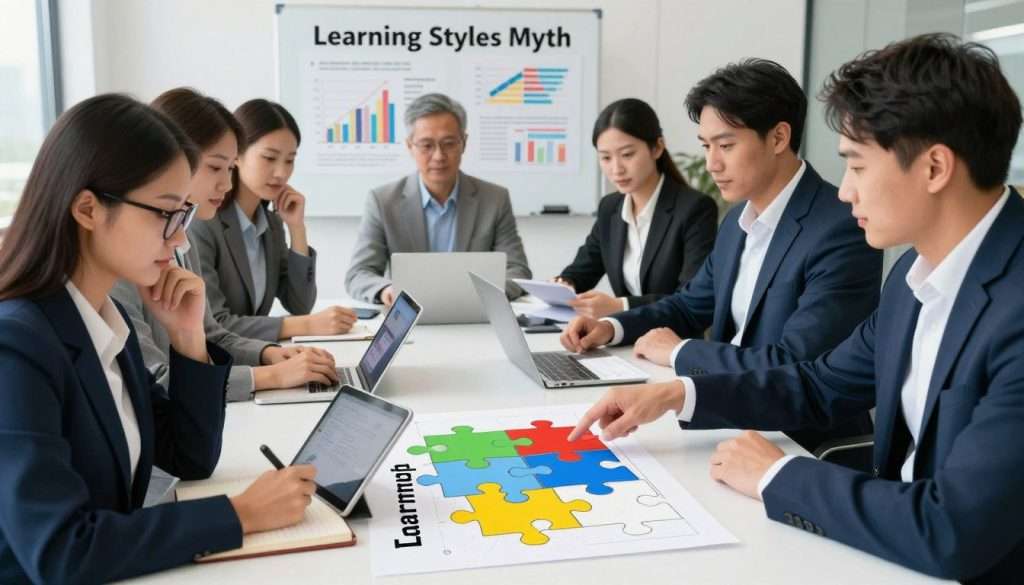
Have you ever thought you’re a visual or auditory person? Many students believe this defines their success in school. It seems natural to think we learn in one way.
But, the learning styles myth has been closely examined. Years of research show that teaching based on these labels doesn’t help. The science of learning reveals our brains are much more flexible than we thought.
We aim to help you adopt better learning habits. If this interests you, check out our free book, How to Become the Smartest Student in the Classroom. It teaches you effective ways to remember and focus. Get your copy here to learn methods that really work.
Key Takeaways
- The idea of distinct sensory preferences lacks empirical evidence.
- Matching teaching methods to these labels does not improve outcomes.
- Human brains possess incredible flexibility for processing diverse information.
- Focusing on active recall and spaced repetition yields superior results.
- Practical study routines outperform outdated categorization systems.
Why the Learning Styles Myth Persists
Ever wondered why the learning styles idea feels so right, even when science disagrees? It promises to unlock our hidden potential by finding our unique way of learning. We all want to know how people learn, but this model has become a big deal.
What People Mean by “Learning Styles”
The theory says we each have a preferred way of learning. You might know these types:
- Visual: You learn best by seeing charts, graphs, and diagrams.
- Auditory: You prefer listening to lectures or discussing topics out loud.
- Kinesthetic: You need to move, touch, or perform hands-on tasks to grasp a concept.
It’s believed that matching your study habits to your style will help you learn faster and remember more. It seems like a perfectly logical way to succeed in school.
Why the Idea Feels Personal and Persuasive
This theory is hard to shake because it matches our experiences. We’ve all had moments where a diagram or hands-on experiment made something click. Debunking learning myths is tough because these preferences feel so real.
Also, the model gives us a simple explanation for our struggles. It’s easier to blame a “mismatched” teaching style than to put in the effort to really learn. We like explanations that make us feel understood and validated.
How Schools, Businesses, and Online Courses Popularized the Model
This idea has spread far and wide. About 67 percent of the public and 59 percent of teachers think students learn better in their preferred style. It’s not just an internet trend; it’s part of our schools and businesses.
The model spread through several key channels:
- Teacher Training: Many educators learned about these concepts in their training.
- Textbooks: Educational materials often included chapters on how to identify and cater to different styles.
- Commercial Assessments: Companies sold tests designed to “diagnose” a student’s learning style.
- Online Courses: Platforms often marketed their content by promising to accommodate every type of learner.
By making these ideas part of our education system, the myth became a standard part of how people learn. It takes effort to see past these labels and focus on what really works for our brains.
Learning Styles Myth: What Science Says About How You Really Learn
Many of us think we have a “learning style.” But, the truth is more fascinating. We often say we’re visual, auditory, or kinesthetic learners, hoping it will help us do better in school. Yet, the learning styles myth keeps going, even though science doesn’t back it up.
The Central Claim Behind Visual, Auditory, and Kinesthetic Categories
The idea is that we each like to learn in a certain way. People say visual learners need pictures, auditory learners need to hear, and kinesthetic learners need to do things to understand.
This idea says our brains prefer one sense over others. It claims we struggle if we don’t get information in our “native” way.
What Researchers Mean by Matching Instruction to a Learning Style
In research, this idea is called the “meshing hypothesis.” It says teaching is best when it matches a student’s style.
If you’re a visual learner, you should avoid reading too much. The cognitive science of learning shows our brains are more flexible than we think.
Why Preference Does Not Prove Learning Effectiveness
It’s key to know what we enjoy versus what helps us remember. Just because you like watching videos doesn’t mean you’ll remember them better than reading.
For example, a student might be good at words but not pictures. Still, they can learn anatomy well with diagrams if the teaching is good.
The Difference Between Enjoying a Method and Remembering Information
We often mix up what feels easy with what we really learn. A study method might feel smooth, but that doesn’t mean we’ll remember it well.
| Feature | Learning Style Belief | Cognitive Science Reality |
|---|---|---|
| Primary Focus | Student’s sensory preference | Nature of the content |
| Instructional Goal | Match format to preference | Use effective encoding strategies |
| Outcome Measure | Student comfort and enjoyment | Retention and problem-solving |
| Flexibility | Fixed, innate trait | Adaptable based on task |
The cognitive science of learning looks at how well we can use what we learn later. Believing in the learning styles myth might hold us back. It makes us avoid methods that are harder but more effective.
What Major Research Reviews Reveal
We are going to examine the major research reviews that put these theories to the test. When we look at the actual data, we find that debunking learning myths is a necessary step for any serious student. Science requires more than just a feeling that a method works; it demands proof.
The Pashler Study and the “Meshing Hypothesis”
A landmark review led by Harold Pashler looked closely at the “meshing hypothesis.” This idea suggests that instruction is most effective when it matches a student’s preferred style. If you are a visual learner, the theory claims you should only learn through pictures.
But the researchers found no solid evidence to support this. To prove the hypothesis, a study would need to show a specific interaction effect. This means visual learners would have to perform better with visual aids, while auditory learners would have to perform better with spoken words.
Why Strong Evidence Requires a Specific Interaction Effect
Without this crossover, we cannot claim that matching styles to instruction improves learning. If everyone learns better with a specific method regardless of their “style,” then the style label is useless. The data across four major meta-analyses showed an average effect size of d = 0.04.
In the world of statistics, this number is effectively zero. It tells us that tailoring lessons to a supposed style provides no meaningful advantage. This is a core pillar of evidence-based learning that every student should understand.
What Later Reviews and Neuroeducation Research Add
Since that initial review, more neuroeducation research has emerged to clarify how the brain processes information. These studies consistently show that our brains are not wired to favor one sensory input over others for deep learning. Instead, the brain thrives on meaning, connection, and active retrieval.
Limits of the Available Evidence
We must admit that the current body of evidence has its limits. Most studies are conducted in controlled settings, which might not always mirror a busy classroom. Yet, the lack of evidence for “styles” is quite consistent across different age groups and subjects.
Why Lack of Support Is Not the Same as Proving Every Method Useless
It is important to be clear: just because learning styles are not real, it does not mean visual or hands-on methods are bad. Using a diagram to explain a complex process is often a great idea. The difference is that it works because the material is visual, not because the student is a visual learner.
| Concept | Myth-Based View | Evidence-Based View |
|---|---|---|
| Instructional Match | Must match style | Match the content |
| Learning Outcome | Higher if matched | Higher if active |
| Student Role | Passive recipient | Active participant |
How Preferences Differ From Abilities and Learning Processes
You might think you’re a certain type of learner, but science shows it’s more complex. You might like watching videos or reading books, but these are just personal preferences. They’re not fixed traits. To understand how people learn, we need to look beyond simple labels and explore the brain’s workings.

Learning Preferences Can Be Real Without Being Learning Styles
It’s okay to have a favorite way to study. You might find that listening to podcasts helps you learn history better. Or drawing diagrams makes biology easier. These preferences are real, but they don’t limit your ability to learn new things.
“The mind is not a vessel to be filled, but a fire to be kindled.”
When we see these preferences as fixed “styles,” we limit ourselves. The best learning strategies adapt to the task, not just what feels comfortable.
Prior Knowledge, Motivation, Attention, and Cognitive Load
Your ability to learn changes with several factors. If you’re already knowledgeable in a subject, your brain processes new info differently. Motivation and attention also matter a lot. If you’re really interested in a topic, you’ll engage more, no matter the format.
We also need to think about cognitive load. Some tasks need intense focus, while others rely on recognizing patterns. Forcing every subject into one “style” might ignore the specific needs of the material.
Why the Same Student May Need Different Methods for Different Subjects
Think about how you study. You might use flashcards for vocabulary but solve problems for algebra. This shows you’re a smart learner.
The best learning strategies are flexible because they match the content’s nature. You wouldn’t learn guitar by only reading, or history by only listening. Effective study systems require adapting to the goal.
| Subject Type | Preferred Method | Effective Strategy |
|---|---|---|
| Mathematics | Watching tutorials | Active problem solving |
| Foreign Language | Listening to audio | Spaced repetition |
| Biology | Reading notes | Drawing labeled diagrams |
| History | Watching documentaries | Self-explanation |
By staying flexible, you use the most efficient tool for each task. This is how people learn best—by being open to new methods and focusing on the outcome.
How the Brain Builds Lasting Knowledge
Ever wonder why you can read a textbook for hours and still feel like you learned nothing? It’s a common problem. It shows a gap between how we study and the science of learning. Your brain is not just a container waiting to be filled. It’s an active engine that builds connections through effort.
Encoding, Retrieval, and Long-Term Memory
To move information into long-term memory, your brain must go through encoding. This happens when you actively engage with material, not just glance at it. Retrieval—pulling information back out of your brain—is the most powerful way to keep that knowledge.
Why Understanding Requires More Than Exposure
Many of us think seeing something enough times will make it stick. But how people learn is more complex. True understanding comes from connecting new concepts to what you already know, creating lasting meaning.
The Role of Attention, Sleep, Practice, and Feedback
Your brain needs specific conditions to perform at its best. Attention is key; without it, information doesn’t make it into your working memory. Sleep acts as the “save button” for your brain. Consistent feedback helps correct mistakes before they become habits.
How Forgetting Can Strengthen Later Recall
Forgetting is a normal part of learning. When you struggle to remember something, your brain is working hard to reconstruct that memory. This mental effort makes the information stickier the next time you try to recall it.
Why Fluency During Studying Can Be Misleading
Have you ever reread your notes and felt like you knew the material perfectly? This is called “fluency,” but it’s often misleading. According to neuroeducation research, feeling familiar with the material doesn’t mean you understand it. You might recognize the words, but explaining the concepts without looking is a different story.
| Study Method | Mental Effort | Long-Term Result |
|---|---|---|
| Passive Rereading | Low | Weak Retention |
| Highlighting Text | Low | False Confidence |
| Active Retrieval | High | Strong Memory |
| Spaced Practice | High | Lasting Mastery |
Evidence-Based Learning Strategies That Work Across Subjects
To master new skills, move beyond personality quizzes and embrace the cognitive science of learning. Instead of searching for a magic style, rely on evidence-based learning methods. These methods turn study time into a productive session that builds lasting knowledge.

Retrieval Practice for Stronger Recall
The most powerful way to learn is to force your brain to pull information out of memory. This is called retrieval practice, a top effective study technique. Instead of just rereading your notes, try closing your textbook and writing down everything you remember.
- Use flashcards to test your memory.
- Try to explain a concept to a friend without looking at your book.
- Take practice quizzes to identify what you actually know versus what you just recognize.
Spaced Practice Instead of Last-Minute Cramming
Cramming might help you pass a test tomorrow, but it doesn’t help you keep information long term. Your brain needs time to process and consolidate new ideas. By spreading your study sessions out over several days or weeks, you allow your memory to strengthen naturally.
Think of it like watering a plant. A little bit of water every day helps it grow, while dumping a whole bucket at once just creates a mess. Consistency beats intensity every single time.
Interleaving Related Skills and Problem Types
Many students make the mistake of studying one topic for hours until they feel “done.” But research shows that mixing up your subjects or problem types—known as interleaving—is much better for your brain. When you switch between different types of math problems or historical themes, you force your brain to work harder to distinguish between them.
This extra effort might feel frustrating at first, but that is exactly why it works. It helps you build a deeper understanding of how different concepts relate to one another.
Elaboration, Self-Explanation, and Concrete Examples
To truly own a new idea, you must connect it to what you already know. This process is called elaboration. When you explain a concept in your own words or create your own examples, you are building a stronger mental map.
These are some of the best learning strategies to deepen your grasp of any subject:
- Ask yourself “why” a specific fact is true.
- Connect new information to your personal experiences.
- Create a concrete example for an abstract theory.
By using these methods, you stop treating study as a passive chore. You start treating it as an active, engaging process that builds real expertise.
How to Use Visual, Auditory, and Hands-On Methods Wisely
To master new skills, you need to choose the right tool for the job. We often prefer certain ways of learning, but effective study techniques depend on the content. Picking the right format can improve retention and make studying more productive.
When Visual Representations Improve Understanding
Visuals are powerful for learning about spatial relationships or complex systems. For example, in biology or engineering, diagrams can show how parts fit together better than words. Seeing the structure helps your brain create a lasting mental map.
When Speaking and Listening Support Memory
Explaining a concept out loud can solidify it in your mind. Speaking forces you to organize your thoughts and find any gaps. This is key to evidence-based learning, turning passive reading into active learning.
When Practice and Demonstration Are Essential
For skills like playing an instrument or coding, practice is crucial. You need to do the work to learn it. Watching a demonstration is a good start, but performing it yourself is when your brain truly learns it.
Match the Method to the Material, Not a Student Label
The secret to success is matching your strategy to the subject matter. Don’t worry about being a “visual” or “auditory” learner. Instead, ask if the topic needs a map, a conversation, or practice.
Combine Multiple Representations Without Creating Distraction
Using different formats is helpful, but be careful not to overdo it. Too many distractions can lead to cognitive overload. Keep your approach simple and focused on the key information.
| Subject Type | Best Method | Why It Works |
|---|---|---|
| Spatial/Structural | Diagrams/Charts | Clarifies relationships |
| Conceptual/Logical | Verbal Explanation | Tests understanding |
| Procedural/Physical | Hands-on Practice | Builds muscle memory |
Common Study Mistakes Caused by the Learning Styles Myth
Believing in the learning styles myth can hold us back. We think we only need one way to learn to succeed. But this limits our ability to tackle complex topics.
Restricting Yourself to One Preferred Study Method
Many of us stick to what feels natural. If you think you’re a visual learner, you might skip audio or hands-on activities. This is a mistake because different subjects need different skills.
By not using different methods, you miss out on learning in many ways. True understanding comes from looking at problems from all sides, not just one.
Confusing Highlighting and Rewatching With Learning
We often think doing something feels like learning. Highlighting or rewatching feels like work, but it’s mostly passive. These actions don’t really help your brain learn or connect information deeply.
When you rely on these methods, you’re just seeing the material again. Real learning is about hard work of retrieval, where you recall information without notes.
Spending More Time Choosing Techniques Than Practicing
Have you ever spent hours looking for the “perfect” study method? This is a common trap. We search for the ideal technique, hoping it will make studying easier.
In reality, this time is taken away from actual studying. Debunking learning myths means realizing the best method is the one that engages you with the content, no matter your preference.
Using Learning-Style Labels as Fixed Limits
Labels can limit us. If you think you’re “not a math person” or “not a reader,” you might not try to improve. These labels can stop you from reaching your full potential.
Remember, your brain can adapt to new challenges. When you stop seeing your abilities as fixed, you can master subjects you thought were hard.
| Study Habit | Type | Effectiveness |
|---|---|---|
| Highlighting text | Passive | Low |
| Rewatching videos | Passive | Low |
| Retrieval practice | Active | High |
| Self-explanation | Active | High |
How to Build a Better Personal Study System
Creating a personal study system is not about finding your “style.” It’s about matching your tools to your goals. By letting go of fixed labels, you open up to evidence-based learning that really sticks. It’s time to move from passive habits to a routine that challenges your brain.
Start With the Learning Goal and Assessment
Before diving into your studies, ask yourself what you aim to achieve. Are you trying to memorize definitions, explain a complex theory, or solve a tricky physics problem? Your goal will guide your strategy.
If you’re aiming to recall facts, your approach will differ from someone trying to master a complex process. Clarity is your best friend when planning your study sessions.
Choose Techniques Based on the Type of Knowledge
Using effective study techniques means picking the right tool for the job. Not every subject requires the same level of mental effort or engagement method.
Facts, Vocabulary, and Definitions
For simple memorization, active recall is key. Use flashcards or a simple Q&A list to test yourself until the information becomes second nature.
Concepts, Processes, and Explanations
When understanding how things work is your goal, try the Feynman Technique. Explain the concept out loud as if you were teaching it to a friend who knows nothing about the topic.
Mathematics, Science, and Problem-Solving Skills
For these subjects, practice by doing is essential. Mix up your problem sets to avoid repeating the same steps. This forces your brain to find the right strategy for each challenge.
| Knowledge Type | Primary Goal | Recommended Strategy |
|---|---|---|
| Facts/Definitions | Rapid Recall | Flashcards & Spaced Repetition |
| Concepts/Processes | Deep Understanding | Self-Explanation & Mapping |
| Math/Science | Application | Interleaved Practice |
Schedule Retrieval, Spacing, and Feedback
Consistency beats intensity every time. Build a weekly rhythm with short, frequent retrieval sessions instead of cramming.
Space out your practice to revisit older material just as you’re about to forget it. Always seek feedback, whether through an answer key or a study partner, to ensure your understanding is accurate.
Measure Progress With Performance, Not Comfort
It’s easy to mistake “feeling good” for learning. Highlighting notes or re-reading chapters might feel productive but doesn’t mean you’re retaining much.
The best learning strategies often feel difficult in the moment. If you can explain a concept or solve a problem without notes, you’ve truly learned it. Trust your performance, not your comfort level!
What to Tell Students, Parents, and Teachers
It’s time to change how we talk about learning in schools and homes. The idea of fixed learning styles has been proven wrong, but it’s still common. In fact, 76 percent of teachers still believe in it, and many teaching materials do too. We should focus on evidence-based learning to help everyone reach their best.
Replace Fixed Labels With Flexible Learning Strategies
Instead of saying a student is a “visual learner,” try something different. Say, “You might like diagrams, but you can learn in many ways, and it depends on the task.” This shows students their brains can adapt, not be stuck by a label.
Encourage them to try different learning methods for different subjects. By focusing on the task, not their identity, you help them build a strong learning toolkit.
Support Student Choice Without Promoting Unsupported Claims
We want students to feel in charge of their learning. It’s okay to let them choose how they study, but don’t make those choices seem like facts. You can support their freedom while guiding them toward effective learning strategies.
“The goal of education is not to increase the amount of knowledge but to create the possibilities for a child to invent and discover.”
Teach Students How to Evaluate Study Advice
In today’s world, it’s crucial to teach students to think critically. Encourage them to ask three questions when they hear a new study tip:
- Is there actual evidence to support this method?
- Does this tip have a clear, achievable learning goal?
- Are there measurable results I can track?
Teaching these skills helps students sort out good advice from bad, focusing on what really helps their learning.
Use Accessible Instruction Without Assuming Individual Matching Is Necessary
Teachers often feel they must create different materials for every student. But, you don’t need to tailor instruction to fit each style to be effective. Good, accessible instruction works for everyone, no matter their preferences.
By providing clear explanations, using various examples, and offering practice, you’re already using the best learning strategies. Focus on the quality of your teaching, not just how you present it, and you’ll see better results.
Conclusion
You now know how to break free from the learning styles myth. Your preference for reading or listening might feel right, but it doesn’t control how your brain stores info. Real growth comes from embracing the science of learning, not just sticking to one way.
Use study techniques that focus on retrieval, spacing, and feedback. These methods work because they match how our memory works. Think of them as a map that helps you master any subject.
You can learn anything by focusing on the material, not your supposed learning style. Let your goals guide your study methods, not a label. This change makes studying a productive habit, not a chore.
If this article struck a chord, check out my free book How to Become the Smartest Student in the Classroom. It offers memory techniques, study routines, and strategies that really work. There’s no cost and no catch. Get your free copy here → https://www.studyingmachine.com/free-books/.