
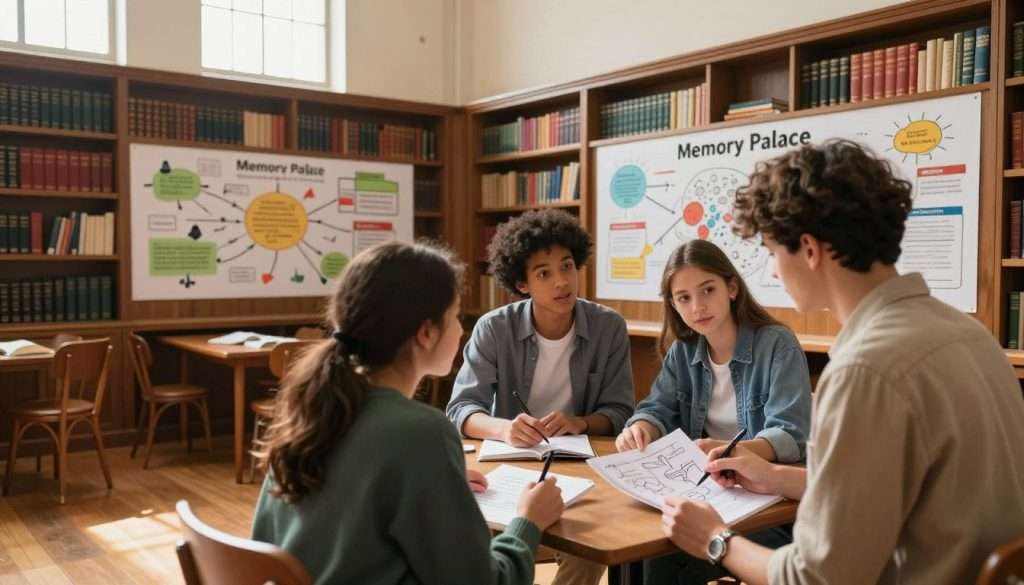
Have you ever wished your brain had a search bar? Many students stare at huge piles of notes and feel completely overwhelmed. You do not need a photographic memory; you need a better filing system.
Learning how to build a “memory palace” to ace your next history or science exam can transform your exam preparation. This ancient technique dates back to Greece. A poet named Simonides used spatial visualization to recall names after a building collapsed.
You need neither a literal mansion nor special talent to use it for complex dates and scientific processes. This strategy makes studying less like a chore and more like a mental adventure. My book, How to Become the Smartest Student in the Classroom, covers the full system; get a free copy here.
Key Takeaways
- The memory palace is an ancient, proven method for storing large amounts of information.
- You can use this technique for dates, vocabulary, and complex lists.
- No special talent is required; anyone can learn to visualize information effectively.
- Spatial association helps your brain retrieve facts much faster during testing.
- This method turns stressful study sessions into an engaging, creative process.
Why a Memory Palace Works for History and Science Exams
Your brain is a high-performance machine built for spatial navigation, not rote memorization. Cramming facts through repetition can work against your brain’s natural design. Instead, use memory techniques that match how your mind organizes information.
How spatial memory supports recall
The hippocampus helps your brain manage spatial memory. It remembers physical locations with great efficiency. Place information in a familiar space to use this hardwired ability to navigate your surroundings.
These familiar locations are already stored in long-term memory, so they become lasting anchors. You do not need to review the “walls” of your palace constantly. After you set the scene, facts stay put until you recall them during your exam.
Why mental imagery beats rereading and highlighting
Rereading your textbook often wastes time because it creates a false sense of familiarity. In contrast, mental imagery makes your brain actively encode information that lasts. A 2017 study found that participants improved word recall from 26 to 62 words after six weeks of training.
Turn a dry historical date or complex scientific process into a vivid, exaggerated picture. This makes the information hard to ignore. Your brain loves novelty and emotion, so weird or funny images last far longer than a highlighted sentence.
When to use a memory palace instead of other mnemonic devices
Many mnemonic devices exist, but the memory palace is the gold standard for organized information. It works best for sequences, lists, definitions, and chronological events. Use it to remember the order of the periodic table or the timeline of the American Revolution.
However, this method stores facts; it does not build deep conceptual understanding. You still need to practice problem-solving and explain the “why” behind the facts. To master the full system of study routines, you can grab my free book, How to Become the Smartest Student in the Classroom, right here.
| Study Method | Best For | Effort Level | Retention |
|---|---|---|---|
| Rereading | General Overview | Low | Very Low |
| Highlighting | Identifying Terms | Low | Low |
| Memory Palace | Lists & Sequences | Medium | Very High |
| Practice Tests | Problem Solving | High | High |
How to Build a “Memory Palace” to Ace Your Next History or Science Exam
To stop cramming, learn how to build a “memory palace” to ace your next history or science exam. This method uses familiar places to help your brain store and find information.
The process is simple and saves hours of frustration. Choose a familiar location, map a clear route, and place vivid study images along it. On exam day, take a mental walk through your palace to recall needed facts.
The complete process from choosing a location to exam-day recall
Building your first palace usually takes 20 to 30 minutes. This small investment saves hours of rereading textbooks. After setting your route, you can review the entire subject within minutes.
For more help, my free book How to Become the Smartest Student in the Classroom explains memory techniques and study routines that stick. You can grab your free copy here.
What makes a memory palace effective rather than confusing
The secret to success is consistency. Your mental journey should feel natural, not like a puzzle. A messy route can make recall messy too.
Use familiar spaces with a clear beginning and ending
Choose a place you can picture easily, such as your childhood home or current bedroom. A clear starting point helps prevent confusion. You should know exactly where the path begins and ends.
Keep one primary route for each subject or unit
Do not mix history dates with science formulas in one palace. Use one dedicated route for each unit to keep your brain organized. This separation makes facts easier to recall during an exam.
| Study Method | Time Required | Retention Level | Stress Factor |
|---|---|---|---|
| Rereading Notes | High | Low | High |
| Highlighting Text | Medium | Low | Medium |
| Memory Palace | Low | High | Low |
These steps show how to build a “memory palace” to ace your next history or science exam. It is a reliable, fun, and effective way to master any subject.
Step 1: Choose a Familiar Location and Route
Building a memory palace starts with a space you know like the back of your hand. A familiar place is already etched into your brain, so you save energy imagining the environment. These study tips can make learning feel natural instead of like a chore.
Select a place you can visualize without effort
Think about your bedroom, apartment, or the route you take to school each morning. Choose a location you can easily “walk” through without pausing to recall its furniture or layout. If the layout is hard to remember, it can distract you from the information you need to learn.
Map a predictable route through rooms, landmarks, or objects
Once you choose your location, create a fixed path through it. Move through your space in a logical order: start at the front door, then hallway, living room, and kitchen. This flow prevents you from skipping important facts during your exam.
Set a manageable number of memory locations
Trying to memorize everything at once can create mental clutter. An organized palace is one of the most effective study tips for long-term retention.
Start with 10 to 20 locations for one exam topic
For your first attempt, use 10 to 20 distinct spots. This keeps your mental storage space clean and prevents a “junk drawer” of random facts. Later, you can build a new palace for a different subject.
Avoid locations that look or feel too similar
Choose spots that look different from one another. Four identical chairs in a row may be hard for your brain to tell apart. Instead, choose a mirror, a couch, a sink, and a front door, so each location is unique.
| Location Type | Why It Works | Example |
|---|---|---|
| Distinct Landmark | Easy to visualize | Front Door |
| Unique Furniture | High contrast | Bookshelf |
| Functional Area | Clear sequence | Kitchen Sink |
If this article resonated, my free book How to Become the Smartest Student in the Classroom gives you memory techniques, study routines, and strategies that stick. It is free, with no catch. Grab your free copy here → https://www.studyingmachine.com/free-books/.
Step 2: Design Memory Locations That Never Change
Imagine searching for keys that move to a different drawer each day. You might never leave on time, and your mental map can create the same problem. Fixed stations and consistent memory techniques show your brain where to find each fact.
Assign each stop a fixed position
Choose specific spots in your location and stick to them. Whether they are a bookshelf, lamp, or specific chair, these items become your anchors. Once the sofa holds your history dates, it must always hold them.
Move in one direction to prevent skipped information
Always walk through your palace in the same order. If you start at the front door and move clockwise, never switch to a counter-clockwise path. This predictable flow helps prevent skipped facts during an exam.
Separate chapters, time periods, and systems with different routes
Sometimes, one palace becomes too crowded. Cramming an entire semester of biology into one bedroom can create confusion. Create separate paths for different topics to keep your mental files organized.
Use a house for a broad unit and individual rooms for subtopics
Think of your house as a giant filing cabinet. You can assign the kitchen to one chapter and the living room to another. This spatial separation helps you retrieve information without mixing topics.
Use a campus, neighborhood, or familiar walk for larger courses
Large subjects need more space. A walk through your neighborhood or across your school campus offers many distinct landmarks. These memory techniques let you expand your palace as needed.
If this article helped, my free book How to Become the Smartest Student in the Classroom offers a complete system. It includes memory techniques, study routines, and strategies that actually stick. It costs nothing, has no catch, and is available here → https://www.studyingmachine.com/free-books/.
Step 3: Convert Facts Into Vivid Mental Images
A perfect memory palace starts when you transform boring facts into wild mental imagery. Your brain does not store dry text well; it remembers experiences that feel real.
When you turn abstract ideas into things you can see, hear, or smell, you create strong memory hooks. For deeper study, my free book How to Become the Smartest Student in the Classroom offers a full study system. Get your free copy here → https://www.studyingmachine.com/free-books/.
Turn abstract terms into concrete objects
To remember a complex definition, give it a physical form first. For “inflation,” imagine a giant, red balloon expanding until it pops in your living room.
Concrete objects give your brain a useful anchor for abstract terms. This simple shift makes mental imagery central to your study toolkit.

Use exaggerated size, motion, color, sound, and emotion
Your brain ignores ordinary things, so make your images loud, weird, and oversized. A small, quiet image may fade, but a giant, neon-colored object making a screeching sound is hard to forget.
Add emotion to your scenes to make them stick. Surprise, amusement, or slight disgust makes your brain favor that memory over a plain definition.
Make images unusual enough to trigger instant recall
The more bizarre your scene, the better it works. Picture the Battle of Hastings: William the Conqueror crashes through your front door with a glowing, oversized “1066” sign.
This kind of mental imagery creates a lasting impression. Because the scene is strange, your brain naturally wants to remember it.
Represent scientific processes with moving scenes
Science often shows change, so avoid static pictures. Create moving scenes of molecules colliding, organs pumping, or forces shifting over time.
Think of these as short, high-definition movies playing in your head. Visualizing motion helps you understand the mechanics instead of memorizing steps.
Represent historical dates and names with visual wordplay
History may seem like random numbers, but visual wordplay changes that. Turn names into puns or dates into shapes that represent their numbers.
A funny visual pun can lock information into your long-term memory. Mental imagery turns a chore into a creative game.
Step 4: Place Key Facts Along the Route
Fill your mental rooms with information to make exam preparation stress-free. Avoid cramming an entire textbook into one corner; it creates mental clutter and confusion.
Treat each location as a dedicated container for one vital fact. Simple locations help your brain retrieve information without extra details getting in the way.
Match each fact to one specific location
Assign one core concept to each stop on your route. For many definitions, give each one its own chair, lamp, or shelf.
Group related information into small visual scenes
Sometimes, one fact cannot tell the whole story. Group related details into a vivid, small scene at one location to preserve the main idea and add context.
Place information in the order required for an essay or explanation
Your memory palace should match your test’s structure. For an essay, arrange locations in the exact order of your arguments.
Build a chronological route for history topics
For history, organize locations by year or event order. Walk through them to see the past unfold from one room to the next.
Build a cause-and-effect route for scientific concepts
For science, map your route by cause, process, and effect. This logical flow makes exam preparation more natural as your brain follows how things work.
For more help, read my free book How to Become the Smartest Student in the Classroom. It offers a full system with memory techniques, study routines, and strategies that stick, with no cost or catch. Get your free copy here → https://www.studyingmachine.com/free-books/.
Step 5: Link Events, Definitions, and Processes Into a Story
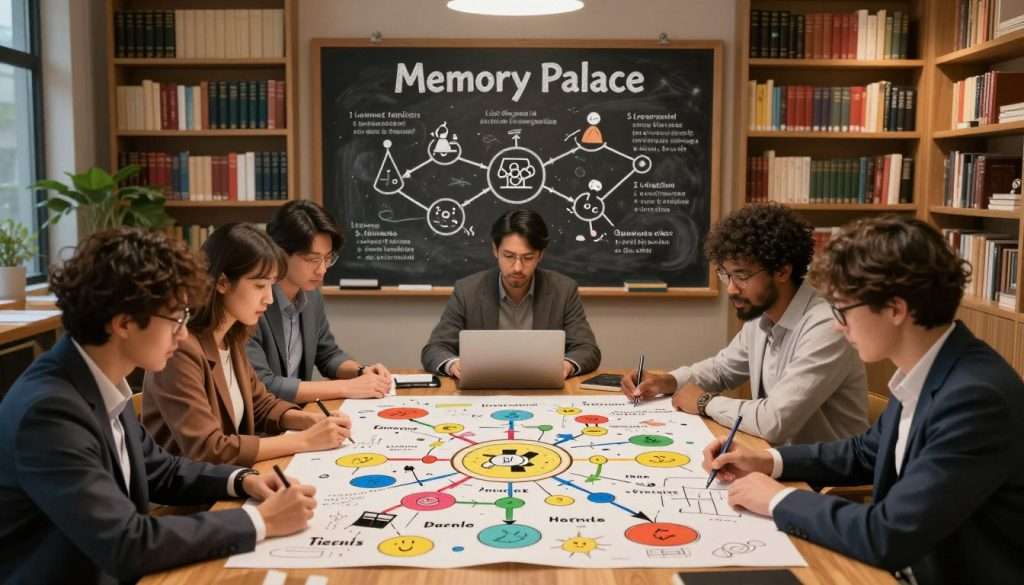
Now that your locations are set, bring your study material to life. Weave facts into a playful, interconnected narrative instead of keeping them isolated. This approach turns static information into a dynamic movie inside your mind.
Turn separate memory images into a chain, so each location nudges the next one forward. This is where mnemonic devices shine, helping you recall complex relationships, not random terms.
Connect adjacent images with exaggerated interactions
Think of your memory palace as a stage where your facts are the actors. For two related concepts, do not place them side by side; make them interact wildly.
Imagine a giant historical figure wrestling with a massive treaty document. The more absurd and exaggerated the action, the easier it is for your brain to remember.
Use characters and actions to remember names and terminology
Abstract terms often feel slippery, but they stick when you give them a personality. Assign a specific character to represent a complex definition or difficult name.
“Memory is the residue of thought.”
When you see that character perform a specific action, you instantly recall the term. This turns dry vocabulary into a vivid, memorable scene you can revisit anytime.
Build a visual chain for multi-step procedures
For ordered processes, create a visual chain where one step leads directly to the next. You are building a mental storyboard that guides you through the entire sequence.
Link historical causes to events and consequences
History is rarely just a list of dates; it tells a story of cause and effect. Visualize a historical leader interacting with consequences of their decisions, such as a war or political movement.
Linking the cause to the event through one cohesive action creates a logical flow. This makes it easier to explain the “why” behind historical shifts during your exam.
Link scientific structures to functions and outcomes
Science becomes simpler when you see a structure doing its job. Instead of picturing only a cell part, visualize it performing its function and producing a clear outcome.
This creates a mini-movie that explains the biological process in real time. If this article resonated with you, explore the free book.
It offers a full system: memory techniques, study routines, and strategies that actually stick. There is no cost or catch; grab your free copy here → https://www.studyingmachine.com/free-books/.
Step 6: Create a History Memory Palace With a Worked Example
Imagine walking through your childhood home and seeing the Battle of Hastings unfold in your living room. History doesn’t have to be a dry list of dates that slip from your mind when you close your textbook. A memory palace turns your exam preparation into a vivid, cinematic experience that sticks.
Organize dates, people, places, and turning points
Start with a location you know well, such as your school or house. Divide your historical era into three logical chunks: the beginning, middle, and end. Assign each major event, such as a treaty or battle, to furniture or a doorway.
Use a chronological route to reconstruct an era
Movement helps keep your facts in order. Walk through your space along a consistent, straight path.
If you start at the front door, move through the hallway and kitchen without backtracking. This spatial flow mirrors the timeline of the events you study.
Turn an abstract timeline into a sequence of memorable scenes
Instead of memorizing “1066,” picture a giant, golden “10” shaped like a knight’s shield crashing into a “66” made of flaming arrows. Place this scene on your living room rug to connect the date with a physical location. This method makes exam preparation feel like watching a movie instead of studying.
“Memory is the treasury and guardian of all things.”
Distinguish similar leaders, treaties, wars, and movements
Similar figures or events can be easy to confuse. Give each leader a distinct, exaggerated trait, such as a neon-colored cape or giant crown. Use the table to categorize and separate your historical data points.
| Historical Element | Visual Symbol | Location |
|---|---|---|
| Battle of Hastings | Flaming Shield | Front Door |
| Magna Carta | Giant Quill Pen | Hallway Table |
| Black Death | Green Fog | Kitchen Sink |
Attach dates to visual symbols without relying on random digits
Do not memorize raw numbers because they are slippery and hard to hold. Turn digits into shapes or objects that interact with your scene. For deeper study, my free book How to Become the Smartest Student in the Classroom gives you a full system for exam preparation.
You can grab your free copy here → https://www.studyingmachine.com/free-books/. Always compare your visual symbols with your class notes before your big test.
Step 7: Create a Science Memory Palace With a Worked Example
Imagine walking through your kitchen as the entire water cycle unfolds around you. Science can feel like abstract terms, but these memory techniques can help you master it. A mental map makes complex systems easier to see.
Represent vocabulary, structures, and functions visually
Turn dry definitions into vivid, physical objects. In biology, do not just memorize “mitochondria.” Picture a tiny power plant buzzing with electricity inside your living room.
- Assign a specific, unique object to every term.
- Give each object a personality or a loud sound.
- Place these objects in locations where they naturally fit.
Map a process such as cellular respiration or the water cycle
Processes are stories that happen in a set order. Turn your hallway into stations for cellular respiration. Each station shows a stage, such as glycolysis or the Krebs cycle, where energy transforms.
Use spatial relationships to compare similar scientific concepts
Use physical space to compare two similar systems. Place one system in your bedroom and the other in your bathroom. These neighboring rooms let you walk between them and spot differences and similarities.
Place parts of a system where their functions can be replayed
Think of your memory palace as a movie set. Place an organelle or chemical compound in a corner. When you visit that spot, replay its function and recall how it supports the whole system.
Show sequences with movement, transformation, and cause-and-effect imagery
Make your mental scenes move instead of using static images. If one chemical changes another, picture a character pushing a button. The button triggers an explosion or a color shift, helping these memory techniques show cause and effect.
These tools help with factual recall, but you still need practice problems to master scientific reasoning. For more help, read my free book, How to Become the Smartest Student in the Classroom, which offers strategies that stick. It is free, with no catch, so grab your free copy here.
Step 8: Practice Retrieval Until the Route Becomes Automatic
Once your mental rooms are furnished, practice navigating them until the path feels natural. Building the palace is the encoding phase, but mastery comes from retrieving information. These study tips help your hard work pay off under pressure.
Walk through the palace with your eyes closed
Find a quiet spot, close your eyes, and mentally stroll through your rooms. See every detail in your vivid images without checking your notes. If one corner is hard to picture, spend more time strengthening that mental connection.
Recall information forward, backward, and from random locations
Many students practice their route in only one direction. To master your test-taking strategies, jump into the middle or walk the route backward. This flexibility keeps memory from becoming a fragile chain that breaks when questions come out of order.
Use active recall instead of repeatedly reviewing the images
Passive reading weakens retention. Instead, explain the concepts aloud as if you were teaching a friend. This process shows what you know and what you have forgotten.
“Memory is the residue of thought.”
Test yourself with blank paper and flashcards
Grab a blank sheet of paper and sketch your route or write each room’s facts. If you prefer digital tools, use flashcards to trigger your stored images. This active recall method works far better than rereading your textbook.
Repair weak or missing images immediately
If an image feels dull or you keep skipping a room, do not ignore it. Re-imagine the scene with more color, sound, or exaggerated action. Small repairs prevent larger knowledge gaps during the actual exam.
| Method | Effectiveness | Best For |
|---|---|---|
| Passive Rereading | Low | Initial familiarity |
| Flashcards | High | Quick definitions |
| Memory Palace | Very High | Complex sequences |
If this article resonated with you, my free book How to Become the Smartest Student in the Classroom gives you a full system. It covers memory techniques, study routines, and strategies that actually stick. There is no cost or catch; get your free copy here → https://www.studyingmachine.com/free-books/.
Step 9: Strengthen the Palace With Spaced Review and Practice Tests
Even the most impressive memory palace needs maintenance to stay sharp. These memory techniques work best when you make them a regular part of your study routine.
Schedule reviews before forgetting becomes complete
You should establish a simple rhythm to keep your information fresh. Walk through your route soon after building it, then revisit it later that same day. Practice it again a few times throughout the following week.
Three or four spaced walkthroughs make your knowledge more durable than one long, exhausting cram session. This steady effort moves the information into long-term storage.
Combine the memory palace with practice questions
Don’t just stare at your mental images; put them to work! Pair each palace review with practice questions to test whether you can apply the facts. This shows whether you understand the material or only recognize the images.
Check accuracy against class notes, textbooks, and teacher materials
A vivid image helps only when it encodes correct information. Always compare your mental scenes with official class notes or textbooks. If you find a discrepancy, fix the image at once to avoid learning wrong details.
Use retrieval practice to expose gaps
Active recall helps you find what you do not know. Rebuild the scenes without notes to find exactly where your memory is fuzzy. These gaps are not failures; they are opportunities to strengthen your understanding.
Update images when course content changes
Your teacher may add details or clarify a concept. Modify your existing palace to include these updates. A current mental map keeps your memory techniques reliable during the actual exam.
| Review Phase | Timing | Goal |
|---|---|---|
| Initial Walkthrough | Immediately after creation | Solidify the path |
| First Reinforcement | End of the same day | Prevent early decay |
| Spaced Practice | Throughout the week | Build long-term retention |
| Final Polish | Day before the exam | Ensure total accuracy |
If this article resonated with you, my free book How to Become the Smartest Student in the Classroom gives you a full system. It covers memory techniques, study routines, and strategies that actually stick. There is no cost and no catch; grab your free copy here → https://www.studyingmachine.com/free-books/.
Conclusion
Turn any dry textbook chapter into a vivid mental landscape. Choose a familiar route, fix your locations, and fill them with wild, memorable images. These test-taking strategies work best for lists, dates, and definitions, but mastery requires applying facts to real-world problems.
Do not wait for the perfect moment to begin. Build a small, 10-location palace this week and see how quickly your recall improves. You will be surprised by how much easier your next exam feels with a reliable system.
For deeper study, my free book How to Become the Smartest Student in the Classroom gives you a full system. You get memory techniques, study routines, and test-taking strategies that stick, with no cost or catch. Get your free copy here at Studying Machine and take your learning to the next level.