

You understood the chapter last night, but the details have vanished just in time for the quiz. It is frustrating to recognize an idea and still struggle to name the term, date, or next step.
The Memory Palace method gives students and lifelong learners another way to practice recall. You use a familiar place as a set of cues, then revisit it with active recall and review. It can support exam prep and healthier learning habits, but it will not store every fact for you.
You still need to choose useful material, make clear connections, and test yourself. The payoff is a more active way to face study stress, especially when a short list refuses to stick. You do not need a photographic memory to give this method a try.
Key Takeaways
- Use a familiar route to cue a short set of facts.
- Choose information you need to recall in order.
- Make images that clearly connect to the facts.
- Test yourself before checking your notes.
- Review missed facts again over time.
- Pair the method with practice that builds understanding.
What Is the Memory Palace Technique?
A memory palace is a familiar place you use as an ordered set of cues for recalling information. The method of loci links information to ordered locations on a familiar route.
“Loci” is Latin for “places,” and the method is also called the memory palace technique. You connect each fact to a distinct location, then mentally retrace the route to recall the facts.
A home, classroom, or regular walk can supply a sequence you already know. Each location holds an image or idea, so the route gives your memory a set order instead of a loose pile.
Use a location as a cue, not as a substitute for the fact itself.
For a shopping list, picture a loaf of bread on the front step. Then see apples rolling across the living room floor. Mentally visiting those locations can help you retrieve the list without reading it again.
This differs from simply rereading notes. Rereading puts the information in front of you, while retrieval asks you to bring it back from memory. That effort can show which links are clear and which need more work.
The traditional story connects the method with Simonides of Ceos, a Greek poet. Cicero and Quintilian later documented the technique, but the story itself should not be treated as proven history.
Memory palaces can hold words, ideas, or steps, as long as the locations follow a clear order. The route supplies the order, while each image gives you a clue to what comes next.
Why Can Spatial Cues Help You Recall?
A familiar route gives your recall a built-in order, like labeled shelves instead of a pile of loose papers. Spatial memory can make a sequence easier to follow because each location cues what comes next.
Connecting a fact to a place gives your mind a framework for retrieving it. Making an image for an abstract idea also asks you to think about that idea, rather than letting your eyes pass over it.
That extra attention can help form a useful connection. A route may also reduce the burden of remembering order, since each location offers a next step during recall.
A small virtual reality feasibility study tested recall with 11 participants. After their first use, the mean rose from 62.55 words before the test to 82.91 afterward.
The study reported a 20.4% increase in non-spatial information after the first use. After the second use, the mean rose from 63.44 to 85.67 words, a reported increase of 22.2%.
| Use | Pre-test mean | Post-test mean | Reported increase |
|---|---|---|---|
| First | 62.55 words | 82.91 words | 20.4% |
| Second | 63.44 words | 85.67 words | 22.2% |
The increases were statistically significant after both uses. The authors also noted the limited participant count, so this small study cannot predict how much any one student will recall.
Memory palace psychology offers a useful idea, not a promise. Spatial cues may help organize non-spatial facts, but learning still depends on the material and your practice.
Treat one small feasibility study as a promising clue, not a guarantee for your next exam.
Choose the Right Material to Store
Start with the facts you repeatedly forget, not every line in the chapter. High-yield facts that are hard to retrieve are better choices for memory palace images.
Save the method for a short set of valuable facts, especially facts that fit a sequence. Vocabulary, names, ordered steps, and must-know terms can all work well.
Prioritize facts that are hard to retrieve
Look for details that matter and keep slipping away. A language learner might choose new vocabulary; a history student might choose names or dates in order.
A list of lab terms or steps in a process can also suit the method. The key test is whether a cue would help you recall something you genuinely need, rather than decorate a detail you already know.
A practitioner’s rule of thumb is to use no more than three images per location. Treat that as a guide, not a law for every learner or every topic.
Leave room for understanding and practice
A memory palace can cue a concept, but it cannot do the thinking for you. You still need to solve problems, explain a process, and apply a rule to a new example.
For instance, remembering a math formula does not prove you can choose when to use it. Keep time for practice questions and explanations in your study plan.
Trying to encode every sentence can make studying slower and more distracting. Reserve the palace for a small group of high-value facts, then use your notes and exercises for the rest.
When a fact needs context, keep that context in your notes rather than cramming it into a crowded image. If you are spending more time decorating an image than understanding the idea, take that fact back to your notes.
Choose a Place and Map a Route
Your first route can be as ordinary as the walk from your front door to the living room. A familiar place is easier to revisit than a building you barely know.
Keep the locations in the same order every time you use the route. A home, classroom, or other familiar building can work if its features are distinct.
Start with somewhere you know well
Pick a place you can picture without effort. A home may have clear furniture and doorways, while a classroom may offer a board, desk rows, and a teacher’s table.
A regular walk can work too, if you can name its landmarks in order. Choose a route that feels simple rather than one that demands a tour guide in your head.
Give each location a fixed place in the order
Choose a starting point and move past distinct landmarks in one direction. Clockwise movement is optional, not a rule; what matters is following one stable path.
Here is a simple five-stop memory palace template for a home route: front door, shoe rack, bathroom, kitchen, and living room. Keep the order fixed, and practice walking it in both directions.
- Can you name a clear starting point?
- Does every stop look distinct from the others?
- Can you follow one direction without changing the route?
- Do you pass each location once, without accidental repeats?
- Can you walk the route in reverse and check its order?
Distinct locations make it easier to notice when you have skipped a stop. If the kitchen and living room blur together in your mind, choose a more specific landmark in each.
Keep the path small while you learn its order. If you cannot walk the route in order without guessing, simplify it before adding study material.
Make Images That Stick
A good image is less like a perfect painting and more like a bright sign pointing to the fact you need. Clear connections matter more than artistic skill.
Make the image point to one fact you can name. A funny scene that has no clear link may be memorable but useless during a quiz.
Connect each image to the fact
Use a personal association, pun, or concrete object to stand for a term. If a word sounds like a familiar name, picture that person doing something that hints at the word’s meaning.
A concrete object can also cue an idea. A tiny clock might represent a deadline, while a key could stand for access or a key term in your notes.
Choose an association that makes sense to you, not one that would impress a stranger. Your own connection is easier to recognize when you retrace the route later.
Make the scene vivid but easy to retrieve
Add movement, sound, touch, or a playful exaggeration to give the scene a little spark. A bell might ring, a paper crown might wobble, or a giant pencil might roll across a desk.
Keep the connection to the fact in view. If the image has so many details that you forget what it stands for, trim the scene until the clue is obvious.
A practitioner’s rule of thumb is to use no more than three images per location. That limit can keep one stop from turning into a crowded stage, though it is not a universal law.
Some facts need only one cue, while a short sequence may need a few linked images. Keep the link obvious enough that you can name the fact as soon as you see the scene.
A Five-Room Memory Palace Example
Imagine you have five presentation topics and a home with five easy-to-picture areas. One topic per room gives you a simple route for recalling the talk’s main points.
Use each room to cue one presentation topic, not to recommend a product. This example focuses on a talk about device features.
Here are five topic-to-room pairings you could use:
- Battery: bedroom
- Camera: work area
- Storage: bathroom
- Speed: kitchen
- Display: living room
In the bedroom, picture a battery bouncing on the bed and lighting the room. The scene points to battery life, the first topic in the presentation.
In the work area, imagine a camera snapping a picture of your desk. In the bathroom, a storage box might overflow with towels, cueing the storage topic.
For speed, picture a kitchen timer racing around the counter. In the living room, a screen could glow across the couch to cue the display topic.
The images are only prompts for the subject you plan to explain. Your presentation still needs clear facts, examples, and practice speaking aloud.
Replace the rooms and cues with places that feel familiar to you. If your work area is easier to picture than a bedroom, swap it into the route.
Walk the same five locations in the same order and say each topic aloud before moving on.
Use a Memory Palace for Studying
A memory palace for studying works best when its route matches the way the information is organized. Sequence and structure can make a route easier to use.
Use locations to cue related facts, then practice explaining or applying them. The method has been used for speeches, texts, lists, historical dates, vocabulary, and key concepts.
Organize vocabulary and ordered material
For language study, a route can hold words and their meanings in a chosen order. For history, locations can cue dates or events along a timeline.
Steps in a process also fit when you need to recall them in sequence. A route can make it clear where one step ends and the next begins.
Give complex subjects a useful structure
In anatomy, locations might cue body areas or structures. In pharmacology, they might hold drug groups or key terms, while a process route could cue stages in pathophysiology.
Biochemistry offers ordered topics such as the Krebs cycle and glycolysis. Lab values or patient-assessment steps may also suit a route when you need an organized recall cue.
A cue can help you name a stage, but it cannot explain why that stage happens. Use practice questions, diagrams, and plain-language explanations to build understanding and application.
| Study task | Possible place or route | What the cue represents | Best recall use |
|---|---|---|---|
| Vocabulary | Home route | Term and meaning | Word recall |
| Anatomy | Body outline | Structures or regions | Location recall |
| Pharmacology | Clinic route | Drug groups or terms | Category recall |
| Biochemical cycle | Looping path | Stages in order | Sequence recall |
| Patient-assessment steps | Assessment route | Actions in order | Step recall |
Use a route that fits the subject rather than forcing every topic into one shape. Keep connected ideas near each other only when that layout makes their relationship easier to explain.
Keep Information Fresh With Spaced Reviews
A memory palace still needs revisits, and spaced repetition gives those visits a place on your calendar. Spaced reviews bring facts back before they fade from easy reach.
Choose a schedule you can follow, then adjust it when a topic remains difficult. These routines are practical guides, not guarantees of recall.
Choose a review schedule
The 2-7-30 rule sets reviews for day 2, day 7, and day 30. Those exact intervals do not come from a specific clinical trial.
The 2357 method schedules reviews at 2, 3, 5, and 7 days. You can adjust the gaps to fit how difficult the material feels and how well you recall it.
Another routine is to summarize after the lesson, test yourself the next day, test again three days later, then test again one week later.
| Schedule | Review timing | How to use it | Adjustment |
|---|---|---|---|
| 2-7-30 | Days 2, 7, 30 | Revisit new material | Move reviews for hard facts |
| 2357 | Days 2, 3, 5, 7 | Test recall over time | Adjust gaps to difficulty |
| Lesson-based | After lesson, next day, day 3, week 1 | Summarize, then test | Repeat missed material sooner |
There is no prize for following a calendar that does not fit your week. The right schedule is one that leaves room for honest recall, not just a quick glance at familiar images.
Plan backward from an exam
For the 2357 method, start with the exam date and count backward. Set a review for the day before, then count back 2, 3, 5, and 7 days for earlier reviews.
If a topic is harder, give it an earlier or extra review. Easier facts may need less attention, so use your test results to decide where study time goes.
A missed answer can guide the next session more clearly than another full reread. Pick one schedule you can actually follow instead of juggling several calendars at once.
Test Yourself Instead of Just Replaying the Route
Close your notes and try to retrieve the fact before you take another walk through the route. Retrieval practice shows whether you can produce an answer, not just recognize a cue.
Combine a vivid cue with self-testing and spaced review instead of relying on rereading alone. That is a practical way to use effective memorization techniques.
Recall before checking your notes
Visit a location in your mind and name the fact it represents before opening your notes. If you cannot answer, mark that location and keep going.
Afterward, return only to the locations that failed. Try to explain why the cue connects to the answer, then test the link again without notes.
- Recall the route in order.
- Name each fact at its location.
- Explain weak links in your own words.
- Retest the items you missed.
A 2022 literature review reported memory benefits lasting nine months after one retrieval-practice session. It reported benefits lasting at least eight years after retrieval over multiple sessions.
Those findings describe different conditions, not a promise that every learner will get the same result. Your own practice should include clear questions and an honest check of each answer.
Use flashcards to strengthen weak spots
Flashcards can test the fact linked to a location or ask you to recall the cue itself. For long-term retention, accurately recall an answer four or five times before setting that card aside.
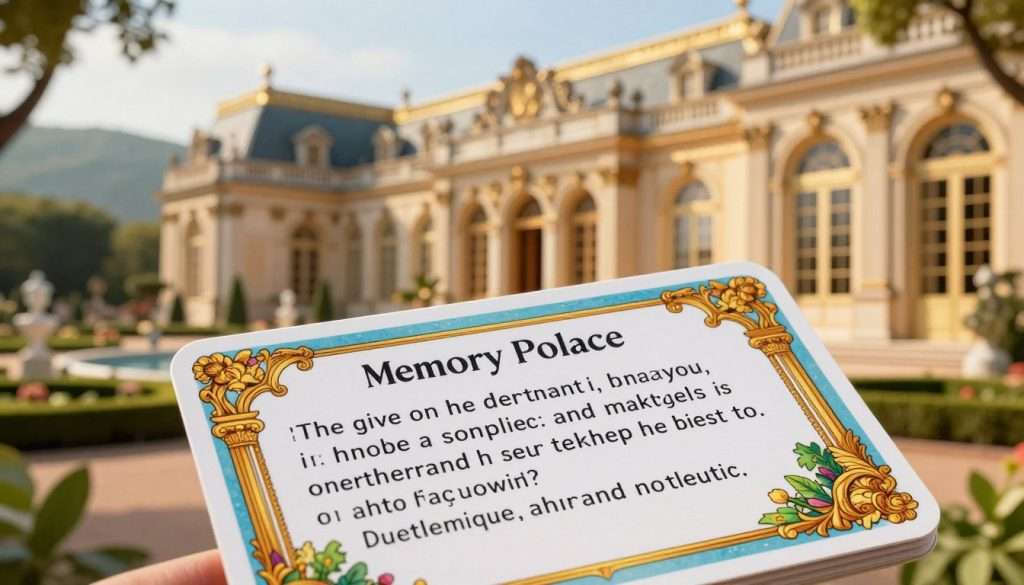
Anki is an optional tool for reviewing facts tied to a memory palace. Paper cards work too; choose the format that makes you answer before you see the back.
If a card keeps tripping you up, make its question more focused. A missed answer is useful feedback, so strengthen that cue and test it again.
Know When the Method Needs a Backup
If the pictures in your mind are faint, you can still use a route as a story or logic framework. Vivid pictures are not required for every learner.
Use the method only when it helps the task in front of you. Some people with aphantasia, or limited mental imagery, can rely on a story, logic, or a concept of an image.
Adapt if you do not picture images clearly
You might know that a desk belongs at the end of a hallway without seeing every detail. That sense of place can still cue the next fact.
A verbal story can also connect one location to another. If a clear picture does not come, build a simple chain of ideas instead of forcing an image.
Use another tool when understanding matters most
Memory palace images may help with ordered facts, but some study tasks depend more on explaining and applying ideas. Elaborate image-making can distract some learners from that work.
| Study need | Memory-palace role | Useful partner | When to switch |
|---|---|---|---|
| Ordered facts | Cue facts in sequence | Flashcards | When order is already easy |
| Concept understanding | Recall key terms | Plain-language explanation | When links do not explain why |
| Problem-solving practice | Recall rules or steps | Practice problems | When you must apply a rule |
Sleep supports learning too. Adults should get at least seven hours, with seven to nine hours as the usual learning-focused range.
If image-making pulls your focus away from the task, use a simpler tool for that task.
Pair a route with tools that fit the work, rather than asking one method to do every job. If a technique pulls your attention away from the actual task, choose a simpler tool for that task.
Build a Short Practice Session
A useful 15-minute session has one job: encode a small set of facts and find out what you can retrieve. Keep the task small so you can finish the test, not just start building scenes.
Try five minutes to organize material, then ten minutes to encode and test it. This is a practical routine, not a scientific rule or a promise that everything will stick.
Use 5 minutes to choose and organize
Select a small group of high-value facts from your notes. Put them in a sensible order, such as a sequence, a short list, or a group of related terms.
Use the first few minutes to decide what belongs together. If the facts have no useful order, make a simple order you can explain.
Use 10 minutes to encode and test
Place simple cues along a route you know, then walk it once in your mind. Close your notes and try to retrieve each fact before checking your work.
Use this checklist to keep the session moving:
- Select a small set of useful facts.
- Order the facts in a clear way.
- Encode each fact with a simple cue.
- Test recall without looking at your notes.
The timer is there to keep the task focused, not to grade your memory. End by marking the one or two facts that need another review, not by adding more images.
Organize Multiple Palaces and Choose a Guide
One route can hold a small set of facts, while separate themed places can keep larger subjects from stepping on each other’s toes. Separate routes can help keep unrelated material apart.
Give different long-term subjects different places when their cues start to blur. Familiar homes, workplaces, buildings, and routes can all serve as possible settings.
You can also extend a familiar route when one set of facts grows. A partly imagined setting may work if its order stays clear and you can reliably revisit it.
A virtual visit can help you explore a possible place. Google Street View, for example, lets you look around a setting and notice landmarks you might use.
Separate themed palaces can keep unrelated information from competing for the same cues. Reusing one location for different long-term sets can cause confusion, so separate those sets when recall gets muddled.
A useful memory palace book should teach route planning, personal image associations, and retrieval practice. Look for worked examples that show how a learner builds and tests a route.
A free book from a study brand may cover memory techniques as part of a wider study system, rather than serve as a dedicated memory-palace guide. Check that its examples match the kind of material you want to remember.
You do not need a grand building or a complicated system. Start with places you know, then add another route when a subject needs its own space.
If you keep confusing two sets, give them different routes before adding more locations.

Conclusion
You do not need to memorize everything to make your next study session easier. A small, well-tested route is more useful than an elaborate palace you never revisit.
Choose five facts from an upcoming lesson and try a short route. Then test what you can recall the next day.
Want to go deeper? If this article resonated with you, my free book How to Become the Smartest Student in the Classroom gives you a full system, including memory techniques, study routines, and strategies that stick. No cost, no catch. Grab your free copy here → https://www.studyingmachine.com/free-books/.
Choose five facts from your next lesson, give them a route, and see what you can recall tomorrow.