

If a chapter feels familiar until someone asks you to explain it, the Feynman Technique gives you a practical way to check what you really understand. It uses plain language to show what you know and what still needs work. Active recall means bringing information to mind without looking at your notes. That small effort can make learning feel more like solving a puzzle than staring at a page.
Students can add this practice to study routines, exam preparation, or a fresh effort to find motivation. It can also pair well with memory tips when you want to keep an idea beyond the next quiz. You do not need special tools or a perfect plan. A notebook and one manageable topic are enough to begin.
Key Takeaways
- Explain one concept in simple words.
- Use a blank page to test your recall.
- Return to source material when you find a knowledge gap.
- Use questions to check unclear ideas.
- Keep the final explanation for later review.
Start with one small topic, not the whole textbook.
How Do You Use the Feynman Technique Step by Step?
The process has four moves: choose a concept, explain it, repair what you cannot explain, and simplify the result. One concept gives your attention a clear job, while a short explanation from memory shows what you can truly explain.
Each move changes your notes from a record of someone else’s words into a test of your own learning. Set aside a single study session, and keep the source material nearby for checking.
Choose one concept to study
Pick a small idea you can work through in one sitting, such as how a cell membrane controls entry and exit. A whole unit is too broad for a useful first attempt. A single term, rule, or process gives you a target you can explain without wandering.
Write the concept at the top of a blank page. If you are studying a chapter, choose one idea from it rather than copying the chapter title. This keeps your learning task focused and makes the finished explanation easier to review.
Explain it in your own words
Put your notes aside and explain the concept as if you were teaching someone who has never studied it. Write from memory or say the explanation aloud. Do not copy source sentences or pause to make the wording sound impressive.
Your Feynman Technique notes should act as a prompt for recall, not a script to copy. A simple Feynman Technique template can use five labels: concept title, explanation from memory, questions or gaps, corrected explanation, and analogy. Leave room under each label, so you can see how your understanding changes.
Try to connect each part of the idea to the next. If you name a result but cannot explain why it follows, mark that point for a closer look. A rough first draft is useful because it shows exactly where you need to return.
Return to source material to fill gaps
Look at the questions or gaps you marked, then return to the specific source material that covers them. Use the textbook section, class notes, or lesson that explains that point. You do not need to reread everything when one step is unclear.
After checking the material, close it and try your explanation again. Add the missing idea in your own words, then check whether it fits with the rest. If the same gap remains, look for a clearer example or ask a classmate to discuss that part with you.
Check only the source material that answers a marked question, then try the explanation again from memory.
Simplify the explanation with an analogy
Now remove jargon that does not help a beginner follow the idea. Keep any technical term that matters, but explain it in plain language. A useful analogy connects an unfamiliar concept to something familiar without changing the core idea.
For example, you might describe a cell membrane as a selective gate around a room. The gate lets some things pass and keeps others out. Then say where the analogy stops matching the biology, so a vivid image does not become a false rule.
Read the final version once and check that each sentence adds something clear. A simplified explanation can fit on one or two pages, which makes it easy to save and revisit. Save the finished explanation in one or two pages so it is ready for a later review.
Why Does Explaining a Concept Reveal Knowledge Gaps?
A concept can look familiar in your notes and still fall apart when you try to explain it from memory. Recognition is not the same as recall: seeing an answer on the page feels easier than producing it yourself. Explaining makes you retrieve and organize ideas without relying on the page.
Explaining makes you retrieve and organize ideas
Active recall asks you to bring an idea to mind instead of simply recognizing it in your notes. When you explain a concept, you must choose what matters and put the parts in order. That work helps you test whether your understanding holds together.
A Feynman Technique book can offer prompts and structure for this kind of practice. A textbook, class notes, or even a blank page can support it, too. The tool matters less than the effort to explain the idea without leaning on a ready-made answer.
Teaching someone else adds a chance for feedback. A classmate may ask why one step follows another, or which part of an example supports your claim. That question is useful feedback, not a verdict on your ability. Inviting questions and feedback can help you find an unclear explanation or a knowledge gap.
Questions expose the parts that still feel fuzzy
A knowledge gap often shows up in a small moment, not a dramatic blank. Watch for these four signs in your explanation:
- You skip a reasoning step between two claims.
- You use a vague phrase such as “it just happens.”
- You get stuck on a question that asks why.
- You cannot answer a follow-up question about your point.
Each sign points to a place where more thought or a closer look at the material may help. A study partner does not need to know the whole subject to ask a useful question. They only need to notice where your words stop making sense to them.
Try asking them to repeat the part that felt unclear, rather than defending your first explanation. Their response can show whether the issue lies in a missing fact, a skipped step, or a confusing example. Treat every question you cannot answer as a useful pointer to what you should clarify.
How Can You Use the Method for Exams and Different Subjects?
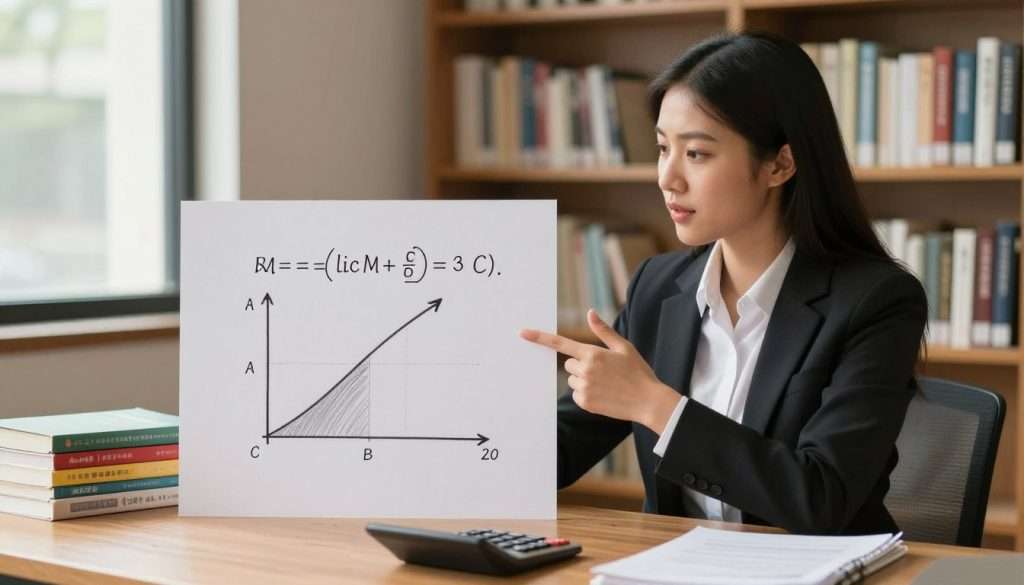
A calculus student can test understanding by explaining what a definite integral adds up, without leaning on the formula alone. Everyday language can make a concept easier to discuss across different subjects. Use the method to support exam study, not to replace course materials or practice.
A definite integral adds up many small pieces to find a total, such as the area under a curve. That plain-language account gives you a starting point; examples and problems still help you use the idea accurately.
Turn a class topic into a plain-language example
Choose one concept from class, then explain it with a simple image or example. The examples below show how the same test can fit different topics. For history, use an event from your own course rather than a made-up example.
| Subject | Example concept | Plain-language test |
|---|---|---|
| Calculus | Definite integral | Explain accumulation as adding many small pieces |
| Biology | Cell membrane | Explain how a boundary controls what enters and leaves |
| History | A named event from your course | Explain one cause and one effect |
Use the table as a starting point, not a complete answer key. A strong explanation can name the main idea, show how it works, and give one fitting example. When a topic has several causes or parts, choose one link to explain first.
Choose the right materials for exam study
Match your source material to the course and exam you need to prepare for. The Feynman Lectures on Physics can support conceptual physics learning. JEE candidates should pair them with study material that matches the relevant syllabus, rather than rely on them alone.
You can also use the Feynman Technique online with a digital blank page and your course materials. Explain the idea aloud on a recording or video call, then listen for places where your account loses its thread. A screen can hold notes, but your own explanation still does the testing.
Keep enough time for problem sets, practice questions, and any review your class requires. The method builds clear explanations, while other study tools help you learn how to solve specific tasks. Those skills work best when your materials match the subject and the test.
Know when explanation needs another study tool
Explanation alone may not train every skill you need. A math test can ask you to solve problems under time limits, while a language course may need listening or speaking practice. Add the tool that fits the task, then use a plain explanation to check the ideas behind it.
Watch for these four common missteps when you use the method:
- Choosing a whole subject instead of one concept.
- Copying sentences from source material.
- Using jargon to hide uncertainty.
- Polishing an explanation forever instead of moving on when it is clear and accurate.
Do not let a clean explanation replace the practice your course requires. Use each tool for the skill it can build.
Sleep also supports study, though it cannot promise a particular exam result. The stated target for JEE aspirants is 6.5 to 8 hours daily, and the recommendation for ages 16-18 is 7-8 hours per night. Protect enough sleep to support study: the stated JEE target is 6.5 to 8 hours daily, and the recommendation for ages 16-18 is 7-8 hours nightly.
Who Was Richard Feynman, and Why Was He Controversial?
Richard Feynman shared the 1965 Nobel Prize in Physics for work in quantum electrodynamics. His name is tied to a learning method, but his scientific work and personal conduct are separate parts of his legacy. His achievements do not make every account of his behavior acceptable.

The physicist behind the name
Feynman was born on May 11, 1918, and died on February 15, 1988. He shared the prize with Julian Schwinger and Shin’ichirō Tomonaga. Their work advanced quantum electrodynamics, the study of how light and matter interact.
He became a well-known physicist, teacher, and writer. His name also appears in The Feynman Lectures on Physics, a set of books used to study physics concepts. The learning method draws on the value of clear explanations, not on a claim that its namesake lived without fault.
Reported IQ and troubling accounts of his conduct
Feynman’s reported high-school IQ score was 125. The exact test edition and technical details are not identified, so the score should be treated as a reported result, not a full measure of his knowledge. His reported score of 125 does not explain his later scientific work by itself.
His second wife accused him of abuse. That is an accusation, and it should be described as such rather than presented as a confirmed finding. Accounts of his life also describe him deceiving younger women by pretending to be an undergraduate student.
Those accounts raise fair questions about how a celebrated person treated others. A person’s scientific ideas can still matter, while their actions deserve honest attention. Keep the learning method separate from any claim that its namesake was flawless.
A useful learning method does not excuse harmful conduct by the person whose name it bears.
Conclusion
You do not need a perfect study session to begin; one honest explanation of one idea is a strong start. Clear words give us a practical check on understanding, and a marked question can point to your next useful review.
Try the method with one concept today, using a notebook or a blank digital page. Keep your first explanation simple, and let the unclear parts guide your next step.
Want to go deeper? If this article resonated with you, my free book How to Become the Smartest Student in the Classroom gives you a full system: memory techniques, study routines, and strategies that actually stick. No cost, no catch. Grab your free copy here → https://www.studyingmachine.com/free-books/.