

You’ve probably heard someone swear that sunrise or midnight is the best time to study. Your classmates may have packed schedules, jobs, family duties, and energy patterns unlike yours. Copying their routine can leave you tired without helping your concentration.
Instead, we’ll help you test study hours that fit your real life and turn the best ones into a steady routine. You can adjust the plan as classes, work, or other commitments shift. A good schedule makes room for useful study habits, too, because timing alone cannot carry every assignment.
We’ll also look at study methods and rest, two parts of learning that matter just as much as your calendar. You don’t need a perfect routine or a color-coded wall planner. Start with one honest week and notice what helps you get work done while still feeling like yourself.
Key Takeaways
- Choose study hours that work with your energy and responsibilities.
- Test a few realistic time slots before settling on a routine.
- Use focused sessions, regular review, and enough rest.
- Keep your schedule flexible when school or life changes.
- The best starting point is the hour you can show up for consistently and still feel like yourself.
What Is the Best Time to Study According to Research?
Research points to a useful rule: you’re more likely to perform well when your study hours match your natural alertness pattern. A chronotype is your natural tendency to feel more alert and ready to think at certain times of day. Students often do better on thinking tests when the test time fits their chronotype.
Alertness usually rises through the day, dips briefly in the early afternoon, and peaks in the late afternoon. The timing shifts among people, so that broad pattern cannot name one ideal clock time for every student. Your own schedule and energy still count.
Treat a popular study hour as a clue to test, not a rule you have to follow.
A 2017 study of first- and second-year university students found that later starts, after 11 a.m. or noon, linked with the best learning performance in that sample. Evening-oriented students outnumbered morning-oriented students by two to one. That finding describes those students, not every learner.
The daily alertness pattern offers a starting point, while your own chronotype helps you choose a useful time of day. There is no fixed peak hour that suits every student. Treat a popular study hour as a hypothesis to test, not a rule you have to obey.
Should You Study in the Morning, Afternoon, or Evening?
If you’re sharp before breakfast, morning may be your sweet spot; if you warm up later, there’s no prize for forcing a dawn session. Match the hour to your alertness, task, and real schedule. The best window is the one when you can focus and complete the work.
A day has 24 hours, but we can compare three practical windows: morning, afternoon, and evening. Alertness often dips briefly in the early afternoon and reaches a general peak in the late afternoon. Your own timing may differ, so use these patterns as clues.
Morning: use it when your mind is ready early
The best time to study in the morning is when your mind feels ready, not simply because the clock says morning. A quiet hour before classes can suit a student who wakes alert and has a little time. Another student may need breakfast, a commute, and a slower start.
Try a task that needs a clear head, then notice whether you can stay with it. The best time to study in the morning or at night depends on when you can focus without rushing. An early start is a choice, not a badge of honor.
Afternoon: work with the midday dip
Early afternoon can bring a brief drop in alertness, so a dense assignment may feel harder then. If you notice that dip, choose a lighter task or take care of an easy school task first. Your energy may rise later, when a longer or tougher task feels more manageable.
Late afternoon often brings a general alertness peak, though people differ. The best time to study math is when you feel alert enough to work through problems with care. You can test math in different windows and see when you catch mistakes and keep going.
Evening: choose quiet without borrowing from sleep
Evening can suit students who focus later, especially when the house gets calmer. Fewer distractions can make a session easier, but quiet alone does not make it a great choice. If studying at night makes you push bedtime later, the tradeoff may not help your learning.
Use your own experience to compare a math problem set, a reading task, or review notes at different times of day. A task match in the table is a personal test, not a proven rule that one subject belongs in one time slot.
| Time window | Typical alertness pattern | A practical task match | A check before choosing |
|---|---|---|---|
| Morning | May feel alert early | Test a hard assignment if your mind feels ready | Does the slot fit breakfast and class? |
| Early afternoon | Alertness may dip briefly | Test lighter work if focus feels low | Can you move a demanding task later? |
| Late afternoon or evening | General peak may occur late; some focus later | Test math or deep work when you feel sharp | Will the session push bedtime later? |
Pick the window that leaves you alert enough to finish the task without pushing bedtime later. A study hour should help your work, not turn the rest of your day into a scramble.
How Can You Find a Study Schedule That Fits Your Day?
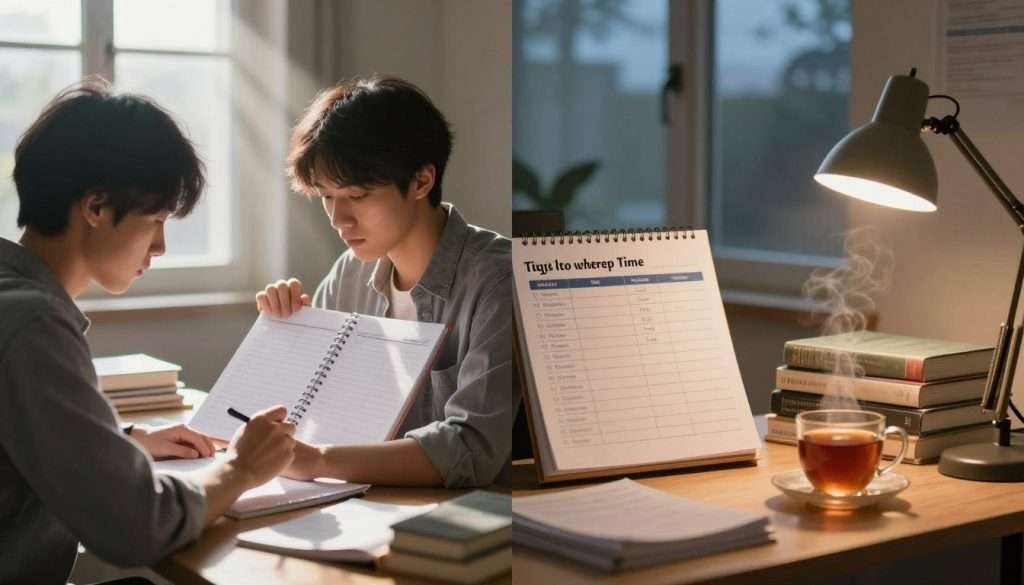
If you only have time after school, test two realistic slots instead of trying to copy a friend’s dawn routine. A workable schedule starts with the hours you truly have. Compare similar tasks at different times, then keep the slot you can sustain.
A seven-day calendar can show where study fits around school, work, meals, and personal plans. The best time to study after school might be right after the final bell, or after dinner and a short rest. Your energy and commitments decide what works, not the bell alone.
Choose a similar type of task for each trial, such as reading two pages or completing a set of practice problems. Record your focus, interruptions, and completed work. That small record can show whether a time slot helps you concentrate or just looks tidy on paper.
- Choose two or three feasible windows.
- Try a similar task in each window.
- Record your focus and completed work.
- Keep the most sustainable option and adjust it when your schedule changes.
Test a few realistic study windows
Use a week to compare the windows you can actually protect. A morning slot may work on days without an early class, while an evening slot may fit better after work. Keep the task type similar, so a difficult project does not make one time look worse by accident.
Note what pulled your attention away, too. A noisy room or a surprise errand can affect concentration, even when you picked a good hour. If one session gets interrupted, record that rather than treating the whole time slot as a failure.
Build a routine around school and life
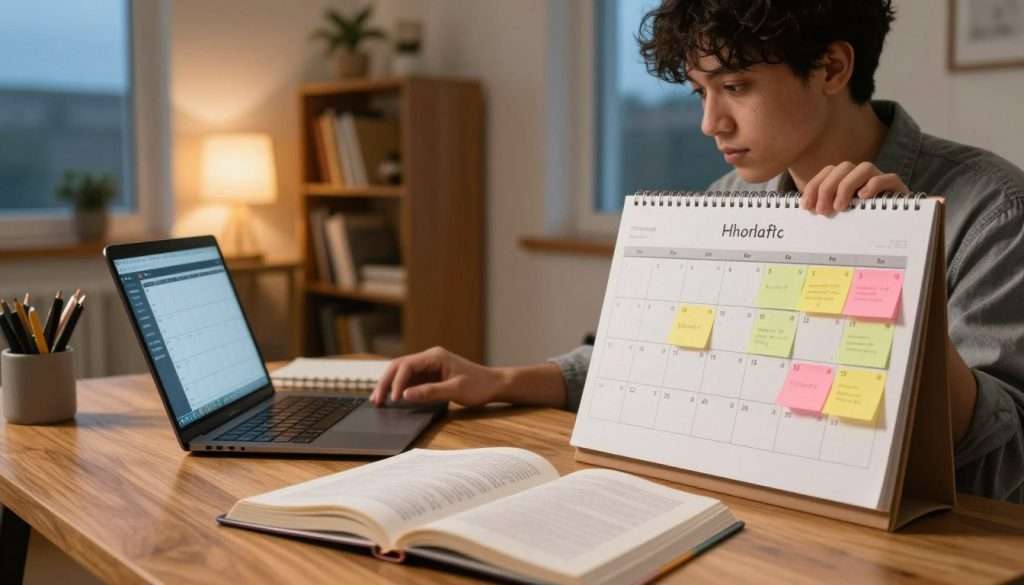
A weekly calendar can make room for classes, meals, work, and rest without filling every open space. Put fixed commitments in first, then add study periods where they fit. Leave breathing room for a bus that runs late, a longer assignment, or simply being human.
Once you have a routine, check whether it still fits after your classes or work shifts change. The point is a schedule that supports your life, not a calendar that demands you live for it. Leave at least one open block in your week so a missed session does not wreck the whole schedule.
How Long Should a Study Session Last?
Try 25 to 50 minutes of focused work and a 5- to 10-minute break, then adjust the rhythm if your attention keeps wandering. That range is a suggested default, not a proven optimum. Choose a work block you can finish with steady concentration.
Research has tested several work-and-break patterns, but those tests do not prove one block length is best. In one university-student comparison, 24-minute work periods with six-minute breaks and 12-minute periods with three-minute breaks linked to less reported fatigue and distraction than self-chosen breaks. Students completed similar work in less time.
Other tests found similar results across different rhythms. During a two-hour session, students reported similar fatigue, motivation, and productivity with 25-minute work periods and five-minute breaks, Flowtime, or self-chosen breaks. For a reading task, 12-minute periods with three-minute breaks and self-chosen breaks produced similar test scores.
| Work-and-break pattern | Study setting | Reported result |
|---|---|---|
| 24/6 and 12/3 fixed breaks versus self-chosen breaks | University-student comparison | Fixed groups reported less fatigue and distraction; similar work took less time |
| 25/5 versus Flowtime and self-chosen breaks | Two-hour study session | Similar reported fatigue, motivation, and productivity |
| 12/3 versus self-chosen breaks | Reading task | Similar test scores; self-chosen breaks brought better reported mood |
Choose a focus block you can sustain
The tested studies used 12-, 24-, and 25-minute work periods, but they did not test which length was best. So use those numbers as options, not a trophy chart. A 30-minute block may suit one assignment, while another task may need a longer stretch.
Breaks of 10 minutes or less had small effects, including more energy and less fatigue. Longer breaks linked to larger gains in performance. That does not mean every break should be long; the task and your attention matter.
Take breaks without chasing a magic timer
In a seminar study of 253 second-year undergraduates, performance declined over time in both micro-break and traditional-break groups. Students taking micro-breaks kept their performance more consistent over time. A quick pause can help you hold a steadier pace, even if it cannot erase fatigue.
Try standing, stretching, or getting water instead of scrolling into a longer break by accident. Notice how you feel when you return to work, then adjust the timing. If a break leaves you more tired instead of refreshed, change its length or step away from the desk.
Break patterns tested in students offer useful options, not a magic timer that every learner must follow.
How Can You Make Study Time Stick?
For exam learning that lasts, spread your preparation across several days or weeks instead of saving everything for one marathon. Spaced practice means learning across separate sessions. It improves long-term memory compared with cramming an equal amount into one session.
Spaced practice has been shown in more than 200 research studies. You might study for one or two hours every other day, or review at least once a week, rather than cram for 12 hours. The best time to study for exams is several weeks ahead when possible, so you have room to return to key ideas.
Review does not have to mean starting every topic from scratch. For example, return to Week 1 material during Weeks 3 and 4. Some learners use 75% of their study time for new material and 25% for review, but that split is an option, not a fixed rule.
Space review across days and weeks
When you leave days between reviews, your brain has to rebuild the path to the information. That effort can help the material last. One giant cram session may help you feel familiar with a chapter, but familiarity is not the same as being able to recall it later.
Build review into your study routine in small, repeatable visits. Pick a day to revisit old notes or work through a few practice questions. The long-term memory benefits of spaced practice make regular review a useful part of exam preparation.
Practise recalling before you reread
Retrieval practice means recalling information without looking at your notes. Try flashcards, a low-stakes quiz, or a brain dump where you write what you remember. Retrieval practice generally improves longer-term retention and can work better than rereading the same page again.
The best time to study and memorize is a time when you can focus, paired with repeated recall and review. Use this simple sequence to work with new material and bring it back later.
- Learn new material and mark the ideas that matter.
- Return to that material in later study sessions.
- Close your notes and retrieve key ideas with a quiz, flashcards, or a brain dump.
End a review session by writing down what you can recall before checking your notes. The gaps you find give you a clear target for the next round of learning.
How Do Sleep and Night Studying Fit Together?
A quiet house can make night study tempting, but a late session only helps if you still get enough sleep afterward. Sleep supports learning and memory, so a calm study hour is not a fair trade for too little rest. Choose a night study time that leaves room for the sleep recommended for your age.
The best time to study at night is early enough to protect your usual bedtime. A calm late session can work for students who focus later, but staying up so long that rest gets cut short can hurt the routine you are trying to build. Quiet is useful; exhaustion is not.
When the house gets quiet, set a firm stop time before opening your notes.
Teenagers ages 13 to 18 are generally advised to get 8 to 10 hours of sleep each night. Adults generally need at least seven hours. The CDC’s 2023 Youth Risk Behavior Survey found that 23% of U.S. high school students reported at least eight hours on an average school night.
Those numbers make sleep a real part of a study plan, not a bonus for unusually organized students. Protecting rest gives your brain time to support learning and memory. Set a stop time that protects your sleep, even when the house finally gets quiet.
Conclusion
Your best study hour is the one that fits your energy, your responsibilities, and your need for rest. A study routine works best when you can repeat it without turning every day into a contest against the clock. Small choices can make learning and memory feel less like a grind.
Choose one realistic study window to test this week, then adjust it based on what you finish and how you feel. Want to go deeper? If this article resonated with you, my free book How to Become the Smartest Student in the Classroom gives you a full system: memory techniques, study routines, and strategies that actually stick. No cost, no catch. Choose one realistic study window to test this week, then grab your free copy of How to Become the Smartest Student in the Classroom at https://www.studyingmachine.com/free-books/.