

You can learn faster and remember more by practicing actively, reviewing over time, and focusing on what you need to understand. Learning faster means making your study time count, not skipping effort.
Maybe exams are coming, a new skill feels hard, or your day already has too much packed into it. We can make learning feel more manageable by choosing useful work over extra hours of rereading. This guide pairs practical methods with research findings, so you can build a plan that fits school, work, and life. Pick one technique to try in your next study session instead of attempting all eight at once.
Key Takeaways
- Measure progress by what you can explain or do without help.
- Use active recall to bring information to mind before checking notes.
- Space reviews across days when you need knowledge to last.
- Match practice to your goal, whether it is understanding or performance.
- Use feedback and new questions to check whether learning transfers.
- Choose one small method to test in your next study session.
What Does Learning Faster Really Mean?
A fast first read is not the same thing as being able to explain or use an idea tomorrow. Real progress means understanding something in less time and still recalling or using it later.
Set a goal you can check, such as explaining a concept without notes or solving a new problem. “10x faster” is an aspiration, not a guaranteed result. There is no shortcut that makes every person learn every subject ten times faster.
Learning quickly means making efficient progress without trading away lasting understanding.
You can learn anything fast and remember it better by matching practice to your goal and returning to material later. A quick first look may help you recognize an idea, but recognition alone does not show that you can explain it from memory.
People learn at different rates, and a familiar idea may click sooner than a new one. The useful measure is not how many pages you finish. It is whether you can use the information when the book is closed and the question changes.
Before studying, write down one thing you want to be able to do without help.
How Do You Protect Your Focus Before Studying?
Protect focus by removing easy distractions and choosing one clear task before you start. A small setup can keep a buzzing phone from turning one study session into a tour of everything except the subject.
Put your phone and other distractions out of reach, then keep only the materials you need nearby. The University of North Carolina Learning Center gives 30- or 45-minute sessions as examples of short, intensive study sessions.
- Silence notifications on your phone and computer.
- Clear the work area, leaving the needed materials in reach.
- Choose one task, such as answering five questions.
Set up a study space with fewer distractions
A quiet room helps, but a perfect desk is not required. Put tempting tabs away, close unrelated apps, and bring out the book, worksheet, or notes for the task.
If you study in a shared space, choose a seat with fewer people walking past. Headphones can mark your study time, even when you do not play music.
Make starting feel manageable
When beginning feels hard, promise yourself five minutes of work. Open the first page, read one question, or set up the materials for one problem.
Once your attention settles, you can keep going. If it does not, five minutes still gives you a start and shows what is getting in the way.
Use a 30- or 45-minute focused session as a starting example, then adjust the length to fit your attention and task.
Should You Practice a Skill or Build Conceptual Understanding First?
Choose conceptual learning when you need to explain an idea, skill practice when you need to perform, and both when the subject requires both. The target matters: explaining a guitar chord does not mean you can change to it smoothly.
Match the study task to the outcome you want. Two broad learning targets are understanding concepts and performing skills, and many subjects combine them.
When you need to understand a concept
Connect a new idea to something you already understand. For example, if you are learning fractions, link one-half to sharing a snack equally between two people.
Then ask how the new concept works and where the comparison stops fitting. A helpful connection gives the idea a foothold without replacing the facts you need to learn.
When you need to perform a skill
To perform a skill, you need to do it, not only describe it. Solve problems, play the chord, write a program, or carry out the steps you must use later.
Math and programming often need both approaches. You might explain why an equation works, then solve a new one without copying a model.
| Learning target | Useful practice | Sign of progress |
|---|---|---|
| Concept learning | Explain an idea with an example | Clear explanation without notes |
| Skill practice | Perform the skill or solve problems | Correct performance on a new task |
| Mixed subject | Explain a rule, then apply it | Can explain and use the rule |
Name whether your next task needs explanation, performance, or both before picking a study activity.
How Can You Learn Faster With Active Recall?
Close your notes and try to explain the last idea you read before you look at it again. Active recall means trying to bring information to mind without looking at the answer.
Retrieving an answer strengthens learning more than simply looking at it again. A systematic review found a medium testing effect, Hedges’ g = 0.50, including in applied classroom settings. A 2025 evidence synthesis found active recall beat passive strategies in 9 of 11 undergraduate comparisons.
Use a question from your notes as a prompt, then answer it with the book closed. You can also solve a problem from memory or recite the key points of a lesson.
A wrong or incomplete answer is useful information, not a verdict on your ability. It shows which part needs another look. Check the material after your attempt, then make the next question focus on what you missed.
Recall practice is not the same as taking a graded test. You are using the effort of retrieving information to find what you know and what still needs work.
For example, after reading about photosynthesis, ask yourself what plants need to make sugar. Try to name the parts before checking your notes.
That short pause matters. When the answer is already in front of you, it is easy to mistake familiarity for memory. Making yourself retrieve it gives you a clearer read on your learning.
End each recall attempt by checking the answer and correcting the part you missed.
How Does Spaced Repetition Help You Remember Longer?
If you need to remember something next week, one long cram session is a poor substitute for returning to it after a gap. Spaced repetition means reviewing information at increasing intervals instead of cramming it all into one sitting.
The useful review gap depends on how long you need to retain the material. A vocabulary study with 102 people learning German-Japanese pairs found different forgetting rates across different spacing intervals.
Choose a review gap that fits your goal
In that study, 4-, 8-, and 12-hour gaps led to almost no forgetting 24 hours after the final session. The 7.5-minute gap led to 9.3% forgetting, while the 24-hour gap led to 3.6%.
After seven days, forgetting was about 13% for gaps between 4 and 24 hours, compared with 34% for the 7.5-minute gap. These results describe one vocabulary study, not a universal schedule.
A study of more than 1,350 people found the best gap was about 20-40% of a one-week test delay. For a one-year test delay, it was about 5-10% of that delay.
Build a simple spaced-review calendar
Start with a review the next day, then return to the material over the following days. Mark each review on a calendar, so a busy week does not make the material disappear.
| Spacing interval | Forgetting 24 hours after final session | Forgetting after 7 days |
|---|---|---|
| 7.5 minutes | 9.3% | 34% |
| 4-12 hours | Almost none | About 13% |
| 24 hours | 3.6% | About 13% |
Put the next review on your calendar before you close your notes.
When Should You Mix Topics With Interleaving?
A mixed set of math problems makes you decide which method fits instead of copying the same steps on autopilot. Interleaving means switching between related topics or problem types during practice.
Mix familiar problem types when you need to choose the right approach. In a university physics study, students did interleaved or regularly arranged homework three times a week for eight weeks. Median improvements after interleaved practice were 50% on test one and 125% on test two.
Mix problem types that use different approaches
Try alternating questions about fractions, equations, and graphs instead of doing every example of one type in a row. Before solving each question, identify which method fits.
That choice is part of the challenge. A worksheet with mixed questions may feel slower at first, because each problem asks you to read, decide, and then work.
Switch back to focused practice when a skill is new
Interleaving can be frustrating before you know the first move for each problem type. Get familiar with each type first, so you can make a real choice when the questions are mixed.
If a new method still feels confusing, work through a few similar examples before switching topics. The goal is to practice choosing, not to guess at a step you have not learned.
Mix familiar problem types when your goal is choosing the right method, not when you are still learning the first move.
How Can the Feynman Technique Expose Gaps?
If your explanation needs a stack of unfamiliar terms, you may have found a gap worth investigating. The Feynman Technique uses a plain explanation to test whether you understand an idea.
Explain the idea as if a sixth-grader needed to follow it. Jargon can hide a gap instead of fixing it, so try the explanation from memory before returning to your notes.
Use these four steps to work through a concept:
- Choose one concept you want to understand.
- Explain it simply in your own words.
- Find the gaps or parts you cannot explain.
- Review the material, then explain it more simply.
For example, explain why a car’s speedometer changes as the car speeds up. You might say that the speedometer shows how fast the car moves, then explain how it responds when the car gains speed.
If you reach for a technical term, ask whether you can describe what it means. A long word may be right, but it should not do all the work for you.
Return to your notes only after trying the explanation from memory. Look for the missing link, then rewrite the explanation with that point in mind.
Rewrite the explanation until someone outside the class could follow its main idea.
How Do Deliberate Practice and Feedback Build Skill?
If you keep missing the same step in a problem, doing another full worksheet may not fix the real issue. Deliberate practice focuses effort on one part of a skill that needs improvement.
Choose a drill that targets the weak link, then use feedback to shape your next attempt. A coach, teacher, answer key, or recording can show what to change.
Find the weak link in your performance
A guitarist may know a song but stumble during one chord change. Instead of repeating the whole song, the guitarist can isolate that change and practice it at a manageable pace.
You can do the same with a missed step in a math problem. Name the step, then work on problems that use that part rather than repeating everything you already do well.
Use feedback to choose the next drill
Compare your answer with a model answer and find the first place they differ. Ask a teacher or coach for one specific correction, such as where your reasoning stops matching the method.
Use this three-stage cycle:
- Practice or apply the skill.
- Measure how well you performed.
- Adjust the drill and practice again.
Make the next drill just hard enough to reveal whether that one weak link has improved.
How Can You Connect New Ideas to What You Already Know?
A new idea often becomes less intimidating when you can attach it to something you already understand. A familiar comparison gives unfamiliar information a place to land in your mind.
Use an analogy to build a foothold, then test where it stops matching the real concept. For example, you might compare a computer’s file folders to folders in a cabinet: both help organize things, but digital files work differently.

A connection-based learning loop can help you refine your understanding. Start with confusion, then look for a first insight that links the idea to something familiar.
Next, expand the insight by finding more useful connections. Trim comparisons that do not fit, then repeat the process as new details appear.
This process keeps a new idea from sitting alone in a pile of facts. It also gives you a way to notice when an analogy is doing more than it should.
For instance, a file folder can help explain organization, but it does not explain every feature of a computer system. Keep the actual concept in view as you make the comparison.
Ask yourself where your analogy stops matching the real idea.
Why Teach or Summarize What You’re Learning?
You do not need a classroom to teach an idea; explaining it to an empty room can still show you what you know. A short teach-back asks you to recall the main point and explain it in your own words.
Write a brief summary from memory, then check it against the original material. That check matters because teaching a mistaken explanation can reinforce an error.
Try one of these quick teach-back options:
- Write a short summary without looking at your notes.
- Explain the idea to a classmate in everyday words.
- Record a voice note and listen for unclear parts.
Afterward, compare your explanation with the course material. Fix any detail that you left out or described in a way that changes its meaning.
A summary does not need to cover every line. Choose the main idea, one key detail, and an example that shows how the idea works.
Check one key claim against your course notes before sharing your explanation.
How Can You Use AI as a Study Partner?
An AI tutor is most useful when it gives you a question to solve, not an answer to copy. Used as a study partner, it can offer hints, practice questions, or another explanation of a hard idea.
Check AI answers against class materials, then solve or explain the answer without AI. Study results differ across settings, so they do not support a claim that AI always improves learning.
Ask for hints and practice questions
Ask the AI tutor to give a hint instead of solving the whole problem. You can also request questions on a topic, then answer them before asking for feedback.
For a tricky concept, ask for a second explanation with a familiar example. Treat it as a starting point, not a replacement for your own thinking.
Check the tutor instead of trusting it
A randomized trial with 2,379 undergraduates and 30 instructors at a large U.S. public university found lower final grades in sections with a course-integrated AI tutor.
In a separate randomized trial, 194 Harvard undergraduates using a custom AI tutor had a higher median post-test score than students in in-class active-learning lessons.
| Setting and sample | Outcome measured | Result |
|---|---|---|
| Public university, 2,379 undergraduates | Final grades | Reduced by 0.37 standard deviations |
| Public university, 2,379 undergraduates | Course participation | Reduced by 0.90 standard deviations |
| Harvard, 194 undergraduates | Median post-test score | 4.5 with AI tutor, 3.5 with active-learning lessons |
Before you accept an AI explanation, see whether you can verify its key point in your class materials.
How Do You Build a Weekly Study Routine?
A five-day plan with small tasks is easier to keep than a giant study session that takes over Sunday. Spread the work across several days, and give each study block a clear job.
Practice questions and spaced review beat a last-night cram for exam preparation. The University of North Carolina Learning Center recommends practice across days and weeks; for history, it suggests studying class notes for 15-20 minutes each day.
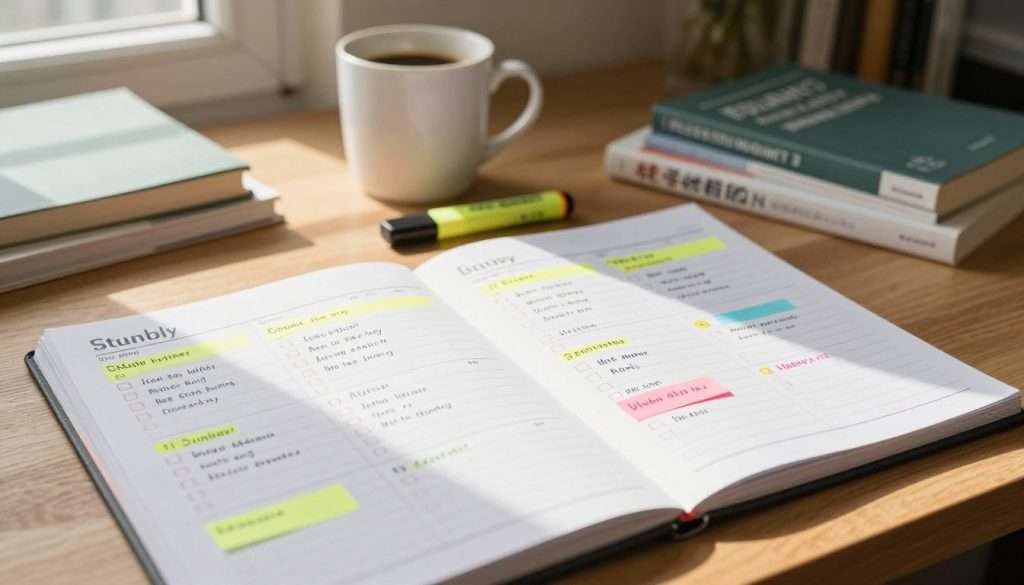
Spread study across several days
Break a large topic into small tasks. One day, sort the key ideas; another day, work through problems; later, return to the questions you missed.
Short tasks are easier to fit around classes, work, and other parts of life. Give each one a start and finish, such as reviewing a chapter’s key terms.
Fit review around classes and exams
Prioritize likely exam tasks first, then return to weak areas. Use practice questions to find what needs work instead of spending the same amount of time on every topic.
| Day | Study focus | Recall or practice task | Review task |
|---|---|---|---|
| Monday | Key topic A | Answer five questions | Review last week’s notes |
| Tuesday | Key topic B | Solve three problems | Revisit Monday’s missed points |
| Wednesday | Key topic C | Explain the main idea | Review Tuesday’s key steps |
| Thursday | Mixed exam topics | Try a practice set | Return to weak answers |
| Friday | Hardest topic | Complete fresh questions | Check key facts from the week |
Schedule the first study block for the time of day when you are most likely to begin it.
Why Does Sleep Matter for Memory?
A late-night reread can feel productive, but it cannot replace the work your memory does after studying. Sleep supports learning by helping the brain strengthen and organize what you have taken in.
Keep a regular chance to sleep instead of treating an all-nighter as a shortcut. A 2023 review of 19 systematic reviews and meta-analyses found that sleep helps memory consolidation, especially for complex declarative information.
How sleep supports memory consolidation
Memory consolidation is the process of organizing and strengthening what you learned. Sleep gives the brain time to work with new information after a study session.
This does not mean sleep can replace practice. You still need to work with the material while awake, but rest supports what you have learned.
Protect sleep during a busy study week
When an exam is near, another late reread may seem like the safest choice. Yet losing sleep can leave less room for rest and steady learning the next day.
Make a regular sleep opportunity part of your plan, even during a busy week. Set a stopping time that gives you room to wind down before bed.
Keep the planned sleep opportunity on your schedule when an exam is near.
How Can You Tell Which Technique Is Working?
If your notes look familiar but a fresh question still stumps you, it is time to measure learning another way. Useful progress means recalling a practiced idea and using it on a new question.
Test yourself without help, then adjust your method based on what the attempt shows. A 2025 study found retrieval practice improved retention and transfer when sufficient practice came before a one-week delay.
Familiar notes are not proof that you can use an idea on a new problem.
Use a simple check: practice or apply the idea, measure unaided recall or performance, then learn from the result and adjust. A new question can show whether the idea transfers beyond the example you practiced.
If progress stalls, check for one of these common problems:
- Rereading without testing what you can recall.
- Practicing only material that already feels familiar.
- Skipping the gaps between review sessions.
- Keeping a method that does not match your goal.
Write down what you could do without help and what still needed a prompt. That small record can show whether a change is helping across several sessions.
Change one part of your routine at a time so you can tell what helped.
Conclusion
You do not need a perfect study system to begin; one focused session is enough to get moving. A small routine you can repeat can make studying feel more manageable and help new knowledge stick.
Choose one method and try it in your next session. Notice what you can explain or do afterward, then keep the parts that help.
Get your free copy of How to Become the Smartest Student in the Classroom, a book with memory techniques, study routines, and strategies that stick: https://www.studyingmachine.com/free-books/. No cost, no catch.