
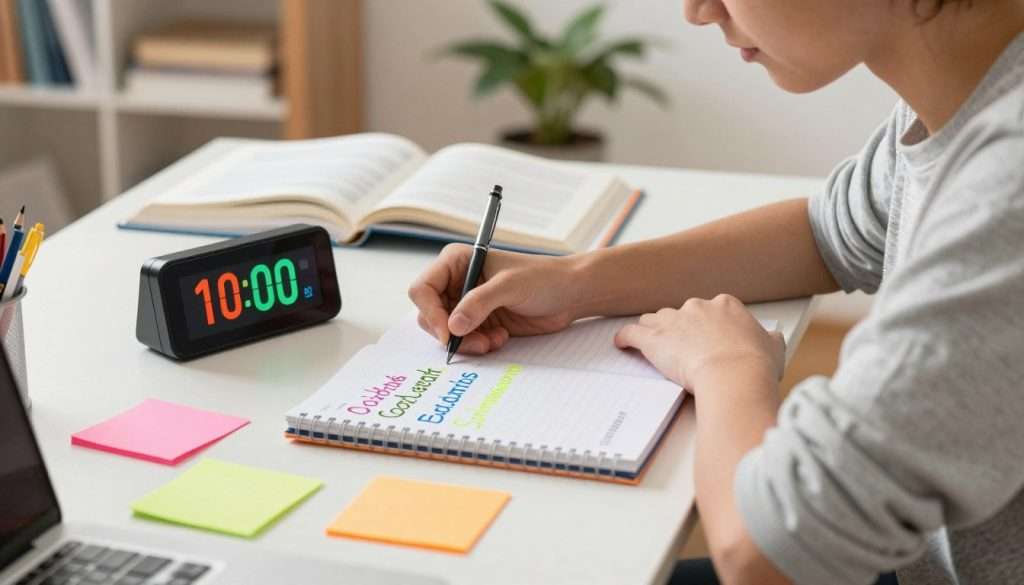
We can make studying easier to return to by giving it a clear cue, a doable challenge, visible progress, and a satisfying reward, not by trying to create a clinical addiction. Social media can make a textbook feel quiet by comparison, but learning does not need to become compulsive to feel rewarding.
Clear goals give students a place to begin, while small wins can build motivation and help protect attention. We can set up study sessions so they feel welcoming, useful, and easy to restart, even on a busy day. That means making progress visible and leaving room to stop when you need to.
Think of this as a friendly nudge, not a trick to keep you at your desk. You choose the task, the pace, and when you are done. The goal is a study routine you can choose, enjoy, and leave when you need to.
Key Takeaways
- Make the first study action clear and small.
- Choose work that stretches your current skills.
- Use active recall to see what you remember.
- Track progress with simple, reachable goals.
- Protect your attention from unwanted distractions.
- Keep rewards short enough to return from.
Can Studying Really Be Addictive?
If “addictive” means you want to come back to a useful routine, that’s a reasonable goal; clinical addiction is a very different thing. A habit can support your learning without taking control of your choices.
Addiction involves compulsive behavior despite harmful consequences. The Cleveland Clinic defines addiction as compulsively seeking and taking a substance or doing an activity despite harm, as explained in its addiction overview.
A useful study habit should help you meet your goals, not push you to keep going when studying harms your life.
Drug addiction is a chronic, relapsing disorder tied to compulsive drug seeking and use, even when it causes harm. It can involve lasting changes in brain circuits linked to reward, stress, and self-control.
For substance use disorder, DSM-5 requires at least two listed signs within 12 months. Two or three signs indicate mild disorder, four or five moderate disorder, and six or more severe disorder.
DSM-5 recognizes gambling disorder as a behavioral addiction. It does not currently include other behavioral addictions because more research is needed. Struggling to start studying, by itself, does not diagnose a disorder.
A study routine may feel rewarding and repeatable without resembling addiction. Keep the difference clear when people use the word casually. Aim for a routine that supports your life, not one that takes it over.
Make Studying Addictive With a Reward Loop You Can Repeat
A useful study loop has three pieces: a cue that gets you started, an action you can manage, and a reward that feels good without derailing your day. Keep each piece simple enough to repeat.
We can call this pattern the habit loop: cue, action, reward. The cue points toward a task, the action moves you forward, and the reward gives your brain a satisfying finish.
Give the routine a clear cue
A reliable cue can be a time, place, or familiar action. You might sit at the same desk after lunch, put a notebook in front of you, and begin there.
The cue does not need to be fancy. A repeated moment makes the next action easier to spot, especially when your day feels crowded.
Make the first action easy
Choose an action so small that starting feels manageable. Open your notes and answer one question, or read one paragraph and write a key idea.
A two-minute starter lowers the barrier to beginning. Treat those minutes as an invitation, not a promise that you will keep going. You may stop when they end.
Small actions are useful because they turn “I should study” into something your hands can do. You can build on that start when you have the time and energy.
Choose a reward that supports the next session
Make the reward easy to enjoy and easy to end. Check off the task, stretch, or take a planned break before returning to your day.
In the Hooked habit model, a trigger leads to an action, a variable reward, and an investment. For study, the useful idea is to notice what makes you want to return, without turning the session into a contest.
A reward should feel like a finish line, not a trapdoor into another hour of scrolling. Pick one you control, such as a snack or a short walk.
Keep the action modest enough for a tired day, too. That gives your routine a better chance of surviving beyond the perfect Monday morning.
Make the reward something you can enjoy and then leave behind when the break ends.
How Challenging Should Each Study Task Feel?
The sweet spot is a question you can’t answer automatically but can make progress on with what you already know. A flow state is a period of deep focus when your attention stays with the task and outside distractions fade.
Match task difficulty to your current skill. Work that is too easy may feel dull, while work far beyond your skill can turn into frustration.
The table can help you choose what to work on next. Use how the task feels as a clue, then adjust the size or difficulty.
| Task fit | How it feels | Example | Next move |
|---|---|---|---|
| Too easy | Familiar, low effort | Rereading notes you already know | Close notes and explain the idea from memory |
| Well matched | Challenging but workable | Answering a question at the edge of your knowledge | Try it, then check your reasoning |
| Too hard | Confusing, little progress | Attempting an advanced problem before learning its foundations | Review one foundation and retry a smaller step |
Skill grows through practice, so a hard topic does not need to stay hard. Break it into smaller parts, then return to the larger task when you have more tools.
Games often introduce one rule before adding another. Mario’s early levels offer a familiar example of gradual challenge, but that does not mean all learning feels effortless.
Pay attention to whether you can make a next move. If you feel stuck, shrink the task until you can take one useful step.
How Do You Know What to Do Next?
“Study biology” is hard to start; “answer one question about cell membranes” gives your brain a place to step in. Write one action you can finish, not a whole subject.
A vague goal leaves you choosing among notes, chapters, and practice questions. A clear task gives your time a job and makes it easier to begin.
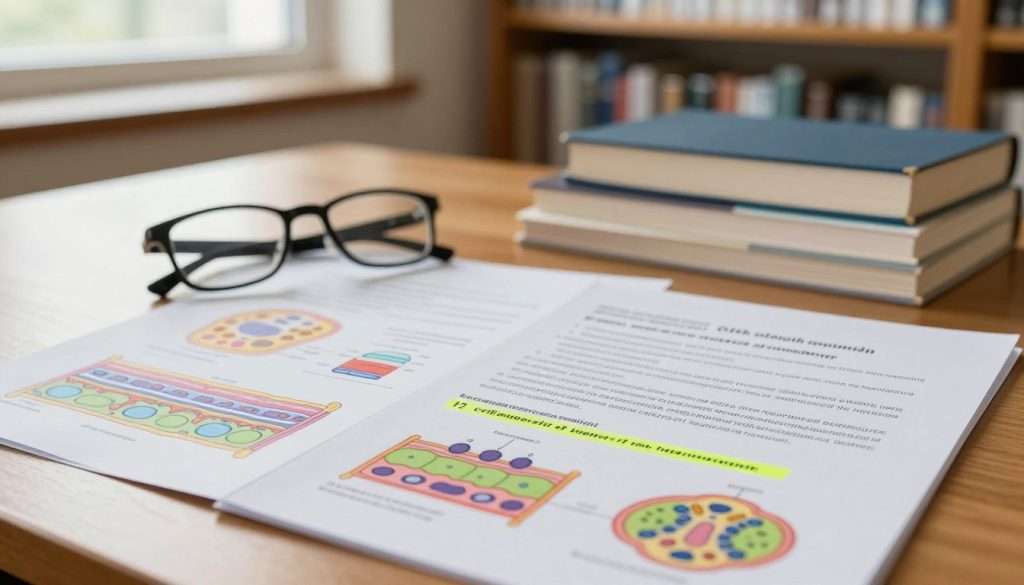
Use this quick checklist to turn a broad topic into a visible task:
- Write down one thing you cannot explain.
- Scan headings and repeated terms in your notes.
- Choose one active-recall question to answer.
- Leave the materials for that task within reach.
A 30-second gap list names things you cannot explain yet. A 30-second frame grab captures the topic’s headings, repeated terms, and order.
Use those quick steps to see the shape of the work. The output dump comes after studying: take 60 seconds to recall key ideas without looking.
Do not let planning become the whole session. It is easy to spend so long making a beautiful plan that no learning happens.
Put only the notes and tools needed for the chosen question in front of you. That keeps the task clear without adding a second project.
Before you stop planning, make sure your next action fits in one plain sentence.
How Can Small Goals Make Progress Visible?
A finish line feels closer when you can see the small steps you have already crossed. Set a goal you can track, such as answering a set number of questions or understanding one section.
Break a large outcome into small checkpoints. The goal gradient effect describes how effort can rise as a goal gets closer.
Instead of aiming to “know the whole unit,” pick a clear target for this session. You might complete a practice test, explain a concept, or reach the end of one topic.
Marking progress gives motivation something solid to hold. Track milestones such as these:
- Questions answered correctly or attempted.
- Concepts recalled without notes.
- Study sessions completed this week.
One student completed 2,000 active-recall questions in a week by setting daily targets. That is one person’s example, not a benchmark or a sensible goal for everyone.
Your target should fit the time and energy you have today. A smaller goal you can finish gives you a clear record of what you did.
Choose a target you can reach in today’s session, then record whether you reached it.
How Can You Make Practice Feel Like a Game?
A study session gets more engaging when you have to make a move, not just watch information pass by. Active recall means retrieving information without looking at your notes.
Choose practice that makes you produce an answer. Flashcards, quizzes, and blank-page recall all test what you can bring to mind.

Rereading can make a topic feel familiar, even when you cannot explain it from memory. The table shows how different methods give you different feedback.
| Method | What you do | What feedback you get |
|---|---|---|
| Rereading notes | Read a page about cell division again | The page feels familiar, but you have not tested what you can produce |
| Flashcards or quiz questions | Answer a prompt before checking the back or answer key | You see which facts you can retrieve and which need work |
| Blank-page recall | Write everything you remember about a topic without notes | Missing details and strong connections become visible |
Game-like learning apps such as Duolingo and Shiken use features that can make practice feel playful. A friend can add social practice by quizzing you on key terms.
Points and streaks can help you notice effort, but they should support learning rather than become the whole point. Your knowledge matters more than a perfect run of badges.
Try one question, check your answer, and keep score only if the score helps you focus. The feedback should tell you what to work on next.
Keep the game mechanic that helps you retrieve knowledge and drop the one that distracts you from it.
What Makes a Study Routine Stick?
A routine is easier to repeat when the same ordinary moment keeps pointing you toward the same first action. Repeat your study action in a stable context to make it more automatic.
Habits form when people repeat a behavior in a steady setting and receive rewards over time. A familiar cue can become linked with a response, much like Pavlov’s bell became associated with food.
A 2025 study tracked 419 people for two weeks using 27,446,977 GPS and app logs, plus 7,226 trip questionnaires. Stronger app habits predicted a higher chance of app use on familiar routes and at familiar places.
Social app habits were stronger and less tied to one setting than non-social app habits. Those findings describe app use, not proof that studying can be made addictive.
Pick a realistic time and place that fit your day. A quiet library table after class may work better than an ambitious plan for midnight.
The Pomodoro Technique is one option: work with focus for 25 minutes, then take a 5-minute break. You can test that pattern, then adjust it to your task.
Habits become easier to repeat through frequent rewards and steady cues, but your schedule still needs room for real life. Keep the routine small enough to repeat on an ordinary, busy day.
What Should You Do When You Get Answers Wrong?
A wrong answer can show you exactly where your memory needs another bridge. Treat it as useful information, not a verdict on your ability.
Use each mistake to choose one specific next attempt. Checking what you missed helps you see what needs a clearer link or another try.
Treat mistakes as information, not a verdict
When an answer is wrong, the useful question is what part you could not recall or explain. Maybe you mixed up two terms, skipped a step, or forgot how one idea connects to another.
Mark that gap in plain words. “I forgot what the cell membrane controls” gives you a better next move than “I’m bad at biology.”
Mark Rober’s 2017 programming puzzle involved 50,000 followers. Among participants who lost no points, 68% solved the puzzle, compared with 52% who lost five points.
The difference was 16 percentage points. The no-penalty group averaged about 12 tries, while the group losing five points averaged about five.
Those figures describe that puzzle experiment, not a promise about exam results. They do show why room to try again can matter during a practice task.
Use feedback to plan the next attempt
Use a short repair process before you try the question again:
- Attempt the question without checking your notes.
- Check the answer and find the missing part.
- Write down the missing idea before trying again.
Keep your note specific: name the step, fact, or link that slipped away. Then make another attempt with that single gap in mind.
You are not trying to erase every mistake from practice. You are turning the last answer into a better clue for the next one.
Before doing another question, name one thing the last mistake taught you.
How Can You Protect Your Focus From Your Phone?
If your phone is within easy reach, a quick check can turn one study question into a detour through your feed. Put more distance between you and easy distractions.
A UT Austin study found that people whose phones were in another room significantly outperformed people with phones on their desks. Even short interruptions can cause resumption lag, the time needed to return attention to a task.
Put friction between you and the phone
Place your phone in another room when you need focused attention. If that is not possible, use a website blocker and close the social media tabs that compete for your time.
Keep your study supplies close, so a missing pencil or book does not send you wandering. Small changes to the room can help your attention stay with the work.
Match music to the task
Music may suit repetitive tasks, while reading, writing, or learning a new topic may be harder with it. Advice from the University of Maryland favors music for repetitive work and against it for those focus-heavy tasks.
Your own response matters, too. Switch music off if you start following the song instead of the task.
| Situation | Phone | Music | Practical choice |
|---|---|---|---|
| Reading or new topics | In another room | Off or quiet instrumental | Read one passage without alerts |
| Repetitive tasks | Out of reach | Try familiar music | Use a playlist that does not need choosing |
| Organization or an artistic project | Nearby only if needed | Try music that suits the task | Keep supplies close and check your focus |
Music does not help every person or every task in the same way. Treat the table as a starting point, not a rule for the whole world.
If you notice yourself singing along or checking alerts, change the setup before blaming your focus.
What Should Your First Week of Study Practice Look Like?
Start your first week with one topic you can revisit, not a promise to overhaul your whole life by Monday. Keep each study session short enough to fit your real schedule.
A 5-minute minimum routine can include a 30-second gap list, a 30-second frame grab, study time, a 60-second output dump, and 2-3 minutes of quick recall.
These times are practical examples to adapt, not a required daily workload.
A 15-minute standard routine adds 10 minutes of blank-page reconstruction. Try this four-step plan for your first week:
- Pick one topic you can return to during the week.
- Use the 5-minute minimum or 15-minute standard routine.
- Check your recall for 30-60 seconds before sleep and after waking.
- Use one brief daily recall for the next seven days.
The first recall checks what stayed with you overnight; the second checks what comes back after sleep. Keep each attempt short and focus on what you can retrieve.
Times are guides, not a daily workload you must hit. A busy day can call for the minimum, while a more open day may suit the longer routine.
Want to go deeper? If this article resonated with you, my free book How to Become the Smartest Student in the Classroom gives you a full system, memory techniques, study routines, and strategies that actually stick. No cost, no catch. Grab your free copy here → https://www.studyingmachine.com/free-books/.
Pick a single topic today and make your first retrieval attempt before you polish your notes.
Conclusion
A study routine becomes easier to return to when the next step is clear and your progress is real. Make learning inviting by choosing a useful action you can finish, then noticing what you have gained.
You do not need to chase the pull of social media or stay at your desk past the point of purpose. A good habit supports your goals and leaves you free to choose what comes next.
Choose one question now, answer it without looking, and let that small win count.