

A study space that helps you focus is one you can use consistently, with fewer distractions and the basics that keep you comfortable. Your setup can be simple and personal, not a perfect office. When messages pop up, household noise rises, and your chair feels wrong, concentration can slip before the work even starts.
Students in online learning programs often study where life is already happening. A few useful choices can make that spot easier to return to and support study motivation without demanding perfect focus. We’ll help you shape a place that fits your real day.
Key Takeaways
- Choose a spot you can use again and again.
- Reduce the distractions you can control.
- Keep the setup comfortable enough for a full session.
- Make small changes that suit your needs and routine.
- Start with one useful adjustment, not a room makeover.
Even a small corner can become a reliable place to begin.
What Makes a Study Space Work?
Your study space works best when it gives you a clear signal to begin and removes the distractions you can control. A familiar spot can become a useful cue: sit down, open the right materials, and start. A dedicated study zone can be as small as one corner of a room.
A study environment includes both your physical surroundings and your mental state. Home desks, libraries, and coffee shops can all support learning, depending on what helps you focus. Retrieval practice means trying to recall information from memory before checking notes.
| Setting | Privacy | Typical sound | Best fit |
|---|---|---|---|
| Home desk | High when the room is private | Household sounds may vary | Regular work with familiar supplies |
| Library | Shared space with personal seating | Usually quiet, with occasional movement | Reading or focused work away from home |
| Coffee shop | Low, with people nearby | Steady talk, music, and activity | Work for someone who likes ambient sound |
A coffee shop can suit you if steady background sound feels easier than silence. Nearby conversation can break concentration if your attention follows every voice. A library may feel calmer, while a home desk can make it easier to settle into a familiar routine.
Pick a setting you can return to reliably, not the one that looks best in a photo.
Your needs may change with the task. Quiet reading can call for a different space than a quick review or a group project. Choose based on what the work asks of you, rather than how impressive the room looks.
Notice how you feel after a few sessions in one location. If you keep leaving to find supplies or escape the setting, that space may not fit your needs. A useful study zone supports the task without needing much upkeep.
Set Up Lighting That Keeps Your Eyes Comfortable
If you can read comfortably without squinting or battling reflections, your lighting is doing its job. Use enough light to see your work clearly, but keep it off your screen. That simple balance can help limit eye strain during long study sessions.
A window can bring natural light into your study environment during the day. Place your desk so daylight reaches your work from the side, rather than shining straight onto your screen. A bright window behind or directly facing a screen can create glare instead of helping.
Make the most of daylight
Check your screen while sitting in your usual place. If reflections make text hard to read, shift your screen or your seat until the glare moves. Daylight changes through the day, so a comfortable morning setup may need a small adjustment later.
Cloudy days and evening study call for a light you can control. You do not need a bright room everywhere; aim for clear light on the page or keyboard. Good lighting makes it easier to stay with the task instead of leaning toward every line.
Add task lighting without glare
An adjustable lamp lets you direct light onto notes without aiming it at your eyes. For evening work, combine its glow with enough room light to avoid a harsh bright spot against a dark room. LED bulbs marked 4000K-5000K offer a daylight-like option for study spaces.
Use this quick setup checklist before a longer session:
- Daylight: let a window light your work from the side.
- Task light: aim an adjustable lamp at notes or the keyboard.
- Screen glare: check for bright reflections from your normal seat.
Keep the lamp steady while you work, then change its angle if reflections return. If your eyes feel tired, take a brief look away from the screen and let them rest. Small lighting changes can make the desk easier to use without turning setup into a project.
Check your screen from your usual seat before settling into a long session.
Control Noise and Interruptions
A nearby conversation can pull your attention away even when you are trying hard to ignore it. Choose a sound level that suits the task, then limit interruptions you can predict. It can take about 23 minutes to regain deep focus after an interruption.
Quiet may work well for reading or solving a hard problem. Instrumental music can mask small sounds without adding lyrics, while steady white noise can soften unpredictable background noise. Try one option at a time; a sound that helps one task may distract you during another.
Choose the sound level that helps you focus
Earplugs and noise-canceling headphones can reduce outside sound. Headphones may be unsuitable when you need to hear a child, an alert, or another important cue. Keep that need in mind before blocking the room out.
| Disruption | Practical response | Tradeoff |
|---|---|---|
| Household conversation | Agree on a quiet period or use earplugs | You may miss a brief request |
| Unpredictable background noise | Try noise-canceling headphones or steady white noise | Headphones can hide important sounds |
| Phone alerts | Silence nonessential alerts before work | You may not see a useful message right away |
Some learners prefer a quiet room, while others work better with steady sound. Instrumental music may suit a familiar task, but lyrics can compete with reading. Keep the goal simple: choose a sound level that leaves your attention available for the work.
Protect your study time from interruptions
Set a clear start and end time for a quiet period. A note on the door, a shared calendar, or a quick conversation can tell people when you are working. If you share a room, agree on a signal that means, “Please wait unless it is important.”
Build a little flexibility into that agreement. A child or housemate may still need you, and emergencies do not follow study plans. A short, clear agreement can reduce avoidable interruptions without turning your home into a silent zone.
Before starting, tell anyone sharing your space when you will be available again.
Make Your Desk and Posture Comfortable
Aim for a position that lets you work without hunching, reaching, or constantly shifting to escape discomfort. The best posture to study in is upright and relaxed, with support rather than a stiff pose. Keep your feet flat and your knees at about 90 degrees when the chair allows.
Comfort is personal, so a posture that feels right for one student may not suit someone with pain or mobility needs. A 2021 study of 82 adults found that upright posture was linked with faster processing and a more positive general mood than stooped posture. The study found no difference in processing accuracy.

Set up your chair and desk
Choose a chair that supports your back and lets your feet reach the floor. If they do not, a sturdy footrest can help you avoid dangling legs. Keep your writing or typing surface at a height that lets your shoulders rest instead of creeping upward.
Put the materials you use most often within easy reach. Notes, a book, and a pen should not require repeated stretching across the desk. A comfortable setup leaves room for your current work without forcing you to balance everything on your lap.
For laptop work, raise the screen if looking down makes your neck tense. An external keyboard can help keep typing at a workable height. You can make these adjustments with books or a box, as long as the screen stays steady.
Sit upright without getting stiff
Let your back rest against the chair, keep your shoulders loose, and avoid locking your knees. The aim is a neutral position, not a rigid “perfect posture” pose. You should be able to move without feeling trapped in place.
The 2021 study found higher processing speed for upright posture, with an effect size of d = 0.42. It also found a more positive mood, with an effect size of d = 0.50. The posture study did not find better processing accuracy for upright sitting.
Change position when you feel stiff or your attention starts drifting from discomfort. A brief stand or stretch can help you reset without making every study session a workout. If you use a wheelchair or need extra support, adapt the setup to what feels safe and workable.
If discomfort keeps returning, adjust the chair or desk before adding more study time.
Clear the Physical and Digital Clutter
A two-minute reset can save you from interrupting your own focus to hunt for a charger or a set of notes. Keep the desk and computer ready for the task you plan to do. A tidy workspace should support the work, not become a new organizing project.
Start with the papers, books, and tools you need for the next assignment. A quick check of your computer can prevent unrelated apps from stealing attention. Do Not Disturb is a phone setting that can quiet notifications while you work.
Use this four-part reset before you begin:
- Keep only materials for the current task on the desk.
- Gather notes, books, pens, and chargers before starting.
- Close unrelated tabs and apps on the computer.
- Silence nonessential alerts and sort course files into clearly named folders.
Folders can make online learning materials easier to find. Google Drive and OneDrive are cloud storage tools that can hold course files. Name folders by class or topic, then use labels that make sense when you are in a hurry.
Digital clutter deserves the same quick check as paper piles. A 2025 review in Educational Technology Research and Development examined 26 studies on digital distractions in education. Its review of digital distraction research found that technology-related factors made up 51.95% of identified causes.
Do not spend study time rearranging folders or decorating the desk instead of starting the assignment. Set a short limit for setup, then open the file or book that holds the first task. A simple system is useful when it gets you to the work faster.
Keep only the materials you need for the next task within reach.
Build a Study Environment for Maximum Focus With a Repeatable Routine
Your best study time is the hour when you can show up consistently and give the work your attention. Choose a time when you tend to feel alert, not one that sounds impressive. The best time of day to study depends on when you can focus and keep a routine.
A 2023 study found that high-school students with morning chronotypes scored better on a crystallized-intelligence test during morning class than evening-chronotype students. The groups showed no difference during afternoon class. Morning is not automatically best for every learner.
Match demanding work to your alert hours
Use your clearest hours for demanding work, such as learning a new idea or solving a hard problem. Save lighter tasks for times when your energy dips. A regular study time can make it easier to begin, even if each session does not feel perfect.
Try a few days of observing your energy instead of guessing. Note when you can read carefully, solve problems, and stay with a task. Build your routine around the pattern you see, while leaving room for school, work, and family needs.
Consistency matters more than picking a magic hour. A short session you can repeat may help more than a long plan you keep postponing. Keep your start time realistic, then protect it as well as your day allows.
Turn study time into memory practice
Retrieval practice means trying to recall information from memory before checking notes. A closed-note self-quiz gives you a simple way to do it: hide the notes, answer questions, then check what you missed. This makes review an active test of what you can recall.
Spaced repetition means reviewing material more than once, with time between reviews. One simple 1-3-5-7 schedule uses a closed-note self-quiz 1, 3, 5, and 7 days after learning new material. Adjust the plan to fit your course and the time you have.
A 2026 meta-analysis of 13 studies involving 21,415 medical learners found that spaced repetition improved objective-test performance compared with standard techniques. The reported standardized mean difference was 0.78, with a 95% confidence interval of 0.56-0.99 and p < 0.0001. The spaced-repetition results show why returning to material can help.
Testing yourself can beat simply rereading. In a 2006 experiment, students who took practice tests remembered 56% after one week, compared with 42% for students who restudied. In another experiment, one reading followed by three recall tests led to 61% remembered after a week, versus 40% after four readings.
A 2023 review of radiology education found that 5 of 8 studies reported significant differences on immediate or delayed exams. The tested methods included spaced learning, interleaving, or retrieval practice. The practice-test findings also show why recall offers a different kind of review than rereading.
The “9-8-7 rule” has no agreed meaning, so do not treat it as a fixed study formula. Its evidence-backed element is 8 hours of sleep, which supports learning and daily attention. Sleep cannot replace review, but an all-night cram session is not a smart routine.
Keep the routine simple enough to repeat. Pick a realistic study hour, test your memory without notes, and plan when you will revisit the material. Schedule the next closed-note review before you leave the material behind.
Adapt the Setup to ADHD and Shared Spaces
A student who struggles to stay on task may benefit more from a clear first step and fewer distractions than from a longer study session. Use specific tasks, planned breaks, and a predictable start to make work easier to begin. Adjust the environment to the student, not the other way around.
A 2023 study observed 55 children with ADHD and 34 typically developing peers, ages 6-12. Children with ADHD were more often off task across classroom settings. Motor and verbal hyperactivity rose during transitions compared with group lessons and individual seatwork.
That finding matters in a home or shared study space, too. A shift from play to homework, or from one assignment to another, may take extra support. Do not assume a student will focus equally well in every setting or during every transition.
Make tasks and transitions easier
Break a large assignment into a first step you can see and finish. “Open the reading and answer question one” gives a clearer start than “work on history.” A short break between tasks can help a student reset before moving to the next part.
Keep the start routine predictable. Put the needed materials in one spot, name the first task, and use the same simple cue to begin. This can make transitions less abrupt without expecting every student to respond in the same way.
Classroom supports from the CDC can include clear tasks, positive feedback, breaks, fewer distractions, and changes to the learning environment. The classroom study also highlights why transitions may need added support. Share the approach with the student so it feels helpful, not like a surprise rule.
Use positive feedback and organization supports
Notice a useful action, such as starting on time or finishing one clear step. A reward system or daily report card can track progress and support academic engagement. Keep feedback specific, so the student knows what went well.
Organizational training can teach time management, planning, and ways to keep school materials organized. A simple weekly check can help a student gather books, notes, and supplies before they are needed. Families and teachers can agree on a system that works in both places.
These five supports offer a practical starting point:
- Clear task directions that name the first step.
- Positive feedback for effort and progress.
- Planned breaks between work periods.
- Fewer distractions during the task.
- An adjusted study area that fits the student’s needs.
In a shared home, choose supports that respect everyone’s needs. A visual task list may help one learner, while another may need fewer items in view. If a support is meant for a child at school, coordinate its use with the student’s teacher or school team.
Personalize Your Space and Adjust as You Go
The best personal touch is one that makes you glad to sit down without asking for your attention every few minutes. A small plant or a motivating note can make a study space feel like yours. Keep personal touches few enough that they support work instead of competing with it.
There is no evidence-backed lucky compass direction for studying. Choose desk orientation for useful light, less glare, and fewer interruptions, rather than a supposedly lucky direction. The arrangement should serve the task, not a superstition.
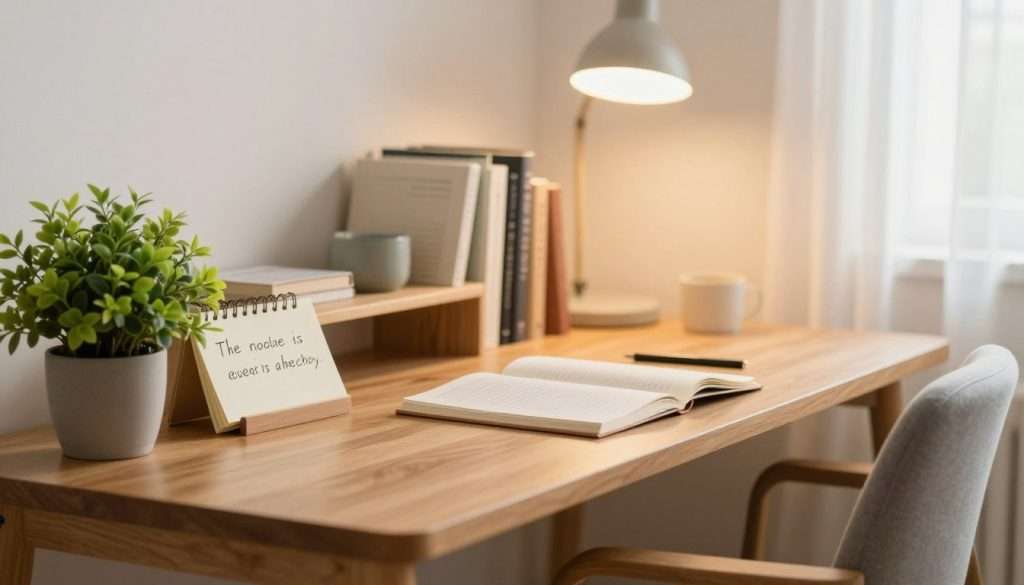
A room that feels welcoming can make it easier to start, especially during a long week. Still, a cozy setup can become distracting if it invites sleep or leisure. Keep the space comfortable for work without making your bed the main place for every study session.
Room temperature is personal, but 68-72°F (20-22°C) is commonly comfortable for study rooms. Change the temperature if you feel too warm or too cool, rather than forcing yourself to tolerate discomfort. Your comfort can shift with clothing, activity, and the room itself.
Test one change at a time. You might adjust the temperature, move your seat, or change the background sound, then notice how the next few sessions feel. If you change several things at once, it is harder to tell which one helped.
Small experiments keep setup from taking over your study time. Give each change a few sessions before deciding whether to keep it. Change one feature at a time so you can tell which adjustment actually helps.
Conclusion
You do not need a perfect room to make your next study session more focused. A useful study space can be simple, and small changes are easier to judge when you test them one at a time.
Want to go deeper? If this article resonated with you, my free book How to Become the Smartest Student in the Classroom gives you a full system, memory techniques, study routines, and strategies that actually stick. No cost, no catch. Grab your free copy here: https://www.studyingmachine.com/free-books/.
Start with one small change today, then grab your free copy of How to Become the Smartest Student in the Classroom.