
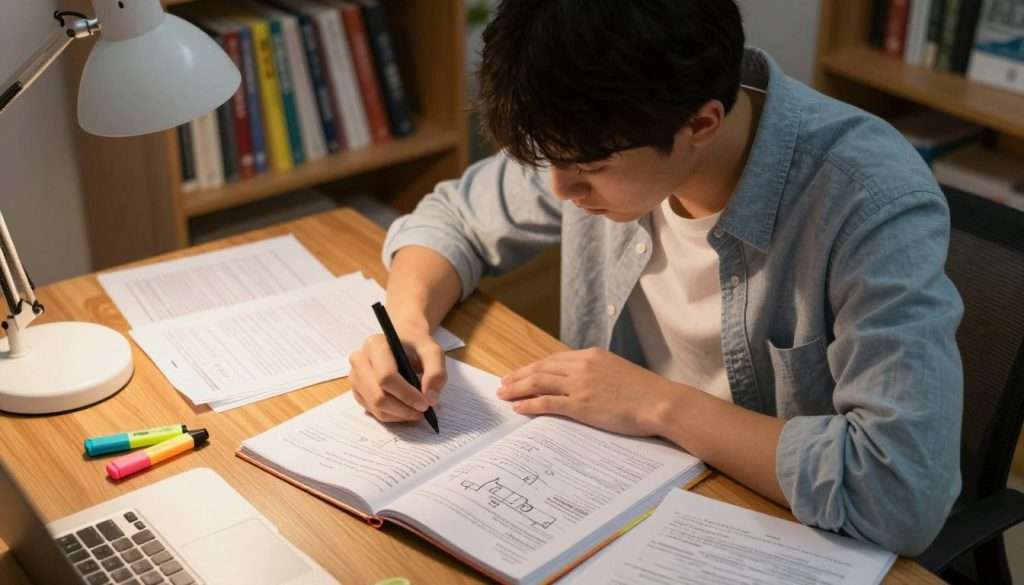
You learn from your mistakes on a practice test by finding why each answer went wrong, then changing how you study or solve the next one. A disappointing score can sting, especially when exam prep already fills your week. Still, a practice test gives you a chance to improve before the real thing.
We’ll use a practical review process, not a lecture about perfection. You’ll turn errors into study routines that fit your goals, while keeping test anxiety from running the show.
Key Takeaways
- Find the reason behind each wrong answer.
- Rework missed questions before reading solutions.
- Keep a mistake log and watch for patterns.
- Practice recalling facts before checking notes.
- Choose one action to change before your next test.
A wrong answer is useful only when it changes what you do next.
How to Learn From Your Mistakes Without Repeating Them
Learning from a mistake means changing what you do after you understand what went wrong. Retrieval practice means trying to recall information without looking, then checking your answer.
A practice test can help you learn; it does not have to judge your ability. Regular low-stakes quizzes helped middle-school social studies students score a full grade level higher on tested material.
Use a practice test to choose what to work on, not to label yourself as a success or failure.
That classroom result came from no-stakes quizzes, not a promise that every study method works the same way. A review of 23 studies found links between effort on low-stakes tests and exam outcomes, while noting limits in the evidence base. You can read the systematic review of low-stakes assessments.
Feedback makes recall useful because it shows whether your answer needs a fix. A quiz used for learning gives you room to find that fix without the pressure of a high-stakes assessment.
Learn from your mistakes by changing a study habit or problem-solving move, not by feeling bad about an answer. Treat each practice test as a map of what to work on, not a final judgment of your ability.
What Kind of Error Did You Make?
Review a practice test 24 to 48 hours after taking it, while you still remember what you were thinking. Error analysis means examining why an answer went wrong and what the error can teach you.
Start by naming the cause, because a fix for a concept gap differs from a fix for rushing. Common errors include slips, missing concepts, flawed procedures, and misreading or time pressure.
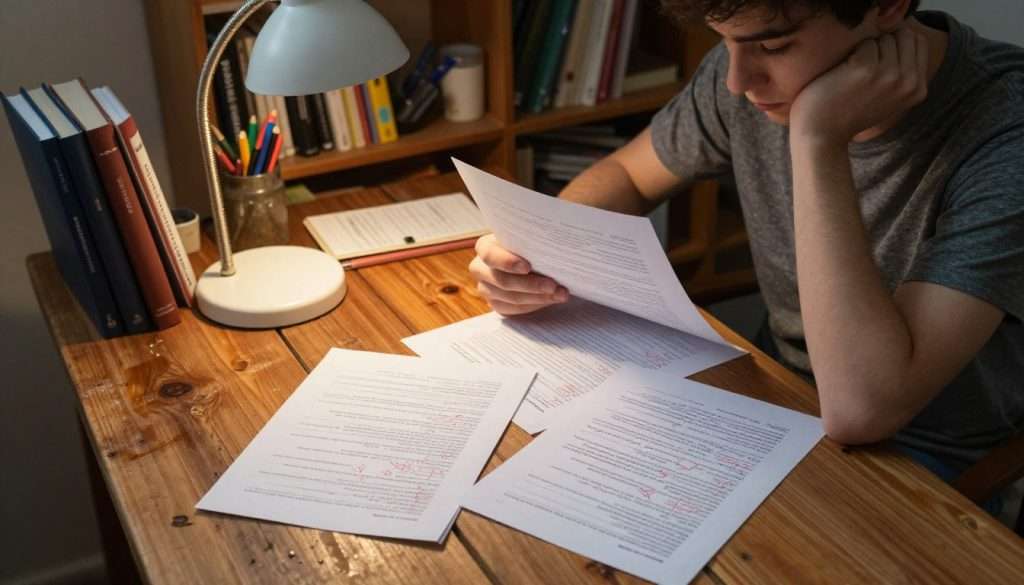
Classify the error before you fix it
One mistake can look small on the page but point to a larger need. Use the first check below to test your best guess.
| Error type | What it may look like | A useful first check |
|---|---|---|
| Silly slip | Sign error in a correct setup | Check copied numbers and signs |
| Concept gap | Cannot explain the key idea | Explain the idea without notes |
| Procedure error | Uses steps in the wrong order | Compare each step with a worked example |
| Misreading or time pressure | Misses a word or rushes the final step | Underline the task and check the clock |
Rework the problem before checking the answer
Use fresh paper and solve the missed problem again before you look at the solution. Write down where your reasoning first took a different turn.
Paired review can help, too. When both students missed a problem, they search for the error together. When only one missed it, the student who got it right explains the solution step by step.
Ask your teacher for help if neither of you can explain a step or the same reasoning keeps breaking down. A clear question, such as “Why does this step work?” gives the teacher a place to start.
Before reading a solution, solve the missed problem again on fresh paper.
Build a Mistake Log That Leads to a Study Plan
A mistake log turns a string of wrong answers into a pattern you can act on. Repeated errors can point to a study goal that fits the problem, rather than a vague promise to work harder.
Record six details for each mistake so you can spot what needs to change:
- Date
- Topic
- What you did
- Error type
- Correct method
- Personal rule to remember
A repeated concept gap may mean you need more time to learn the topic before doing another test. If you often rush the last questions, practice finishing a timed set with a few minutes left for checks.
For example, one student might set a goal of 2 hours each weekday and 4 hours on Saturday. Adapt that example to your classes, energy, and other duties; it is not a required schedule.
A book about learning from mistakes helps most when it gives you prompts and routines you can actually use. Review your log before each test and choose one recurring pattern to target.
Use Retrieval Practice to Fix What You Missed
If you missed a question because you could not recall the idea, close the notes and try to retrieve it before checking the answer. Trying first makes the next review more than another pass through familiar words.
Recall the answer before you flip a flashcard or read a solution. Then check your response and correct it while the question is still clear.

Try to recall before you check
In a laboratory study, 177 Saudi undergraduate students learning English as a foreign language read a 487-word passage. Researchers compared four ways to practice:
| Practice method | Feedback timing | Reported one-month result |
|---|---|---|
| Repeated studying | No testing feedback | Lower than testing without feedback |
| Repeated testing | No feedback | Outperformed repeated studying |
| Repeated testing | Immediate feedback | Outperformed no-feedback and restudying groups |
| Repeated testing | Delayed feedback | Outperformed no-feedback and restudying groups |
Space practice and use feedback
The students took tests right away, one week later, and one month later. Immediate and delayed feedback both helped more than testing without feedback or repeated study. Immediate feedback led to better long-term retention than delayed feedback in this study.
The one-month test results offer a useful lesson, not a guarantee for every student or subject. Try to recall, check the answer, and correct any gap you find.
Flashcards work best when you make your brain do the first step. Try to retrieve the fact before flipping the card, then shuffle the deck after a few passes.
Short sessions spaced over time work better than one long session, and feedback helps you correct errors. Keep each card in rotation until you have retrieved its answer successfully 3 times.
How Can You Stop Replaying a Bad Score?
If you have replayed the same wrong answer for ten minutes without learning anything new, you may be stuck in a loop rather than solving the problem. Useful review leads to a choice; a loop keeps bringing back the same thought.
Rumination focuses on past events, while worry focuses on possible future problems. Both have links to trouble concentrating and solving problems.
Notice when review turns into rumination
A 2022 online survey of 207 adults found that 48% used distraction to cope with rumination or worry. Another 21% said they could not stop the cycle.
In that survey, 25% named social situations or interactions as triggers, and 24% named negative events or experiences. These figures describe adults in the survey, not every student.
Set a short reset and choose one action
A therapy guide suggests setting a daily 15-minute appointment for worry, then putting the loop aside outside that time. Write the worry down and return to it during the appointment.
Use a concrete-next-step test: can you name one action that would help? If not, the replay may not be helping right now. A short mistake quote or meme can soften shame for a moment, but humor alone will not correct a knowledge gap.
- Pause and name the thought as rumination or worry.
- Write one action you can take about the test.
- If no action appears, close the notebook until your set time.
End each review by writing one action you can take, or close the notebook and return at your scheduled worry time.
Carry the Lesson Into Your Next Test
One missed question describes what happened on one test, not your ability to learn or improve. Separate the action from your identity: “I rushed this step” describes behavior, while “I’m bad at math” turns one moment into a label.
A mistake can guide your next choice without defining your skills, your life, or your future career. Proverbs 24:16 offers perspective: “For the righteous falls seven times and rises again, but the wicked stumble in times of calamity.”
Separate one wrong answer from your identity
That Bible verse is about getting back up, not a memory technique or a promise of easy success. Proverbs 11:2 also says, “When pride comes, then comes disgrace, but with the humble is wisdom.” Both can remind us to stay open to learning.
A useful lesson points toward a next move; it does not stamp a label on you.
Put the lesson into words you can reuse
A short speech about learning from mistakes can follow three beats: what happened, what you learned, and what you will do next. For example, describe a rushed test answer, the missed word you noticed, and your plan to underline key terms.
Philippians 3:13 says, “Forgetting what lies behind and straining forward to what lies ahead.” That Bible verse can frame a speech about moving forward after a setback.
The line “Anyone who has never made a mistake has never tried anything new” is widely shared, but its attribution is unverified. Quotes can offer a quick spark, while your own words show the lesson you earned.
Before your next practice test, write one sentence naming the behavior you will change.
Conclusion
A practice-test mistake becomes a lesson when you change one small action before the next round. One clear move, such as checking signs or starting a study session with recall, can make your study routines more useful.
Pick a study goal you can keep, then use memory techniques that make you retrieve what you know. Want to go deeper? If this article resonated with you, my free book How to Become the Smartest Student in the Classroom gives you a full system, memory techniques, study routines, and strategies that actually stick. No cost, no catch.
Grab your free copy of How to Become the Smartest Student in the Classroom here: https://www.studyingmachine.com/free-books/.