
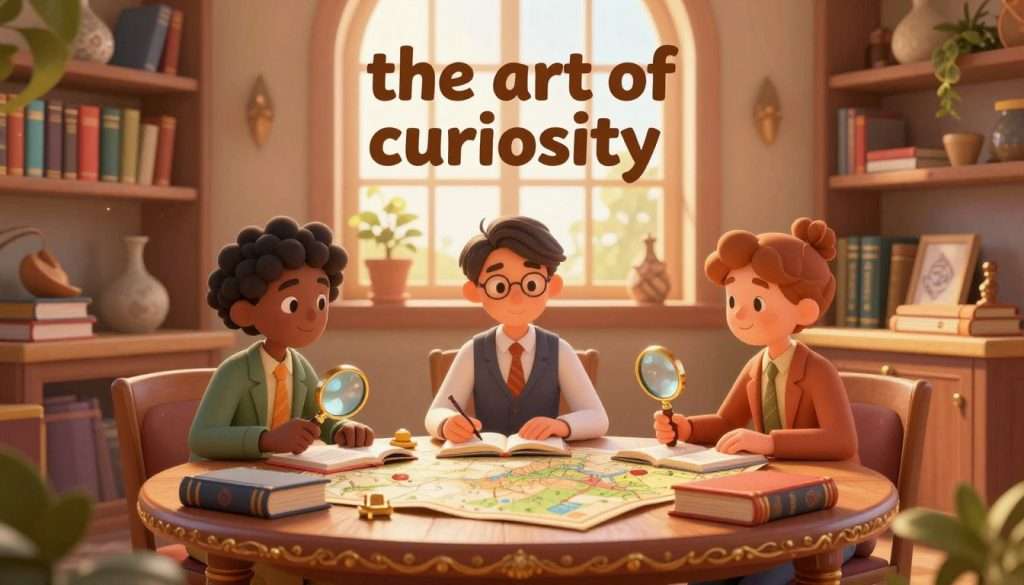
Curiosity is a powerful tool that can change how we learn and grow. By embracing the art of curiosity, we make studying fun. It helps us understand the world better.
Studies show curiosity is connected to good traits like humility, creativity, and resilience. It also leads to success in school and work.
When we cultivate curiosity, we welcome new experiences and views. This helps us grow personally and professionally. With a curious mindset, learning becomes a lifelong journey.
Key Takeaways
- Cultivating curiosity can make learning more enjoyable and effective.
- Curiosity is linked to a range of positive character virtues and outcomes.
- Embracing curiosity can lead to increased academic and professional success.
- A curious mindset can help us grow both personally and professionally.
- Curiosity is a powerful tool for lifelong learning.
The Power of Curiosity in Learning and Engagement
Curiosity is the spark that ignites the flame of learning. It turns dull subjects into fascinating explorations. When we cultivate curiosity, we open the door to a more engaging and effective learning experience.
Why Curiosity Drives Deeper Understanding
Curiosity makes us ask questions and seek answers. This process helps us understand topics deeply. It makes connections between different pieces of information, leading to a more nuanced comprehension.
The Neurological Benefits of Curiosity-Driven Learning
Research shows curiosity has a positive impact on our brains. Madeleine Gross, a psychologist at the University of California, Santa Barbara, says, “curiosity is linked to an impressive host of character virtues.” Curiosity-driven learning stimulates the brain’s reward system, releasing dopamine and motivating us to explore more.
How Curiosity Transforms Passive Learners into Active Explorers
Curiosity changes the learning process. It turns passive learners into active explorers. By encouraging questions and exploration, curiosity helps learners engage more deeply with the material. This leads to a more meaningful and lasting learning experience.
| Benefits of Curiosity | Description |
|---|---|
| Deeper Understanding | Curiosity drives exploration, leading to a more nuanced comprehension of the subject matter. |
| Neurological Benefits | Curiosity stimulates the brain’s reward system, releasing dopamine and motivating continued exploration. |
| Active Learning | Curiosity transforms passive learners into active explorers, engaging more deeply with the material. |
The Art of Curiosity: How to Make Any Subject Fascinating
Learning to be curious can turn dull topics into exciting ones. Curiosity means being open to new things and wanting to explore. When we’re curious, we see things in a new way, finding things we might have missed before.
Defining the Art of Curiosity
Curiosity is about being eager to learn and ask questions. It’s not just for school or work; it’s for life. It makes our experiences richer and more interesting.
The Curiosity Mindset: Approaching Topics with Wonder
Having a curious mindset means seeing the world with wonder. It’s about being open to new ideas and brave enough to question our own thoughts. When we’re curious, we learn so much more about the world.
Practical Techniques for Developing Your Curiosity Muscles
Getting curious takes practice and effort. Here are some ways to grow your curiosity:
- Ask open-ended questions that encourage exploration and discussion.
- Seek out diverse perspectives and experiences.
- Engage in activities that challenge your assumptions and broaden your knowledge.
“Storyocity” is a great way to make learning fun. It combines stories with curiosity. This makes hard topics easier to understand and more fun to learn.
| Technique | Description | Benefit |
|---|---|---|
| Open-ended Questions | Encourage exploration and discussion | Enhances engagement |
| Diverse Perspectives | Expose yourself to different viewpoints | Broaden understanding |
| Challenging Activities | Engage in activities that challenge assumptions | Fosters deeper learning |
By using these methods and embracing curiosity, you can make any topic exciting for your audience.
Storytelling: Transforming Facts into Narratives
Storytelling makes even the most boring topics exciting. It turns dry facts into stories that grab our attention.
The Science Behind Story-Based Learning
Studies show that stories help us remember things better. They engage our feelings and imagination, making info stick in our minds.
Techniques for Crafting Educational Narratives
To create great educational stories, we need to focus on characters and settings. Here’s how:
- Use real-life examples to explain complex ideas
- Create a story with a clear beginning, middle, and end
- Add emotional connections to make the story hit home
Examples of Successful Educational Storytelling
Storytelling works for all subjects, making them fun and easy to learn.
Historical Subjects Brought to Life
Stories about history make it more relatable and fun. For example, telling about a historical figure’s life can connect students emotionally to that time.
Making Scientific Concepts Relatable
Science can be hard to understand, but stories can simplify it. Like explaining the water cycle through a water droplet’s journey, making it easier to grasp.
By using storytelling techniques, we can spark interest in any subject. Learning becomes a fun adventure.
The Question Technique: Sparking Inquiry and Discussion
Curiosity is the spark that ignites the flame of learning, and questions are the fuel that keeps it burning. By mastering the art of questioning, we can significantly enhance engagement in any subject.
Formulating Thought-Provoking Questions
The key to sparking inquiry lies in formulating questions that are thought-provoking and challenging. We should move beyond simple factual recall and encourage critical thinking. For example, instead of asking “What is the capital of France?”, we could ask “How does the historical significance of Paris influence its role as the capital of France?”
Creating Question Hierarchies for Progressive Learning
Creating a hierarchy of questions allows for progressive learning. Each question builds upon the previous one, guiding learners through a structured thought process. We start with broad, open-ended questions and then narrow them down to more specific ones.
Using the Socratic Method in Modern Education
The Socratic Method is an effective way to encourage critical thinking and inquiry. It engages learners in a dialogue that challenges their assumptions and fosters deeper understanding. This creates a more interactive and engaging learning environment. Some key strategies include:
- Asking open-ended questions that encourage discussion
- Encouraging learners to question their own assumptions
- Using probing questions to guide learners towards deeper understanding
By incorporating these techniques into our teaching practices, we can make learning more engaging and effective.
Visual and Experiential Learning Strategies
Learning by doing and seeing is very effective. It makes complex topics easier to understand and remember. Using visual aids and hands-on experiences makes learning fun and accessible.
Using Visual Aids to Enhance Understanding
Visual aids like diagrams, charts, and infographics help a lot. They give a clear picture of information. Visual learning makes complex ideas easier to grasp and remember.
For example, a timeline infographic can help students understand historical events better. In science, diagrams can make hard-to-understand concepts clear.
Designing Hands-On Experiences for Any Subject
Hands-on experiences, like experiments and projects, let learners interact with the subject. This experiential learning method helps students understand better and develop skills.
In physics, doing experiments with simple machines teaches mechanics. In language learning, role-playing improves speaking skills and confidence.
Virtual and Augmented Reality in Education
Virtual Reality (VR) and Augmented Reality (AR) are changing education. They offer immersive learning experiences. These technologies take students to new places, making learning fun and interactive.
Low-Tech vs. High-Tech Visualization Tools
While VR and AR are high-tech, simple tools like flashcards and whiteboard drawings work well too. The right tool depends on the learning goal and the students. Mixing different strategies helps educators create compelling content that engages learners and promotes deep understanding.
Making Connections: Relating Complex Topics to Everyday Life
Showing how complex topics relate to our daily lives makes them fascinating. When we connect these topics to real-life scenarios, we understand them better. This also sparks curiosity and interest.

Finding Relevant Real-World Applications
To make complex topics engaging, we need to find their practical uses in our lives. For example, explaining how quantum physics affects our daily technology makes it relatable and interesting.
Building Bridges Between Disciplines
Many complex topics span across different fields of study. By showing these connections, we gain a deeper understanding. For instance, linking historical events to today’s social issues makes history more relevant and exciting.
The Analogy Method: Explaining the Unknown Through the Known
Analogies are great for making complex topics easier to grasp. By comparing the unknown to something familiar, we simplify it. For example, explaining a computer processor like a factory assembly line makes it more understandable.
Gamification: Adding Elements of Play and Competition
Gamification is changing how we learn by adding fun and competition to schoolwork. It makes learning more engaging and motivating.
Principles of Effective Educational Gamification
To make learning fun, we need to know the key principles. These include:
- Clear goals and objectives
- Immediate feedback mechanisms
- Progress tracking and rewards
- Social interaction and competition
Tools and Platforms for Creating Gamified Learning
Many tools and platforms help teachers make learning fun. Some top choices are:
- Gamification platforms like Classcraft and ClassDojo
- Learning management systems with gamification features, such as Moodle and Blackboard
- Game development software like Unity and Construct 3
Case Studies of Successful Gamification
Many schools have seen great results from gamification. For instance, a study on Classcraft showed better student engagement and behavior.
Balancing Fun with Educational Value
Gamification makes learning fun, but we must keep it educational. This way, we meet learning goals without losing interest.
By designing fun and educational experiences, we create a learning space that’s both entertaining and valuable. This boosts curiosity and helps students understand more deeply.
Overcoming the “Boring Subject” Challenge
Making dull subjects interesting is an art. It turns boring topics into exciting stories. We can make any subject engaging with the right approach.
Reframing Seemingly Dull Topics
First, we need to see dull topics in a new light. Ask yourself, “What’s the big deal about this?” or “How does it affect me?” For example, tax law might seem boring at first. But, when we look at how it affects businesses or our money, it becomes more important.
Finding the Hidden Fascination in Any Subject
Every subject has something fascinating hidden inside. We just need to look closely. Using real-life examples or case studies makes complex ideas easier to understand. For instance, instead of just teaching grammar rules, we can use stories or songs to show how they work in real life.

Success Stories: Making the Mundane Magnificent
Let’s look at some examples where dull topics became interesting. Mathematics and grammar are often seen as boring. But, with the right way of teaching, they can be fun.
Mathematics: From Dreaded to Delightful
Math can be made fun by showing its real-world uses. Like in coding or finance. This makes math more appealing by showing its practical value.
Grammar: Turning Rules into Revelations
Grammar can be taught through stories and creative writing. By using grammar to tell exciting stories, it becomes more enjoyable. This way, learners see the rules in action.
As we’ve seen, creativity can turn even the most boring subjects into exciting content. By changing how we see these subjects and finding their hidden interest, we can make learning fun. This way, we overcome the “boring subject” challenge and make learning enjoyable.
Adapting Curiosity Techniques for Different Audiences
We must adjust our ways to spark curiosity for everyone. Each learner is unique, needing their own approach to stay engaged. We’ll look at how to tailor our methods for different ages, cultures, and learning styles.
Age-Specific Approaches to Sparking Curiosity
What sparks curiosity in kids might not work for adults. Young learners love play and interactive activities. For example, stories with vivid tales can spark their imagination and drive them to explore.
Cultural Considerations in Curiosity-Based Learning
Culture greatly affects how we learn and respond to curiosity. Some cultures focus on group learning, while others value individual questioning. It’s key to understand these differences to create effective learning strategies.
Addressing Different Learning Styles and Preferences
Everyone learns differently, with some preferring to see, hear, or do. To keep learners engaged, we must use a variety of teaching methods that match these styles.
Techniques for Visual, Auditory, and Kinesthetic Learners
Visual learners do well with infographics and videos. Auditory learners enjoy podcasts and talks. Kinesthetic learners benefit from hands-on activities. Mixing these methods makes learning more inclusive and fun.
| Learning Style | Effective Techniques |
|---|---|
| Visual | Infographics, Videos, Images |
| Auditory | Podcasts, Oral Presentations, Audiobooks |
| Kinesthetic | Hands-on Activities, Experiments, Role-playing |
Conclusion: Cultivating a Lifetime of Curiosity
Curiosity is the spark that starts a lifelong journey of learning and growth. By using the techniques and strategies we’ve talked about, you can make content that grabs attention and inspires others. This content encourages people to explore new things.
To grow curiosity, we need to be open to questions and new experiences. We must also challenge our own beliefs. This way, even simple topics can become exciting stories that teach and engage us.
Curiosity is a journey, not just a goal. It’s about creating a culture of inquiry and wonder in our lives. As you keep exploring, the world will become more interesting and full of new discoveries.
So, let’s keep this spark alive in ourselves and others. Let’s keep learning and growing together. This way, we make the world a more fascinating place, one curious mind at a time.