
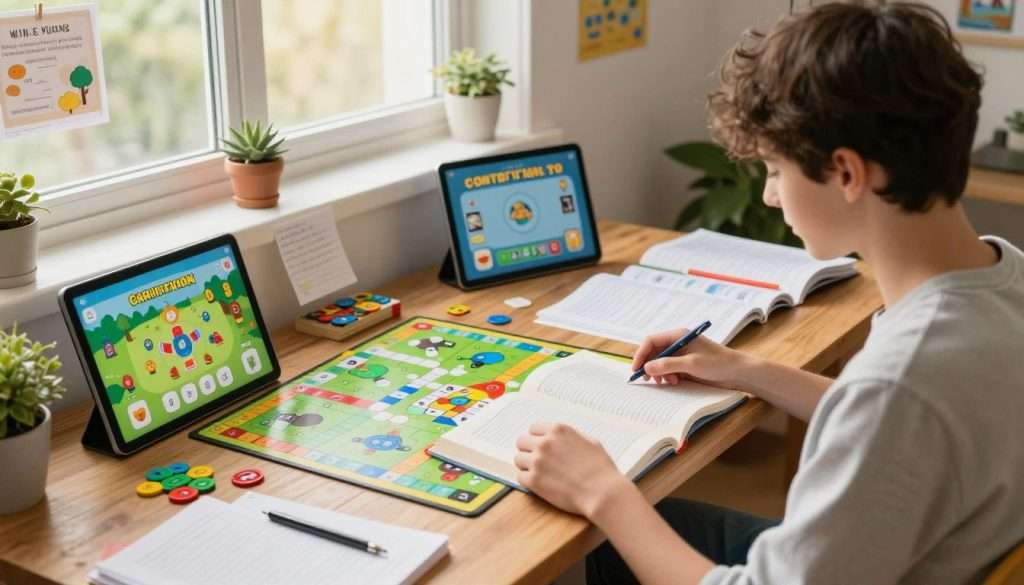
Are you tired of studying from dry textbooks? We can change that! Imagine turning your study materials into an interactive adventure. With the rise of study gamification, learning is becoming more engaging and fun.
Tools like Seppo and StudyPDF are changing how we study. They make books and content into exciting challenges that motivate you to learn more.
By gamifying your study routine, you can make learning more effective and enjoyable. In this article, we’ll explore how to turn your textbooks into games and make studying a fun experience.
Key Takeaways
- Study gamification makes learning more engaging and interactive.
- Tools like Seppo and StudyPDF can transform study materials into games.
- Gamifying studies can improve motivation and learning outcomes.
- Interactive challenges make studying more enjoyable and effective.
- Turning textbooks into games can revolutionize the way you study.
The Science Behind Gamification in Learning
Gamification is more than just making learning fun. It uses how our brains work to our advantage. By adding game elements to our studies, we trigger our brain’s reward system. This releases dopamine, motivating us to keep learning.
How Games Activate the Brain’s Reward System
Playing educational games boosts dopamine in our brains. This neurotransmitter is linked to pleasure and motivation. It makes us want to learn more because our brain sees it as a positive experience.
Research on Gamification’s Impact on Knowledge Retention
Research shows gamification boosts knowledge retention. Interactive learning makes us more engaged with the material. This leads to better recall and understanding.
Why Game-Based Learning Works for Different Learning Styles
Gamification meets the needs of all learners, whether you’re visual, auditory, or kinesthetic. It uses different game elements to fit each person’s learning style. This makes learning more effective for everyone.
Why Traditional Studying Methods Often Fail
Traditional studying methods often leave students feeling uninspired. We’re here to explore why this is the case and how we can make studying more engaging.
The Monotony Problem in Textbook Learning
Textbook learning can be a tedious process. The dry, factual content can be overwhelming, making it difficult for students to stay motivated. Gamification can be a game-changer here, making learning more interactive and fun.
Attention Span Challenges in the Digital Age
In today’s digital world, distractions are just a click away. Students often struggle to focus on a single task for an extended period. Breaking study sessions into shorter, manageable chunks can help alleviate this issue.
The Motivation Gap in Academic Settings
Many students lack the motivation to study due to the absence of immediate rewards or feedback. Creating a system of rewards and achievements can help bridge this motivation gap.
| Traditional Studying Methods | Gamified Studying Methods |
|---|---|
| Monotonous and unengaging | Interactive and fun |
| Lack of immediate feedback | Instant rewards and feedback |
| Difficulty in staying motivated | Motivation through achievements |
Gamify Your Studies: Turn Your Textbook into a Game – Core Principles
To make studying fun, you need to know the basics of educational games. It’s not just about adding game elements. It’s about making learning exciting and boosting study motivation.
Elements of Successful Educational Games
Good educational games have a few key things. We’ll look at points, badges, and achievements, and how stories and characters add to the fun.
Points, Badges, and Achievements
Points, badges, and achievements give you instant feedback. They make you want to keep going. For example, getting badges for hard tasks makes you feel proud and ready for more.
Narrative and Character Development
A good story and characters can turn studying into an adventure. By making your learning a story, it becomes more fun and memorable.
Balancing Fun and Learning Objectives
It’s important to keep learning fun, but also make sure it meets your goals. Finding the right mix of fun and learning is key to making it work.
| Game Element | Learning Objective | Example |
|---|---|---|
| Points System | Completing daily study tasks | Earn 100 points for finishing a chapter review |
| Narrative Development | Understanding historical events | Create a storyline where each event is a plot twist |
| Badges and Achievements | Mastering a difficult concept | Receive a “Math Wizard” badge for solving complex equations |
By using these key principles, you can make studying fun and effective. The goal is to enjoy learning as much as you do other things!
Setting Up Your Personal Learning Game System
Turning your study routine into a game is easier than you think. It just needs a few key steps. These steps will make learning fun and effective.
Creating Your Student Character and Leveling System
First, create a student character that’s you in the learning world. This character will grow as you finish study tasks and hit milestones. It’s like your avatar in game-based learning.
You can make your character unique by adding traits that show your strengths and weaknesses. This makes learning more fun and personal.
Establishing Meaningful Rewards and Consequences
To stay motivated, set up a reward system. Rewards can be things you like, like treats or extra time to relax. Or they can be feeling proud of yourself for doing well.
Make sure these rewards mean something to you. For example, treat yourself to your favorite meal after a tough chapter. Or, if you’re late, do extra chores.
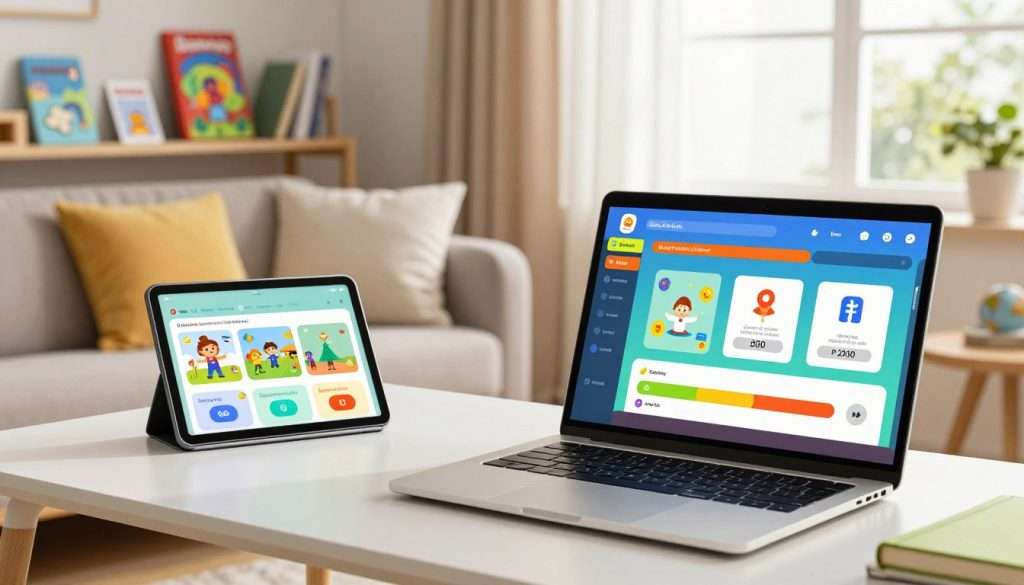
Designing Your Game Dashboard or Tracker
A game dashboard or tracker is key to seeing how you’re doing. You can use a spreadsheet, a habit app, or a notebook. It helps you keep track of your study sessions, progress, and rewards.
Here’s what your tracker might look like:
| Study Session | Topic Covered | Time Spent | Reward Earned |
|---|---|---|---|
| 1 | Introduction to Serious Games | 60 minutes | 10 points |
| 2 | Gamification Basics | 45 minutes | 7 points |
| 3 | Game Design Principles | 90 minutes | 15 points |
By setting up this system, you’re not just studying. You’re on a serious games adventure. You’re leveling up your knowledge and skills with every step.
Transforming Chapters into Game Levels
Start by turning chapters into exciting levels to conquer. This makes studying fun and helps organize content better.
Breaking Down Content into Manageable Quests
To make your textbook interactive, break down chapters into smaller quests. For instance, each section can be a quest with its own goals and rewards. This keeps you focused and tracks your progress.
- Identify key concepts in each chapter
- Create specific learning objectives for each concept
- Assign rewards or points for completing each quest
Creating Progression Systems for Long-Term Engagement
A good progression system keeps you engaged over time. Create a leveling system where you move up as you finish quests. Each level unlocks new content or challenges.
To do this, you can:
- Set up a leveling system with clear criteria for advancement
- Create a visual tracker to monitor your progress
- Offer bonus challenges or side quests for extra rewards
Mapping Knowledge Trees for Subject Mastery
Mapping knowledge trees shows how concepts are connected. It helps you see the big picture and understand how each piece fits into the subject.
To map a knowledge tree:
- Identify the main topics and subtopics in your textbook
- Create a diagram showing how these topics are related
- Highlight key concepts and their connections
By turning chapters into game levels, you make studying more fun and effective. This improves your learning experience.
Designing Challenges and Quests from Textbook Material
To make studying more fun, we need to turn important concepts into interactive challenges and quests. This means looking at your textbook and finding ways to make learning feel like a game.
Converting Key Concepts into Challenges
The first step is to find the key concepts in your textbook. These concepts should be the heart of your challenges. For example, if you’re studying history, you might create challenges about important dates, events, or figures.
Let’s say you’re studying a chapter on World War II. You could make a challenge that asks you to:
- List the main causes of the war
- Identify key battles and their outcomes
- Explain the significance of major historical figures involved
Creating Mini-Games for Different Types of Content
Different content needs different mini-games. Let’s look at a few examples:
Text-Based Content Games
For text-based content, you can make games like crossword puzzles, word searches, or quizzes. These games test your understanding and recall of the material.
Visual Content Games
Visual content, like diagrams or infographics, can be turned into games like “identify the component” or “label the diagram.” This helps reinforce your understanding of complex visual information.
Mathematical and Formula-Based Games
For math content, you can create games that involve solving problems quickly or completing a series of calculations. These games improve your problem-solving skills and mathematical fluency.
| Content Type | Mini-Game Example | Learning Benefit |
|---|---|---|
| Text-Based | Crossword Puzzle | Improved recall and understanding |
| Visual | Label the Diagram | Enhanced visual recognition |
| Mathematical | Timed Problem-Solving | Better problem-solving skills |
Incorporating Time Challenges for Improved Recall
Adding a time element to your challenges can really help with recall and retention. By setting timers for your study sessions or challenges, you create a sense of urgency that can enhance your focus and motivation.
For example, you could set a 10-minute timer to complete a quiz on a particular chapter. This timed challenge not only tests your knowledge but also your ability to work under pressure.
Using Digital Tools to Enhance Your Textbook Game
In today’s digital world, we can boost our learning by using digital tools. These tools make studying fun, interactive, and engaging.
Apps and Platforms for Educational Gamification
Many apps and platforms are made for educational gamification. For example, Seppo lets us create interactive games for studying. Kahoot and Quizlet also offer fun learning experiences tailored to our needs.
Creating Digital Flashcards with Game Elements
Digital flashcards are great for making studying more fun. Tools like StudyPDF add points, badges, and leaderboards to flashcards. This makes studying a game we can win.
Using Learning Management Systems for Game Progression
Learning Management Systems (LMS) help track our progress. They offer features like quizzes and discussion forums for a gamified learning experience. This helps us stay motivated and track our learning journey.
| Digital Tool | Features | Benefits |
|---|---|---|
| Seppo | Interactive games, activities | Engaging, fun learning experience |
| StudyPDF | Digital flashcards, game elements | Interactive studying, competitive edge |
| LMS Platforms | Progress tracking, quizzes, discussion forums | Monitoring progress, staying motivated |
By using these digital tools, we can make studying more fun and effective. Whether it’s apps, digital flashcards, or LMS platforms, adding game elements to our studies makes learning enjoyable. It helps us reach our academic goals.
Low-Tech Gamification: Analog Methods That Work
You can make learning more fun with simple, analog gamification. While digital tools are popular, low-tech methods are just as good. They make studying more engaging and enjoyable.
Paper-Based Tracking Systems
Using paper-based tracking systems is an effective low-tech method. You can make a simple grid or chart to track your progress. For example, mark off each chapter or section as you finish it.
This visual tracking can really motivate you. To make it more fun, add a points system. Give points for each task or chapter based on its difficulty. As you get points, you can level up or reach milestones.
Dice and Card Games for Study Review
Dice and card games can make studying fun. For example, roll a die to choose the type of question from your textbook. Or, use flashcards and draw them randomly for a surprise in your study sessions.
Card games like “Go Fish” or “Memory Match” with terms and definitions can also be enjoyable. Create your own deck or use existing ones to match key terms with their definitions. This helps you understand the material better.
Creating Physical Rewards and Achievement Tokens
Physical rewards and achievement tokens add a real element to your strategy. Create tokens or stickers for achievements, like finishing a hard chapter or mastering a new skill. Collecting these tokens shows your progress.
For example, use a “reward jar” for tokens. Each milestone, add a token. When the jar is full, trade tokens for a reward, like a break or a favorite snack. This system boosts your motivation and makes learning more fun.
Collaborative Gamification: Studying with Friends
Collaborative gamification boosts study motivation by turning learning into a team sport. Learning with friends creates a supportive space. It encourages teamwork and friendly rivalry.
Competitive vs. Cooperative Game Structures
You can choose between competitive or cooperative game structures for collaborative gamification. In competitive games, you and friends compete to get the best score. Cooperative games, on the other hand, focus on teamwork to reach a shared goal.
Setting Up Multiplayer Study Games
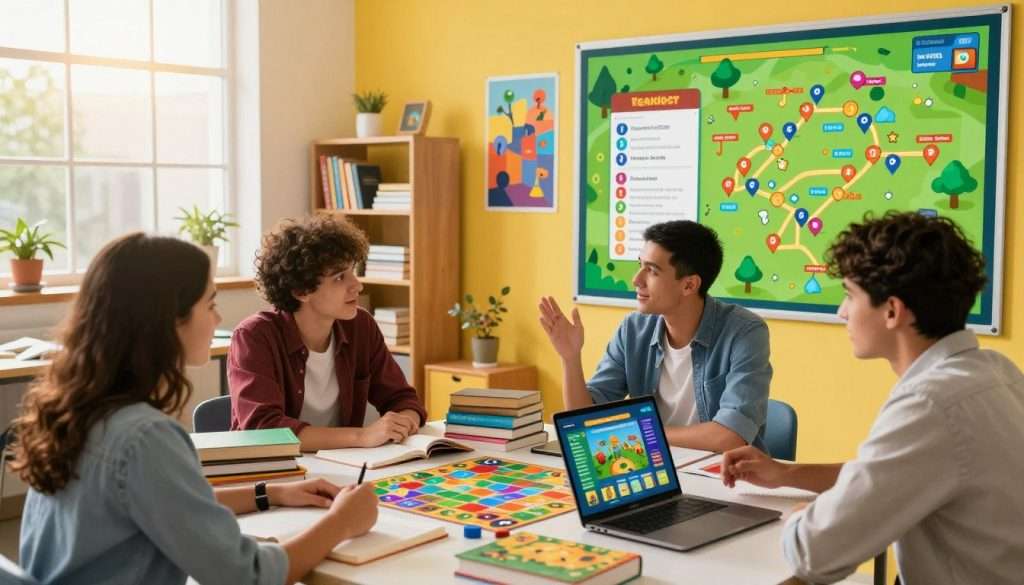
To start a multiplayer study game, first pick the game structure and rules. You can use digital tools or traditional games like board games. For instance, you can make a quiz game where everyone takes turns answering questions. Or, use a platform like Kahoot for a live quiz competition.
Using Social Accountability for Consistent Study Habits
Collaborative gamification brings social accountability. Studying with friends keeps you on track because you don’t want to disappoint them. Sharing your progress on social media or messaging apps also helps stay motivated.
| Benefits | Competitive | Cooperative |
|---|---|---|
| Motivation | High | High |
| Teamwork | Low | High |
| Engagement | High | High |
By adding game-based learning to your study routine with friends, you make studying fun and effective. So, get your friends together and start making your studies more engaging today!
Adapting Gamification to Different Subjects
Gamification can make learning fun, no matter the subject. Whether it’s math or literature, you can tailor games to fit your needs. This makes studying more enjoyable and effective.
Gamifying Math and Science Textbooks
Math and science need problem-solving skills. You can turn these into games by solving equations or doing experiments. Try setting up a “lab” where each task you complete gets you points or badges.
Interactive learning tools, like apps or online platforms, can also help. They often have features like timers and scoreboards to make learning fun.
Creating Games for Language and Literature Studies
For language and literature, focus on building vocabulary and understanding. You can play a “word quest” game to learn new words. Or try “literary charades” to act out book scenes.
History and Social Sciences Gamification Techniques
History and social sciences can be made into games too. Create timelines or profiles of historical figures. You can also play a “history mystery” game to solve clues about past events.
| Subject | Gamification Techniques |
|---|---|
| Math & Science | Problem-solving challenges, experiment-based rewards |
| Language & Literature | Vocabulary quests, literary charades, comprehension challenges |
| History & Social Sciences | Timelines, historical figure profiles, event-based challenges |
By using educational games for different subjects, studying becomes more fun. Try out different games to see what works best for you.
Conclusion: Level Up Your Learning Journey
You now know how to make studying fun by turning textbooks into games. We’ve covered the science of gamification and why old study methods don’t work. You can create your own learning game system, turn chapters into levels, and make studying a fun challenge.
Starting your gamified learning journey means making studies both effective and enjoyable. Adding game elements to your study routine boosts motivation and helps you remember more. So, why wait? Begin making your studies a game today and elevate your learning!
Study gamification opens up a world of possibilities. You can apply it to various subjects, study with friends, and track your progress. By turning learning into a game, you’ll stay engaged, motivated, and on track to succeed. So, give it a try and see how you can start loving learning all over again.