
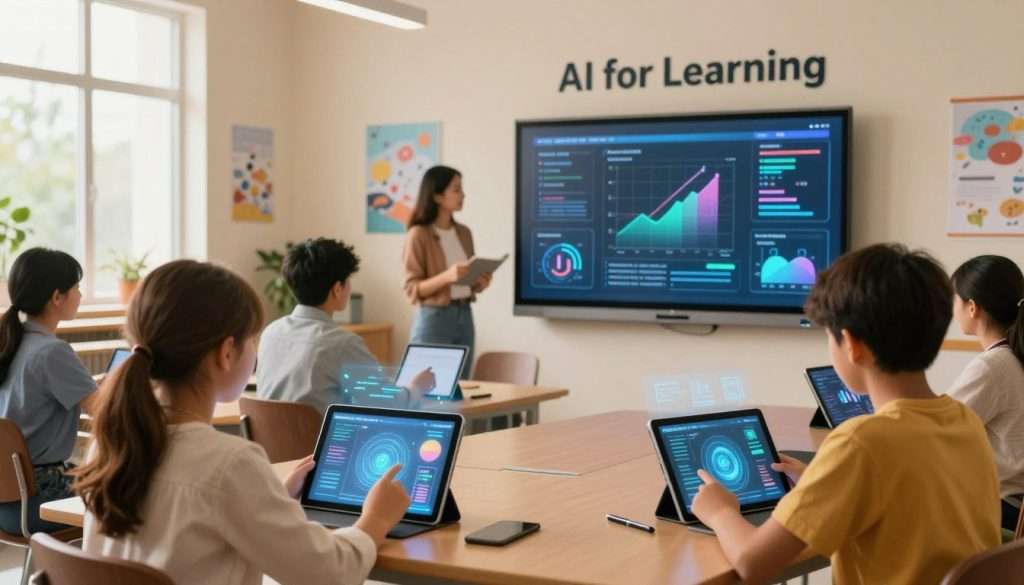
We live in a world where technology changes how we learn every day. Studying is no longer a boring task. Instead, it can be an exciting, tech-powered adventure that fits your pace.
Asyia Kazmi says that artificial intelligence helps close gaps for kids who struggle with reading. These smart tools make sure no student is left behind in our digital world.
Using AI for Learning is now crucial to keep up in school. We’ll show you how these innovations make hard topics easy to understand.
Key Takeaways
- Technology is changing how we learn and absorb information.
- Studying can become an engaging experience instead of a chore.
- Smart tools help close gaps for students who struggle with reading.
- Adopting modern tech is key to staying competitive in studies.
- Personalized digital support makes complex subjects easier to grasp.
Understanding the Shift Toward AI-Driven Education
Ever feel like your classroom is moving too fast or too slow? For a long time, we were stuck with a one-size-fits-all model. But now, educational technology is changing to put you in control.
The Evolution of Digital Learning Tools
From the clunky software of the past to today’s advanced tools, we’ve made huge strides. In the late 90s, educators like Asyia Kazmi started using early adaptive programs. Her students saw results in the top 2% of England, showing tech’s power.
Now, digital learning is more intuitive. We’ve moved away from static textbooks and rigid programs. Instead, we use systems that grow with our knowledge.
How Machine Learning Personalizes the Student Experience
Machine learning brings real magic to learning. It analyzes how you interact with content to find your strengths and weaknesses. This creates a personalized learning environment that values your time and effort.
With artificial intelligence, these platforms adjust to your pace and style in real-time. You don’t waste hours on what you already know. Here’s how traditional and AI-driven learning compare:
| Feature | Traditional Learning | AI-Driven Learning |
|---|---|---|
| Pacing | Fixed for the group | Adjusts to the individual |
| Feedback | Delayed or generic | Instant and specific |
| Content | Static materials | Dynamic, evolving paths |
| Focus | Memorization | Mastery and retention |
Setting Up Your Personal AI Learning Environment
Ready to boost your study skills with smart digital friends? Creating a personalized study space is easy and shouldn’t be stressful. The best setup is one that feels natural and supports your goals without cluttering your day.
Selecting the Right Artificial Intelligence Platforms
Choosing tools can be overwhelming with so many options. Focus on platforms that are user-friendly and improve your grades or understanding. You need software that helps, not hinders.
Seek artificial intelligence solutions that solve specific problems, like note organization or clarifying tough concepts. If a tool makes your life harder, it’s not right for you. Always choose quality over quantity in your digital toolkit.
Integrating Educational Technology into Your Daily Routine
After picking your favorite apps, integrate them into your daily routine. The aim of educational technology is to free up your time for deep thinking. Start with one or two tools to see how they fit into your habits.
Remember, keep the human touch in your learning. Use these tools for the mundane tasks, but keep your curiosity and critical thinking central. A simple routine ensures your tech is a helpful assistant, not digital noise.
Mastering Adaptive Learning Systems
Adaptive learning is changing the game by turning static study sessions into dynamic, personalized conversations. It’s like having a private coach who knows exactly when you are struggling and when you are ready to move on to harder topics. This approach ensures you never feel left behind or bored during your study time.
How Smart Tutoring Adjusts to Your Pace
Modern smart tutoring platforms use natural language processing and advanced dialogue systems to simulate human-like interactions. Instead of reading a flat page, you engage in a back-and-forth exchange that feels natural and supportive. The system monitors your responses in real-time to determine if you have mastered a concept.
If you answer correctly, the platform nudges you toward more complex challenges. If you stumble, it gently pivots to offer extra practice or a different explanation. This fluid adjustment keeps your momentum high and prevents the frustration that often comes with rigid, one-size-fits-all curricula.
“The art of teaching is the art of assisting discovery.”
Identifying Knowledge Gaps with Cognitive Computing
Beyond just pacing, cognitive computing acts like a high-powered lens for your academic performance. These systems analyze your patterns to pinpoint specific knowledge gaps with incredible accuracy. You no longer have to guess what you need to review; the software highlights your weak spots automatically.
By focusing your energy on these identified areas, you build a much stronger foundation. This targeted practice boosts your confidence and helps you master subjects that once felt impossible. Check out the table below to see how this modern approach compares to traditional study methods.
| Feature | Traditional Learning | Adaptive Learning |
|---|---|---|
| Pacing | Fixed for everyone | Personalized to you |
| Feedback | Delayed grading | Instant and specific |
| Content | Static textbooks | Dynamic, evolving |
| Focus | Broad coverage | Gap-specific mastery |
Leveraging AI for Learning to Optimize Study Sessions
Imagine finishing your reading list in half the time and remembering more. Your study sessions are about to get a major upgrade thanks to AI for Learning. Technology will handle the tedious parts, letting you focus on what really matters.
Staring at dense textbooks can feel like a chore. Thankfully, adaptive learning tools make complex information easier to handle. They act like a personal coach, ensuring you focus on the most important parts.
Using Deep Learning for Summarization and Note-Taking
Now, deep learning models can turn big chapters into summaries in seconds. Instead of highlighting every sentence, they find the core arguments and key takeaways for you. This saves you hours of manual labor every week.
These platforms also help organize your notes into logical structures. Your study materials become easier to review when they are clean and concise. It’s a game-changer for mastering difficult subjects quickly.
Automating Flashcard Creation with Intelligent Algorithms
Formatting flashcards is often the most boring part of studying. But now, machine learning can do it for you. By uploading your notes, smart algorithms create high-quality questions and answers automatically. This lets you jump straight into active recall without manual data entry.
These intelligent algorithms keep improving to match your specific goals. You’ll spend less time clicking and typing, and more time testing your knowledge. Embracing this level of automation is key to staying ahead in your studies.
Enhancing Critical Thinking Through AI Collaboration
We believe the future’s top students will master working with AI to improve their critical thinking. Instead of seeing tech as a quick fix, view it as a dynamic partner in your learning. This mindset turns study sessions into deep conversations, not just data searches.
Engaging with AI as a Socratic Tutor
Transform your AI into a Socratic tutor by changing your questions. Instead of asking for a summary, ask it to challenge your current understanding or suggest follow-up questions. This approach makes you think harder and explain your thoughts clearly.
Through this dialogue, you develop scientific reasoning and a curious mindset. If a concept puzzles you, ask the AI to explain it with an analogy or highlight any flaws in your argument. This way, you’re not just taking in info, but really processing it.
Validating Information and Avoiding AI Hallucinations
AI is amazing, but it’s not perfect. It can make “hallucinations,” or confident but wrong statements. Always verify critical facts with trusted sources to keep your knowledge accurate.
Think of the AI as a well-read but sometimes forgetful friend. It’s your job to fact-check its answers. This is a fantastic exercise for sharpening your critical thinking skills. By checking data, you learn to be skeptical and rigorous, skills that last a lifetime.
| Feature | Passive Consumption | Active AI Collaboration |
|---|---|---|
| Primary Goal | Getting the answer | Understanding the process |
| Student Role | Receiver of information | Critical thinker and editor |
| Outcome | Short-term memorization | Long-term knowledge retention |
| Risk Level | High risk of errors | Low risk due to verification |
Developing a Sustainable AI-Powered Study Workflow
Creating a study routine that lasts is easier when you treat learning like a job. A structured system helps you know what to do next. We aim to help you build a workflow that grows with your studies.

Step One: Defining Your Learning Objectives
Before using digital tools, know your goals. Break your syllabus into manageable milestones instead of seeing the whole semester at once.
Use AI to make initial lesson plans or summaries. Then, add your own touch to make sure they fit your needs.
Step Two: Curating Your AI Toolset
Choose your apps wisely. Look for tools that solve specific problems, like note-taking or scheduling.
When picking tools, consider these:
- Ease of integration: Does it work well with your current apps?
- Reliability: Does it give consistent, good results?
- Focus: Does it help you learn faster or just add clutter?
Step Three: Iterating Based on Performance Data
Using a digital workflow lets you track what works and what doesn’t. Treat your study sessions like experiments for valuable feedback.
If an AI tool isn’t helping, change it. Regularly check your performance data to improve your methods. The goal is to make your system stronger and smarter each week.
Overcoming Common Challenges in AI-Assisted Study
Using AI for studying can be tricky. It’s like walking a tightrope between getting help and cheating. Digital learning tools are fast, but they also bring challenges. You should use them to learn, not to cheat.
Maintaining Academic Integrity and Originality
AI can have biases, which is a big problem. Many AI models are trained on data that might not be fair to everyone. If you rely too much on AI, you might pick up biased views or lose your own voice. Always verify the facts from AI to keep your work real and honest.
To keep your work honest, follow these tips:
- Use AI as a brainstorming tool, not a ghostwriter.
- Check facts against reliable sources.
- AI can sometimes make up information that sounds real.
- Use smart tutoring to understand concepts, but write your thoughts in your own words.
Balancing Digital Tools with Deep Work Practices
It’s easy to get lost in AI’s endless answers and notifications. True learning comes from focused, offline work. Think of digital learning as a tool to help you think, not replace it.
Smart tutoring is like a coach for warming up. But you’re the one running the race. Set aside time for offline study to keep your brain sharp. Mixing tech with traditional study is key to learning well.
Advanced Strategies for Long-Term Knowledge Retention
Are you tired of learning and then forgetting? It’s time for a change. True mastery goes beyond just memorizing. With smart technology, you can make your study sessions last forever.
Studies show we learn better when we’re actively involved. Deep learning algorithms help you plan your study schedule. They do it based on how your brain works.
Combining Spaced Repetition with AI Scheduling
Spaced repetition is key for memory, but it can be a hassle. AI tools can automatically schedule your reviews. They keep track of your progress and focus on what you struggle with.
AI makes sure you spend your time wisely. You just log in and follow the system’s suggestions. It’s like having a personal coach that knows when you’re about to forget something.
Using Generative Models to Create Practice Exams
Testing yourself is the best way to remember new information. Instead of old textbooks, use generative models to create practice exams. These tools make questions that challenge you in new ways.
These models use deep learning to tailor tests to your weaknesses. You get a new test every time, keeping your mind sharp and ready for anything.
| Feature | Traditional Study | AI-Enhanced Study |
|---|---|---|
| Review Timing | Fixed Schedule | Dynamic/Personalized |
| Practice Material | Static Textbooks | Generative/Custom |
| Engagement Level | Passive Reading | Active Interaction |
| Retention Goal | Short-term Exam | Long-term Mastery |
The Future of Personalized Learning and Cognitive Computing
Imagine a classroom where your unique potential is mapped out by advanced algorithms. We are moving toward a world where personalized learning is not just a buzzword, but a daily reality for every student. By blending human curiosity with the raw power of cognitive computing, we can unlock doors that once seemed locked tight.

Predictive Analytics in Student Success
Have you ever wished for a roadmap that shows exactly where you might stumble before it happens? That is the promise of predictive analytics. By using machine learning, AI evaluators can now scan your progress to spot patterns that human eyes might miss.
These systems provide deep insights that help you stay on track. Here is how this tech changes the game:
- It identifies specific topics where you need extra practice.
- It suggests the best time of day for you to tackle difficult subjects.
- It predicts potential knowledge gaps before they become major hurdles.
This is the true power of AI for Learning. It turns the daunting task of studying into a clear, manageable path toward your goals.
The Role of Human Mentorship in an AI World
Even with the most advanced cognitive computing at your fingertips, technology cannot replace the warmth of a mentor. We believe that human connection remains the heartbeat of the educational experience. While machines are great at processing data, they lack the empathy needed to guide your personal growth.
Think of AI as your high-tech assistant and your mentor as your compass. You need both to reach your full potential. Machine learning can handle the heavy lifting of data, but your mentor provides the wisdom to apply that knowledge in the real world.
“The best learning happens when we combine the precision of technology with the heart of human guidance.”
By embracing AI for Learning while keeping your mentors close, you create a balanced approach to success. This synergy ensures that your journey toward personalized learning is both efficient and deeply meaningful.
Essential Resources for the Modern Student
Success in today’s classroom is about using the right tools and techniques. We aim to equip you with everything needed to excel in your studies. It’s not just about working harder; it’s about working smarter with the right support.
Global innovation is changing how we learn. The Bill & Melinda Gates Foundation is funding groups like EIDU and Teacher AI. This means better tools are coming to you every day.
Accessing Advanced Memory Techniques
Remembering information doesn’t have to be hard. Advanced memory techniques help you store complex data quickly. These methods make recalling facts easy during exams or presentations.
We’ve compared modern methods to old habits. See how your study sessions can improve in the table below.
| Study Method | Traditional Approach | AI-Enhanced Approach |
|---|---|---|
| Information Retention | Rote Memorization | Spaced Repetition |
| Note-Taking | Manual Transcription | Intelligent Summarization |
| Knowledge Gaps | Trial and Error | Predictive Analytics |
| Study Pace | Fixed Schedule | Adaptive Learning |
Claiming Your Free Guide to Becoming the Smartest Student
Want to learn more? My free book, How to Become the Smartest Student in the Classroom, offers study routines and strategies that work.
There’s no cost or catch. Get your free copy here at https://www.studyingmachine.com/free-books/. Start changing your learning today with these proven strategies.
Practical Tips for Staying Ahead of the Curve
AI has quickly become a key part of classrooms in just two years. It’s amazing how fast things have changed! To keep up, you need to change how you study every day.
Continuous Learning in the Age of Automation
Success comes from seeing education as a lifelong journey, not just a goal. With educational technology changing fast, set aside time each week to learn about new tools. This keeps you sharp and ready for new challenges.
Here are some simple habits to help you stay ahead:
- Take fifteen minutes each week to read about new digital learning trends.
- Try out one new app or feature before making it a regular part of your study routine.
- Connect with friends to share which tools really save you time.
Building a Growth Mindset with Digital Assistance
A growth mindset is crucial in today’s fast-changing world. Instead of getting stressed by new software, see each update as a chance to level up your skills. Using educational technology as a partner turns stress into a fun challenge.
Your goal is to master the process, not just the content. By using digital learning in your studies, you become more adaptable and resilient. Stay curious, keep trying new things, and you’ll find learning’s future is exciting!
Conclusion
You now have the keys to smarter learning. By using digital tools, study sessions become exciting adventures, not boring chores.
Artificial intelligence is like your personal coach. It guides you through tough topics and keeps your goals in sight. You save hours each week by letting tech handle organization and review.
Your curiosity is the most powerful tool. Technology is your partner, but your determination leads to success. Stay consistent and watch your confidence soar.
Start small today. Try one tool and see how it changes your study routine. You have the chance to be the smartest student. Enjoy the journey of learning ahead!