

A more efficient way to read is to preview a small section of your textbook, read with a question in mind, and recall its main ideas before moving on. Dense assignments can make reading feel like a slow march through every line. Active reading means engaging with a passage by asking questions, checking meaning, and recalling ideas instead of just moving your eyes across the page.
A useful session does not require you to highlight every sentence or finish a chapter in one sitting. We can use a manageable routine to notice the ideas that matter for class and spend our time with purpose. You will leave with something you can use, not just colorful pages.
Key Takeaways
- Preview headings before reading a section.
- Read with one clear question in mind.
- Recall ideas before checking your notes.
- Break a long assignment into useful chunks.
- Use a short question or note instead of copying whole passages.
You do not need to capture every sentence to leave a study session with something useful.
How to Read a Textbook With the P2R Routine
Start with P2R, a three-step routine that gives a chapter a clear beginning, middle and finish. Begin with one short section, not the whole chapter, especially if you are new to textbook reading.
Preview the chapter before you dive in
Preview means scanning headings, subheadings, visuals, and the chapter ending before reading closely. Notice bold terms, summaries, and review questions, too. These clues show how the author has arranged the information and what your class may expect you to learn.
For beginners learning to read a textbook, this quick survey makes reading textbooks feel less like wandering through a maze. You do not have to understand every heading yet. Just notice the chapter’s main topics and how they fit together.
Read a short section to answer a question
Turn one heading into a question, then read the short section beneath it for an answer. A heading such as “Causes of the Civil War” might become, “What conditions led to the war?” This gives your reading a purpose and helps you spot useful details.
Read actively by checking whether each paragraph adds evidence, an example, or a new idea. If a sentence does not help answer your question, keep moving rather than marking it automatically. Selective notes leave more room for your own thinking.
Recall the answer before you move on
Close the book and explain the answer in your own words. Then reopen the section to check any detail you missed. This review step shows whether the main point stuck, rather than whether a sentence looked familiar.
Keep the routine simple: preview, read actively, then review the main points.
P2R has three steps: Preview, Read Actively, and Review. SQ3R and S-RUN are other named strategies, not extra steps to stack onto P2R.
| Method | Steps | What the final step asks you to do |
|---|---|---|
| P2R | Preview, Read Actively, Review | Review the main points |
| SQ3R | Survey, Question, Read, Recite, Review | Recite an answer in your own words |
| S-RUN | Survey, Read, Underline, Notetaking | Summarize the section |
These systems offer different paths to purposeful reading. Before you begin, pick one heading and turn it into a question you want the section to answer.
How Long Should You Spend on a Reading Session?
For a rough college-reading estimate, set aside about 5 minutes per page, then adjust for how dense the material is. Use that figure as a planning rule of thumb, not a promise. A textbook page with new ideas may take longer than one with familiar examples.
Worked problems, unfamiliar vocabulary, and dense text can slow a session. Lighter material or a topic you already know may move faster. Your pace should leave enough room to understand the ideas, not just turn pages.
Plan for about 5-10 pages per sitting, then set another block later in the day or week. This approach spreads a long reading assignment across several manageable sessions instead of one marathon. A smaller block is easier to fit between class, work, and the rest of life.
For example, a 20-page assignment could become several planned sittings, with the hardest pages getting more time. Adjust the number of pages when the material changes, rather than forcing every block to match. Put the first short block on your calendar before the assignment starts feeling like a mountain.
Turn Headings Into Questions to Stay Active
If a paragraph stops making sense, pause where the meaning breaks instead of rereading the whole chapter from the top. Comprehension monitoring means noticing what you understand, where you lose the thread, and what might help. Find the exact point where meaning breaks down.
A question gives your attention a job: find the claim, follow the steps, or explain how two ideas connect. It also helps you check whether the section answered what you meant to learn. Write a short margin note when a question remains open.
Unfamiliar words can cause trouble, but they are not always the real snag. You may know every term and still miss the key relationship or logic between ideas. Try one of these repair moves:
- Restate the passage in your own words.
- Look back at earlier text for a missing idea.
- Read ahead for a detail that clarifies the point.
A brief note or question can guide your next look; copying whole paragraphs usually hides what you do not understand. Effective strategy practice can include an explanation of why and when to use a strategy, a modeled example, guided practice, and independent use. That sequence gives you a chance to see the skill, try it with help, then apply it yourself.
Use the same check on your notes: can you explain the marked idea without looking at the original sentence? If not, name the missing link in plain words. Mark the exact idea you cannot explain, so your next reread has a target.
Recall the Chapter Before You Reopen It
Once you finish a section, test what stayed with you before you give the page another look. Close the book and write or say the central ideas from memory. Then check the text and mark what you missed, instead of treating another full reread as the only way to study.

This kind of recall and spaced review can help you read textbooks and retain information over time. Use a few different prompts to bring ideas back without leaning on the page:
- Summarize the main idea.
- Answer your margin questions.
- Sketch an outline or concept map from memory.
- Try an end-of-chapter question or worked problem before checking the answer.
Review the result, then give extra attention to the missing pieces. A 2024 study of nine introductory STEM courses found mixed results across courses, so the same benefit is not guaranteed in every class.
The study found significant positive end-of-course test-score effects in Calculus I for Engineers and Chemistry for Health Professionals. It also found small positive effects in General Chemistry and Diversity of Life. Across all courses, the meta-analysis found a significant spacing effect, but that result was not significant when Calculus I for Engineers was excluded.
Use retrieval as a practical study tool, not a promise of a higher score. Revisit the ideas you could not recall later, rather than rereading every page by default.
Can You Have a Textbook Read Aloud?
Yes, built-in device features and dedicated text-to-speech (TTS) readers can read many digital textbook pages aloud. Word-for-word TTS speaks the text on the page, while an audio summary gives you an overview rather than reading every word. Check whether your assigned material is selectable text or an image.
Built-in read-aloud tools
Microsoft Edge Read Aloud can speak webpages and PDFs opened in the browser, while highlighting words as it goes. It is free in 2026. Apple Spoken Content and Read & Speak can read text on Apple devices, and Live Text can recognize text in images. Android Select to Speak reads text in apps.
These built-in options can be enough for a reading textbook on a phone or computer. Try them first if you want spoken text without adding another service. For a scanned page, text recognition may be needed before a reader can speak the words.
Dedicated readers and audio summaries
Audeus supports PDFs, EPUBs, slides, Word documents, research papers, and web articles. It highlights spoken text word by word, offers speeds from 0.5x to 3.5x, and has a free plan. Its Pro plan costs $9.92 per month when billed annually in 2026.
Speechify reads documents, articles, PDFs, and email. It can also turn photographed pages and screenshots into audio, highlight words in sync, and play at speeds up to 5x. Speechify Premium costs $29 per month or $139 per year in 2026.
Voice Dream Reader supports PDFs, EPUBs, and Word files, with controls for voices, pronunciation, highlighting, playback, and offline voices. Google NotebookLM can create a two-voice audio summary from uploaded documents, but it does not read them word for word.
| Tool | Supported input | Notable feature | 2026 price or speed |
|---|---|---|---|
| Microsoft Edge Read Aloud | Webpages and PDFs | Free, word highlighting | Free |
| Apple Spoken Content and Read & Speak | Text on Apple devices | Built-in reading and Live Text OCR | Built-in |
| Android Select to Speak | Text in apps | Built-in read aloud | Built-in |
| Audeus | PDFs, EPUBs, slides, Word documents, research papers, web articles | Word highlighting, 0.5x-3.5x | $0 free plan, Pro $9.92/month billed annually |
| Speechify | Documents, articles, PDFs, email, photographed pages, screenshots | Synchronized highlighting, up to 5x | Premium $29/month or $139/year |
For a scanned page, check whether your device can recognize the text before you press play.
Adapt the Routine for Online and Science Texts
Online chapters ask you to manage both the ideas and the page controls, while science chapters often make visuals part of the explanation. Digital reading works best when you know how to move, save your place, and return to a page after following a link.
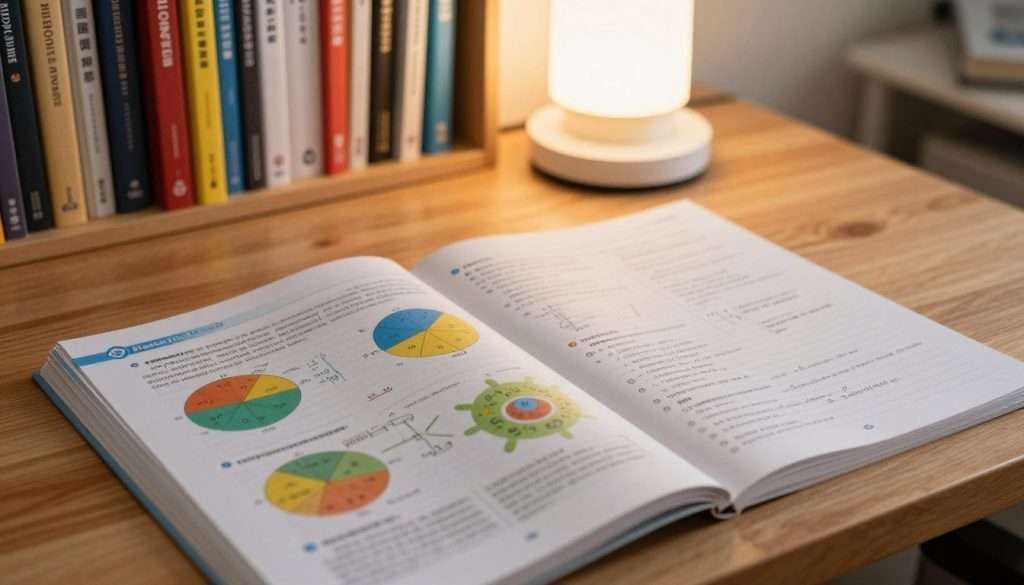
Before reading online, check how to move between pages or sections, how to set a bookmark, and how to return after opening a hyperlink. These small navigation checks help you keep track of the information you meant to study.
Science reading asks you to pause at figures and worked examples, not treat them as decorations. Read the labels, identify what a visual represents, and connect it to the nearby explanation. Use each part as a separate piece of evidence.
| Material | What to look for | What to do |
|---|---|---|
| Prose section | The relationship or claim | Restate it in your own words |
| Worked example | The setup, steps, and result | Cover the solution and try the steps |
| Graph or diagram | Labels, variables, and relationships | Explain what it shows in a sentence |
A graph may show how two variables change together, while an example may reveal why a formula works. Tie each visual to the text around it before going on. Before leaving a digital section, make sure you can return to the page, figure, or example you meant to save.
Keep Focus From Slipping
When your attention starts wandering, shrink the next task until it feels easy to begin again. Choose one clear action at a time, such as reading one paragraph or answering one question. A visible timer and fewer distractions may also help, including for students with ADHD.
These are options to test, not a treatment plan or a rule that fits every student. Put your phone out of sight, choose a quiet place, or set a timer for a work block. One learner’s Spring 2021 example used 30-minute reading blocks followed by 5-minute breaks, with movement and water breaks.
If you want to read a textbook without getting bored, connect the topic to something you care about or know from daily life. In a history chapter, you might link a policy to a current event. For science, switch from a stretch of prose to a relevant example or assignment problem.
When focus slips, try one small reset from this list:
- Move to a quieter spot.
- Put your phone out of reach.
- Stand or stretch during a break.
- Write one precise question for a professor, peer, or academic coach.
A break should help you return with a clear next move, not become another task to manage.
You can adjust the length of a work block to match your attention and the material. Keep the goal small enough to restart without turning a tough page into a verdict on your ability. If the same concept keeps blocking you, bring your written question to a professor, classmate, or academic coach.
Conclusion
The goal is not to finish pages at any cost, but to leave each session knowing more than you did when you started. Choose a small section, then check what you can recall before deciding what needs another look. That simple check makes study time count.
For a fuller system, get the free book How to Become the Smartest Student in the Classroom. It covers memory techniques, study routines, and strategies that stick. There is no cost and no catch, so you can start building a more useful approach to the material today.
If you want a fuller study system, grab your free copy of How to Become the Smartest Student in the Classroom athttps://www.studyingmachine.com/free-books/.