
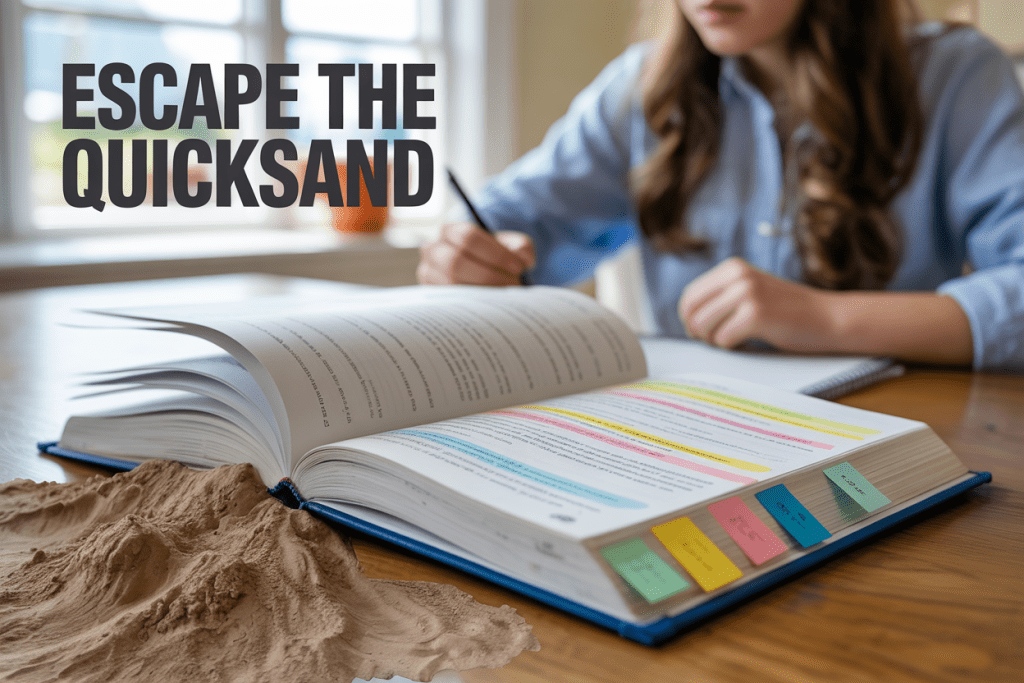
Getting lost in dense textbooks feels like drowning in information overload. Many students, professionals returning to school, and lifelong learners struggle with heavy academic material that seems impossible to absorb.
How to read textbooks without feeling like you’re in quicksand starts with understanding what’s actually slowing you down. This guide shows you practical ways to tackle challenging content and actually remember what you read.
We’ll cover how to identify the mental blocks that make reading feel overwhelming and master pre-reading strategies that set you up for success before you even open the book. You’ll also learn active reading techniques that help information stick in your brain, plus simple methods to break down complex chapters into bite-sized pieces you can actually handle.
By the end, you’ll have a clear system for reading academic material efficiently without the usual brain fog and frustration.
Identify Your Reading Obstacles and Mental Blocks

Recognize Overwhelming Feelings When Facing Dense Material
That sinking feeling hits the moment you crack open a textbook and see walls of dense text staring back at you. Your brain immediately shifts into panic mode, and suddenly even the table of contents feels intimidating. This overwhelming sensation isn’t a character flaw – it’s your mind’s natural response to information overload.
Dense academic material triggers what psychologists call “cognitive overwhelm,” where your working memory becomes flooded with too much information at once. Your brain literally can’t process everything simultaneously, so it does what any sensible organ would do: it hits the emergency brake and makes you want to close the book.
Pay attention to these physical warning signs:
- Your eyes start skimming without actually reading
- You feel restless or fidgety after just a few paragraphs
- Your mind wanders to literally anything else
- You experience a tight feeling in your chest or shoulders
- You suddenly remember “urgent” tasks that need doing right now
Pinpoint Specific Subjects That Trigger Avoidance Behavior
Some subjects make you want to run for the hills while others feel manageable. There’s usually a pattern hiding in your avoidance behaviors, and spotting it gives you power over it.
Math-heavy subjects often trigger avoidance because they require sequential understanding – miss one concept and everything after it becomes gibberish. Science textbooks can feel overwhelming due to their specialized vocabulary and abstract concepts. Philosophy and theory-heavy materials create anxiety because they deal with ambiguous ideas that don’t have clear-cut answers.
Track your avoidance patterns for a week:
| Subject Type | Avoidance Behaviors | Emotional Response |
|---|---|---|
| Mathematics | Procrastination, calculator dependency | Anxiety, inadequacy |
| Sciences | Skipping diagrams, rushing through formulas | Confusion, frustration |
| Literature | Speed reading, avoiding analysis | Boredom, disconnection |
| History | Focusing only on dates, ignoring context | Overwhelm, disinterest |
Your avoidance behaviors reveal valuable information about what specifically challenges you. Maybe you avoid chemistry because you struggle with visualization, or you dodge economics because the mathematical models feel abstract and disconnected from real life.
Acknowledge Perfectionist Tendencies That Slow Progress
Perfectionism disguises itself as high standards, but it’s actually a reading killer. When you demand perfect understanding on the first pass, you create an impossible standard that guarantees frustration and slowdown.
Perfectionist readers often fall into these traps:
- Re-reading the same paragraph multiple times until it’s “perfect”
- Taking excessive notes to capture every single detail
- Refusing to move forward until everything is crystal clear
- Spending hours on single chapters that should take 30 minutes
- Avoiding active reading strategies because they feel “messy”
This all-or-nothing approach backfires because learning is inherently messy and iterative. Your brain needs multiple exposures to complex material, and demanding instant mastery actually interferes with the natural learning process.
Address Fear of Not Understanding Complex Concepts
The fear of looking stupid or missing something important creates a mental traffic jam that blocks comprehension. This fear often stems from past experiences where you felt lost in class or struggled with challenging material.
Complex concepts become less threatening when you realize that confusion is part of the process, not evidence of failure. Professional researchers and experts regularly encounter material they don’t immediately understand – it’s how learning works at advanced levels.
Break down this fear by:
- Accepting that first-pass understanding is supposed to be incomplete
- Viewing confusion as your brain’s way of identifying what needs attention
- Remembering that textbooks are reference materials, not novels meant for linear reading
- Recognizing that even experts re-read and look things up constantly
The goal isn’t to understand everything perfectly on first encounter. The goal is to build familiarity that makes each subsequent reading more productive and less intimidating.
Master Pre-Reading Strategies for Maximum Comprehension

Survey chapter headings and summaries before diving in
Think of surveying a textbook chapter like checking out the terrain before a hiking trip. You wouldn’t just start walking into unknown territory without looking at the map first, right? The same logic applies to tackling dense academic material.
Start by flipping through the entire chapter and scanning all the headings and subheadings. This gives your brain a roadmap of where the content is going. Notice how the information flows from one section to the next. Are there bolded terms scattered throughout? Those are probably key concepts you’ll need to master.
Next, hunt down the chapter summary – usually tucked away at the end. Read this first, not last. The summary acts like a movie trailer for the chapter, highlighting the main plot points without spoiling every detail. When you know what the big takeaways are supposed to be, you can read with more purpose.
Don’t skip the visual elements either. Charts, graphs, diagrams, and highlighted boxes contain concentrated information that authors consider crucial. These visual aids often explain complex concepts more clearly than paragraphs of text.
This surveying process typically takes 5-10 minutes but saves hours of confusion later. Your brain starts building mental filing cabinets for the incoming information, making it easier to organize and remember what you read.
Set realistic time boundaries for each reading session
Your brain isn’t designed to absorb textbook information for hours on end. Research shows that focus starts declining after about 25-30 minutes of intensive reading. Instead of fighting this natural limit, work with it.
Break your reading into focused chunks with clear start and stop times. Set a timer for 25 minutes and commit to staying engaged for that entire period. When the timer goes off, take a 5-10 minute break. Walk around, grab some water, or do some light stretching. This isn’t procrastination – it’s strategic brain maintenance.
For particularly challenging material, consider even shorter sessions of 15-20 minutes. Dense subjects like organic chemistry or advanced mathematics often require more mental energy per page. You’ll actually retain more information reading for 15 focused minutes than struggling through 45 minutes of half-distracted effort.
Plan your reading sessions around your natural energy levels too. If you’re a morning person, tackle the hardest chapters before lunch. Night owls might find their sweet spot after dinner. The key is matching your peak alertness with your most challenging reading tasks.
Create specific learning objectives for every chapter
Reading without clear objectives is like grocery shopping without a list – you’ll wander aimlessly and probably forget the most important items. Before opening any textbook chapter, write down 3-5 specific things you want to learn or understand by the time you finish reading.
Transform vague goals like “understand photosynthesis” into specific targets: “explain the two main stages of photosynthesis,” “describe what happens in the light-dependent reactions,” and “identify three factors that affect photosynthesis rates.” These concrete objectives give your brain clear targets to hunt for while reading.
Use the chapter’s learning objectives if they’re provided, but don’t stop there. Add your own based on upcoming assignments, exam topics, or areas where you’ve struggled before. If you know there’s going to be a problem set on equilibrium constants, make sure one of your objectives focuses on understanding how to calculate and interpret these values.
Write your objectives on a separate piece of paper or at the top of your notes. Check them off as you find the answers. This creates a satisfying sense of progress and helps you stay focused when the material gets tough. When you can clearly articulate what you’ve learned, you’ll know the reading session was successful.
Develop Active Reading Techniques That Stick

Use the SQ3R method for systematic information processing
SQ3R transforms passive page-flipping into a strategic reading process. The five steps—Survey, Question, Read, Recite, and Review—create a framework that forces your brain to engage with material on multiple levels.
Start by surveying each chapter before diving in. Scan headings, subheadings, bold terms, and any graphics or charts. This preview primes your brain for what’s coming and helps you spot the chapter’s main themes in just 2-3 minutes.
Next, turn headings into questions. If you see “Photosynthesis Process,” ask yourself “How does photosynthesis work?” or “What are the steps in photosynthesis?” These questions create mental hooks that grab relevant information as you read.
During the reading phase, focus on finding answers to your questions rather than just consuming words. This targeted approach keeps you alert and prevents that dreaded zone-out state where you read three pages and remember nothing.
After each section, recite the key points without looking at the text. This step reveals gaps in understanding immediately, while the information is still fresh. Finally, review the material within 24 hours to cement it in long-term memory.
Take strategic notes using visual mapping techniques
Traditional linear notes often miss the connections between concepts. Visual mapping techniques like mind maps, concept maps, and flowcharts mirror how your brain naturally organizes information.
Mind maps work particularly well for subjects with hierarchical structures. Place the main topic in the center, then branch out with subtopics and supporting details. Use different colors for each branch and add small drawings or symbols to make concepts more memorable. The visual variety helps your brain create stronger memory pathways.
For complex processes or cause-and-effect relationships, try flowcharts. These work especially well in subjects like biology, chemistry, or history where you need to understand sequences and connections. Draw boxes for key concepts and use arrows to show relationships.
Concept maps excel when you need to show how multiple ideas interconnect. Unlike mind maps with their central focus, concept maps can have multiple starting points and show cross-connections between different areas. This technique works great for literature analysis or understanding how different historical events influenced each other.
Keep your visual notes clean but not perfect. The act of drawing and organizing information engages different parts of your brain than just writing words, making the material stick better.
Ask yourself questions while reading to maintain engagement
Your inner dialogue determines whether you stay engaged or drift off into mental autopilot. Replace passive reading with an active internal conversation by asking yourself specific types of questions throughout each section.
Start with clarification questions: “What does this mean?” or “How does this connect to what I just read?” These questions catch confusion early, before it snowballs into complete lost comprehension.
Challenge the material with critical thinking questions: “Is this always true?” or “What would happen if the opposite were the case?” This approach works especially well with textbooks that present information as absolute fact. Questioning helps you understand limitations and exceptions.
Make prediction questions part of your routine: “What do I think will happen next?” or “How will this concept apply to the next section?” These questions create anticipation and help you spot patterns in how the author presents information.
Connect new information to your existing knowledge with bridge questions: “How is this similar to something I already know?” or “Where have I seen this concept before?” These connections make new material easier to remember and understand.
Summarize key points in your own words after each section
Putting concepts into your own language forces deeper processing than simply highlighting or copying text. This translation process reveals whether you truly understand the material or just recognize familiar words.
After reading each section, close the book and write a 2-3 sentence summary using completely different words than the author used. If you studied a section on market competition, don’t just repeat “firms compete for market share.” Instead, write something like “Companies fight for customers by offering better products or lower prices.”
Focus on the “so what?” when summarizing. Don’t just restate facts; explain why they matter. If you’re reading about the French Revolution, don’t just list events. Explain how economic problems led to political uprising and social change.
Create comparison summaries when moving between related topics. Write how new concepts differ from or build upon previous sections. This technique helps you see the bigger picture and understand how individual pieces fit together.
Test your summaries by explaining them to someone else or reading them aloud. If your explanation sounds unclear or incomplete, revisit the original material. Your summary should make sense to someone who hasn’t read the textbook.
Break Down Complex Material Into Manageable Chunks
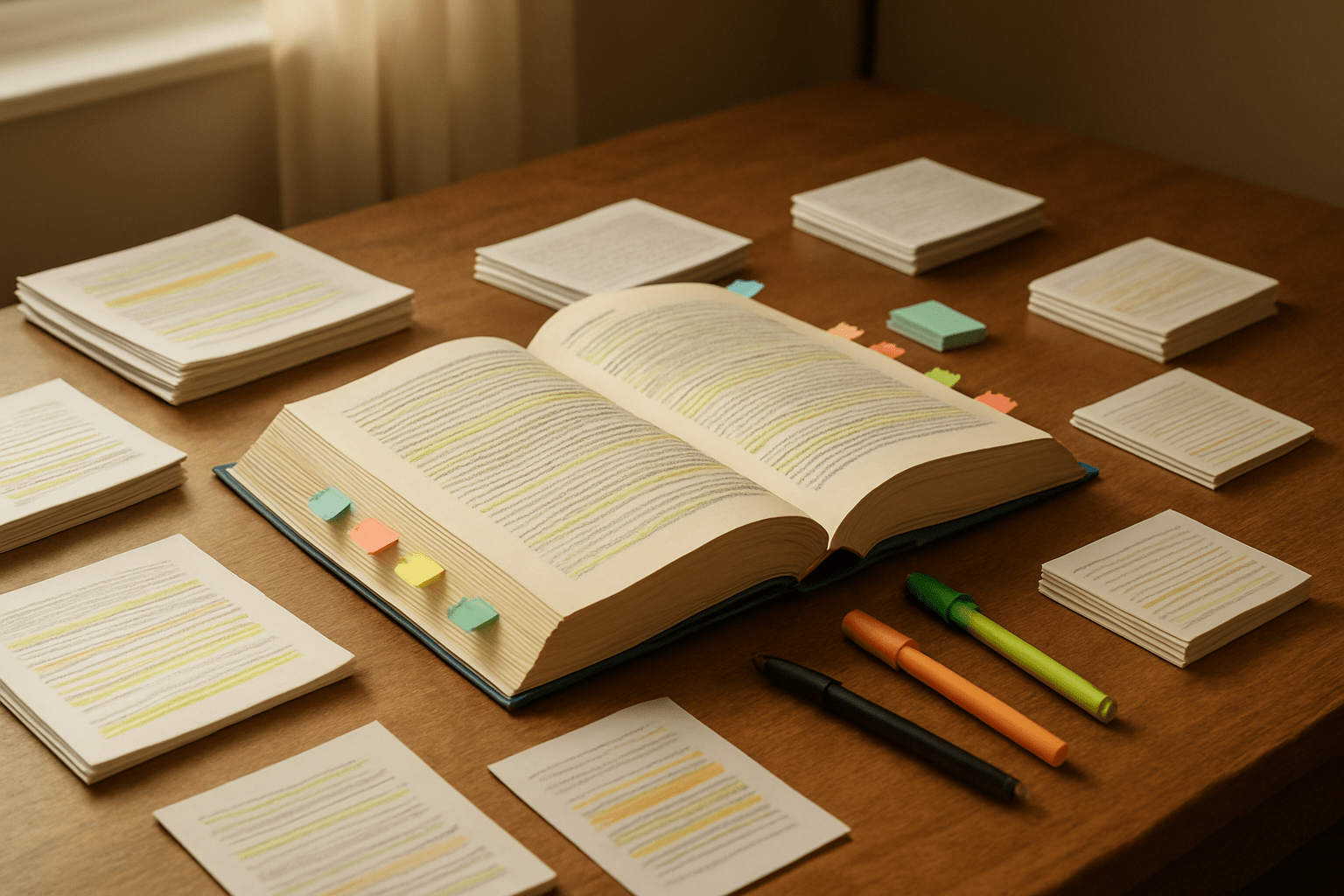
Divide chapters into smaller, digestible sections
Dense textbook chapters can feel overwhelming when you try to tackle them all at once. The secret lies in breaking them down like you would a large meal – into smaller, more manageable portions that your brain can actually process.
Start by skimming through the entire chapter to identify natural breaking points. Look for major headings, subheadings, or topic shifts that create logical divisions. Most textbook chapters follow a predictable structure with clear sections that build upon each other. These existing divisions are your roadmap for creating bite-sized study sessions.
Create your own mini-chapters by grouping related concepts together. For example, if a biology chapter covers cell structure, you might divide it into “cell membrane and transport,” “nucleus and genetic material,” and “organelles and their functions.” Each mini-section should contain no more than 10-15 pages of material – enough to feel substantial but not overwhelming.
Mark these divisions physically in your textbook with sticky notes or digitally with bookmarks. This visual organization helps your brain see progress as you complete each section, creating momentum that carries you through the entire chapter.
Use the Pomodoro Technique for focused reading bursts
Reading textbooks for hours straight is like trying to sprint a marathon – you’ll burn out fast and retain little information. The Pomodoro Technique transforms your reading sessions into focused, energizing bursts that maximize both comprehension and retention.
Set a timer for 25 minutes and commit to reading with complete focus during this time. No phone checking, no social media scrolling, no mental wandering. Just you and the material. When the timer goes off, take a 5-minute break to stretch, grab water, or step outside.
During your reading sprint, engage actively with the content. Highlight key points, jot down questions in the margins, or create quick mental summaries of what you’ve learned. This active engagement prevents your mind from going on autopilot and turning pages without absorbing information.
After four pomodoros (about two hours of reading with breaks), take a longer 15-30 minute break. This pattern prevents mental fatigue while maintaining the intensity needed for deep comprehension. Your brain will actually crave these focused sessions once you establish the rhythm.
Track your pomodoros to see how much material you can realistically cover in each session. This data helps you plan study schedules more accurately and builds confidence as you see consistent progress.
Create logical stopping points to prevent mental fatigue
Your brain needs clear signals about when to consolidate information and when to prepare for new concepts. Random stopping points mid-paragraph or mid-concept create mental chaos and poor retention. Strategic stopping points, however, allow your mind to properly file away what you’ve learned.
End each reading session at the conclusion of a complete idea or section. This might be at the end of a subsection, after a set of examples, or following a summary paragraph. Your brain can then properly categorize and store the information without leaving loose ends dangling.
Before you stop, spend two minutes creating a mental or written summary of what you just read. Ask yourself: “What were the three main points here?” or “How does this connect to what I learned yesterday?” This brief reflection cements the material in your memory and creates strong retrieval pathways.
Build in buffer time between reading sessions, especially when switching between different subjects or complex topics. Your mind needs processing time to move information from short-term to long-term memory. Jumping immediately from organic chemistry to medieval history without a pause creates interference that muddles both subjects.
Plan your stopping points in advance based on the material’s natural flow. This prevents the temptation to push through when fatigue sets in, which often leads to diminished comprehension and wasted time that you’ll need to spend re-reading later.
Build Retention Through Smart Review Systems

Schedule spaced repetition sessions for long-term memory
Your brain forgets information on a predictable curve, losing roughly 50% of new material within an hour and 70% within 24 hours. Spaced repetition fights this natural decay by timing your reviews at strategic intervals when you’re just about to forget.
Start with your first review session 1-2 days after initial learning, then space subsequent reviews at 4 days, 1 week, 2 weeks, and 1 month intervals. Apps like Anki automatically calculate these intervals, but you can also create a simple calendar system. Mark review dates in your planner and stick to them religiously.
The magic happens when you struggle slightly to recall information during these sessions. That moment of difficulty actually strengthens the memory pathway, making future recall easier and more permanent.
Connect new information to existing knowledge
Your brain stores information in networks, not isolated boxes. New concepts stick better when you actively link them to what you already know. Think of this as building bridges between mental islands.
When encountering unfamiliar material, ask yourself: “What does this remind me of?” or “How does this relate to something I learned in another class?” Create mental maps showing these connections. For example, if you’re studying cellular respiration in biology, connect it to the combustion engines you learned about in physics – both involve fuel consumption and energy release.
Write these connections down. Your notebook should include not just facts, but the relationships between ideas from different chapters, courses, or even personal experiences.
Use flashcards for key terms and concepts
Flashcards work because they force active recall – the most powerful learning technique available. But most students create terrible flashcards that encourage mindless memorization instead of real understanding.
Make effective flashcards by following these rules: keep questions specific and focused, include context clues, and create multiple cards for complex concepts. Instead of “Define photosynthesis,” write “What process allows plants to convert sunlight into chemical energy, and what are its two main stages?”
Digital flashcard apps offer advantages like automatic scheduling and multimedia support, but handwritten cards can be equally effective if you review them consistently. The key is regular practice, not the medium.
Teach concepts to others to reinforce understanding
Teaching forces you to organize information clearly and identify gaps in your knowledge. When you can’t explain something simply, you don’t understand it well enough yet.
Find study partners, join study groups, or even explain concepts to imaginary audiences. Walk through processes step-by-step, use analogies, and answer questions. You’ll discover holes in your understanding that weren’t obvious during passive reading.
Create mini-lessons for complex topics. Pretend you’re preparing a 5-minute explanation for someone who’s never encountered the material. This exercise reveals which parts you truly grasp and which need more work.
Practice retrieval without looking at notes
Retrieval practice – testing yourself without reference materials – builds stronger memories than re-reading notes multiple times. Close your textbook and write everything you remember about a topic. Don’t peek until you’ve exhausted your memory.
This feels harder than reviewing notes, which is exactly why it works better. The struggle to remember strengthens neural pathways and reveals what you actually know versus what feels familiar.
Set aside time for “blank page” sessions where you reconstruct key concepts, formulas, or processes from memory. Compare your recall to the original material and focus future study on the gaps you discover.

Reading textbooks doesn’t have to feel like you’re drowning in dense material that never sticks. The strategies we’ve covered—from spotting your reading roadblocks to breaking down complex chapters into bite-sized pieces—can transform your study sessions from overwhelming marathons into productive, manageable experiences. When you combine pre-reading techniques with active engagement and smart chunking methods, you’re setting yourself up to actually understand and remember what you’re reading instead of just getting through the pages.
The real game-changer is building those review systems that keep information fresh in your mind long after you’ve closed the book. Start with just one or two of these techniques and see what clicks for you—maybe it’s the pre-reading scan or the chunk-and-review approach. Once you find what works, you can gradually add more strategies to your toolkit. Your textbooks will start feeling less like quicksand and more like stepping stones to the knowledge you actually want to gain.