

We’re born with a natural curiosity that makes us want to explore. As we grow, we can either keep or lose this curiosity. When we cultivate a love for learning, we open up to new experiences and knowledge.
By embracing our curiosity, we can make learning exciting again. Exploring new subjects and interests shows us the world in a new way. This journey of discovery helps us grow and develop.
Key Takeaways
- Curiosity is a natural trait that drives us to learn and explore.
- Cultivating a love for learning can help us stay motivated and engaged.
- Embracing new experiences and knowledge can lead to personal growth and development.
- Learning can be a fun and enjoyable experience when approached with curiosity.
- Nurturing our curiosity can help us stay curious and open to new ideas.
The Power of Lifelong Learning
Curiosity sparks the flame of lifelong learning, leading us to new discoveries. Learning is key to our growth, both personally and professionally. It helps us adapt and innovate in a changing world.
Why Learning Matters in Today’s World
In today’s fast world, learning is essential. Lifelong learning is a must for staying ahead. It keeps our skills sharp and helps us navigate today’s complex world.
By learning, we become stronger and better at facing life’s challenges.
The Connection Between Learning and Personal Growth
Learning is linked to personal growth. It boosts our confidence and opens new perspectives. This growth brings us joy and fulfillment.
By loving to learn, we embrace new experiences. This leads to a more fulfilling life.
Becoming passionate about learning changes us. It helps us reach our full potential and live more fully.
Understanding the Psychology of Learning
To love learning, we must know how our brains work and what drives us to learn more. The psychology of learning is key. It helps us understand how we absorb and keep new information.
How Our Brains Process New Information
Our brains process information in a unique way. New data first goes into our short-term memory. If we think about it more, it moves to our long-term memory.
As the saying goes, “Memory is the residue of thought.” We remember most what we think about most. So, engaging deeply with what we’re learning is important. This way, we improve our memory.
The Role of Dopamine in Learning Motivation
Dopamine is key in motivating us to learn. It’s called the “feel-good” neurotransmitter. It’s released when we feel pleasure or achieve something.
In learning, dopamine is released when we find something new or complete a tough task. This makes us want to keep learning. Our brain links learning with pleasure. Knowing how dopamine works helps us stay motivated and engaged.
| Learning Aspect | Role of Dopamine | Impact on Learning |
|---|---|---|
| Motivation | Dopamine release associated with new discoveries | Increased enthusiasm for learning |
| Engagement | Dopamine encourages continued exploration | Better retention of information |
| Satisfaction | Dopamine release upon achieving learning milestones | Enhanced motivation to learn more |
Common Barriers to Loving Learning
Starting a lifelong journey of learning can be tough. We face many obstacles that make it hard to stay excited about learning. Knowing what these barriers are is the first step to beating them and sparking a passion for learning that never fades.
Negative Educational Experiences
Many of us have had bad experiences in school. This can make us dislike learning. It might be because of a strict curriculum, harsh teachers, or a competitive atmosphere that makes us anxious.
These experiences can turn learning into something we dread, not something we enjoy.
Fixed Mindset vs. Growth Mindset
Carol Dweck’s work on fixed and growth mindsets is key. A fixed mindset makes us think our abilities can’t change. This can make us avoid challenges. But a growth mindset sees challenges as chances to grow, helping us foster a love for learning.
Overwhelm and Information Overload
Today, we’re hit with endless data from everywhere. This can overwhelm us and make it hard to focus on what really interests us. To fall in love with learning, we must learn to sort through this information. We need to choose what we learn and how we learn it.
By tackling these barriers, we can start to see learning in a more positive light. It’s about creating a space that lets our curiosity shine. It’s about encouraging us to dive into new ideas and interests.
How to Fall in Love with Learning: Step by Step
Falling in love with learning begins with finding what sparks your curiosity. We often get curious when we can explore topics we find interesting. For example, kids are naturally curious, and their questions can lead to amazing discoveries. By embracing this curiosity, we can rekindle our love for learning.
Identifying Your Natural Curiosities
First, think about what naturally interests you. What do you enjoy reading or exploring in your free time? Make a list of these interests. This will be the starting point of your learning journey.
Exercise: Creating Your Curiosity Map
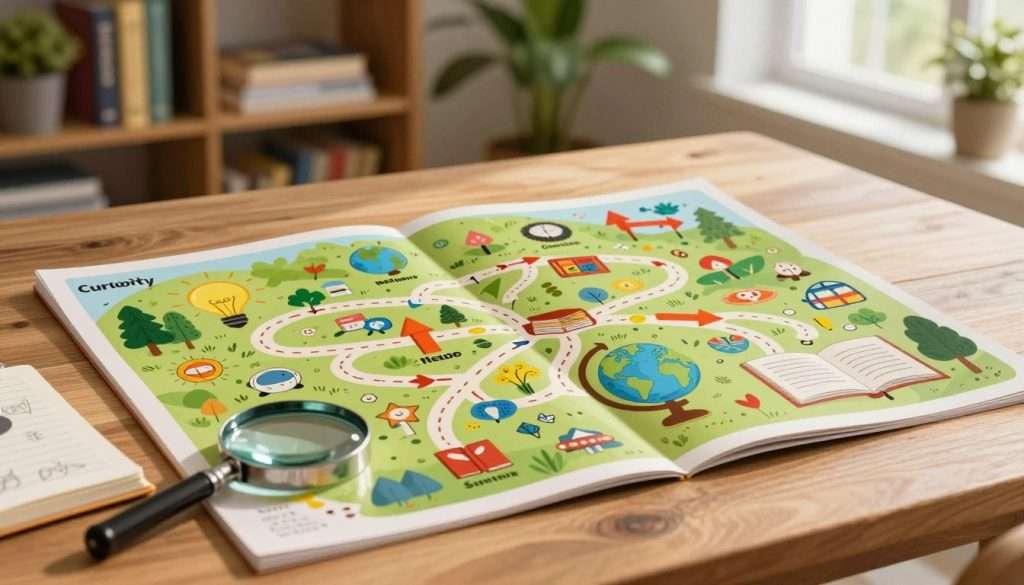
Make a visual map of your curiosities. Start with a central idea and branch out to related topics. This exercise helps you see your interests and find connections between subjects. For example, you might see that your interest in science is connected to your love of nature.
Connecting Learning to Personal Goals
After identifying your interests, connect them to your personal goals. Ask yourself, “How can learning about these topics help me achieve my goals?” For example, if you’re interested in technology, learning to code could boost your career.
Setting SMART Learning Objectives
To make your learning more effective, set SMART (Specific, Measurable, Achievable, Relevant, Time-bound) goals. For example, “I want to learn Python programming by dedicating 30 minutes, three times a week, for the next three months.” This keeps you focused and motivated.
| Goal | Specific Objective | Timeline |
|---|---|---|
| Learn Python | Dedicate 30 minutes, 3 times a week | 3 months |
| Improve Writing Skills | Write 500 words, 2 times a week | 2 months |
By following these steps and setting clear goals, you can make learning enjoyable and rewarding.
Discovering Your Learning Style
Understanding your learning style is key to loving learning. Humans are naturally curious, always exploring and solving problems. Finding your learning style can make you more passionate about learning.
There are many learning styles, each with its own traits. Knowing these can help you learn better. Let’s look at how you can make your learning fit you.
Visual, Auditory, Reading/Writing, and Kinesthetic Learners
Most people have a main learning style: visual, auditory, reading/writing, or kinesthetic. Visual learners like images and videos. Auditory learners get information best from sound. Those who prefer reading/writing learn from written stuff. And kinesthetic learners do best with hands-on activities.
Customizing Your Learning Approach
After finding your main learning style, you can tailor your learning. For example, visual learners might use diagrams. Auditory learners can record lectures. Reading/writing learners take detailed notes. Kinesthetic learners do experiments.
By making your learning fit your style, you’ll learn better. This can help you develop a love for learning that lasts forever.
Creating an Optimal Learning Environment
To become a true learning enthusiast, you need to create a great learning space. It’s not just about having the right books. It’s about making a place that sparks curiosity and helps you grow.
Physical Space Considerations
Your learning space should be comfy, bright, and free from distractions. Think about these key points:
- Ergonomic furniture for long study times
- Good lighting to avoid eye strain
- Less clutter to stay focused
- A soothing color scheme for calm and focus
By making your physical space better, you’ll focus better and enjoy learning more.
Digital Environment Organization
In today’s world, your online space is as crucial as your physical one. Here are some digital tips to stay organized and focused:
- Use a good learning management system to track your courses
- Organize your digital files with clear folders and labels
- Turn off notifications to avoid digital distractions
- Use productivity tools and apps to streamline your learning
By organizing your digital space well, you can spark a passion for learning and use your study time wisely.

Practical Strategies to Spark a Passion for Learning
Learning something new is more than just knowing what to learn. It’s about how we learn it. To fall in love with learning, we need to use effective and fun strategies. Here are some ways to make learning a joy.
The Pomodoro Technique for Focused Learning
The Pomodoro Technique is a simple yet powerful method to enhance focus. It involves working in 25-minute focused intervals (called Pomodoros) separated by 5-minute breaks. After four cycles, take a longer break of 15-30 minutes. This technique helps in maintaining concentration and avoiding burnout.
- Choose a task you want to work on.
- Set a timer for 25 minutes.
- Work on the task without any interruptions until the timer goes off.
- Take a 5-minute break.
- Repeat the cycle.
Spaced Repetition for Better Retention
Spaced repetition is a technique that involves reviewing material at optimal intervals to help solidify it in your long-term memory. This method is effective for learning new languages or memorizing key concepts.
To apply spaced repetition:
- Review the material shortly after learning it.
- Review it again after a few days.
- Then, review it after a week, and so on, increasing the interval.
Learning Through Teaching Others
One of the most effective ways to reinforce your own learning is by teaching others. When you teach someone else what you’ve learned, you not only help them understand the concept but also deepen your own understanding.
Try explaining what you’ve learned to a friend or family member. You can also write a blog post or create a video tutorial. This process helps in:
- Clarifying your thoughts.
- Identifying areas where you need more practice.
- Retaining information better.
By incorporating these strategies into your learning routine, you can make the process more engaging and enjoyable. This will help you to fall in love with learning.
Leveraging Technology to Cultivate a Love for Learning
Technology has made learning easier and more fun than ever. It has made learning accessible and interactive. This has changed how we learn for the better.
Educational Apps and Platforms
Educational apps and platforms have changed learning. They offer personalized experiences. Apps like Duolingo and Khan Academy provide interactive and engaging content for all learning styles.
Online Communities for Learners
Online communities are great for learners. They offer a place to share, ask, and work together. Sites like Reddit’s r/learnprogramming and Stack Exchange are supportive environments for growth.
Using AI Tools to Enhance Learning
AI tools are improving learning. They include adaptive learning systems and tools for organization. Technology helps learners stay on track and achieve their goals.
| Tool | Description | Benefit |
|---|---|---|
| Duolingo | Language learning app | Interactive and gamified learning experience |
| Khan Academy | Free online courses | Personalized learning paths |
| Reddit’s r/learnprogramming | Community for programming learners | Supportive environment for skill development |
By using these technologies, learners can enjoy learning. As we keep exploring new tech, learning will only get better.
Making Learning a Social Experience
Learning with others can change how we view knowledge. It keeps us motivated and engaged. Sharing our learning with others makes it more enjoyable.
Finding Learning Partners and Accountability Buddies
Having someone who wants to learn the same things as you is great. You can encourage and motivate each other. Look for online forums or social media groups that match your interests.
You can also ask friends or coworkers if they want to learn together. This way, you can make learning a fun team effort.
Joining Study Groups and Learning Circles
Study groups and learning circles are perfect for learning together. They let you work together, talk about topics, and learn from each other. Check out local community centers, libraries, or online groups for these.
By joining, you’ll become more passionate about learning. You’ll also understand your subject better.
To get the most from these groups, be active and share your thoughts. Ask questions and listen to others. This way, you’ll learn more and help create a community that loves learning.
Maintaining Your Learning Enthusiasm Long-Term
You’ve started learning, now let’s keep that fire burning! Keeping enthusiasm for learning is key for long-term success. Motivation can change, but there are ways to stay engaged.
Overcoming Learning Plateaus
Learning plateaus can be tough, but they’re part of learning. To beat them, try new things and challenge yourself.
Technique: The 30-Day Learning Challenge
Try the 30-Day Learning Challenge. Learn something new every day for 30 days. It could be reading, watching tutorials, or practicing a new skill.
| Day | Learning Activity | Time Spent |
|---|---|---|
| 1 | Read an article on a new topic | 30 minutes |
| 2 | Watch a tutorial on a skill you’re interested in | 45 minutes |
| 3 | Practice a new language using an app | 20 minutes |
Celebrating Small Wins and Progress
Celebrate your progress, no matter how small. It’s crucial for keeping your love of learning. It boosts positive habits and keeps you going.
Be patient and don’t freak out because of the silence during the first inquiry lesson. Let them fail a few times before they get it. This mindset sparks a passion for learning and keeps you engaged.
Conclusion: Embracing the Lifelong Learning Journey
We’ve explored how to fall in love with learning. We hope you’re now inspired to keep learning for life. Curiosity is key to enjoying and finding happiness in life.
By understanding learning psychology and finding what interests you, you’re on the right path. Creating a good learning space helps too. The journey to lifelong learning is as valuable as the end goal.
As you keep learning, you’ll find new interests and skills. You’ll grow personally. We urge you to stay curious and keep exploring. This way, you’ll not only improve your life but also inspire others to love learning too.