

Ever feel like your brain is a cluttered junk drawer? We’ve all been there, staring at a huge pile of notes that don’t make sense. We want to help you turn messy chaos into a clear, bright picture.
Imagine a tool that lets you draw your thoughts like a growing tree. This special study strategy helps you see how every piece fits together. It breaks down complex topics and opens a door to new possibilities.
Our mission is to make learning fun and exciting. Using visual layouts sparks new ideas and makes remembering easy. Let’s dive in together and improve how you see the world of books!
Key Takeaways
- Visualize complex topics with ease.
- Organize thoughts using branching structures.
- Connect ideas to improve memory.
- Make learning sessions more engaging.
- Break down large projects into small parts.
- Discover an ocean of possibilities.
What Is Mind Mapping and Why Does It Matter?
Visual learning is at the heart of mind mapping. It’s becoming more popular among students and professionals. Mind mapping is a visual way to organize information, just like our brains do.
Mind mapping is about making a visual map of your thoughts and ideas. It’s a creative way to organize and connect your thoughts. This makes it easier to remember and review information later.
Mind maps let you use your creativity, whether on paper or with software. They follow your thoughts and help you think differently. This makes them great for visual learners.
Using mind maps helps you understand complex information better. It breaks down information into smaller, easier-to-see parts. This not only helps you understand better but also remember more, as it uses more of your brain than writing notes.
Mind mapping is important because it fits different learning styles, like visual learning. It uses colors, images, and layout to share a lot of information in a small space. This makes it easy to understand and remember.
The Science Behind Visual Learning and Memory Enhancement
Our brains love visual cues more than plain text. This isn’t just a personal choice. It’s how our brains are wired to handle visual information.
Visual information is processed in many parts of the brain at once. This makes it easier to remember. Colors, images, and diagrams help us recall information better.
How Your Brain Processes Visual Information
The human brain processes visual data in a special way. When we see an image, it’s not just a simple picture. It’s broken down into colors, shapes, and context.
Our brains also love color. They get tired of the same information over and over. Mind maps use lots of colors, helping us remember better. This is why adding colors and images to study materials works well.
The Connection Between Cognitive Mapping and Long-Term Retention
Cognitive mapping, like mind mapping, uses our brain’s visual skills. It turns information into a visual map that’s easy to remember. This method keeps information engaging and organized, helping us remember it for longer.
Now, let’s see how visual learning helps improve memory:
| Aspect | Description | Benefit |
|---|---|---|
| Colors | Using different colors to categorize information | Enhances visual distinction and memory |
| Images | Incorporating relevant images to support information | Increases engagement and recall |
| Diagrams | Creating diagrams to illustrate complex concepts | Simplifies understanding and retention |
Mind Mapping 101: The Visual Study Strategy That Boosts Retention
To understand mind mapping, we must grasp its basics and how it differs from old note-taking ways. It’s a visual strategy that helps the brain keep information better when it’s organized visually.
Core Principles of Effective Mind Mapping
Good mind mapping follows a few key rules. These make it a great tool for learning. The main points include:
- Starting with a central idea or topic
- Making branches or connections from the center
- Using keywords and images to share info
- Using colors to highlight and sort info
- Building a structure to organize info
By sticking to these rules, mind maps make learning more fun. They help with making connections, summarizing complex ideas, and improving thinking. They’re better than plain text because they match how our brains work.
Why Mind Maps Outperform Traditional Note-Taking Methods
Mind maps beat old note-taking for a few big reasons:
- Visual Processing: Mind maps use our brain’s visual strengths better than text notes.
- Organization and Structure: Their radial design makes info easier to organize and remember.
- Association and Connection: Mind maps help link different info pieces, boosting memory and understanding.
These benefits make mind mapping a powerful tool for learning. It’s flexible for many subjects and learning styles. It’s a key tool for students and anyone who wants to keep learning.
Key Benefits of Mind Mapping for Students and Learners
Mind mapping offers many benefits for students, from better memory to more creativity. It’s a visual tool that can greatly improve your grades and learning experience.
Enhanced Information Recall and Retention Techniques
Mind maps are great for remembering things. They organize information in a way that’s easy to remember. This makes it less likely to forget what you’ve learned.
Here are some ways mind maps help with remembering:
- Visual Association: They connect new info to what you already know, using images and colors.
- Simplified Review: Mind maps make complex info simple to review, saving time.
- Active Engagement: Making a mind map helps you understand and remember better.
Improved Understanding of Complex Subjects
Mind maps are perfect for breaking down hard subjects. They help you:
- Identify Key Concepts: Spot the main ideas and what’s supporting them.
- See Relationships: Understand how different parts of a subject fit together.
- Simplify Study Material: Make complicated info easy to see and understand.
Increased Creativity and Critical Thinking Skills
Mind mapping boosts your creativity and problem-solving skills. It makes you think differently and:
- Explore Different Perspectives: Look at ideas from various angles.
- Make Novel Connections: Find new ways to link ideas together.
- Think Outside the Box: Use colors and images to express your thoughts in new ways.
Adding mind mapping to your study routine can bring many benefits. It helps with remembering, understanding complex topics, and thinking creatively. Mind mapping is a powerful tool for reaching your academic goals.
Essential Elements Every Mind Map Needs
To get the most out of mind mapping as an educational tool, knowing its key parts is key. A solid mind map starts with a central idea. It then adds related subtopics and concepts. It uses visuals and text to help remember information better.
Central Topic and Main Branches
Every mind map has a central topic at its heart. This topic is the main idea or subject you’re diving into. From this core, main branches spread out. They show the main subtopics or categories tied to your central theme.
Keywords, Colors, and Visual Symbols
Good mind maps use keywords to share info quickly, colors to make it look good and help tell ideas apart, and visual symbols to help remember. These elements together make a map that’s both fun to look at and full of useful info.
| Element | Purpose | Example |
|---|---|---|
| Central Topic | Represents the main idea | A clear, concise statement or image |
| Main Branches | Symbolize primary subtopics | Thick lines or branches radiating from the center |
| Keywords | Convey information concisely | Short phrases or single words |
| Colors | Differentiate between ideas and add visual appeal | Different colors for different branches or themes |
| Visual Symbols | Enhance memory recall | Icons, images, or simple drawings |
Hierarchical Structure and Connections
A well-organized mind map has a hierarchical structure. It starts with broad ideas and then gets into the details. Connections between parts of the map highlight how ideas relate to each other.
How to Create Your First Mind Map: Step-by-Step Guide
Let’s explore mind mapping with a simple guide. Creating a mind map is exciting. It helps you organize your thoughts and ideas visually.
Step 1: Choose Your Central Topic and Position It
Start by picking your central topic. This is the main idea you want to explore. Place it in the center of your map.
Tip: Use a clear and concise title for your central topic. This keeps you focused on the main idea.
Step 2: Add Primary Branches for Main Ideas
After choosing your central topic, add primary branches. These branches are for the main ideas or categories. Think of them as the main headings in an outline.
- Use keywords and short phrases to label your branches.
- Keep your primary branches limited to 3-5 main ideas to maintain clarity.
Step 3: Develop Secondary and Tertiary Branches
Once you have your primary branches, add secondary and tertiary branches. These represent subtopics and further details under each main idea.
Example: If your central topic is “Plan a Vacation,” a primary branch might be “Destination,” with secondary branches like “Places to Visit” and “Accommodation.”
Step 4: Incorporate Visual Elements and Colors
Visual elements and colors make your mind map more engaging. Use different colors to differentiate between main ideas or to highlight important information.
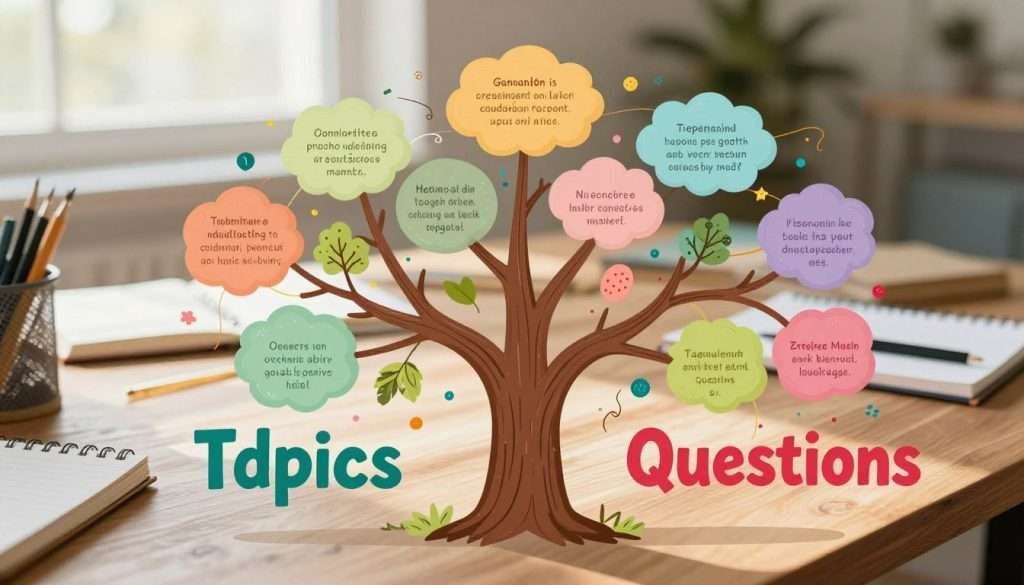
Step 5: Review and Refine Your Brain Mapping
The final step is to review and refine your mind map. Check for clarity and ensure the information is well-organized. Make any necessary adjustments.
| Step | Description |
|---|---|
| 1 | Choose Your Central Topic |
| 2 | Add Primary Branches |
| 3 | Develop Secondary and Tertiary Branches |
| 4 | Incorporate Visual Elements and Colors |
| 5 | Review and Refine |
Digital vs. Hand-Drawn Mind Maps: Choosing Your Educational Tool
When you start with mind mapping, you’ll see two main ways: using a pen and paper or digital tools. Each has its own benefits, and picking one can really change how you learn.
Benefits of Traditional Pen-and-Paper Approach
Hand-drawn mind maps give a hands-on feel that many people like. Drawing by hand can help you remember things better and be more creative. With paper and pen, you don’t have to worry about software limits or digital distractions.
Key advantages of hand-drawn mind maps include:
- Tactile learning experience
- No software limitations or distractions
- Enhanced creativity through freehand drawing
Top Digital Mind Mapping Software and Apps
Digital tools, like Canva, Coggle, EdrawMind, GitMind, and MindManager, offer flexibility and easy editing. They also have features for working together and sharing ideas. Each tool is designed for different learning styles and preferences.
| Tool | Key Features | Collaboration |
|---|---|---|
| Canva | User-friendly interface, vast template library | Real-time collaboration |
| Coggle | Automatic saving, hierarchical structure | Multi-user editing |
| EdrawMind | Gantt charts, built-in symbols library | Team collaboration features |
Hybrid Approaches for Maximum Flexibility
Why pick just one when you can mix both? Many people find that using both digital and hand-drawn methods works best. For example, you can start with a hand-drawn mind map in class and then use GitMind or MindManager to digitize it later.
Think about your learning style and needs when choosing between digital, hand-drawn, or a mix of both mind mapping methods.
Proven Study Skills: Applying Mind Maps to Different Subjects
Mind maps are great for studying history, science, or a new language. They help you organize and remember information better. By making visual maps of your study materials, you get a powerful tool for learning in many subjects.
Literature and History Classes
Mind maps are super helpful for literature and history. They let you keep track of characters, plotlines, and events. By making a mind map, you can visually connect different elements of a story or historical period. This makes it easier to remember important details and dive deeper into the material.
For example, you can make a mind map to outline a novel’s plot. It can have branches for characters, themes, and key events. This visual map helps you see the story’s big picture and how all parts fit together.
Science and Mathematics
Science and math have complex concepts and formulas. Mind maps can organize these into a clear structure. This makes it simpler to review and grasp the material.
You can break down tough topics into smaller parts with mind maps. They help you see how different concepts are linked. For example, you can map out a biological system or the steps to solve a math problem.
Language Learning
Mind maps are also useful for learning a new language. They help organize vocabulary, grammar, and other key concepts. By making a visual map of your language learning, you can see how different parts fit together. This helps you know where to focus your practice.
For instance, you can group vocabulary by theme, like food or travel. Mind maps can also show grammar rules and exceptions. This makes them easier to understand and remember.
Advanced Mind Mapping Techniques for Effective Learning
To improve your mind mapping skills, we’ll look at some advanced strategies. These will enhance your memory enhancement and brain mapping abilities. They unlock mind mapping’s full potential for learning and managing projects.
Incorporating Mnemonics and Memory Triggers
Mnemonics and memory triggers can make your mind maps more powerful. They help encode information in a memorable way. This makes it easier to recall later. Use acronyms, rhymes, or vivid images to link to key concepts.
For example, to remember the planets, use “My Very Excellent Mother Just Served Us Nachos” (Mercury, Venus, Earth, Mars, Jupiter, Saturn, Uranus, Neptune). This mnemonic in your mind map aids in remembering the order.
Creating Connected Mind Map Networks
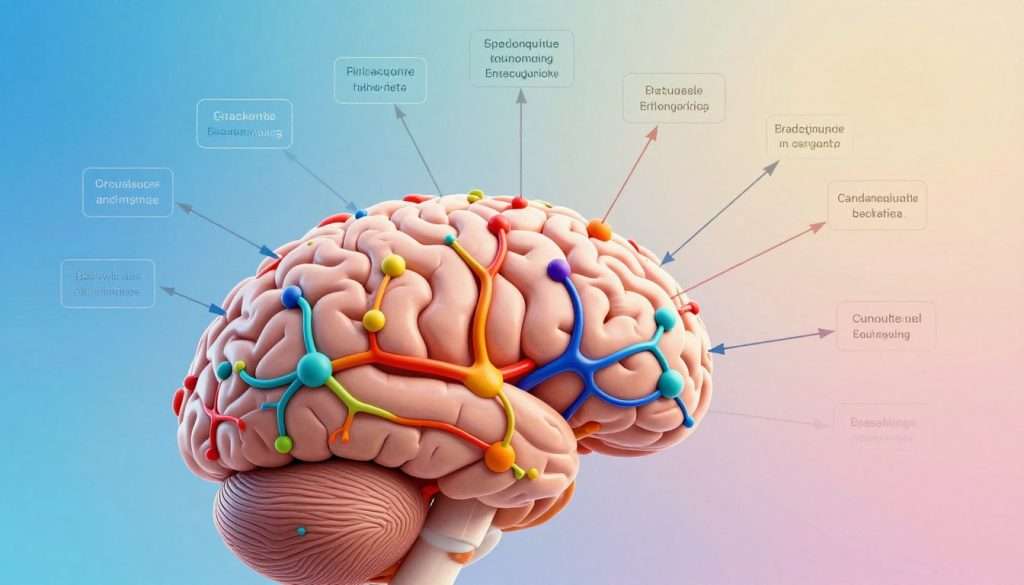
Creating connected mind map networks is another advanced technique. It links multiple maps to form a comprehensive network. This visualizes relationships between concepts, making the big picture clearer.
Start with a central map for main topics, then create separate maps for each. Linking these maps helps navigate your knowledge network. It connects different ideas and concepts easily.
Time-Based and Sequential Mind Maps for Projects
Time-based and sequential mind maps are great for project management. They show a sequence of events or tasks over time. This keeps you organized and on track.
Here’s how to use a time-based mind map for projects:
| Week | Task | Status |
|---|---|---|
| 1 | Research | In Progress |
| 2-3 | Outline | Not Started |
| 4-6 | Drafting | Not Started |
| 7 | Revision | Not Started |
| 8 | Finalize | Not Started |
Time-based mind maps help you see your project timeline. They keep you on top of tasks. This is very helpful for big projects or team work.
Common Mind Mapping Mistakes to Avoid
Mind mapping can change your study game, but watch out for common mistakes. It’s a great tool for remembering and understanding, but it needs skill to use right. Let’s look at some mistakes to avoid for better mind mapping.
Overcomplicating Your Visual Structure
One big mistake is making your mind map too complicated. It’s easy to add too many branches, colors, or images. This makes it look like a mess, not a clear map. Keep it simple and focused on the main topic. You can make different maps for different parts of a subject.
To avoid this, start with a clear idea and only use the most important branches. Use colors and symbols to show different ideas, but don’t go overboard. The goal is to be clear, not to make art.
Neglecting the Review and Revision Process
Another mistake is not reviewing and revising your mind maps. A mind map is not a one-time task; it grows as you learn more. Regular reviews help you remember and find areas to improve.
Make time to go back to your mind maps, add new info, and simplify them if needed. This helps you remember and connect new and old knowledge.
Using Too Many Words Instead of Keywords
Using too many words is a common mistake. Mind maps work best with short keywords and phrases. Keywords are the backbone of a good mind map, helping you quickly get the main ideas.
Try to summarize your thoughts into key words or phrases. This makes your map easier to read and helps you understand and summarize better.
| Common Mistake | How to Avoid It |
|---|---|
| Overcomplicating the map | Keep it simple and focused on the main topic |
| Neglecting review and revision | Regularly revisit and update your maps |
| Using too many words | Use concise keywords and phrases |
Integrating Mind Mapping Into Your Daily Study Routine
Adding mind mapping to your study routine can really boost your grades. It makes learning more effective and helps you improve your study skills. Let’s see how mind maps can fit into your study schedule.
Pre-Lecture Preparation with Mind Maps
Before a lecture, make a mind map to get ready. Start by researching and picking out important points. These points become the main branches of your map. This helps you grasp the topic better and take better notes.
For example, if you’re learning about a historical event, your map could have sections for causes, key figures, major events, and outcomes. Seeing how these pieces fit together makes learning easier.
Active Note-Taking During Class Sessions
Use mind maps as a way to take notes during lectures. Instead of writing down everything, focus on the main ideas. Add colors, symbols, and images to make your notes stand out.
Mind mapping in class keeps you focused and makes reviewing easier. It also helps you spot areas you need to study more.
Exam Preparation and Review Strategies
For exams, mind maps are super helpful. Make a detailed map that covers all the important points from your studies. This makes reviewing complex topics easier and helps you remember better.
Here’s how you can use mind maps for exam prep:
| Topic | Mind Mapping Strategy | Benefits |
|---|---|---|
| Pre-Lecture Prep | Create a mind map of key concepts before class | Better understanding of the topic, easier to follow lectures |
| Active Note-Taking | Use mind maps to capture main ideas during lectures | Improved engagement, structured notes |
| Exam Prep | Summarize course materials into a comprehensive mind map | Efficient review, better retention |
By using mind maps every day, you can improve your learning habits. They’re great for getting ready for lectures, taking notes, or studying for exams. Mind maps are a powerful tool for better learning.
Conclusion
Mind mapping is a great way to study better. It helps you remember more and learn faster. By using mind maps, you can change how you study and keep information.
Try using mind mapping every day. It’s good for students and anyone who wants to learn more. With regular use, you’ll remember things better, grasp tough subjects, and think outside the box.
Get a pen and paper, or use digital tools like MindMeister or Coggle. Start making your own mind maps today. As you get into the habit, you’ll see how it makes learning easier and helps you grow.