

Are you tired of studying for hours only to forget what you’ve read? You’re not alone! Many students struggle to retain information. But, what if there was a way to make studying more effective and even enjoyable?
Enter mind mapping, a powerful visual technique that can change how you study. It creates a diagram that connects ideas and concepts. This visual study hack has been shown to double retention rates, making it a valuable tool for students.
We will explore how you can harness the power of mind mapping to achieve academic success.
Key Takeaways
- Discover the benefits of using mind maps for studying
- Learn how to create effective mind maps for retaining information
- Understand how mind mapping can improve your academic performance
- Explore tips for incorporating mind mapping into your study routine
- Find out how mind mapping can help reduce study stress
1. What Is Mind Mapping and Why Every Student Should Use It
Mind maps are more than just pretty notes. They’re a strong tool for better memory and understanding complex ideas. They help you use your brain’s visual skills, making it simpler to remember and recall important details.
The Visual Learning Revolution
The way we learn is evolving, and mind mapping leads this change. It uses your brain’s visual skills to grasp and hold onto complex info. This method is great because it involves more senses, making learning fun and interactive.
How Mind Maps Differ from Linear Note-Taking
Mind maps are different from old-school note-taking. They’re flexible and creative, letting you organize info in a visual way. This lets you see how different ideas connect, giving you a clearer view of the whole picture.
Why Your Brain Loves Visual Information
Our brains love visual stuff, and mind maps use this to their advantage. They add images, colors, and symbols, which makes your brain work better. This way, you can remember more and study smarter.
2. The Science Behind Why Mind Mapping Doubles Retention
Mind mapping works because it matches how our brains handle information. It’s not just about making a pretty picture. It uses our brain’s natural skill for processing visuals better than text.
How Your Brain Actually Stores and Retrieves Information
Our brains don’t store info like a computer. Instead, they have a network of neurons that connect and change based on what we learn. Mind maps help strengthen these connections, making it easier to remember things later.
The Dual Coding Theory: Words Plus Images Equal Better Memory
The dual coding theory by Allan Paivio says that using words and images together creates two memory paths. This means combining words and images in a mind map doubles our memory chances. This theory is key to why mind mapping works well for students.
Research-Backed Evidence from Educational Psychology
Studies show that visual note-taking, like mind mapping, boosts recall by 10-15% over linear notes. Here are some important findings:
| Study | Method | Result |
|---|---|---|
| Paivio (1986) | Dual coding theory application | Improved memory retention |
| Buzan (2002) | Mind mapping vs. linear notes | 15% increase in recall |
| Mento et al. (1992) | Visual-spatial techniques | 10% improvement in retention |
These studies prove mind mapping is more than a trend. It’s a science-backed method that improves memory retention and doubles retention for students.
3. Mind Mapping for Students: The Visual Study Hack That Doubles Retention in Practice
Let’s explore how mind mapping boosts students’ grades and understanding. Many students have seen big improvements in their school work after using this visual method.
Real Student Success Stories and Transformations
Students at all levels have seen great success with mind mapping. For example, a high school student who struggled with history dates and events improved a lot with timeline mind maps. A college student also used mind maps to understand complex science better, leading to better retention and understanding.
Measurable Grade Improvements from Academic Studies
Studies back up the benefits of mind mapping. They show that students who use mind mapping do better than those who just take notes. They retain information better and understand it more clearly.
| Study | Method | Result |
|---|---|---|
| Educational Psychology Review | Mind Mapping vs. Traditional Notes | Improved retention by 25% |
| Journal of Educational Research | Mind Mapping with Visual Elements | Better comprehension by 30% |
These examples and studies prove mind mapping’s effectiveness. It’s a visual tool that can greatly improve retention and grades.
4. Creating Your First Mind Map: Complete Step-by-Step Guide
Let’s start making your first mind map with a simple guide. Mind maps help students learn better by using pictures and colors. Follow these steps to make a mind map that helps you study and learn more fun.
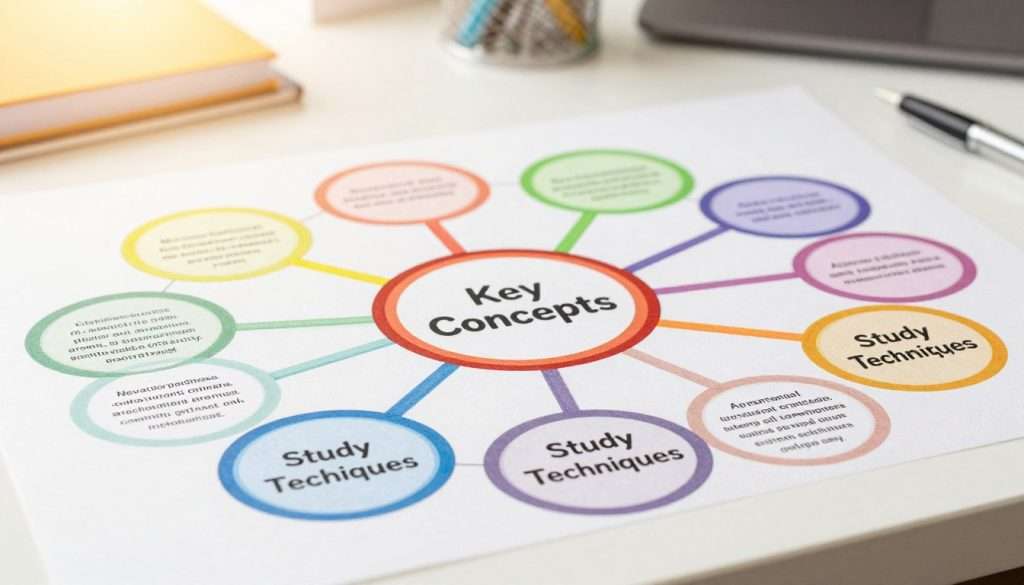
Step 1: Start with a Powerful Central Image or Topic
Start with a central image or topic that shows the main idea you’re studying. It could be a symbol, picture, or a few words. For example, a history lesson might have a key event or person as the central image. Use bold colors and clear imagery to make it pop.
Step 2: Create Main Branches for Key Themes
From your central image, make main branches that go outwards. These should cover the main topics related to your idea. For instance, a historical event might have branches for causes, key players, and outcomes. Make sure to label them clearly and use different colors.
Step 3: Develop Sub-branches with Supporting Details
Once you have your main branches, add sub-branches with more details. This is where you add specific information or examples. Keep your sub-branches organized and use short phrases to stay concise.
Step 4: Add Colors, Images, and Memorable Symbols
Colors, images, and symbols make your mind map fun and easy to remember. Use colors to highlight important info or to make your map look good. Images and symbols help explain complex ideas and help you remember.
“The mind is not a vessel to be filled, but a fire to be kindled.” – Plutarch
Step 5: Review and Refine Your Map
After making your mind map, review it carefully. Make sure it’s clear, organized, and shows the info you need. You might need to rearrange branches, add more details, or simplify the language. This step is key to making your mind map useful for studying.
| Step | Description | Tips |
|---|---|---|
| 1 | Central Image | Use bold colors and clear imagery |
| 2 | Main Branches | Label clearly, use different colors |
| 3 | Sub-branches | Keep organized, use keywords |
| 4 | Add Visuals | Use colors, images, symbols |
| 5 | Review & Refine | Ensure clarity, organization |
By following these steps, you’ll make effective mind maps that improve your learning. Remember, a great mind map is personal and meaningful to you.
5. Best Mind Mapping Tools and Resources for Students in 2024
As we enter 2024, it’s key for students to check out the top mind mapping tools. The right tools can change how you study, making it better and more fun. Whether you love digital tools or prefer paper, there’s something for you.
Top Digital Mind Mapping Software
Digital mind mapping tools are flexible and packed with features to boost your study. Here are some top picks:
- XMind: Great for big academic projects, XMind has cool features like Gantt charts and project tools.
- MindMeister: Ideal for working together, MindMeister lets you collaborate and share in real-time.
- Coggle: Perfect for newbies, Coggle has an easy-to-use interface and simple templates.
- Notion: Best for everything in one, Notion mixes mind mapping with note-taking and task management.
Essential Supplies for Paper-Based Mind Mapping
Even though digital tools are handy, paper-based mind mapping has its own perks. Here’s what you’ll need:
- Blank paper or a special mind mapping notebook
- Colored pens or markers for clear visuals
- Highlighters to highlight important points
- Stickers or symbols for fun visuals
By mixing these tools and methods, you can make a mind mapping routine that fits your style. Try out different digital and paper methods to see what works best for you.
6. Subject-Specific Mind Mapping Strategies That Work
Mind mapping isn’t for everyone; different subjects need their own approach. By learning how to tailor mind mapping to various subjects, you can make your study sessions better.
Mind Mapping for Math and Science Concepts
Mind maps are great for math and science. Start with a central idea, like a key formula. Then, branch out to related theories, examples, and applications. Use different colors for different types of info to make your maps clearer.

History and Social Studies: Timeline and Theme Maps
In history and social studies, timeline mind maps are useful. They help you see the order of events. You can also make theme maps to connect different periods or events through common themes. This helps you see the bigger picture and make connections.
English Literature: Character and Plot Analysis Maps
Mind maps are perfect for analyzing characters and plot structures in literature. Start with a central node for the main character or plot. Then, branch out to sub-characters, themes, and key events. This makes it easier to follow complex stories and character changes.
Foreign Languages: Vocabulary and Grammar Visualization
For foreign languages, mind maps help organize vocabulary by theme or topic. You can also map out grammar rules, exceptions, and examples. Seeing these elements helps you remember and understand the language better.
Using these specific mind mapping strategies can improve memory with mind maps and make learning more effective. Whether you’re studying for a math test or analyzing a literary work, mind maps are a flexible and powerful tool to improve your grades.
7. Advanced Mind Mapping Techniques to Boost Your Grades
Now that you know the basics of mind mapping, it’s time to level up. Advanced techniques can help you organize complex info, improve recall, and retain more. These methods will make studying more effective.
The Memory Palace Integration Method
The Memory Palace, or Method of Loci, is an ancient trick. It’s great for memory when used with mind mapping. Imagine your mind map in a place you know well. Link each part of your map to a room in that place.
Layered Mind Maps for Multi-Chapter Content
For big topics across many chapters, use layered mind maps. Begin with a big map, then make detailed maps for each part. This way, you can handle complex info without getting lost. Use colors or symbols to connect the detailed maps to the main one.
Color-Coded Systems for Different Information Types
A color-coded system makes mind maps better. Use colors for different info types, like definitions or examples. This makes it easy to find what you need. For example, use red for dates, blue for terms, and green for examples.
The Progressive Disclosure Technique
The Progressive Disclosure Technique reveals info as you need it. Start with a simple map, then add more as you dive deeper. This keeps your maps organized and focused.
Using these advanced techniques can really help your grades. Try different methods to see what works best for you. This way, you can understand and remember complex stuff better.
8. Combining Mind Maps with Proven Study Methods
To boost your learning, try mixing mind maps with spaced repetition and active recall. Mind maps are great on their own, but they’re even better when paired with other study techniques.
Let’s see how combining mind maps with other study methods can supercharge your learning.
Mind Maps Plus Spaced Repetition for Long-Term Memory
Spaced repetition helps you remember things by reviewing them at longer intervals. Pairing this with mind maps makes a strong combo for keeping complex info in your memory.
- Create a mind map for a specific topic or chapter.
- Review the map once a day, then a week later, and again after a month.
- Each review, add new info or connections to the map.
This mix strengthens your memory and keeps the info fresh and easy to access.
Active Recall Practice Using Your Mind Maps
Active recall means actively recalling info instead of just reading it. Use your mind maps to test yourself by covering parts and trying to remember the hidden info.
For example, you can:
- Cover the sub-branches and try to recall the details.
- Use colors to mark what you know well and what you need to work on.
- Make flashcards from your map to quiz yourself.
The Feynman Technique with Visual Mapping
The Feynman Technique is about explaining complex info in simple terms. When you add mind mapping to it, it gets even more effective.
To use this technique:
- Make a mind map of the concept you’re learning.
- Find the main idea and branches.
- Make the language and images in your map simple.
- Use your map to teach the concept to someone, either in person or by recording it.
By mixing mind maps with these study methods, you can greatly improve your learning and memory. Try different combinations to see what works best for you!
9. Five Critical Mind Mapping Mistakes to Avoid
Mind mapping is a great way to study, but it must be done right. There are common mistakes that can make it less effective. We’ll look at five big mistakes to avoid, helping you study better.
Mistake 1: Creating Cluttered, Overcomplicated Maps
One big mistake is putting too much on your mind map. This makes it hard to follow. To avoid this, focus on key concepts and keep it simple. Start with a main idea and then add more details in a clear order.
Mistake 2: Using Only Text Without Visual Elements
Mind maps are meant to be visual. Using only text makes them dull. To make them better, add images, colors, and symbols to show different information. This makes your maps more interesting and helps you remember better.
Mistake 3: Making Maps But Never Reviewing Them
Just making a mind map isn’t enough. You need to review and update it often. By regularly reviewing your maps, you’ll remember more and learn better.
Mistake 4: Copying Instead of Processing Information
Just copying information into a mind map doesn’t help you learn. To really benefit, you need to process the information as you map it. This means summarizing and connecting different pieces of information. Being active with the material is key to learning well.
Mistake 5: Sticking to One Format for All Subjects
Each subject needs its own mind mapping style. For example, math might focus on formulas, while history might use timelines. Be flexible and adapt your mind mapping style to fit each subject.
Avoiding these five mistakes can make your mind mapping much more effective. The goal is to make studying more efficient and fun. With practice, mind mapping can really change how you learn.
10. Building a Mind Mapping Study Routine That Sticks
Creating a consistent mind mapping study routine can greatly improve your academic success. It helps you remember information better. Let’s explore how to make mind mapping a regular part of your study routine.
Pre-Lecture Preparation: Creating Framework Maps
Before a lecture, make a framework map to organize your notes. This involves:
- Identifying the main topic and subtopics
- Creating a basic structure with main branches
- Leaving space for additional details during the lecture
This preparation helps you understand the lecture better and focus on important points.
During Class: Live Mind Mapping Techniques
During lectures, use live mind mapping to capture information well. Some strategies include:
- Using different colors for different types of information
- Creating symbols and icons to represent complex concepts
- Connecting new information to your existing knowledge framework
Post-Class Review: Expanding and Connecting Ideas
After class, review and expand your mind maps by:
- Adding more details and examples
- Connecting new information to your existing knowledge
- Identifying areas that need further clarification
This step strengthens your understanding and solidifies information in your memory.
Weekly Review Sessions: Consolidating Knowledge
Make time each week to review your mind maps and:
- Consolidate information from multiple lectures
- Identify patterns and connections between different topics
- Update your maps with new insights and information
Regular review sessions help you stay on top of your coursework and retain information better.
Exam Preparation: The 30-Day Mind Map Strategy
For exam prep, use a 30-day mind map strategy by:
- Creating a master mind map that integrates all relevant topics
- Breaking down the study material into daily chunks
- Reviewing and refining your maps daily
This focused approach helps you thoroughly prepare for exams and retain information long-term.
By using these strategies, you can double your retention and achieve academic success.
11. Conclusion
Mind mapping can change how you study, making you retain information better and get higher grades. It’s not just about taking notes. It’s a way to engage your brain in a deep learning process.
Mind mapping is not just a trick for students. It’s a powerful way to make complex information easy to remember. It helps you organize and keep track of math, literature, and history.
Mind mapping does more than just improve grades. It can make studying faster, reduce stress, and help you learn better. Try using mind mapping in your studies and see the difference for yourself.
Start with simple maps and get better at them over time. With regular use, mind mapping will become a key part of your studying. It will help you reach your goals and love learning more.