

Use what you know to rule out weak choices, then choose the best answer left. Our multiple-choice test strategies help you Guess Like a Pro when one answer feels uncertain. Educated guessing means using partial knowledge and reasoning to rule out options before choosing the strongest answer. One uncertain question does not have to derail your whole test.
These tips work for multiple-choice tests in class and beyond. The digital SAT also has a useful no-penalty rule for multiple-choice guesses. We’ll help you make a clear choice without letting one tough question take over your focus. Even your study routines can build the calm that helps on test day.
Key Takeaways
- Use partial knowledge to remove weak answers.
- Read the question before scanning choices.
- Check why a tempting answer may be wrong.
- Change an answer when you have a clear reason.
- Watch the timer on digital SAT modules.
Even one eliminated option can make a guess more informed than a coin flip.
How to Guess Like a Pro on a Multiple-Choice Test
On the digital SAT, a wrong answer earns no less than a blank. A multiple-choice guess can help without risking points. Answer every digital SAT multiple-choice question before time ends, even when you feel unsure.
A guess can come from chance, intuition, or a little evidence. Informed guesses use partial knowledge to narrow the field, while blind guesses pick randomly.
Blind guesses still have a chance
The digital SAT gives each multiple-choice question four answer choices. A blind guess has a 25% chance of being correct. Eliminating one option raises that chance to 33%, and eliminating two raises it to 50%.
| Options eliminated | Options left | Chance of a correct answer |
|---|---|---|
| 0 | 4 | 25% |
| 1 | 3 | 33% |
| 2 | 2 | 50% |
Educated guessing is not random picking; use what you know to rule out weak choices.
A university test-taking guide also advises guessing when wrong answers carry no penalty or you can eliminate options. On the digital SAT, a blank and a wrong answer both earn nothing.
Use clues in guessing games
A Guess Like a Pro game asks you to identify a mystery football player from clues. Each guess can reveal the player’s nationality, club, league, and position.
A Guess Like a Pro quiz works like a small detective puzzle: clues narrow the player field. On a test, you narrow answer choices instead. One clue might point to a player’s nationality, while another identifies the league or club.
In both settings, each new clue gives your next guess a better direction. A player’s position can also help separate two likely candidates. Treat a test question’s details with the same care, and give the strongest clue more weight than a hunch. If you can cross out even one answer, take that extra clue seriously.
Read the Question Before the Answer Choices
Before the options start competing for your attention, read the question and say in your own words what it wants. Your answer must fit the whole question, not just sound familiar or plausible.
Cover the answer choices with your hand or a scrap of paper. Restate the prompt, then recall the facts or steps that could answer it.
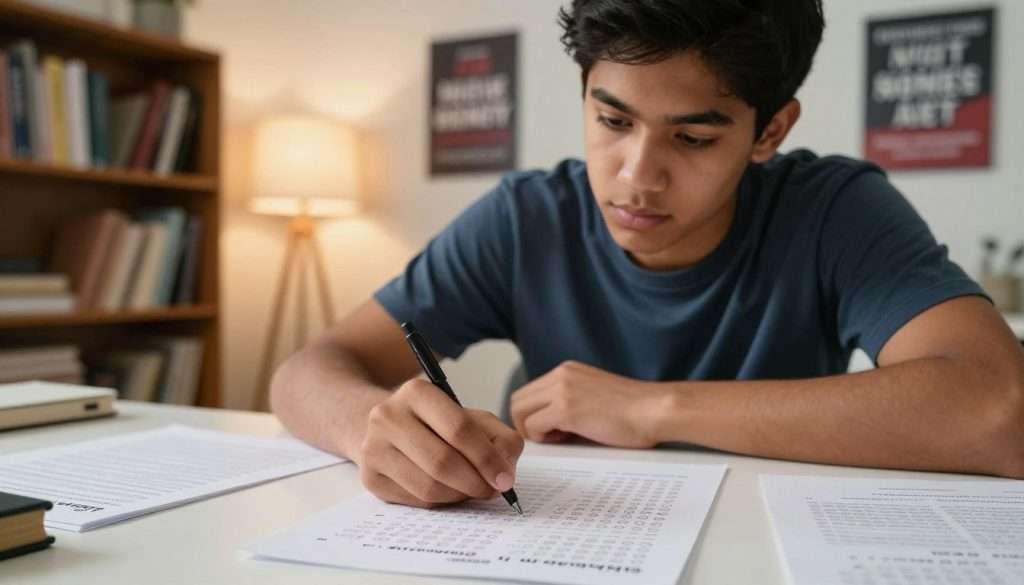
Put the task in your own words
That pause keeps a tempting phrase from steering you toward the wrong idea. For example, a question about why a character acts may ask for a cause, not a detail about what happened. Keep the task in mind as you uncover the options.
Eliminate options and test the finalists
Eliminating known wrong choices can narrow a multiple-choice question to two options. A factually true answer can still be wrong if it does not answer the prompt.
Use this five-step process to compare the remaining answers:
- Cross out options that are clearly wrong.
- Check context clues, grammar, tense, and key terms.
- Check absolute words like “always” and “never”; they are clues, not proof.
- Compare the options that remain.
- Choose the answer that fully addresses the question.
Similar wording or a longer answer can signal that you should look closer, but neither decides the answer. When two options seem plausible, the stronger choice fully answers the question rather than being partly true or true only under a narrow condition.
A test-taking guide on answer choices makes this distinction clear: correctness depends on the question, not just the fact itself. Before you lock in a choice, ask whether it answers the whole question rather than just sounding true.
When to Guess or Change an Answer
Change an answer when you have a concrete reason, not just a sudden wave of doubt. A new clue or a mistake you spot gives you a sound reason to switch. Confidence should come from evidence, not nerves, so trust a clear reason over a last-second wobble.

A reasoned change is a decision; a nerves-only change is a coin toss.
Answer changes do not usually hurt students. In one study, students changed incorrect answers to correct ones 2.8 times on average, versus 1.0 change from correct to incorrect. The average benefit was statistically significant.
A 2004 study of 79 third-year medical students found that 48.2% of changes went from wrong to right. Another 21.6% went from right to wrong, and 30.2% stayed wrong. Students who changed at least one answer gained 1.4 points on average.
Each digital SAT Reading and Writing module has 27 questions and 32 minutes. Each Math module has 22 questions and 35 minutes. You cannot return after a module timer ends, and first-module performance helps select the second module. The College Board’s digital SAT scoring rules explain this adaptive setup.
Typed-response Math differs from multiple choice: a blind typed guess is rarely right, but entering your best estimate costs no points. On a digital SAT module, make your best choice before the timer runs out.
Conclusion
A calm, evidence-based choice beats a last-second panic pick. Each time you explain why an answer fits, you practice a skill that helps beyond exams. Small study routines can make that kind of thinking feel more natural.
If this advice resonated with you, our free book, How to Become the Smartest Student in the Classroom, offers a full system of memory techniques, study routines, and strategies that stick. There is no cost and no catch. Grab your free copy of How to Become the Smartest Student in the Classroom for memory techniques, study routines, and strategies that stick, with no cost and no catch.