

Do you feel like your brain is a sieve? You study for hours, but the info goes away by morning. It’s time to break free from stressful cramming and find a better way.
We’re here to show you a proven study technique. By reviewing info at set times, you can keep it in your long-term memory. This method, spaced repetition, works with your brain, not against it.
When you mix this with active recall, studying becomes fun and easy. Let’s explore how to master your subjects and keep your knowledge sharp. Spaced repetition is your secret to success.
Key Takeaways
- Ditch the stress of last-minute cramming for a sustainable routine.
- Use intervals to improve your overall memory retention.
- Apply active recall to test your brain and strengthen connections.
- Focus on efficient learning to save time and reduce burnout.
- Build a solid foundation for long-term memory success.
The Science Behind Spaced Repetition
Your brain is like a complex library. It needs a good system to keep information from getting lost. If you feel like your brain is a sieve, you’re not alone. The good news is that you can improve your mental filing system with a proven study technique.
Cognitive Psychology and Memory Encoding
Cognitive psychology shows that memory is more than just recording information. It involves encoding, storing, and retrieving what we learn. When you actively engage with material, you create strong neural pathways. These pathways lead to long-term memory.
Think of your brain as a muscle that grows with exercise. By spacing out your review sessions, you make your mind work harder. This is the key to efficient learning and keeping knowledge accessible for years.
Why Cramming Fails the Brain
We’ve all been there: staring at notes at 2:00 AM, hoping they’ll stick. Unfortunately, cramming is like trying to fill a leaky bucket. You might remember facts for a test, but they disappear quickly.
In 1885, Hermann Ebbinghaus found the forgetting curve. It shows how fast we lose information without recall. If you don’t review what you’ve learned, your brain clears the space for new data. Spaced repetition helps prevent this, making information permanent.
Understanding the Forgetting Curve
Our brains are like leaky buckets, constantly losing information unless we take specific steps to plug the holes. You might feel like you have mastered a topic today, only to find that the details have vanished by tomorrow morning. This isn’t a sign that you aren’t smart; it is simply how our minds work.
By mastering a reliable study technique, you can stop this natural decline. Understanding the mechanics of memory allows you to work with your brain rather than against it.
The Ebbinghaus Discovery
In the late 19th century, a researcher named Hermann Ebbinghaus conducted groundbreaking experiments on himself to see how we retain information. He discovered that without any review, our brains are surprisingly quick to discard new data. In fact, most people forget roughly 50% of new information within just one hour.
The decline continues rapidly, with up to 70% of that information lost within 24 hours. This phenomenon is known as the forgetting curve, a core concept in cognitive psychology. It proves that our brains naturally shed what they deem unimportant if we do not revisit the material.
How Intervals Prevent Information Decay
The good news is that you can flatten this curve and keep your knowledge fresh. The secret lies in spaced repetition, which involves reviewing information at strategic intervals before your brain has a chance to fully delete it. Each time you revisit a concept, you reset the clock and strengthen the neural pathways associated with that memory.
This process is essential for building long-term memory. By spacing out your reviews, you transform efficient learning from a stressful chore into a manageable habit. You are telling your brain that this information is valuable, forcing it to store the data more securely for the future.
Core Principles of Spaced Repetition
We often think of our brains as hard drives, but they’re more like muscles. They grow stronger with the right exercise. Using a smarter study technique lets you work with your brain, not against it. This change makes studying easier and more effective.
The Role of Spaced Learning
Studies show that spaced learning beats old methods. One spaced repetition session is like two standard ones. Cramming, on the other hand, might only count as one.
Spreading out your study sessions helps your brain keep information. It gives your brain time to make new connections. This way, you move from just remembering to truly mastering the material.
Balancing Difficulty and Retention
Finding the right balance is key to keeping your brain engaged. Material that’s too easy doesn’t challenge you. Stuff that’s too hard can make you give up.
Active recall is the best way to find this balance. Testing yourself instead of just reading notes makes your brain work harder. When you struggle to remember, you’re actually making that information stick longer.
How to Implement Spaced Repetition in Your Daily Routine
Make your daily study routine easy and effective. You don’t need to spend hours to see results. By using a smart study technique, you can learn better without feeling overwhelmed.
Structuring Your Study Schedule
Consistency is key for efficient learning. Try the 2357 method to keep your brain sharp. Review a new topic one day, three days, five days, and seven days after learning it.
This method strengthens your long-term memory at the right time. It turns complex notes into a simple habit. Your brain will start to look forward to these quick review sessions.
Managing Multiple Subjects Simultaneously
Handling different classes can be tough, but it’s doable. Use flashcards to organize your subjects. Combine these with active recall to make your brain work harder and remember better.
Set aside specific times for each subject to avoid confusion. This spaced learning method ensures you cover all topics. Aim to make studying a natural part of your day, not a heavy task.
Digital Tools for Efficient Learning
Imagine having a personal assistant that knows exactly when you need to review your notes. Technology can be your best friend when it comes to mastering complex information without the usual stress. By using the right software, you can turn a daunting pile of books into a manageable, efficient learning experience.
Leveraging Flashcard Applications
Digital flashcards are a game-changer for anyone looking to improve their retention. Instead of carrying around stacks of paper, you can keep thousands of cards in your pocket. These apps are designed to support active recall, which is the gold standard for moving information into your long-term memory.
You might want to check out these popular options to get started:
- Anki: Perfect for those who love customization and deep data tracking.
- Quizlet: Great for quick setups and sharing decks with friends.
- Gizmo: A user-friendly choice that makes building your study sets feel like a breeze.
Automating Your Review Cycles
The real magic happens when you let these tools handle the scheduling for you. You no longer have to guess when to study next, as the software uses spaced repetition algorithms to prompt you at the perfect moment. This study technique ensures you review material just as you are about to forget it.
By automating your review cycles, you save massive amounts of mental energy. You can focus entirely on the act of learning rather than the logistics of planning. Here is a quick look at how these tools compare:
| Feature | Anki | Quizlet |
|---|---|---|
| Algorithm | Advanced | Standard |
| Best For | Deep Mastery | Quick Review |
| Spaced Learning | Highly Precise | Basic |
Integrating these digital helpers into your daily workflow will supercharge your progress. When you combine active recall with smart scheduling, you will find that your study sessions become much more effective. Give these tools a try and watch how your ability to retain information grows!
Combining Active Recall with Spaced Repetition
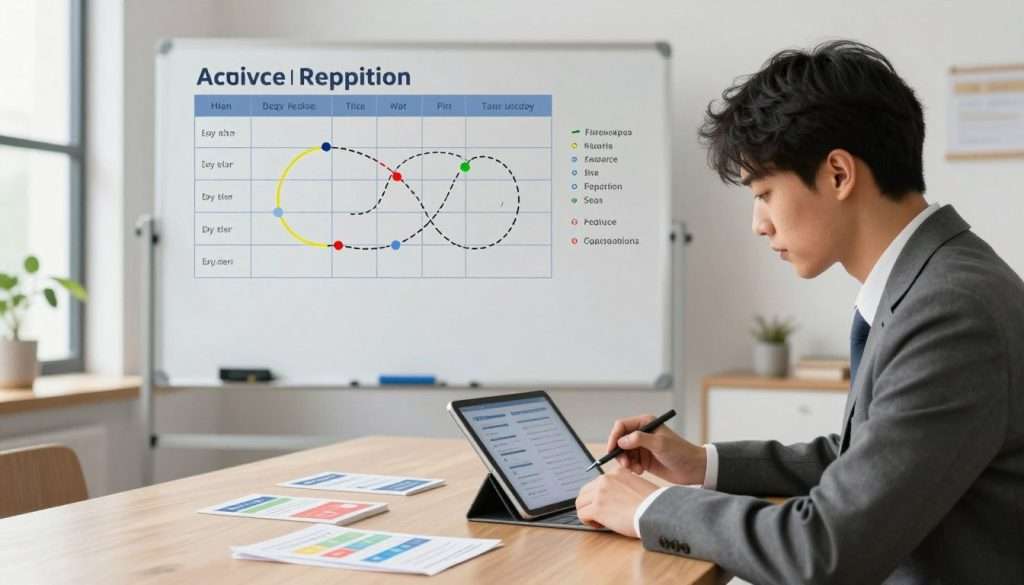
You can make your study sessions better by mixing two top methods in cognitive psychology. Passive reading often doesn’t help build long-term memory. But combining these methods makes your brain work harder to remember things.
The Synergy of Retrieval Practice
When you make your brain recall information, you make the connections in your brain stronger. A study by Roediger and Karpicke (2006) showed this. Students who practiced active recall remembered 80% of the material after a week. But those who just read their notes again remembered only 34%.
This big difference shows that testing yourself is much better than just reading again. Adding spaced repetition makes sure you review the right stuff at the right time. This mix is the best way to learn well.
Techniques for Self-Testing
You don’t need special tools to start using this study technique today. There are easy ways to test your knowledge during spaced learning:
- The Blurting Method: Read a section, then write down everything you remember on a blank sheet.
- The Feynman Technique: Try to explain a hard concept in simple words, like you’re teaching a kid.
- Flashcard Quizzing: Use cards to make your brain remember answers before you see them.
Using these methods, you stop just looking at your notes. You start actively learning. Consistency is key to making these habits last!
Common Pitfalls to Avoid During Study Sessions
Studying is a skill that can be tricky. Even when you’re motivated, bad habits can slow you down. Knowing these traps helps you stay on track.
Over-relying on Passive Reading
Many of us spend hours highlighting and re-reading, thinking we’re getting it. But this passive approach doesn’t really work. You might see the words, but it’s not the same as truly remembering.
Switch to active recall instead. Use flashcards to test your memory. This simple change can make a big difference in how well you remember.
Ignoring the Importance of Sleep
We often see sleep as a luxury, but it’s key for long-term memory. While you sleep, your brain moves info from short-term to long-term storage. Cutting sleep short means losing the progress you made.
Think of sleep as the last step in your spaced repetition cycle. Without enough rest, your brain can’t solidify what you’ve learned. Prioritizing a full night of rest is as crucial as studying itself.
Optimizing Your Study Environment for Long-Term Memory
Ever wondered why some days studying is easy, while others are hard? Your study space greatly affects your memory retention. By improving your workspace, you can turn a simple desk into a powerful study technique that helps your brain.
Minimizing Cognitive Load
A cluttered desk can make your brain feel overwhelmed. To stay focused, break down big ideas into smaller parts. This makes it easier to learn one thing at a time using active recall.
Think of studying like a workout. You wouldn’t lift heavy weights right away. So, don’t try to learn too much at once. Keep your flashcards tidy and your desk free of distractions. This lets your brain focus on spaced repetition without interruptions.
“The environment is the invisible hand that shapes human behavior.”
Creating Consistent Study Triggers
Being consistent is key for efficient learning. By setting specific triggers, you signal to your brain that it’s time to learn. This makes it easier to switch into a focused state of spaced learning.
Here are some simple ways to create your own triggers:
- Lighting: Use a desk lamp only for studying.
- Sound: Play the same music every study session.
- Scent: Use a certain candle or essential oil to focus.
Repeating these actions trains your brain to associate them with deep work. Over time, these cues become automatic. This makes it easier to stay on track with your goals. You’re creating a mental shortcut to productivity!
Advanced Strategies for Complex Subjects
Learning complex information is easier when you focus on small parts. Topics that seem like huge, tangled knots can be untangled with the right study technique. Breaking down dense material into smaller pieces makes learning less overwhelming.

Breaking Down Dense Information
Think of your study material as a wall you need to build. Trying to lift the whole wall at once is a sure failure. Instead, focus on individual “bricks” of knowledge that you can easily handle.
Isolating these smaller concepts lets you apply spaced repetition to each one. This way, you’re not just memorizing words but truly understanding the logic. It’s a great way to learn efficiently without exhausting your brain.
Using Mnemonics with Spaced Intervals
Sometimes, abstract concepts are hard to grasp. That’s where cognitive psychology helps with mnemonics. Creating a funny story or a catchy acronym gives your brain a “hook” to remember the information.
Combining these memory hooks with spaced learning creates a powerful effect. Use active recall to test yourself on these mnemonics during review sessions. Whether with digital flashcards or a notebook, these tools help move complex data into your long-term memory. Keep your intervals consistent, and you’ll see how quickly even the toughest subjects become clear!
Measuring Your Progress and Retention Rates
If you don’t measure your learning, you’re studying in the dark. We think data-driven study is a game-changer for students. By monitoring your performance, you turn vague efforts into a precise study technique that works.
Tracking Your Success Metrics
To see real growth, track how well you do in self-testing. Active recall is the best way to get this data. Keep a log of easy and hard concepts during self-testing.
This habit shows your memory retention in real-time. Whether using digital flashcards or paper notes, tracking accuracy scores shows your progress. It’s rewarding to see those numbers go up as you learn new things!
Adjusting Intervals Based on Performance
With your data, it’s time to act. If a topic is easy, increase the gap between review sessions. This is key to efficient learning, avoiding time on known info.
If a topic is tough, shorten the interval to review it sooner. This dynamic spaced repetition challenges your brain where it needs it most. By using cognitive psychology, you build a stronger long-term memory.
The goal of active recall is to refine your spaced repetition schedule. Keep testing and tracking to boost your confidence!
Mastering Your Learning Potential
You now have the tools to unlock your brain’s full potential. By using these methods, you can boost your academic performance. This will take you to new heights.
Accessing Further Resources
We want to make sure you have all the support you need to grow. Consistency is the secret ingredient to making these methods a part of your life.
How to Become the Smartest Student in the Classroom
If this article spoke to you, check out my free book. It’s called How to Become the Smartest Student in the Classroom. It covers advanced memory techniques and study routines.
This guide focuses on spaced repetition and active recall. It helps your knowledge stick. It’s designed to make learning efficient and stress-free.
Claiming Your Free Study System at https://www.studyingmachine.com/free-books/
Building a long-term memory for complex subjects doesn’t have to be hard. Get your free copy at https://www.studyingmachine.com/free-books/. Start your journey to becoming a better learner today. There’s no cost and no catch—just the tools you need to succeed.
Conclusion
You now have a smarter way to work with your mind. Learning this technique changes how you tackle every challenge.
Creating a habit of spaced repetition makes daily review a natural part of your life. You’ll see your memory improve as you follow these simple steps.
Think of your brain as a muscle that grows stronger with the right exercise. Consistent practice is key to building lasting memory.
Apps like Anki or Quizlet make learning easy on the go. They do the hard work for you, making learning efficient.
Begin today by choosing one subject to try these methods. Soon, you’ll see your grades and confidence soar.
What topic will you master first? Share your progress with us and keep pushing your limits.