

Staring at textbooks for hours can feel overwhelming. We’ve all been there! If you’re not reviewing what you learn at the right times, your brain can’t keep it.
But there’s a better way. Spaced repetition learning is known for its effectiveness. Ancient poet Horace first noted its power when he said, “Repetition is the mother of learning.” That’s pretty insightful.
Did you know that 90% of new knowledge is lost within three days without review? It’s crazy when you think about all the hours we spend studying.
But there’s a twist. Reviewing material at smart intervals can make knowledge last. It’s like getting a pass to study smarter, not harder. Are you ready to learn how it works?
Key Takeaways
- Spaced repetition is the top method for building long-term memory
- Without review, 90% of new information is forgotten within three days
- Reviewing at the right intervals helps knowledge stick
- This approach makes studying more efficient and less frustrating
- It’s a practical gateway to learning better with less effort
What Is Spaced Repetition?
Imagine a study technique that lets you remember almost anything for months or years. That’s what spaced repetition offers. It works with your brain’s natural rhythms, not against them.
Defining the Learning Technique
Spaced repetition is simple. Instead of cramming, you spread out your studying over time. You review material, then wait, and review again. Each time, you’re refreshing your brain’s memory.
This method is about reviewing at the right moments. It’s not just about re-reading notes. You’re timing your reviews to catch your brain just before it forgets. It’s pretty smart.
Understanding the Forgetting Curve
In 1885, Hermann Ebbinghaus discovered how fast we forget information. It’s like water draining from a bucket.
His research showed we lose nearly 90% of new information within three days if we don’t review it. That’s the forgetting curve at work. It’s not that you’re bad at remembering; it’s just how our brains are.
“Ebbinghaus discovered that information retention decreases exponentially unless you review it at intervals. The spacing effect flattens the forgetting curve, meaning you will remember information longer!”
How Timing Intervals Strengthen Memory
Timing your reviews just right can flatten the forgetting curve. Your brain needs time to build memory pathways. It’s like building muscle.
Each successful recall strengthens your memory. The intervals get longer as you go, because your brain needs less frequent reminders. It’s like learning to ride a bike without training wheels.
Spaced repetition works with your brain, not against it. You’re catching information right before you forget it. This makes the memory stick stronger next time.
This is why spaced repetition is a game-changer for memory retention. It’s not just memorizing; it’s building lasting knowledge.
The Science Behind Spaced Repetition and Memory Retention
Research on spaced repetition might surprise you! Scientists have studied how our brains keep information for decades. They found something amazing. This isn’t just a trick—it’s real science that shows why spacing reviews works well.
Cognitive Science Research Findings
Here’s a number that might change how you study: research shows spaced repetition leads to 80% recall accuracy. This is much better than cramming’s 60%. Studies prove spacing out learning beats cramming every time.
But why does spacing work? It’s because our brains process and store information in a special way. Spacing out reviews lets your brain solidify what you’ve learned. This makes it easier to remember later.
The spacing effect was first found by psychologist Hermann Ebbinghaus in 1885. Modern research confirms: spaced learning is much better than cramming.
How Your Brain Encodes Long-Term Memory
Your brain organizes your experiences and knowledge all the time. It consolidates what you’ve learned into long-term memory. This mostly happens while you sleep.
Memory enhancement doesn’t stop there. When you review material later, your brain strengthens the memory. This is why spaced reviews are so effective—they make memories stronger and easier to recall.
The Critical Role of Active Recall
Active recall is when you try to remember something without looking at notes. It might be hard, but it strengthens your brain’s pathways more than reading does.
When you actively recall, your brain works harder to remember. This signals that the memory is important. The more you do this, the stronger your brain’s pathways become. It’s like brain exercise!
Combining active recall with spaced repetition is a powerful learning method. You’re not just reviewing; you’re building the brain’s memory infrastructure for years to come.
Neuroplasticity and Memory Consolidation
Your brain changes and adapts with every active recall practice. This is called neuroplasticity. It’s pretty cool, right?
When you learn something new, your brain creates new connections. Each spaced repetition strengthens these connections. It’s like a path in a forest getting clearer with each use.
Consolidation happens during sleep, which is why rest is key for learning. Sleep replays your day’s experiences and strengthens important connections. This is why cramming before a test is bad—it skips the consolidation process.
Understanding how your brain stores long-term memory helps you learn better. Spaced repetition speaks your brain’s language and helps it keep information.
| Study Method | Recall Accuracy | Memory Duration |
|---|---|---|
| Cramming (massed practice) | 60% | Short-term only |
| Spaced Repetition | 80% | Long-term retention |
| Active Recall + Spacing | 90%+ | Years of retention |
The science is clear: learning with your brain’s natural processes makes it easier and more effective. Spaced repetition isn’t just a trick—it’s how your brain was designed to learn.
Why Spaced Repetition Is the #1 Hack for Long-Term Memory
Want to know why spaced repetition is a top memory trick? It doesn’t just slightly improve memory. It changes how your brain keeps information. The results are clear, and once you see them, you’ll change your study ways forever.
Proven Superior Retention Rates
Something amazing might surprise you: revising new info 20 times in a day doesn’t help as much as revising it 10 times over a week. Your brain isn’t a simple storage bin. It needs time to create new connections, and spaced repetition gives it that time.
Studies show that spaced learning beats cramming big time. The spacing effect shows that each time you recall info, your brain gets stronger. The gaps between reviews make each recall more effective than the last.
Maximum Efficiency with Minimum Time Investment
Spaced repetition makes studying smarter, not harder. It focuses your time on areas where you need improvement. This means you study less but remember more.
This is what true learning optimization is all about. You get the best results with the least effort. Who wouldn’t want that?
Universal Application Across All Subject Areas
This method works for everything. Need to learn German for a university presentation? Spaced repetition is your ally. Studying for med school and memorizing complex terms? It’s perfect for that too. History, math, musical instruments, programming languages—anything you want to learn!
Spaced repetition is for everyone, from high school students to lifelong learners. It’s like a learning Swiss Army knife!
Key Benefits of Using Spaced Repetition for Effective Learning
Ready to learn why spaced repetition is a big deal? It’s not just another study trick. It changes how your brain keeps information. Let’s explore the benefits that make it so effective!
Dramatically Enhanced Memory Retention
Traditional studying is like trying to hold water in your hands. It slips away. Spaced repetition changes this. It makes your brain keep information longer.
By reviewing at the right times, your brain treats the info as important. It moves from short-term to long-term memory. This makes recalling information much easier later on.
Many learners find they can recall info with 90% accuracy weeks or months later. This is because spaced repetition works with your brain’s natural processes.
The spacing effect makes your brain think the info is key. This leads to deeper processing and stronger connections. You’ll remember more with less effort.
Reduced Overall Study Time
Spaced repetition can save you time. How? It makes each review session shorter and more focused. This is different from cramming, where you spend hours re-learning forgotten material.
After the first or second review, you’ll know most of the material. This means you spend minutes, not hours, on each topic. Your brain has time to absorb and process the info between sessions.
These short review sessions add up to big time savings. You won’t need to pull all-nighters before exams. Instead, you’ll breeze through your reviews. It’s a cycle of less effort for better results.
Increased Confidence and Reduced Test Anxiety
Feeling confident in exams is a great feeling. Spaced repetition builds that confidence naturally. When you’ve reviewed info many times, it becomes part of you, not just something for a test.
Test anxiety often comes from doubt. You worry if you studied enough or if you’ll remember. Spaced repetition makes these doubts disappear. You’ll recall info automatically, not just hope you will.
This confidence boosts your learning journey. You’ll feel more prepared and less stressed. And, being relaxed helps your brain perform better. It’s a win-win!
Permanent Knowledge Preservation
Remember that feeling when you forget everything after an exam? We’ve all been there. But spaced repetition makes knowledge last long after the test.
Traditional studying creates “temporary memory.” You cram, pass, and forget. Spaced repetition builds permanent connections. The info you learn stays with you for months or years.
Imagine remembering chemistry from years ago when you need it again. Or retaining foreign language vocabulary for your trip. That’s the power of permanent knowledge preservation. You’re learning for life, not just to pass.
These benefits make learning almost effortless. Your memory retention improves, you save study time, confidence soars, and knowledge lasts. It’s amazing!
| Benefit | Traditional Study | Spaced Repetition |
|---|---|---|
| Memory Retention | Information fades within days | Information stays for months/years |
| Study Time Required | Long sessions with frequent re-learning | Short, efficient review sessions |
| Confidence Level | Often uncertain before tests | Strong recall and test readiness |
| Knowledge Longevity | Temporary (post-exam forgetfulness) | Permanent (long-term retention) |
How Spaced Repetition Differs from Traditional Study Methods
We’ve all studied the same way for years. We re-read notes, flip through flashcards, or study all night before exams. These methods might feel good at the time but they don’t help our brains learn well. Spaced repetition changes this by spreading out study sessions to match how our memory works.
This method is different from what we’re used to. It’s based on how our brains learn best. Let’s explore why it’s better and how it differs from old study habits.
Spaced Learning vs. Cramming Sessions
Cramming seems like a good idea at first. You study hard and feel like you’re getting it all done. But, psychologist William James said it’s not effective. He noted that cramming doesn’t help us remember well because it doesn’t let us make connections.
When you cram, you don’t build strong connections in your brain. The information might help you pass a test but then it’s forgotten. Spaced repetition is different. It reviews material at longer intervals, like today, then in three days, a week, and a month. This strengthens your memory over time.
Active Recall vs. Passive Reading and Highlighting
Highlighting and re-reading can make you feel like you know the material. But, it’s not the same as really remembering it. When you need to recall information without looking at your notes, you’ll see how different it is.
Active recall is a better way to study. It means trying to remember information from memory without looking at your notes. This might include saying answers out loud or using flashcards. It’s harder in the moment but it makes your memory stronger.
Adaptive Intervals vs. Fixed Study Schedules
Traditional study plans are set in stone. You might study at the same time every week. But, not all material is the same. Some is easy to learn; some is hard.
Adaptive intervals adjust to how well you remember each piece of material. If you get a question wrong, it comes back sooner. If you get it right, it comes back later. This makes your study time more effective by focusing on what you need to work on.
| Traditional Study Method | Spaced Repetition Approach |
|---|---|
| Cramming sessions before tests | Distributed practice over weeks or months |
| Passive reading and highlighting | Active retrieval and self-testing |
| Fixed schedule (same time each week) | Adaptive intervals based on performance |
| Focuses on recognition | Builds genuine recall ability |
| Quick forgetting after tests | Long-term knowledge retention |
Ready to try spaced repetition? It’s not about starting over. It’s about working with your brain instead of against it. Small changes can make a big difference in what you remember. This is key when it really counts.
How to Implement Spaced Repetition in Your Daily Study Routine
Ready to start using spaced repetition in your studies? We’ll show you how to add it to your daily routine easily. No complicated systems needed.
Step 1: Identify and Organize Your Learning Material
First, gather all your study materials. This includes class notes, textbooks, and lecture slides. Having everything in one place makes reviewing easier.
Review your notes for 5-10 minutes the next evening. This helps solidify what you learned. It also helps you see what needs more practice.
Step 2: Create Effective Study Materials
Now, make your study materials better. Good materials are key to learning with spaced repetition.
Crafting High-Quality Flashcards
Flashcards should focus on one idea each. Keep them simple and clear. This helps your brain learn better.
Write questions that make you think. Instead of “The mitochondria is the ___ of the cell,” ask “What cellular structure produces energy for the cell?” This makes your brain work harder.
Breaking Down Complex Concepts
Big topics can be overwhelming. Break them into smaller parts. Each part is a mini-study session.
This method works well for subjects like biology and history. Learning one piece helps you understand the next.
Using Images and Mnemonics
Use vivid images and mnemonics to remember things. Create mental pictures that are silly or unexpected. For example, remember the brachial plexus by imagining stomping on brakes made of plexiglass.
Always use mnemonic imagery when studying. The more personal and creative your associations, the better you’ll remember.
Step 3: Establish Your Initial Review Schedule
Now, set up your review schedule. Space out your reviews to improve long-term memory.
First Review: 1 Day After Learning
Review your material a day after learning it. This first review is important. Keep it short, around 10-15 minutes.
Second Review: 3 Days Later
Review again three days later. Some details might feel fuzzy. That’s okay. It means your brain needs to work on those connections.
Subsequent Reviews: Progressive Intervals
Double the gap between each review. So, review at 2 days, then 4 days, then 8 days, and so on. This pattern helps your memory get stronger.
Here’s a quick guide for your first month:
- Day 1: First review (evening after class)
- Day 3: Second review
- Day 5: Third review
- Day 9: Fourth review
- Day 17: Fifth review
Step 4: Practice Active Recall During Reviews
Active recall is key to learning. Always write out what you remember first. This is crucial for real retention.
Start with a blank sheet of paper or a new document. Try to recall and write down everything you know. It’s okay to make mistakes. They show where you need to improve.
If you get something wrong, don’t just look at the answer. Think about why you got it wrong. This turns mistakes into learning chances.
Step 5: Track Progress and Adjust Your System
Spaced repetition needs regular checks and adjustments. Some topics might be easier than others. That’s normal.
Keep track of what you struggle with. If something’s hard, try simpler flashcards or better mnemonics. If you find some material easy, you can space out your reviews more.
This system is flexible. It adapts to your learning needs. Give it a few weeks to settle in. You’ll be amazed at how much you remember with less stress.
Best Tools and Techniques for Spaced Repetition Success
Ready to boost your study sessions? The right tools can turn spaced repetition into a powerful memory booster. Whether you prefer apps or pen and paper, there’s something for everyone. Let’s see what works best!
Top Digital Spaced Repetition Software
Digital tools have changed how we learn. They schedule reviews for you, so you can focus on remembering. Many students say these apps are key to their study routine.
Anki: The Most Powerful Option
Anki is the top app for spaced repetition. It uses a smart algorithm to schedule reviews based on how well you remember. You can make your own cards or use thousands from others. It’s great for students, language learners, and trivia buffs.
Anki lets you customize everything. It might take some time to learn, but the results are worth it.
Quizlet: User-Friendly and Social
Quizlet is easy to use and fun. It has a clean design and fun features. You can make flashcards, play games, or test yourself.
It’s great for studying with friends or competing. Teachers use it too. It’s not as customizable as Anki, but it’s easy to start with.
RemNote: Note-Taking Meets Spaced Repetition
RemNote combines note-taking with spaced repetition. Write notes during class, and it turns them into flashcards. This makes studying more efficient.
It uses a similar algorithm to Anki. It’s perfect for students who take detailed notes.
SuperMemo: The Original Algorithm
SuperMemo was the first to use spaced repetition. It introduced the SM-2 algorithm. SuperMemo focuses on efficiency, with a simple interface.
Newer versions have multimedia support and cloud sync. It’s the tool that started it all.
Traditional Paper-Based Methods
Not everyone likes studying on screens. Physical flashcards offer a hands-on experience. They’re great for reducing screen time or studying anywhere.
The Leitner Box System
The Leitner Box System uses physical flashcards. You sort cards in boxes based on how well you know them. It’s like digital apps but hands-on.
Grab index cards and boxes, and you’re set. It’s a great way to learn through touch.
Manual Flashcard Organization
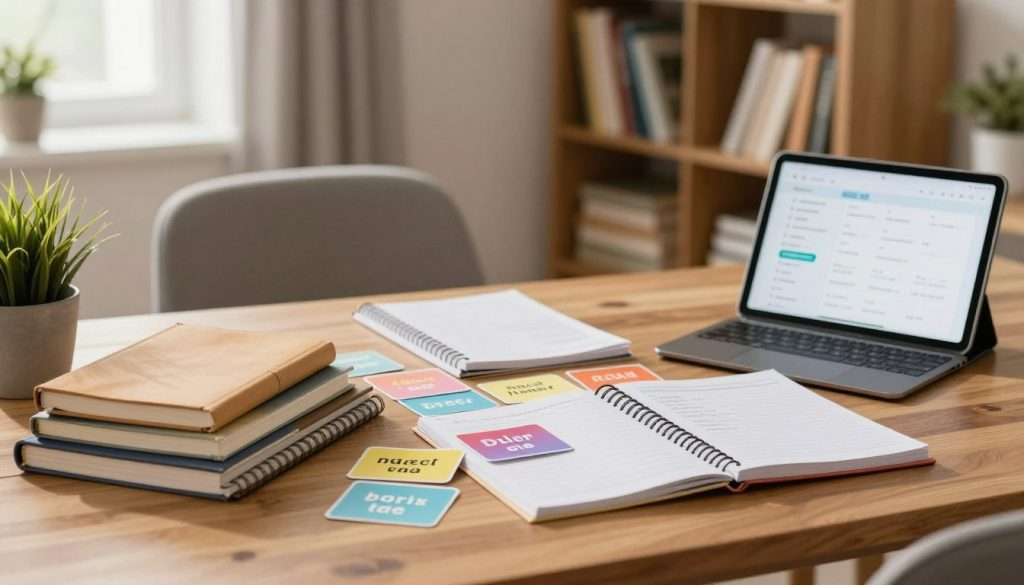
Creating flashcards by hand is simple yet effective. It forces you to process information twice. Use colors, drawings, or sticky notes to make them interesting.
Store them in envelopes or binder rings. It’s more effort but helps with memory. There’s satisfaction in flipping through your own cards.
Combining Spaced Repetition with Other Learning Strategies
Spaced repetition works well with other techniques. Pairing it with the Memory Palace technique is powerful. Imagine walking through a familiar place and placing items to remember along the way.
Use spaced repetition to review this journey. It’s amazing how well it works.
Mnemonics and visualization also enhance spaced repetition. Create vivid images or associations to remember information. Then, schedule reviews to keep it fresh in your mind. This combo is great for remembering vocabulary, scientific terms, or historical dates.
Ready to find your perfect match? Here’s a quick comparison to help you decide:
| Tool/Method | Best For | Cost | Learning Curve | Platform |
|---|---|---|---|---|
| Anki | Serious learners wanting maximum control | Free (iOS: $24.99) | Steep | Desktop, Mobile, Web |
| Quizlet | Students wanting social, easy experience | Free (Premium: $35.99/yr) | Easy | Web, Mobile |
| RemNote | Note-takers wanting integrated system | Free (Pro: $8/mo) | Moderate | Desktop, Web |
| SuperMemo | Fans of original algorithm | Free to $5.99 | Moderate | Desktop, Mobile |
| Leitner Box | Physical learners, screen-free studying | $5-15 | Easy | Paper-based |
Pick the tool that fits your lifestyle and start small. The best system is the one you’ll use regularly. Your brain will thank you for the memory boost!
Common Mistakes to Avoid When Using Spaced Repetition
Ready to learn about the pitfalls that could sabotage your progress? Even the most powerful learning technique can backfire if you fall into these common traps. Let’s make sure that doesn’t happen to you!
Creating Low-Quality or Overly Complex Cards
One of the biggest mistakes learners make is creating flashcards that are just too complicated. Your brain needs time to form new neural pathways, and that won’t happen if your cards are messy or overloaded. Keep it simple—one concept per card, people! When you pack too much information into a single card, you’re not really testing your memory retention; you’re just testing whether you can read fast.
Reviewing Too Frequently or Skipping Sessions
Here’s where things get tricky. Some people get so excited about spaced repetition that they start reviewing every few hours. But if you review a card before you’ve actually forgotten it, you’re not strengthening your memory—you’re just memorizing the card itself. That’s not learning; that’s just recognition in disguise!
On the flip side, skipping sessions is equally bad. Inconsistent reviews mean your brain doesn’t get the proper spacing it needs to really lock things in. The whole point of this system is that timing matters. Stick to your schedule, even when life gets busy.
Relying on Recognition Instead of Recall
Ah, the classic trap! You see a card and think “oh yeah, I know this!” But can you actually explain it without looking? That’s the difference between recognition and true recall. Cognitive science shows that recognition is lazy—your brain is just pattern matching. True memory retention comes from being able to pull information out of your head on demand.
People who get poor results usually aren’t elaborating the material with mental imagery, or they’re not recalling information properly. So when you study, really force yourself to retrieve that information before you check the answer. It feels harder, but that’s exactly why it works!
Giving Up Before Seeing Results
Patience is key here. Spaced repetition isn’t an overnight magic trick. It takes time for your brain to build those neural pathways. Some people give up after a week because they don’t see instant results. But here’s the truth: the magic happens after a few weeks of consistent practice.
Don’t abandon the system just because you feel like it’s not working yet. Trust the process! Your brain is forming new connections, and those bonds strengthen with each review session. Stick with it and you’ll be amazed at what you can remember.
Ignoring the Importance of Sleep and Memory Enhancement
This might be the most overlooked mistake of all. Your brain literally forms memories while you sleep! Scientists think that the majority of the bonds in your brain form while you are sleeping. Pulling all-nighters is completely counter-productive—you’re undoing all your hard work.
Prioritize sleep, and you’ll see your memory retention improve dramatically. Your brain does its best consolidation work when you’re catching those Z’s. So study hard, but sleep harder!
Avoid these traps, follow the system consistently, and you’ll be golden!

Conclusion
Your brain is made to remember things. You just need to work with its natural rhythms instead of fighting against them. Spaced repetition lets you turn any subject into lasting knowledge without endless hours in books.
This method works because it matches how your mind stores information. Reviewing material at the right times strengthens the neural pathways. This means knowledge that lasts years, not just until the test.
Now you have everything to start. Choose a small topic, make some flashcards, and review them with spaced intervals. See how your retention gets better each week. Your future self will thank you for starting today.