
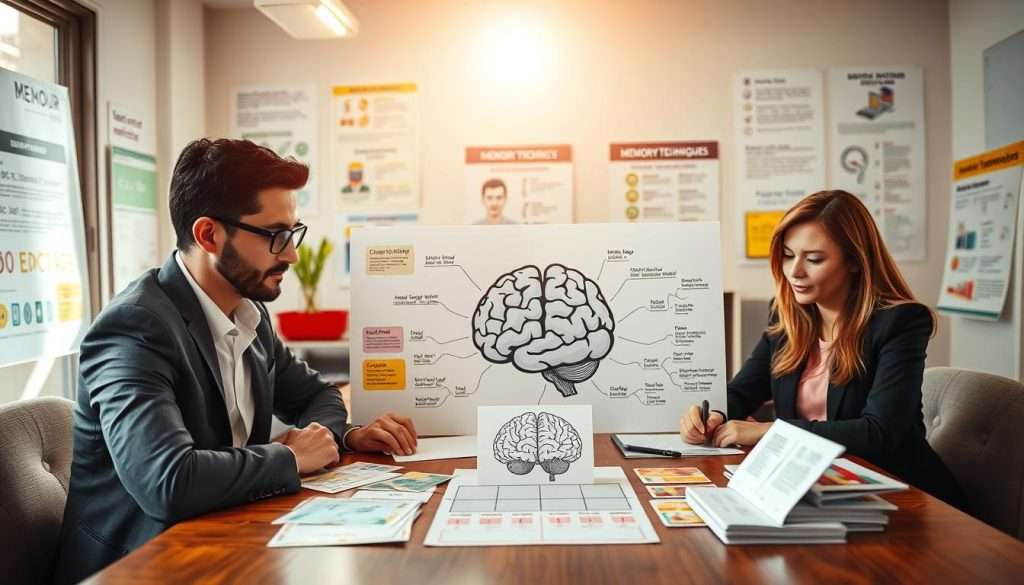
Ever noticed how kids soak up information like sponges? It’s because their brains are wired to make connections fast. Their hippocampus, key for memory, is super active. As adults, we can tap into this and boost our memory retention with the right methods.
We can supercharge our memory by using the brain’s quick connection-making ability. By using memory improvement techniques, we can improve how we learn and remember. This way, we can recall more in less time.
Key Takeaways
- Understand how the hippocampus plays a crucial role in memory formation.
- Discover techniques to boost memory retention.
- Learn how to apply memory improvement techniques effectively.
- Enhance your learning capabilities and remember more in less time.
- Unlock your brain’s full potential with the right strategies.
The Science of Memory: Why Most People Forget 80% of What They Learn
Memory is a complex process that’s key to our daily lives. We take in new info all the time, but how much do we keep? Knowing how memory works can help us remember better.
How Your Brain Forms and Stores Memories
Our brains learn by repeating what we learn. This strengthens the connections between brain cells. This is called synaptic plasticity, and it’s vital for memory.
When we first learn something, it goes into our short-term memory. But with repetition, it moves to long-term memory.
The Forgetting Curve and Why It Matters
The forgetting curve shows how our memory fades over time if we don’t recall it. Knowing this curve helps us fight it. We can use spaced repetition to keep our memories sharp.
Working Memory vs. Long-Term Memory: Optimizing Both
Working memory holds info in our minds briefly. Long-term memory keeps it for longer. Improving both is key for learning well.
Techniques like chunking and active recall boost working memory. Spaced repetition helps with long-term memory. By understanding how our brains work, we can use memory enhancement strategies to improve memory recall and retention. This makes learning more fun and effective.
How to Remember 10x More in Half the Time: The Core Principles
Unlocking the secret to supercharging your memory involves understanding and applying a few core principles. To significantly boost your memory capacity, it’s essential to adopt techniques that enhance how you learn and retain information.
Active Recall: The Single Most Effective Learning Technique
Active recall is the process of actively recalling information from memory rather than simply re-reading it. This technique has been shown to be highly effective in improving memory retention. By testing yourself on the material you’re trying to learn, you strengthen your ability to recall it.
For example, instead of re-reading a chapter, try summarizing it in your own words or taking a quiz on the material. This active engagement with the information helps solidify it in your long-term memory.
Spaced Repetition: Scheduling Your Way to Perfect Recall
Spaced repetition involves reviewing material at increasingly longer intervals to help solidify it in your long-term memory. This technique takes advantage of the psychological spacing effect, which shows that information learned in multiple, spaced sessions is retained more effectively than information learned in a single session.
To implement spaced repetition, you can use flashcards or apps designed for this purpose. Review the material just before you’re about to forget it, and gradually increase the time between reviews.
Chunking Information: Making the Complex Simple
Chunking involves breaking down complex information into smaller, more manageable units. This technique is useful for remembering lists, numbers, or other complex data. By organizing information into chunks, you reduce the cognitive load and make it easier to retain.
For instance, when trying to remember a long phone number, it’s easier to break it down into smaller groups of numbers rather than trying to recall the entire sequence at once.
To illustrate the effectiveness of these techniques, let’s look at a comparison of different memorization strategies:
| Technique | Description | Effectiveness |
|---|---|---|
| Active Recall | Actively recalling information from memory | High |
| Spaced Repetition | Reviewing material at increasingly longer intervals | High |
| Chunking | Breaking down complex information into smaller units | Medium to High |
By incorporating these core principles into your learning routine, you can significantly improve your ability to remember information. Whether you’re a student looking to ace your exams or a lifelong learner seeking to expand your knowledge, these techniques can help you achieve your goals.
Preparing Your Mind: Mental States That Boost Memory
Improving your memory is not just about using techniques. It’s also about being in the right mental state. Your mental state affects how well you remember and recall information. When you’re in the best mental state, you focus better, take in new info more easily, and remember it longer.
Achieving the Optimal State for Memory Formation
To be in the best state for memory, your brain needs to work its best. This means being relaxed but alert, focused, and without distractions. As neuroscientist Andrew Huberman says, “The key to better memory is not just about storing information, but being in a state where you’re able to retrieve it effectively.”
Sleep, Nutrition, and Exercise: The Memory Enhancement Trifecta
Sleep, nutrition, and exercise are key for your memory. Adequate sleep helps your brain solidify memories. Eating a balanced diet with antioxidants, omega-3 fatty acids, and other essential nutrients keeps your brain healthy. Regular aerobic exercise boosts blood flow to the brain, enhancing memory and thinking.
“Exercise is a powerful tool for improving memory and cognitive function. It promotes blood flow, boosts neurotrophic factors, and even encourages neurogenesis.”
Practical Stress Management Techniques for Better Recall
Too much stress can hurt your memory by releasing cortisol, a hormone that damages the hippocampus. Techniques like meditation, deep breathing exercises, and mindfulness help manage stress. By adding these to your daily routine, you can improve your memory and thinking skills.
The Memory Palace Technique: Build Your Mental Storage System
The Memory Palace technique is an ancient method that boosts memory today. It involves making a mental map of a place you know, like your home. Then, link the information you want to remember to specific spots in that space.

Step-by-Step Guide to Creating Your First Memory Palace
First, pick a place you’re familiar with, like your house or school. Imagine walking through it in your mind, marking key spots. Then, connect the information you need to remember to these spots. For example, picture your favorite fruit on the front porch or eggs in the living room.
Linking and Association: Populating Your Palace with Memorable Images
Creating vivid, memorable images is crucial for a good Memory Palace. The more unusual or emotional the image, the better it will stick in your memory. For instance, to remember 1492, imagine a huge “1492” sign in your bedroom or a Columbus figure on your bed.
“The true art of memory is the art of attention.” – Samuel Johnson
Advanced Memory Palace Strategies for Complex Information
For complex info, use multiple Memory Palaces or a detailed mental map in one. This is great for studying different subjects or long sequences of info.
Multiple Palaces for Different Subjects
Have a separate Memory Palace for each subject you study. This keeps your info organized and avoids confusion.
Refreshing and Maintaining Your Palaces
Regularly visit your Memory Palaces to refresh your memory. This strengthens your learning and improves recall over time.
Mnemonic Devices: Memory Shortcuts That Actually Work
Mnemonic devices are the unsung heroes of memory improvement. They help encode information in a way that’s easy to recall. This makes them perfect for learning new skills or memorizing complex data.
Creating Powerful Acronyms and Acrostics for Quick Memorization
Acronyms and acrostics are simple yet effective mnemonic devices. An acronym is a word formed from the initial letters of a phrase or word. An acrostic is a sentence where the first letter of each word corresponds to the first letter of a word or phrase.
For example, “ROY G BIV” is an acronym for the colors of the rainbow (Red, Orange, Yellow, Green, Blue, Indigo, Violet).
To create your own acronym or acrostic, follow these steps:
- Identify the information you want to memorize.
- Extract the first letter from each key word or phrase.
- Form a word or sentence using these letters.
The Major System: Turning Numbers into Unforgettable Images
The Major System is a powerful mnemonic technique. It converts numbers into memorable images. It involves assigning consonant sounds to numbers and then creating words or images from these sounds.
For instance, the number 1 might be associated with the sound “t” or “d,” and 2 with “n.”
Example: To remember the number 12, you could imagine a “tin” (t/n) can.
Using Rhymes, Songs, and Visual Associations for Stubborn Facts
Rhymes and songs are great for memorizing information. They’re catchy and easy to recall. Think of how easily you remember song lyrics or nursery rhymes from childhood.
Visual associations work the same way. They link new information to something you already know or find memorable.
By incorporating these mnemonic devices into your daily routine, you’ll significantly boost your memory capacity. And you’ll make learning more enjoyable.
The Feynman Technique: Learn Anything by Teaching It
Learning new things can be easier with the Feynman Technique. It involves teaching what you’ve learned to someone else. This helps you understand better and find any knowledge gaps.
Four Steps to Implement the Feynman Technique Today
To use the Feynman Technique, just follow these four steps:
- Choose a concept you want to learn about.
- Teach it to a 10-year-old – or someone with no prior knowledge of the subject.
- Identify any gaps in your explanation and revisit the material to fill them.
- Simplify your language and use analogies to make the concept more accessible.
These steps can greatlyimprove memory recalland help you keep complex information.
Using Simplification to Enhance Understanding and Retention
Breaking down complex info is crucial in the Feynman Technique. It makes learning easier by simplifying it. Use clear language and examples to explain what you’ve learned.

Identifying and Filling Knowledge Gaps Through Self-Explanation
Teaching what you’ve learned shows you any knowledge gaps. This self-explanation helps you know where to focus your studying. It’s a way toboost memory retentionover time.
Using the Feynman Technique can make learning more effective. It helps you reach your goals faster.
Digital Tools and Apps to Enhance Your Memory Practice
Discover how digital tools can change your memory practice for the better. Today, many apps and software are out there to help you improve your memory. They make learning easier and more fun.
Mastering Spaced Repetition Software
Spaced repetition is a key to remembering things for a long time. Tools like Anki and SuperMemo use this method. They help you review what you’ve learned at the best times.
Quizlet is also great. It offers different study modes, like flashcards and tests. This makes learning more engaging.
Mind Mapping Tools That Enhance Visual Memory
Mind mapping helps you organize information visually. This makes it easier to remember. MindMeister and XMind are top tools for this.
They let you create detailed maps and work with others. You can also link them to other apps.
Note-Taking Systems That Support Long-Term Retention
Good note-taking is key for remembering things. Notion and Obsidian are great for this. They have features like tagging and linking.
These help you organize your notes better. This makes it easier to recall information later.
Using these digital tools daily can really boost your memory. Try out different ones to see what works best for you!
Rapid Memorization Techniques for Different Types of Information
Want to remember numbers, names, or facts better? We’ve got the best techniques for you. Each type of information needs a special approach. Let us show you the most effective ways.
Memorizing Numbers and Dates: Systems That Work
Numbers and dates can be hard to remember. But, there are systems that can help. The Major System turns numbers into words or phrases you can remember. For instance, you can make a phone number into a story or sentence.
Never Forget a Name or Face Again: Practical Association Methods
Forgetting names and faces is common. But, there are ways to remember them. When you meet someone, link their name with something unique or a similar-sounding word. You can also use images to remember names better.
Learning Languages in Record Time: Memory-Based Approaches
Learning a new language can seem tough. But, memory-based methods can make it easier. Use spaced repetition and mnemonic devices to learn vocabulary and grammar fast. Language apps that use these methods can also help.
Mastering Facts and Concepts for Tests and Presentations
To master facts and concepts, mix different techniques. Use mind maps to organize, acronyms to remember terms, and self-testing to solidify your knowledge. With practice, you’ll get better at recalling complex info.
By using these quick memorization techniques, you can boost your memory. You’ll feel more confident in remembering various types of information.
Overcoming Memory Obstacles: Solutions to Common Problems
Improving your memory can be tough, with challenges like too much information and putting things off. But, with the right strategies, you can beat these hurdles.
Dealing with Information Overload: Filtering and Prioritization
Too much information is a big problem for better memory. We need to sort out what’s important and ignore the rest.
- Identify your learning goals
- Focus on one task at a time
- Use tools like to-do lists or apps to organize information
Conquering Procrastination and Distraction: Focus Techniques
Procrastination and distractions can slow down memory improvement. The Pomodoro Technique is a great way to stay on track.
- Work in focused 25-minute increments
- Take a 5-minute break
- Repeat the cycle for improved productivity
Breaking Through Memory Plateaus: Progressive Challenges
When you reach a plateau, it’s time to step up your game. Try harder material or use different memory enhancement strategies.
When to Push Harder vs. When to Rest
It’s important to know when to push yourself and when to take a break. Too much effort can burn you out, but enough rest helps solidify memories.
Tracking Progress to Stay Motivated
Keeping an eye on your progress is key to staying motivated. Use a journal or app to see how far you’ve come.
| Technique | Description | Benefit |
|---|---|---|
| Spaced Repetition | Review material at increasingly longer intervals | Improved long-term retention |
| Active Recall | Actively recall information from memory | Strengthens memory |
| Chunking | Break down information into smaller chunks | Eases information processing |
By using these strategies and watching your progress, you can beat common memory challenges. Keep improving your memory with effective memory improvement techniques.
Creating Your Personalized Memory System
To boost your memory, we need a system that matches your goals and learning style. This means mixing different techniques, adjusting them to your taste, and making them a part of your daily routine.
Combining Techniques for Maximum Effect
Using a mix of memory methods, like mnemonic devices and spaced repetition, can make your system strong. For example, using acronyms for lists and the Major System for numbers works well together.
Adapting Methods to Your Learning Style
Try out different memorization tips to see what suits you best. Whether you learn better through seeing, hearing, or doing, tailoring your system to your style can greatly increase memory capacity.
Building Consistent Memory Habits
Consistency is crucial for better memory. Regular use of your chosen methods will turn them into habits. Set up a schedule to practice and review your techniques often.
| Technique | Description | Frequency |
|---|---|---|
| Spaced Repetition | Review material at increasingly longer intervals | Daily |
| Mnemonic Devices | Use associations to remember information | Weekly |
| Active Recall | Actively try to recall information from memory | Daily |
Conclusion: Your Journey to Exceptional Memory
You’ve learned how to remember 10x more in half the time. By using the tips from this article, you’re on your way to better memory. You’ll reach your learning goals faster.
We’ve looked into how memory works, the power of recalling information, and mnemonic devices. You now know how to make a memory palace and use spaced repetition. You also know how to use digital tools to boost your learning.
Improving your memory takes regular practice. Make these methods a daily habit. You’ll see big improvements fast. This skill is useful for students, professionals, and anyone who loves to learn.
So, start today. Build your own memory system. Watch your memory get better. With effort and the right methods, you’ll see amazing results and reach your full potential.