
Ever felt like you’re spinning wheels when trying to learn? We’ve all been there, staring at a screen, feeling lost. This framework is here to save your sanity and boost your confidence.
Stuart and Hubert Dreyfus created this system. It shows how we grow from beginners to experts. It’s like a roadmap for your brain, with five stages of learning that everyone goes through. Progress isn’t a mystery; it’s a ladder we climb step by step.
By knowing where you are, you can stop stressing. This tool is a game-changer for anyone wanting to improve their life. It turns a scary mountain into a simple path you can walk.
Whether you’re a student or a teacher, knowing these steps makes learning fun. Let’s explore the dreyfus model of skill acquisition and conquer your next big challenge. You have potential, and we’re here to help you unlock it!
Key Takeaways
- Development happens in five distinct stages.
- Moving toward expertise requires changing how you use rules.
- Context and intuition become vital as you gain experience.
- Learners can use this framework to set better goals.
- Educators design better lessons by matching a student’s current level.
- Understanding your stage reduces frustration during study sessions.
Understanding the Dreyfus Model of Skill Acquisition
Ever wondered how people go from beginners to experts? The Dreyfus model has the answers. It shows how we learn and get better through different stages.
What the Model Reveals About Learning
The Dreyfus model says learning isn’t just a straight line. It’s a journey through different stages. Experience and practice are key to getting better.
Key Takeaway: The model shows skill acquisition is a slow process. We go through stages, each with its own traits.
Why Traditional Skill Training Often Fails
Traditional training focuses too much on rules. The Dreyfus model says this doesn’t work well in real life. Learners might find it hard to use what they’ve learned.
Context is crucial for learning skills. The model’s focus on experience and understanding situations explains why old training methods don’t work.
The Five-Stage Framework Explained
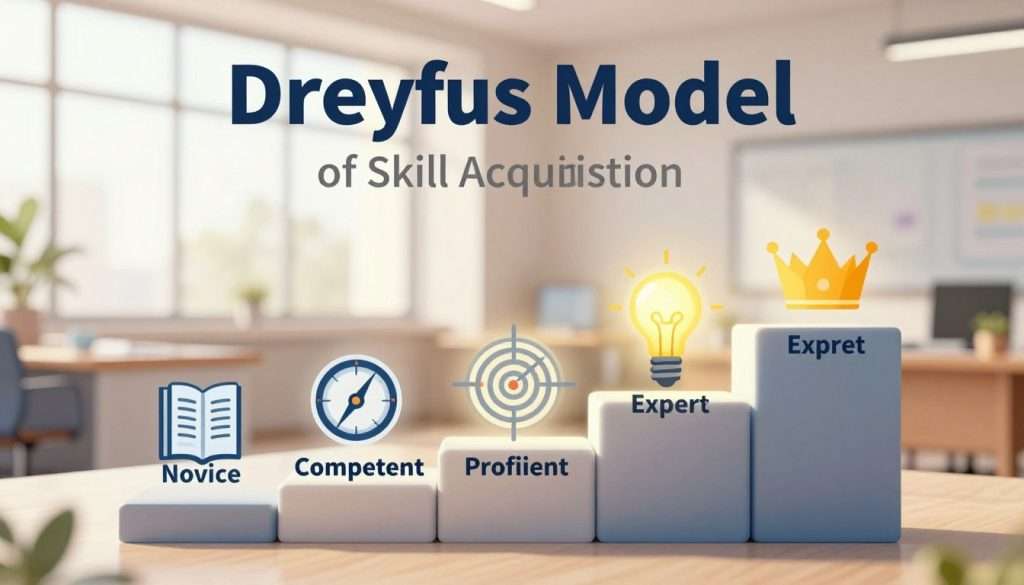
The Dreyfus model has five stages: Novice, Advanced Beginner, Competent, Proficient, and Expert. Each stage is a big step in learning.
| Stage | Description |
|---|---|
| Novice | Starts with basic rules and guidelines, lacking context. |
| Advanced Beginner | Starts to recognize patterns and apply rules in context. |
| Competent | Develops personal decision-making models and takes ownership. |
| Proficient | Intuition begins to guide actions, with a holistic understanding. |
| Expert | Demonstrates unconscious mastery, with fluid and intuitive performance. |
Knowing these stages helps learners and teachers improve training. It makes learning more effective.
The Origins and Research Behind the Model
To understand the Dreyfus model, we must look at the groundbreaking research by Hubert and Stuart Dreyfus. Their work is key to how we see skill learning today.
Hubert and Stuart Dreyfus’s Groundbreaking Study
The Dreyfus brothers studied how people learn and master skills. They found that it’s not just about knowing facts. It’s about changing how you see and do things.
Their research showed that skill learning is complex. It’s not just about knowing more. It’s about understanding the context and details better. This shows how learning is more than just getting information.
| Key Aspects | Description |
|---|---|
| Comprehensive Research | The Dreyfus brothers conducted extensive research across multiple domains to understand skill acquisition. |
| Evolution in Perception | Their study highlighted that mastering skills involves a fundamental shift in how individuals perceive and approach tasks. |
| Contextual Understanding | The research emphasized the importance of developing a deeper contextual understanding in skill acquisition. |
From Artificial Intelligence to Human Learning
The Dreyfus brothers started in artificial intelligence. They wanted to make machines think like humans. But, they soon turned to studying human learning.
“The more we tried to replicate human expertise in machines, the more we realized that human learning is far more complex and nuanced than we had initially thought.”
Switching to human learning was a big change for them. It led to the Dreyfus model. Their work has greatly influenced how we see human skill learning and expertise development.
Their model shows how people go from beginners to experts. It outlines the stages of learning. Knowing these stages helps learners plan their learning better and move faster.
Stage 1: Novice – Starting Your Learning Journey
When you start learning something new, you enter the novice stage. This is a key phase that shapes your future progress. At this point, you’re not just learning a new skill; you’re building a strong foundation for mastery.
Key Characteristics of Novice Learners
Novice learners rely on context-free rules and lack experience in the skill they’re trying to learn. They need clear, step-by-step instructions to perform tasks without much thinking.
For example, when learning a new language, you start with basic grammar rules and vocabulary. You follow these rules rigidly to form sentences, even if it feels mechanical.
Why Novices Need Rigid Rules and Recipes
Novices need rigid rules and recipes because they lack the cognitive skills to understand the nuances of the task. These rules help them complete tasks without being overwhelmed by the complexity of the skill.
Think of a novice programmer following a coding tutorial line by line, or a novice driver meticulously following driving instructions. These rules are their guide in the initial stages.
Practical Examples Across Different Skills
Let’s explore how novice learners approach different skills:
Novice Programmers
Novice programmers rely heavily on coding tutorials and step-by-step guides. They learn to write code by following established patterns and rules.
Novice Drivers
Novice drivers need to follow strict driving rules and guidelines. They learn to drive by practicing these rules in a controlled environment.
Novice Cooks
Novice cooks use recipes to prepare meals. They follow the recipe instructions carefully, measuring ingredients and following cooking times to the letter.
Here’s a comparison of how novices approach different skills:
| Skill | Rules/Recipes Used | Learning Focus |
|---|---|---|
| Programming | Coding tutorials, syntax rules | Writing clean, functional code |
| Driving | Driving manuals, traffic rules | Safe driving practices |
| Cooking | Recipes, ingredient measurements | Preparing dishes correctly |
Understanding the novice stage is crucial for effective skill development. By recognizing the importance of rigid rules and recipes, learners can better navigate this initial phase and set themselves up for success in their journey from novice to expert.
Stage 2: Advanced Beginner – Recognizing Patterns
At this stage, you’re not just following rules; you’re seeing the bigger picture. You’ve started to understand that skill acquisition is more than just memorizing rules.
Moving Beyond Context-Free Rules
As an advanced beginner, you’re learning to apply rules in different situations. You’re realizing that the same rule can have different effects depending on the context. This is a key step in learning stages, helping you adapt and improve your skills.
Situational Pattern Recognition Begins
Advanced beginners start to recognize patterns in different situations. You’re beginning to see that certain situations require specific actions or decisions. This pattern recognition is vital for improving your skills and moving towards expert performance.
For example, in cooking, you might notice that the same ingredient can be used in various dishes. But how it’s prepared changes with each recipe. This understanding makes you more flexible and creative in cooking.
Common Challenges at This Stage
Being an advanced beginner is exciting but comes with challenges. Two common ones are:
- Information Overload
- Difficulty Prioritizing
Information Overload
As you learn more, you face a lot of information. This can be overwhelming, making it hard to know what’s important. Focus on the most relevant information and learn to filter out what’s not essential.
Difficulty Prioritizing
With more knowledge, prioritizing tasks or information becomes harder. You might struggle to decide what to focus on first. Set clear goals and then prioritize tasks that align with those goals.
By understanding these challenges and finding ways to overcome them, you can keep moving forward in your learning journey. Stay focused, be patient with yourself, and keep practicing.
Stage 3: Competence – Making Deliberate Choices
As you move forward in your skill development, you hit a key point. You’re no longer just following rules; you’re making choices. This is the competence stage. Here, you can analyze situations, weigh options, and decide what to do.
Developing Personal Decision-Making Models
Now, you start to create your own decision-making models. You’re not just following instructions; you’re using your experience and understanding. This means assessing situations, identifying key factors, and making choices based on your analysis.
For example, in learning a new language, a competent learner doesn’t just memorize words. They understand the context of certain words and decide how to use them.
Taking Ownership of Outcomes
At this stage, you take ownership of your outcomes. You’re not just following a set path; you’re making decisions that affect your learning or project. This sense of responsibility can be both empowering and challenging.
- You start to see the direct impact of your decisions.
- You’re more invested in the outcomes because you’ve made conscious choices.
- This ownership fosters a deeper understanding and retention of what you’ve learned.
The Emotional Investment Shift
As you become more competent, your emotional investment changes. Your successes and failures start to feel more personal.
Success Feels Rewarding
When you succeed, it feels truly rewarding because you’ve put thought and effort into your decisions. This success boosts your confidence and motivates you to keep improving.
Mistakes Feel Personal
On the other hand, when you make mistakes, they feel more personal. You’re not just following a recipe; you’ve made a choice that didn’t work out. This can be a valuable learning experience, teaching you to analyze what went wrong and how to improve.
By understanding and embracing the competence stage, you can make the most of your skill development journey. It’s a critical phase where you transition from being a passive learner to an active decision-maker.
Stage 4: Proficiency – Developing Intuition
At the proficiency stage, learners start to see things more as a whole. They’ve gained enough experience to spot patterns and details they missed before.
Holistic Situation Assessment
Proficient performers see the big picture, not just parts. This helps them understand and decide better, based on a deeper understanding of the situation.
Key characteristics of holistic situation assessment include:
- Recognizing complex patterns
- Understanding the interplay between different elements
- Making decisions based on a comprehensive view
When Intuition Begins to Guide Action
As people get better, they start to act more on instinct. It’s not about ignoring facts, but using experience and instinct together.
Intuition at this stage is not guesswork; it’s the result of extensive experience and pattern recognition. Proficient performers often know the right action without needing to check every detail.
Recognizing Proficiency in Practice
Proficiency shows up in many ways, depending on the field. Let’s look at a few examples to see how it looks in different areas.
Proficient Musicians
For musicians, being proficient means playing with feeling and detail. They can improvise and adjust to the moment, making music that feels alive and fitting for the situation.
Proficient Managers
In management, being proficient means handling complex situations smoothly. Proficient managers can read the room, understand the underlying issues, and make the right decisions for the situation.
| Domain | Characteristics of Proficiency | Examples |
|---|---|---|
| Music | Expressive performance, improvisation | Jazz soloists, orchestral conductors |
| Management | Strategic decision-making, team leadership | Department heads, project managers |

Stage 5: Expert – Achieving Unconscious Mastery
We reach the top of skill learning at the expert stage. Here, mastery feels natural. People at this level don’t need to think much about their actions. They perform with ease and skill.
Transcending Analytical Thinking
Experts have gone beyond needing to think things through. According to the Dreyfus Model, they solve problems in a more complete way. Their intuition leads their actions.
“The expert’s mind is not cluttered with the details of the task; instead, it’s free to focus on the nuances that make all the difference.”
Fluid, Intuitive Performance
Experts do complex tasks easily and precisely, often without thinking. This comes from lots of practice and experience. They respond better to situations.
| Characteristics | Description |
|---|---|
| Intuitive Decision-Making | Experts make decisions based on pattern recognition rather than analysis. |
| Holistic Understanding | They see the bigger picture, understanding how different components interact. |
| Adaptability | Experts can adjust their approach as situations demand. |
What Separates Experts from Proficient Practitioners
Proficient practitioners and experts differ in their unconscious mastery. While proficient ones still think a bit, experts rely more on instinct.
The Expert’s Paradox
Experts perform well but often can’t explain how they do it. This makes teaching them hard. They find it hard to share their thought process.
“The more you know, the less you need to think about it.”
Teaching Challenges for Experts
Experts face a unique teaching challenge. Their deep understanding makes it hard to connect with those still learning. They must simplify their knowledge for students.
As we aim for expertise, we see the value of the Dreyfus Model stages. Understanding the expert stage helps us appreciate the depth of knowledge needed for true mastery.
Step-by-Step Guide to Accelerating Your Progression
To speed up your skill development, you need a plan that fits your current learning level. Whether you’re starting out or want to improve, knowing the right strategies for your level can really help.
Strategies for Novices: Building Strong Foundations
For beginners, building a solid base is crucial. Here are some tips to help you start:
Follow Proven Rules Consistently
It’s important to stick to established rules early on. This helps you develop good habits and avoid bad ones that are hard to fix later.
Practice in Controlled Environments
Practice in controlled settings helps you focus on specific skills. This means using simulations, simplified scenarios, or guided practice.
Seek Immediate Feedback
Feedback is key for beginners. It shows you what needs work and rewards good habits. Look for feedback from teachers, friends, or self-assessment tools.
Strategies for Advanced Beginners: Expanding Context
Once you’re past the beginner stage, it’s time to learn in more varied situations.
Study Varied Examples
Learning from many examples deepens your understanding. This includes case studies, real-world examples, or scenarios that challenge your skills in different ways.
Analyze Situational Patterns
Start to notice patterns in what you learn. This means understanding the underlying principles and applying your knowledge in different situations.
Strategies for Competent Learners: Deliberate Practice
At the competence stage, you take more control of your learning. Deliberate practice is essential.
Set Specific Performance Goals
Setting clear goals helps focus your practice. These goals should be challenging but achievable.
Reflect on Decisions and Outcomes
Reflection is vital in deliberate practice. It means analyzing your choices, understanding the results, and making adjustments as needed.
Strategies for Proficient and Expert Development
At the proficient and expert levels, focus on refining your skills and gaining a deeper understanding.
Seek Complex Challenges
Take on tough challenges to push your skills. This could mean new responsibilities, competitions, or projects that challenge you.
Mentor Others to Deepen Understanding
Teaching or mentoring others helps deepen your knowledge. It makes you explain your ideas clearly and shows where you need to improve.

By using these strategies tailored to your stage, you can quickly move from novice to expert. Remember, knowing your current stage and adjusting your learning approach is key.
Common Mistakes That Stall Skill Development
The journey to becoming an expert is full of challenges. Knowing common mistakes can help you avoid them. Understanding what can go wrong is as important as knowing how to progress.
Skipping the Novice Stage Fundamentals
Many learners skip the novice stage, which is a big mistake. This stage is vital for building a solid foundation. Don’t rush through it, as it’s essential for advanced learning.
At the novice stage, you need clear rules and recipes. These help you understand the basics. For example, when learning a new language, starting with basic grammar is crucial. Skipping these basics can lead to confusion and a weak foundation.
Plateauing at Competence
Many learners get stuck at the competence stage. They feel they’ve reached a good level of performance. But, this is also a time when complacency can creep in.
The Comfort Zone Trap
At the competence stage, tasks become easier, and learners often get too comfortable. Staying in this zone means missing growth opportunities. It’s important to recognize when you’re getting too comfortable and challenge yourself to grow.
Breaking Through the Plateau
To move past competence, you need to face challenges that push you out of your comfort zone. This could mean taking on harder projects or seeking feedback from experts. Deliberate practice is crucial for breaking through the plateau and reaching proficiency.
Confusing Knowledge with Expertise
Another common mistake is confusing knowledge with expertise. Knowledge is important, but it’s not the same as being able to apply it well. True expertise means being able to respond intuitively and make decisions based on deep understanding and experience.
To avoid this mistake, apply your knowledge in real-world situations. The more you practice, the closer you’ll get to true expertise. Remember, expertise development is about using your knowledge effectively, not just accumulating it.
Applying the Dreyfus Model in Real-World Contexts
The Dreyfus model is very useful in many areas, like work and personal projects. It breaks down learning into stages, helping us understand and improve how we learn. This is true for many fields.
Professional Career Development
In work, the Dreyfus model shows how people grow from beginners to experts. This is very helpful in jobs that need constant learning and adapting.
Software Engineering
For software engineers, the model helps figure out their skill level. Novice programmers need strict rules, while expert developers use their instincts for tough problems. Knowing where they are helps them learn better.
Healthcare and Medicine
In medicine, the model makes training better. Medical students start with clear rules, while doctors learn to make complex decisions. This leads to better training and care for patients.
Business Leadership
Business leaders can use the model too. They see their own and their team’s skill levels. This helps them plan better for growth and success.
Educational System Design
The Dreyfus model changes how we design schools. It helps teachers create lessons that fit each student’s level. This makes learning more effective.
For example, beginners need clear rules, while more advanced learners need practice and feedback. This approach makes education better.
Personal Skill Development Projects
People working on personal projects can use the Dreyfus model too. They learn at their own pace, using the right strategies for their skill level.
For example, learning a new language starts with rules and basic words. As you get better, you move to more complex conversations. This way, you learn to communicate smoothly.
Conclusion
Understanding the Dreyfus model of skill acquisition is key to learning well. It shows how to move from beginner to expert. This knowledge helps you learn more effectively.
The model explains that learning skills takes time. At first, you follow strict rules. Later, you make decisions without thinking. Using this model, you can improve how you learn and get better faster.
If you teach or want to learn something new, the Dreyfus model is helpful. It guides you through each stage of learning. This way, you can reach your highest level of skill.