
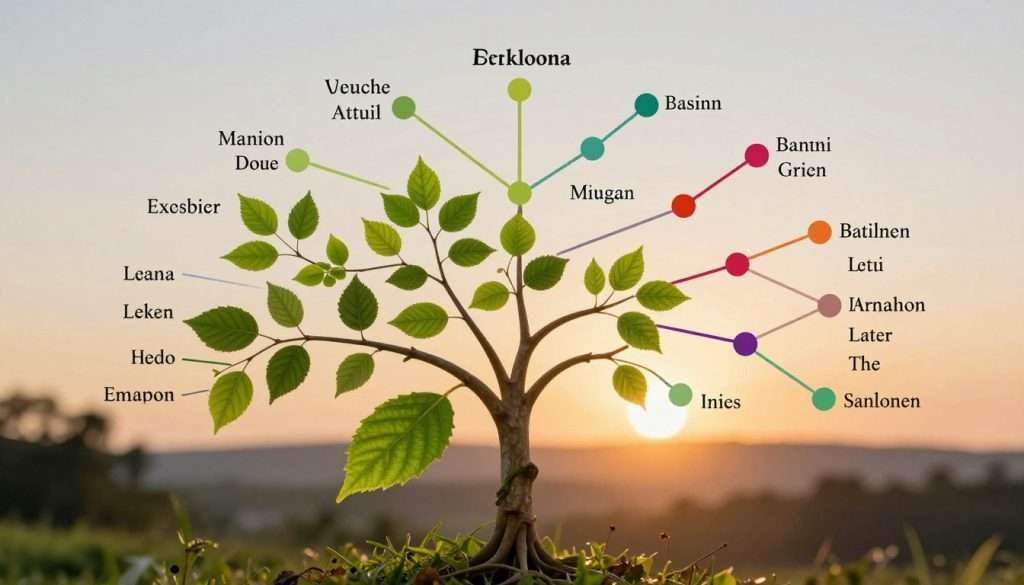
Ever felt lost trying to understand something complex? You’re not alone! We’ve all been there. But what if you had a tool to simplify complex info into basic truths?
Elon Musk shared his secret: “First principles” thinking. It’s about breaking things down to their simplest forms. We’re excited to introduce you to the Semantic Tree, a method that uses this approach.
The Semantic Tree is a game-changer for anyone wanting to understand complex ideas better. It helps you see things in a new light and understand the world more deeply.
Key Takeaways
- Discover the power of “First principles” thinking and its application in understanding complex concepts.
- Learn how the Semantic Tree method can help you break down complex information into its fundamental truths.
- Understand how to apply the Semantic Tree to achieve a deeper understanding of complex concepts.
- Develop a more nuanced understanding of the world around you using the Semantic Tree.
- Unlock new insights and improve your ability to retain complex information.
What Is a Semantic Tree?
In a world full of data, Semantic Trees offer a clear path. They help us understand complex information better. A Semantic Tree is not just a visual tool; it’s a structured way to organize knowledge. It shows how our brains naturally process information.
Definition and Core Concepts
A Semantic Tree is a hierarchical structure of concepts. It starts with a central idea and branches out to related sub-concepts. This structure is inspired by Elon Musk’s learning method. It focuses on understanding foundational concepts first.
The Structure of Knowledge Organization
The Semantic Tree organizes knowledge in a way that helps with cognitive mapping. It creates a visual hierarchy. This makes it easier to see the connections between different pieces of information.
Visualizing Information Hierarchies
One big advantage of Semantic Trees is their ability to visualize information hierarchies. This makes it simpler to move through layers of information. From general concepts to specific details, it improves understanding and recall.
By using Semantic Trees, you can manage your learning better. You create a structured and meaningful way to understand complex subjects.
The Origins of the Semantic Tree Method
The semantic tree comes from Aristotle’s “first principles.” This idea has grown a lot over time. It helps us understand complex ideas by breaking them down to their simplest truths.
Historical Development in Cognitive Science
The semantic tree method started in cognitive science. Researchers have always looked into how we organize and process information. They use hierarchical structures to help us understand and remember complex stuff better.
Elon Musk’s Popularization and Application
Elon Musk made the semantic tree method famous with his “first principles thinking.” He uses it in many areas, like physics and business. Musk shows how breaking down big problems into simple parts can be very effective.
Evolution in Educational Psychology
In educational psychology, the semantic tree has grown as a way to improve conceptual understanding. It helps learners see how different ideas are connected. This makes it easier to understand and remember what they learn.
Looking into the semantic tree method, we see it’s based on old philosophical ideas and new science. It’s a strong tool for understanding concepts in many fields.
Why Traditional Learning Methods Often Fail
We’re hit with tons of information every day. Yet, old learning methods often don’t get us ready for real-world challenges. This is because these methods use outdated ways that don’t match how our brains learn best.
The Problem with Rote Memorization
Rote memorization is a classic outdated learning method. It means memorizing info without getting its context or importance. This method might help us remember things for a short time. But it doesn’t help us understand or use the info in new ways.
Disconnected Knowledge Fragments
Traditional learning often leaves us with disconnected knowledge fragments. When we just memorize, we get isolated bits of info. These bits don’t link to what we already know. This makes it hard to remember or use the info when we need it.
Information Overload in the Digital Age
The digital age has made info explosion a big problem. We face the challenge of sorting through huge amounts of data to find what’s important. Old learning methods don’t teach us how to handle this info overload. Here are some big issues:
- It’s hard to tell what info is important and what’s not
- We get tired from seeing so much new data
- It’s tough to organize and connect new info to what we already know
By knowing these problems, we can look for better learning ways. The Semantic Tree method is one example. It helps organize knowledge in a clear and connected way.
The Semantic Tree: A Powerful Way to Actually Understand Anything
Structuring knowledge like a tree helps you understand and remember better. Elon Musk made this method popular. He says, “I think it’s important to view knowledge as sort of semantic tree… Make sure you understand the fundamental principles, i.e., the trunk and big branches, before you get into the leaves/details.”
Building Knowledge from First Principles
The semantic tree starts with a strong foundation: the trunk. This is the core concept or first principle. For example, learning about artificial intelligence, the trunk is the AI definition. Then, the major branches are related concepts like machine learning and neural networks.
Connecting Concepts Hierarchically
Building your semantic tree creates a hierarchy of information. The branches split into smaller twigs for more specific details. This structure shows how different pieces of information are connected. It makes recalling and applying information easier.
Creating Meaningful Associations
The semantic tree is not just for organizing information. It’s also about making meaningful connections between concepts. By linking related ideas, you build a strong network of knowledge. This network helps you understand new information and see how it fits into what you already know.
| Benefits | Description |
|---|---|
| Improved Understanding | Hierarchical structure clarifies complex concepts |
| Better Retention | Meaningful associations enhance memory recall |
| Enhanced Application | Clear connections between concepts facilitate practical use |
How Our Brains Process Information Hierarchically
When we learn something new, our brains create a structure automatically. This is how we understand and remember things. The Semantic Tree method uses this natural process to organize information like our brains do.
Cognitive Science Insights
Studies in cognitive science show our brains make mental maps of information. This process, called cognitive mapping, helps us navigate and remember better. By organizing info in a hierarchy, we grasp how different ideas relate.
Mental Models and Knowledge Frameworks
Mental models help us understand the world. They are key for organizing and using knowledge. The Semantic Tree shows these models visually, making it simpler to see important ideas and how they connect.
Neural Networks and Information Processing
Our brains process info through neural networks. These networks have nodes that work together to spot patterns and store info. The Semantic Tree’s structure matches how these networks work, making learning and remembering easier.
| Key Aspect | Description | Benefit |
|---|---|---|
| Cognitive Mapping | Creating mental maps of information | Improved navigation of complex systems |
| Mental Models | Frameworks for understanding the world | Enhanced knowledge organization and application |
| Neural Networks | Interconnected nodes processing information | Efficient learning and recall |
Da Vinci said, “The noblest pleasure is the joy of understanding.” By matching our learning to how our brains process info, we can find this joy. This leads to a deeper understanding of our world.
Creating Your First Semantic Tree
Now that we’ve talked about semantic trees, it’s time to make your own. This isn’t just about organizing info. It’s also about really getting to know the topic.
Step-by-Step Guide
To start, pick a central concept or topic you want to learn about. This will be the heart of your tree.
Identifying Trunk Concepts
The trunk of your tree is the main idea. To find it, ask yourself: “What’s the core topic I’m exploring?” For example, if you’re looking into climate change, your trunk might be “factors influencing global temperature.”
Developing Branches and Connections
After you have your trunk, it’s time for branches. These are related ideas or subtopics. For instance, branches from “factors influencing global temperature” could be “greenhouse gases,” “deforestation,” and “ocean currents.”
Don’t make your trunk too wide. For example, if your trunk is “science,” you’ll have too many branches. Instead, pick a specific area like “cell biology.”
Misplaced Branches
Another issue is where to put branches. Make sure each branch is closely related to your trunk. If a branch doesn’t fit, think about starting a new trunk or changing your tree’s layout.
By following these steps and watching out for common mistakes, you can build a strong semantic tree. This will help you understand and remember complex info better.
Key Takeaways:
- Identify a clear, focused trunk concept.
- Develop relevant branches and connections.
- Avoid overly broad trunk concepts.
- Ensure branches are correctly placed.
Real-World Applications of Semantic Trees
The semantic tree is more than a theory; it’s used in many areas. It helps organize knowledge in a way that’s easy to understand. This makes tackling tough challenges easier.
Academic Learning and Research
In schools, semantic trees are great for studying and research. They help students organize their thoughts and see how ideas connect. This leads to deeper understanding and better study habits.
Professional Skill Development
Professionals can also use semantic trees to learn new skills. They break down complex skills into smaller parts. This makes learning more efficient, which is key in fast-changing fields like tech and healthcare.
Problem-Solving in Complex Scenarios
Semantic trees shine when dealing with complex problems. Elon Musk’s work shows how they help solve problems by seeing how different parts connect. This leads to more creative and effective solutions.
Decision-Making Frameworks
Semantic trees are also good for making decisions. They help organize information in a way that makes choosing easier. This is very useful in fields like artificial intelligence and machine learning.
Some key benefits of using semantic trees include:
- Improved conceptual understanding
- Enhanced problem-solving capabilities
- More effective decision-making
- Better organization of knowledge
By using these benefits, people and groups can do better in their fields.
Semantic Trees vs. Other Learning Methods
When we look at different ways to learn, it’s key to see how Semantic Trees stack up against mind mapping and concept mapping. These methods share some commonalities but differ in how they organize knowledge.
Comparison with Mind Mapping
Mind mapping is a well-known method that connects ideas around a central point. But Semantic Trees focus more on organizing information in a structured way. They offer a clearer path to understanding complex subjects than mind maps do.
Differences from Concept Mapping
Concept mapping helps visualize how ideas are connected. Yet, Semantic Trees take a more detailed and systematic approach. They stress the need to grasp the underlying principles and create a solid framework for knowledge.
Advantages over Linear Learning Approaches
Linear learning methods often only scratch the surface of a topic. Semantic Trees, on the other hand, help learners dive deeper by organizing information in a hierarchical manner. This way, learners can see the overall picture and still understand the finer details.
| Learning Method | Key Features | Benefits |
|---|---|---|
| Semantic Trees | Hierarchical organization, focus on first principles | Deeper understanding, structured approach |
| Mind Mapping | Visual web of ideas, brainstorming | Creative exploration, idea generation |
| Concept Mapping | Visualizing relationships between ideas | Understanding connections, relationships |
Knowing the strengths and weaknesses of each method helps you pick the right one for you. Whether you’re in school or always learning, Semantic Trees are a great tool for organizing and deepening your understanding of knowledge.
Semantic Trees in Different Disciplines
Semantic trees are used in many fields to help us understand and organize complex ideas. They are useful in science, math, humanities, social sciences, and even in business and entrepreneurship. This tool helps us break down big ideas into smaller, easier-to-grasp parts.
Science and Mathematics
In science and math, semantic trees make complex theories easier to handle. For example, in physics, they help us understand quantum mechanics step by step. This way, we can dive deep into complex subjects.
Humanities and Social Sciences
In humanities and social sciences, semantic trees aid in studying history, literature, or social structures. They help us see how different parts are connected and find patterns that might be hard to spot.
Business and Entrepreneurship
Business leaders and entrepreneurs use semantic trees for planning and analysis. Elon Musk, for instance, uses his knowledge of economics and physics to innovate in electric cars. Semantic trees help us see how business ideas are linked together.
Personal Development
For personal growth, semantic trees are great for setting goals and organizing tasks. They let us visualize our objectives and the steps to reach them. This way, we can make better choices and stay on track.
Semantic trees are incredibly versatile and valuable in many areas. They help us grasp complex subjects and discover new insights. Their ability to break down big ideas into smaller parts makes them a powerful tool.

Digital Tools for Building Semantic Trees
In today’s digital world, making a semantic tree is easier than ever. Many digital tools help you do this. They make the process simpler and improve your knowledge structure.
Software Applications and Platforms
There are many software apps and platforms for building semantic trees. MindMeister and Coggle have easy-to-use interfaces. They offer features like drag-and-drop, collaboration, and export options.
Online Resources and Communities
Online resources and communities also help a lot. Sites like GitHub and Reddit have communities. They share knowledge, templates, and tips for making semantic trees.
Integration with Note-Taking Systems
Many tools work with popular note-taking apps. For example, Evernote and Roam Research let you link notes. This helps you organize and find information easily.
Using these digital tools can greatly help you create and manage semantic trees. This is useful for learning and work.
Semantic Trees in Artificial Intelligence and Machine Learning
In the world of artificial intelligence, semantic trees are becoming key for organizing knowledge. As AI and machine learning grow, so does the need for better ways to organize information.
Knowledge Representation in AI Systems
Semantic trees help AI systems understand complex information in a structured way. They make it easier for AI to learn from data and make smart choices.
Machine Learning Classification Hierarchies
In machine learning, semantic trees help build better classification systems. This is very helpful in tasks like recognizing images or understanding language.
Future Applications in Cognitive Computing
As we move towards smarter AI, semantic trees will play an even bigger role. They help AI think like humans by understanding the connections between information.
Elon Musk’s learning style, as shared by his brother Kimbal, shows the value of linking different areas of knowledge. This skill is vital in AI and machine learning, where semantic trees help combine various data sets.
Conclusion: Transforming How We Learn and Understand
The Semantic Tree method is a game-changer for learning and understanding complex topics. It breaks down big problems into smaller parts. This makes it easier to grasp and encourages new ideas.
Elon Musk said it’s hard but worth it. “It’s very hard to do. You can’t think that way about everything. It takes a lot of effort, but if you’re trying to do something new, it’s the best way to think.”
The Semantic Tree is not just a learning tool. It’s a way to think that deepens your understanding. By using it, you can see the world in a new light. We suggest you try it out and see how it changes your learning and problem-solving.
Using the Semantic Tree helps you face big challenges head-on. It prepares you to reach your goals. So, start making your own Semantic Trees today. See how this new way of learning and understanding can change your life.