
Math class never showed you the weird, wonderful world hiding behind those equations. Most people think mathematics is just numbers and formulas, but there’s an entire universe of beautiful patterns, impossible puzzles, and mind-blowing discoveries that make math feel like magic.
This exploration is for curious minds who want to see math’s creative side – whether you’re a student who thinks math is boring, an artist looking for inspiration, or anyone who enjoys “did you know” moments that make you question reality.
We’ll dive into how nature secretly follows mathematical blueprints, from spiral galaxies to flower petals. You’ll discover paradoxes that break your brain in the best way possible, and see how mathematical concepts create stunning visual art that rivals anything in a gallery. Plus, we’ll uncover the strange, infinite world where normal rules don’t apply and mathematical truths get seriously weird.
Get ready to see math as the creative, mysterious force it really is.
Mathematical Patterns Hidden in Nature’s Design
Fibonacci Spirals in Sunflowers and Seashells
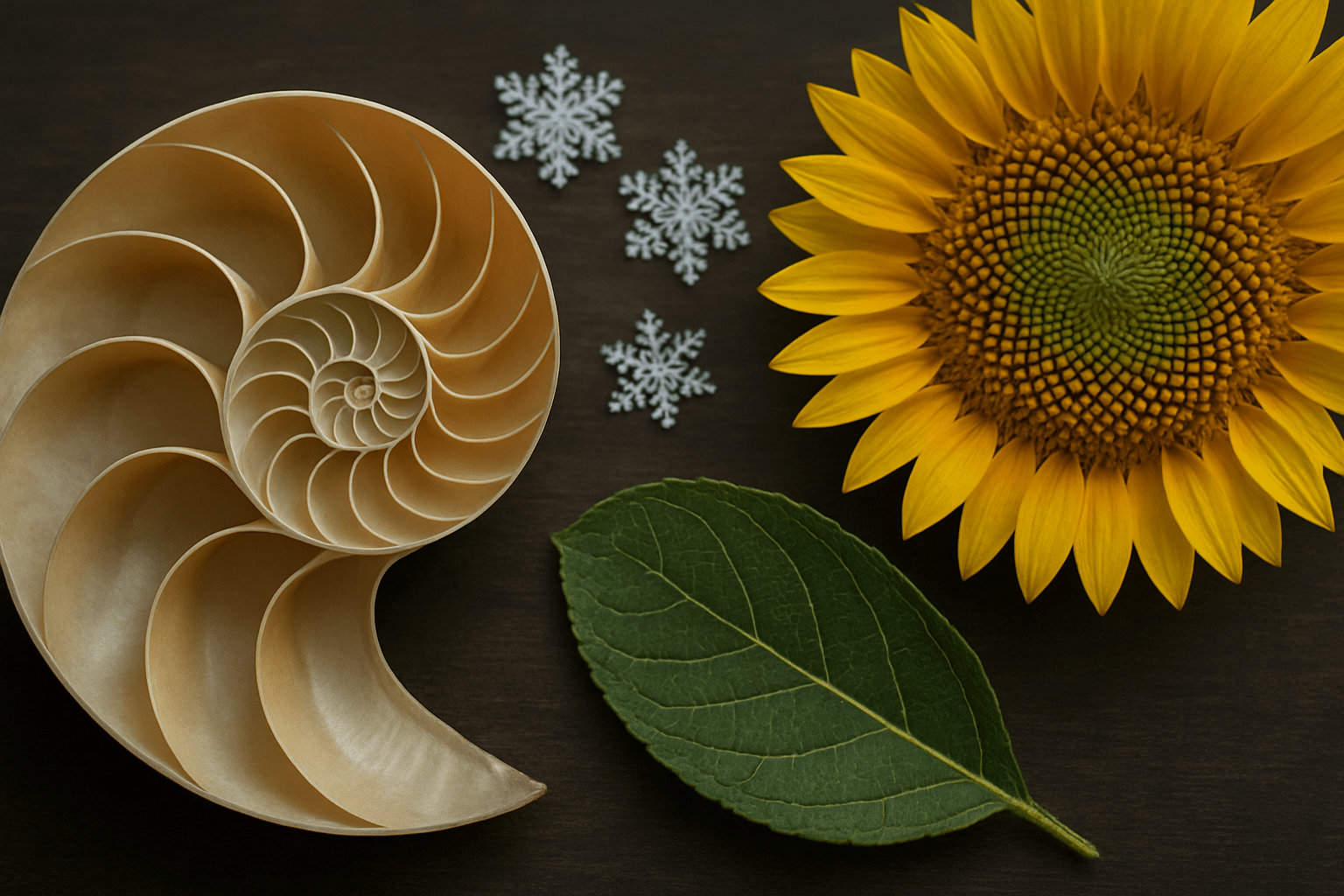
Look closely at a sunflower’s center, and you’ll discover one of nature’s most elegant mathematical secrets. The seeds don’t arrange themselves randomly—they follow the Fibonacci sequence, creating perfect spirals that wind both clockwise and counterclockwise. Count the spirals in each direction, and you’ll find consecutive Fibonacci numbers: 21 and 34, or 55 and 89, depending on the flower’s size.
This same pattern appears in nautilus shells, where each chamber grows according to the golden spiral derived from Fibonacci ratios. Pine cones display it too, with their scales arranged in spiraling patterns that maximize packing efficiency while maintaining structural integrity.
The reason behind this phenomenon lies in optimization. Plants that follow Fibonacci spirals can pack the maximum number of seeds or leaves into the smallest space while ensuring each element receives adequate sunlight and resources. Nature discovered this mathematical principle millions of years before humans even conceived of numbers.
Golden Ratio Architecture in Ancient Monuments
The ancient Greeks didn’t just stumble upon beautiful proportions—they embedded mathematical perfection into stone. The Parthenon’s facade reveals the golden ratio (1.618…) in its width-to-height relationship, creating a visual harmony that feels naturally pleasing to human eyes.
Egyptian pyramids showcase similar mathematical precision. The Great Pyramid of Giza incorporates the golden ratio in its slope angle and chamber proportions. These weren’t accidental choices—ancient architects understood that certain mathematical relationships create aesthetic appeal that transcends cultural boundaries.
Modern analysis reveals that Notre-Dame Cathedral, the Taj Mahal, and countless other architectural marvels employ golden ratio proportions in their designs. Even contemporary architects like Le Corbusier built entire design systems around these mathematical principles, proving that beauty and mathematics remain inextricably linked across millennia.
Fractal Geometry in Coastlines and Clouds
Measuring Britain’s coastline seems straightforward until you realize the answer changes dramatically based on your ruler’s size. Use a mile-long ruler, and you’ll get one measurement. Switch to a foot-long ruler, and the coastline suddenly becomes much longer as you trace around smaller inlets and rocky outcroppings.
This paradox reveals fractal geometry—patterns that repeat at every scale level. Coastlines exhibit self-similarity, where small sections mirror the jagged complexity of the whole. The same mathematical principle governs cloud formations, mountain ranges, and blood vessel networks.
Mandelbrot’s revolutionary work showed that these aren’t just curiosities—fractals represent a fundamental organizing principle in nature. Lightning bolts branch fractally, tree structures follow fractal patterns, and even your lungs maximize surface area through fractal branching. What appears chaotic actually follows precise mathematical rules that create infinite complexity from simple recursive formulas.
Symmetry Principles in Snowflakes and Crystals
Every snowflake’s six-sided symmetry emerges from the hexagonal structure of water molecules as they freeze. Despite the saying that no two snowflakes are identical, they all follow the same mathematical symmetry principles—six-fold radial symmetry that reflects the underlying molecular geometry.
Crystal formation follows similar mathematical rules. Salt crystals form perfect cubes because sodium and chloride ions arrange themselves in cubic lattices. Quartz grows in hexagonal patterns, while diamond’s incredible hardness comes from its tetrahedral carbon structure.
These symmetries aren’t random—they represent the most energy-efficient arrangements possible. Nature consistently chooses configurations that minimize energy while maximizing stability. The mathematics governs everything from how atoms bond to how ice crystals grow, creating the stunning geometric perfection we see in mineral collections and winter windows.
The beauty lies in realizing that mathematical principles operating at the atomic level manifest as the gorgeous patterns we observe in everyday natural phenomena.
Mind-Bending Mathematical Paradoxes That Challenge Logic
The infinite hotel paradox explained simply
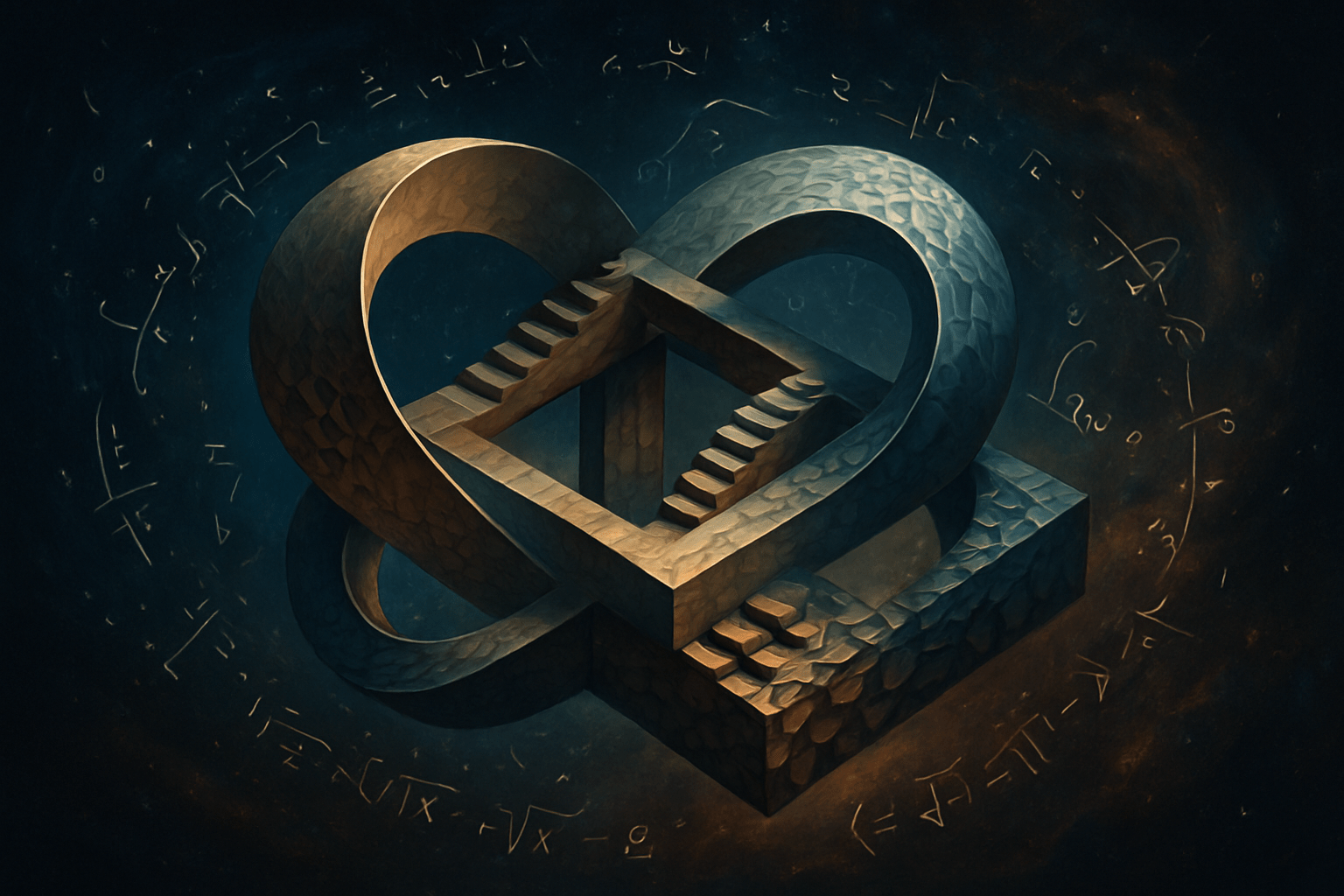
Picture the Grand Hotel—a peculiar establishment with infinitely many rooms, all numbered 1, 2, 3, and so on forever. Every single room is occupied, yet when a new guest arrives, the clever manager always finds space. How? He simply asks every guest to move from their current room number to the next room up. The person in room 1 moves to room 2, the person in room 2 moves to room 3, and this pattern continues infinitely. Now room 1 is free for the newcomer.
This gets even stranger. What if infinitely many new guests arrive at once? The manager has a solution: he asks all current guests to move to the room number that’s double their current room. So the guest in room 1 moves to room 2, room 2 goes to room 4, room 3 to room 6, and so forth. This clears out all the odd-numbered rooms (1, 3, 5, 7…), creating infinite space for the infinite newcomers.
David Hilbert created this paradox to show how infinity breaks our normal understanding of “full” and “empty.” In finite situations, a full hotel can’t accept more guests. But infinity plays by different rules, revealing that our everyday logic has limits when dealing with the infinite.
Why 0.999… actually equals 1
Most people’s first reaction to “0.999… = 1” is skepticism. The repeating decimal 0.999… looks like it should be just slightly less than 1, but mathematics proves they’re identical—not approximately equal, but exactly the same number.
Here’s one way to see this: Let x = 0.999… If we multiply both sides by 10, we get 10x = 9.999… Now subtract the original equation: 10x – x = 9.999… – 0.999…, which simplifies to 9x = 9. Divide both sides by 9, and x = 1.
Another approach uses fractions. We know that 1/3 = 0.333… When we multiply both sides by 3, we get 3 × (1/3) = 3 × 0.333…, which gives us 1 = 0.999…
The key insight is that 0.999… represents an infinite process, not a finite approximation. When we write 0.999…, we’re describing the limit of the sequence 0.9, 0.99, 0.999, 0.9999, and so on. This sequence gets arbitrarily close to 1, and in the infinite limit, it becomes exactly 1.
This paradox challenges our intuition about decimal representation and shows that some numbers can be written in multiple ways.
The birthday problem’s surprising probability
Ask someone to guess the odds that two people in a room of 23 share the same birthday, and they’ll typically estimate something low—maybe 5% or 10%. The actual answer: over 50%. This counterintuitive result is called the birthday paradox, and it demonstrates how poorly our brains handle probability.
The secret lies in counting all possible pairs. Instead of asking “What’s the chance someone shares my birthday?”, we’re asking “What’s the chance any two people share a birthday?” With 23 people, there are 253 possible pairs (calculated as 23 × 22 ÷ 2), giving us 253 chances for a match.
The math works by calculating the opposite: the probability that everyone has different birthdays. For the first person, the probability is 365/365. For the second person to have a different birthday, it’s 364/365. For the third, it’s 363/365, and so on. Multiply all these fractions together for 23 people, and you get about 49.3%—the chance everyone has different birthdays. Subtract from 100%, and there’s a 50.7% chance of at least one match.
Push this to 30 people, and the probability jumps to about 70%. With 50 people, it’s virtually certain at 97%. This paradox appears everywhere from sports teams to classrooms, consistently surprising people who encounter it for the first time.
Visual Mathematics That Creates Stunning Art
Mandelbrot Sets and Their Infinite Complexity
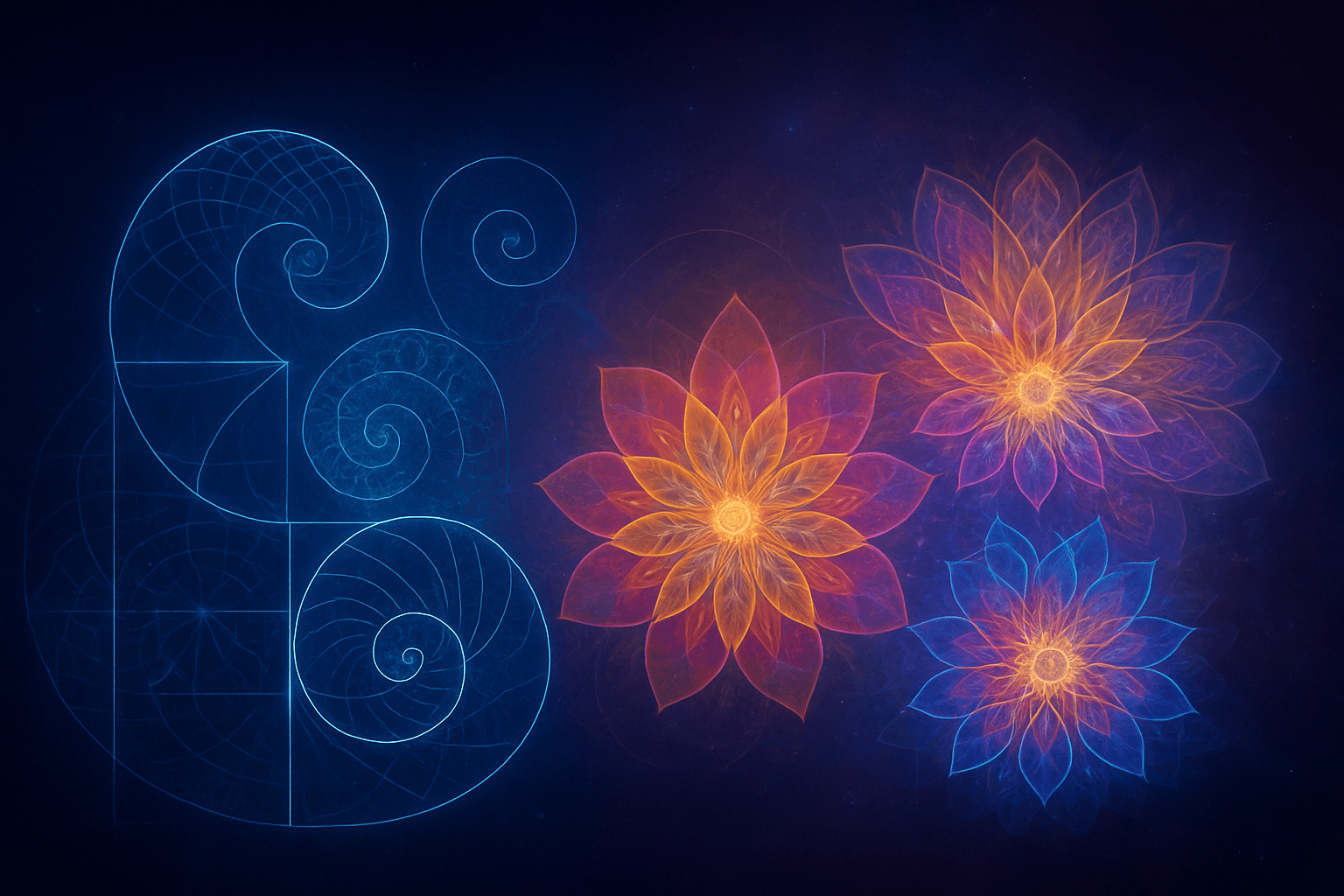
Picture zooming into a Mandelbrot set forever and never reaching an end. Every time you think you’ve seen the finest detail, new patterns emerge with breathtaking complexity. These mathematical objects demonstrate how simple equations can create infinite beauty.
The Mandelbrot set comes from repeatedly applying the equation z² + c to complex numbers. When you plot which values stay bounded and which escape to infinity, you get intricate boundary patterns that reveal self-similar structures at every scale. Zoom into any edge and discover spirals, tendrils, and miniature copies of the entire set.
What makes these sets extraordinary is their fractal nature. The boundary has infinite length despite enclosing a finite area. Computer graphics reveal seahorse valleys, lightning-bolt patterns, and delicate filaments that branch endlessly. Artists and mathematicians collaborate to explore these digital landscapes, creating stunning visualizations that blur the line between mathematical research and artistic expression.
Geometric Transformations in Islamic Patterns
Islamic art showcases mathematical principles through mesmerizing geometric patterns that have decorated mosques and palaces for over a millennium. These designs demonstrate sophisticated understanding of symmetry, tessellation, and transformation.
Master craftsmen used fundamental mathematical operations—rotation, reflection, and translation—to create complex patterns from simple shapes. Starting with basic polygons like squares, hexagons, and octagons, they applied systematic transformations to generate infinite networks of interlocking designs.
The patterns often feature multiple layers of symmetry. A single design might display 4-fold rotational symmetry while simultaneously exhibiting mirror symmetries across multiple axes. This mathematical precision creates visual harmony that feels both ordered and organic.
Common Transformation Types:
- Rotational patterns: Based on 4, 6, 8, or 12-fold symmetries
- Reflection networks: Mirror images across central axes
- Translation grids: Repeating motifs across infinite planes
- Glide reflections: Combined sliding and mirroring operations
Mathematical Equations That Generate Beautiful Curves
Simple mathematical formulas can produce curves of surprising elegance. The rose curve, defined by r = a·cos(nθ), creates flower-like patterns where the number of petals depends on whether n is odd or even. When n equals 3, you get a three-petaled rose; when n equals 4, you see an eight-petaled flower.
Parametric equations offer another pathway to beauty. The equations x = 16sin³(t) and y = 13cos(t) – 5cos(2t) – 2cos(3t) – cos(4t) generate a heart shape with mathematical precision. These cardioid curves appear in physics, engineering, and romantic greeting cards alike.
Spirals captivate through their mathematical elegance. The Archimedean spiral grows steadily outward, while the logarithmic spiral maintains constant angles—the same shape found in nautilus shells and galaxy arms. Each equation type produces distinct visual characteristics that artists and designers exploit for creative projects.
Color Mathematics Behind Digital Art Creation
Digital art relies heavily on mathematical color models that transform numerical values into visual experiences. The RGB color space represents colors as combinations of red, green, and blue intensities, each ranging from 0 to 255. This simple mathematical framework enables millions of color variations.
HSV (Hue, Saturation, Value) provides another mathematical approach to color manipulation. Hue represents position on the color wheel (0-360 degrees), saturation measures color intensity (0-100%), and value determines brightness. Artists use mathematical functions to smoothly transition between colors, creating gradients that would be impossible to achieve manually.
Algorithmic color generation uses mathematical formulas to create palettes. The golden ratio (1.618) helps determine harmonious color relationships, while trigonometric functions generate cycling color schemes. Fractals use mathematical iteration to assign colors based on computational behavior, creating the rainbow patterns seen in Mandelbrot set visualizations.
Sacred Geometry in Famous Paintings
Renaissance masters embedded mathematical principles into their greatest works, using geometric relationships to create compositions that feel naturally balanced and harmonious. The golden ratio appears repeatedly in classical paintings, dividing canvases into proportions that please the human eye.
Leonardo da Vinci’s “Vitruvian Man” demonstrates perfect geometric proportions based on mathematical relationships found in human anatomy. His “Last Supper” uses linear perspective—a mathematical technique that creates the illusion of three-dimensional space on flat surfaces through vanishing points and geometric projection.
Georges Seurat applied mathematical color theory in his pointillist paintings, using scientific understanding of how adjacent colors interact optically. His systematic approach to color placement relied on mathematical principles of light wavelength and retinal perception.
Mathematical Elements in Classical Art:
- Golden rectangles: Proportions based on φ (phi) ≈ 1.618
- Perspective geometry: Mathematical vanishing points and sight lines
- Circular compositions: Arrangements based on radial symmetry
- Triangular structures: Stable compositional frameworks using geometric principles
Strange Mathematical Truths About Infinity

Different Sizes of Infinity Explained
Infinity isn’t just one massive, incomprehensible number that stretches on forever. There are actually different types of infinity, each with its own unique properties and “size.” The smallest infinity, called countable infinity, includes sets like all natural numbers (1, 2, 3, 4…) or all even numbers. You can list these numbers in sequence, even though the list never ends.
Then there’s uncountable infinity, which is genuinely larger. The real numbers between 0 and 1 represent this type of infinity. No matter how you try, you can never create a complete list of all decimal numbers between 0 and 1 because there are infinitely many digits after the decimal point, creating infinite possibilities.
Georg Cantor proved this using his famous diagonal argument. He showed that even if you think you’ve listed every possible decimal between 0 and 1, you can always construct a new number that’s not on your list by changing the diagonal digits. This proves that some infinities are genuinely larger than others.
Why Some Infinities Are Bigger Than Others
The concept of infinity having different sizes breaks our everyday understanding of “bigger” and “smaller.” When mathematicians compare infinite sets, they use a process called one-to-one correspondence. If you can pair up every element from one infinite set with every element from another infinite set, without any leftover elements, then those infinities are the same size.
Here’s where things get weird: the set of all natural numbers has the same infinity size as the set of all even numbers, even though even numbers seem like only “half” of all natural numbers. You can pair them up perfectly: 1 pairs with 2, 2 pairs with 4, 3 pairs with 6, and so on.
But the real numbers create a larger infinity because they can’t be paired up with natural numbers in this way. Cantor’s hierarchy shows us there are infinitely many different sizes of infinity, each one larger than the last. The power set (all possible subsets) of any infinite set always creates a larger infinity than the original set.
The Counterintuitive Behavior of Infinite Series
Infinite series produce some of the most mind-bending results in mathematics. Take the harmonic series: 1 + 1/2 + 1/3 + 1/4 + 1/5 + … This series grows forever, even though each term gets smaller and smaller. Add enough terms, and you’ll eventually surpass any number you choose, no matter how large.
Meanwhile, other infinite series behave completely differently. The series 1 + 1/2 + 1/4 + 1/8 + 1/16 + … adds up to exactly 2, despite having infinitely many terms. Each term halves the previous one, creating a pattern that converges to a finite answer.
Perhaps most shocking is Grandi’s series: 1 – 1 + 1 – 1 + 1 – 1 + … Depending on how you group the terms, you can make this infinite series equal 0, 1, or even 1/2. This isn’t mathematical trickery—it reveals deep truths about how infinity behaves under different conditions.
The Riemann zeta function produces another stunning result: 1 + 2 + 3 + 4 + 5 + … = -1/12. This seems impossible since you’re adding positive numbers, but advanced mathematical techniques reveal this extraordinary relationship, which actually helps physicists understand quantum field theory and string theory.
Mathematical Concepts That Power Modern Technology
How algorithms predict your preferences
Every time you scroll through Netflix, Spotify, or TikTok, sophisticated mathematical models are watching your every move. These recommendation algorithms use collaborative filtering, a technique that compares your behavior with millions of other users to predict what you’ll love next.
The core mathematics relies on matrix factorization—imagine a giant spreadsheet where rows represent users and columns represent items. Your ratings create a sparse matrix filled mostly with blanks. The algorithm fills these gaps using singular value decomposition, breaking down complex user-item relationships into simpler mathematical patterns.
Machine learning algorithms like neural networks process thousands of features about you: time spent watching, clicks, skips, demographic data, and even cursor movements. These systems use gradient descent optimization to continuously adjust their predictions, minimizing the difference between what they predicted you’d like and what you actually enjoyed.
The math gets wild when you consider real-time processing. Streaming platforms analyze your behavior within milliseconds, updating recommendations using stochastic gradient descent while you’re still deciding what to watch. They’re essentially solving massive optimization problems in real-time, balancing accuracy with computational speed.
The mathematics behind internet security
Your online banking, shopping, and private messages depend on mathematical concepts so elegant they feel like magic. RSA encryption, the foundation of internet security, relies on a deceptively simple mathematical fact: multiplying two large prime numbers is easy, but factoring the result back into those primes is computationally nightmarish.
When you connect to a secure website, your browser and the server perform a mathematical dance called the Diffie-Hellman key exchange. Both sides pick secret numbers and use modular arithmetic—basically clock math with enormous numbers—to create a shared secret key without ever transmitting it directly.
Elliptic curve cryptography takes security to another level using the mathematical properties of curves defined by equations like y² = x³ + ax + b. The discrete logarithm problem on these curves is so difficult that even quantum computers would struggle with properly chosen parameters.
Hash functions like SHA-256 use number theory to create digital fingerprints. These mathematical functions take any input and produce a fixed-length output that’s practically impossible to reverse. Bitcoin’s blockchain relies on finding hash values with specific properties—a process requiring billions of mathematical calculations.
Compression techniques that save digital space
JPEG images, MP3 files, and ZIP folders all exist because of mathematical transformations that identify and eliminate redundancy. The discrete cosine transform (DCT) breaks images into frequency components, similar to how a prism separates white light into colors.
Huffman coding assigns shorter binary codes to frequently occurring data and longer codes to rare elements. If the letter ‘e’ appears often in text, it gets a short code like “10,” while ‘q’ might get “110101.” This variable-length encoding dramatically reduces file sizes through pure mathematical optimization.
Video compression uses motion estimation algorithms that track how pixels move between frames. Instead of storing each frame completely, codecs like H.264 use mathematical models to predict pixel values based on previous frames, storing only the differences. This involves complex mathematical operations like block matching and temporal prediction.
Lossless compression algorithms like LZ77 use sliding window techniques to find repeated patterns. The mathematics identifies the optimal way to reference previous data, creating a compressed representation that perfectly recreates the original. These algorithms solve optimization problems in real-time, balancing compression ratio with processing speed.
Game theory strategies in everyday decisions
Game theory mathematics shapes everything from auction bidding to traffic patterns. When you choose the fastest route to work, you’re participating in a massive game where everyone’s trying to minimize travel time simultaneously.
The prisoner’s dilemma appears everywhere in real life: price wars between companies, environmental cooperation, and even social media interactions. Nash equilibrium—the mathematical concept describing stable strategy combinations—explains why gas stations cluster together and why companies often match competitors’ prices rather than starting price wars.
Online auctions use Vickrey auction mathematics, where the optimal strategy is truthful bidding. eBay’s proxy bidding system implements second-price auction theory: you pay just above the second-highest bid, making honest bidding mathematically optimal.
Dating apps employ matching algorithms based on stable marriage problems—mathematical frameworks ensuring that matches are mutually beneficial and stable. These algorithms process compatibility scores, preferences, and behavioral data to maximize overall satisfaction across the entire user base.
Traffic light timing systems use queuing theory and stochastic processes to optimize flow. The mathematics considers arrival rates, service times, and system capacity to minimize waiting times. Modern smart traffic systems adapt in real-time using mathematical models that predict congestion patterns and adjust signal timing accordingly.
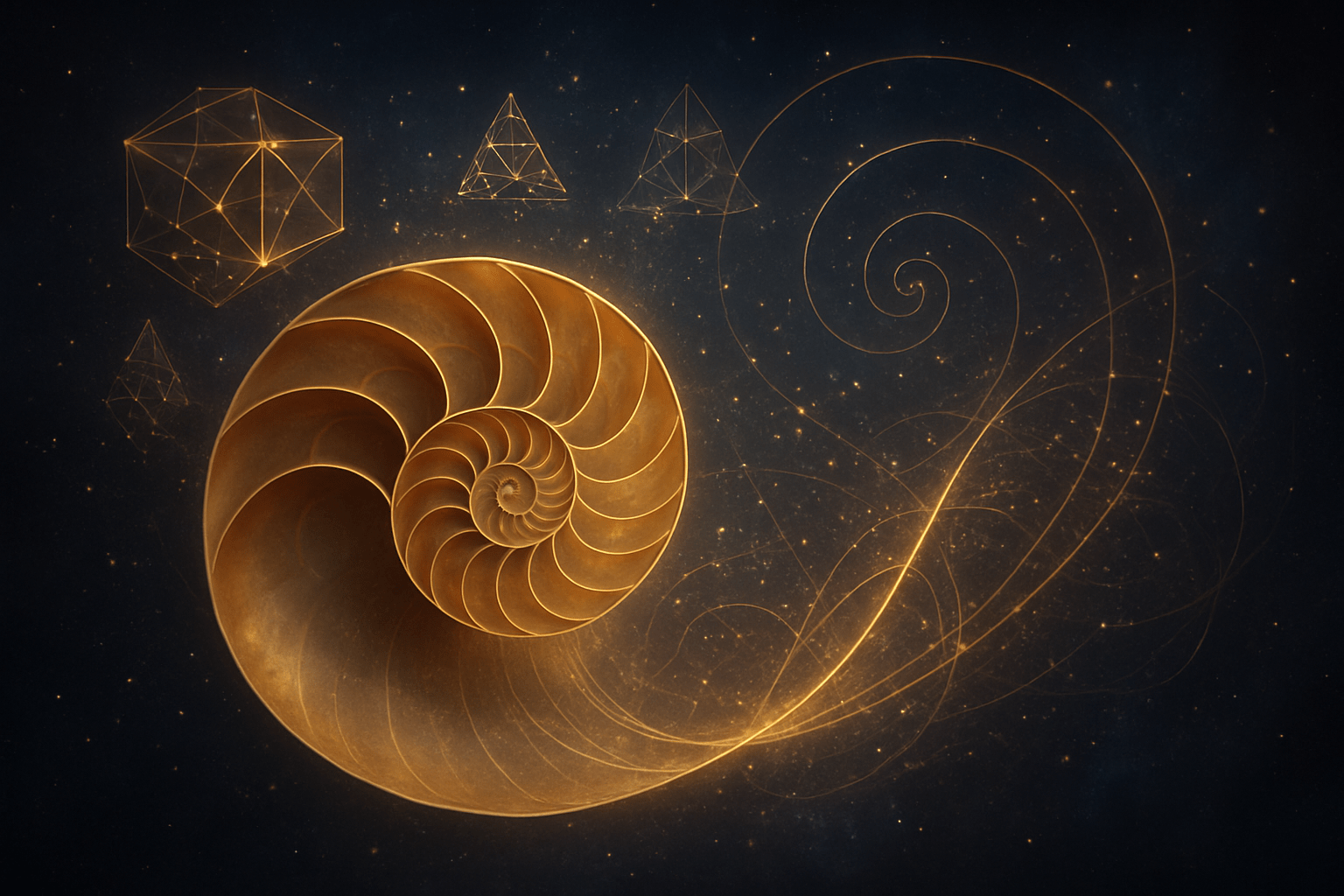
Mathematics reveals itself everywhere around us, from the spiraling patterns of seashells to the infinite puzzles that have stumped brilliant minds for centuries. The golden ratio shapes sunflower petals, paradoxes like the birthday problem flip our intuition upside down, and fractal geometry creates artwork that looks almost magical. These aren’t just abstract concepts sitting in dusty textbooks – they’re the hidden language that describes how our world actually works.
The next time you see a pinecone or scroll through your smartphone, remember that incredible mathematical principles are working behind the scenes. Math isn’t just about solving equations or passing tests. It’s about discovering the secret patterns that make everything from nature’s beauty to our digital lives possible. Start looking for these mathematical fingerprints in your daily life, and you’ll never see the world the same way again.