

Ever found yourself really into a subject that others might not find interesting? Maybe you love history or science books. What’s your secret? It’s probably because you’ve discovered the power of dopamine-driven learning.
Dopamine is a key brain chemical for motivation, attention, and rewards. It’s what makes us want and search for things. When we learn something new, dopamine makes it feel good and fun.
Traditional learning methods often don’t trigger our reward systems. This leaves us feeling unmotivated and disconnected. But, what if we could use dopamine to make learning addictively engaging? By understanding dopamine, we can make learning fun and enjoyable.
Key Takeaways
- Understand the role of dopamine in motivation and reward processing.
- Discover how to harness dopamine to make learning feel engaging.
- Learn how to transform educational content into an enjoyable experience.
- Find out how to make hard subjects feel addictively engaging.
- Unlock the secrets to dopamine-driven learning.
The Science Behind Learning and Dopamine
Dopamine is key to our motivation to learn. It’s a neurotransmitter that affects how we enjoy learning. It makes learning materials more engaging.
How Dopamine Drives Motivation and Reward
Dopamine links certain actions to pleasure. When we find something interesting or reach a goal, dopamine makes us want to do more.
The Neuroscience of the “Aha!” Moment
The “aha!” moment is when we suddenly get it. It releases a lot of dopamine. This makes us more likely to do it again.
Dopamine’s Role in Memory Formation
Dopamine motivates us and helps us remember. It makes the information we learn stick better in our memory.
Why Traditional Learning Often Fails to Trigger Reward Pathways
Old ways of learning don’t always excite us. They don’t always make us feel good. Without dopamine, learning feels like a task, not fun.
The Connection Between Pleasure and Knowledge Retention
Learning that feels good helps us remember better. Dopamine makes the information stick in our minds. This means we keep it longer.
| Learning Aspect | Role of Dopamine | Impact on Learning |
|---|---|---|
| Motivation | Dopamine release associates learning with reward | Increased engagement |
| Memory Formation | Enhances emotional connection to learned information | Better retention |
| Interactive Learning | Triggers dopamine release through engagement | More effective learning experience |
Why Hard Subjects Feel Difficult and Unrewarding
Hard subjects can be tough because of how our brains and feelings work together. When we face a lot of information, our brains can get too full. This makes us less motivated and less interested.
Identifying Common Cognitive Barriers to Engagement
There are many reasons why hard subjects seem hard to get into. For example, when the material is too hard, it can cause cognitive overload. This makes it hard to understand and remember things. Good student motivation strategies can help by breaking down big topics into smaller, easier parts.
The Emotional Cycle of Frustration and Avoidance
Feeling frustrated and then avoiding learning is a common cycle. When we find something hard, we might feel stuck and want to give up. But, using fun and interactive ways to learn can help. This can make learning less frustrating and more exciting.
How Difficulty Creates Dopamine Deficits in Learning
When we struggle to learn, it can make our brains feel less happy. This is because our brain links hard tasks with feeling bad. But, by making learning fun and curious, we can change this. Asking students to explore and learn through questions can make them feel good and excited about learning.
Teachers can use these insights to make hard subjects more fun and rewarding. This way, they can make learning a better experience for everyone.
The Dopamine of Discovery: How to Make Hard Subjects Feel Addictive
Exploring new things can be thrilling. With the right methods, even hard topics can grab our attention. By using dopamine, we can make learning fun.
Reframing Challenges as Dopamine-Triggering Opportunities
Turning tough subjects into fun puzzles is a great idea. It makes learning more enjoyable and boosts our drive to learn more.
Creating Reward Loops That Keep Learners Coming Back
Setting up rewards for reaching goals keeps us interested. This could be through badges or points for our hard work. It shows our progress and keeps us going.
Waiting for rewards can make us feel good, thanks to dopamine. Adding surprises makes learning even more exciting.
Building Momentum Through Strategic Micro-Achievements
Breaking big goals into small steps helps us keep moving. Celebrating these small wins gives us a boost to keep going. It keeps the dopamine flowing, keeping us engaged.
By using these methods, we can make hard subjects fun and addictive. The secret is to know how to release dopamine, making learning both fun and rewarding.
Gamification Strategies That Transform Learning Experiences
Gamification is changing how we learn by making tough subjects fun. It adds game elements to education. This makes learning more interactive and fun, motivating students to dive in.
Designing Point Systems and Progress Trackers
Good gamification starts with points and trackers. These show learners their progress. You can use:
- Digital badges for reaching milestones
- Leaderboards for friendly competition
- Progress bars to see how far you’ve come
Digital and Analog Tracking Methods
There are digital and analog ways to track progress. Digital tools like learning systems track automatically. Analog methods, like charts, give a real feel of progress.
Balancing Challenge and Achievement
It’s key to balance challenge and success. Too much challenge can frustrate, while too little can bore.
Implementing Levels and Unlockable Content
Levels and unlockable content add depth. As learners move up, they get new stuff. This keeps learning exciting and fresh.
Competitive and Collaborative Game Mechanics for Classrooms
Using competitive and team-based game mechanics boosts learning. Team challenges promote teamwork, while competitions push individual effort.
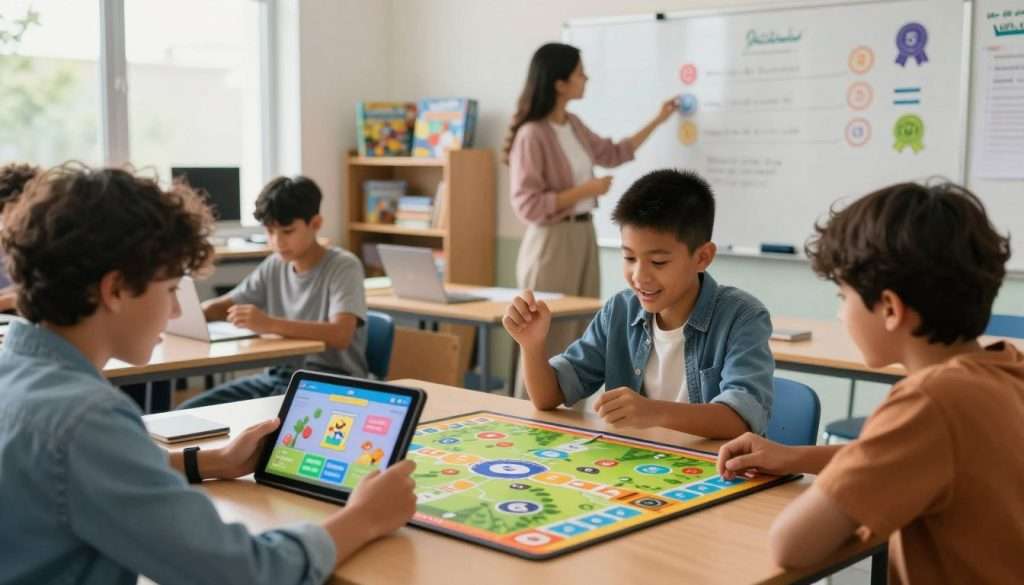
By using these strategies, teachers can make learning fun and engaging. It’s not just about knowing stuff; it’s about enjoying the journey.
Storytelling Techniques That Make Complex Concepts Stick
The art of storytelling can make even tough subjects fun to learn. It turns complex ideas into stories we can follow. This way, we can learn and enjoy at the same time.
Crafting Narratives Around Abstract Principles
We can make hard ideas easier by telling stories about them. A good story can make abstract ideas clear and stick in our minds. For example, a scientific theory can be explained through a historical story or a character’s journey.
Using Character Development to Explain Difficult Processes
Characters can help us understand complex processes. By using characters to show different parts of a concept, we can learn it better. This method makes it easier to see and understand the process.
How to Create Emotional Connections to Theoretical Material
It’s important to connect emotionally with theoretical material. We can do this by making it relatable and personal. Using real-life stories or personal experiences can make complex ideas more impactful and easy to remember.
By using these storytelling methods, we can make learning fun and effective. It not only grabs our attention but also helps us understand and remember complex ideas better.
Interactive Study Methods That Trigger Dopamine Release
To make learning addictive, we need to trigger dopamine release through interactive study methods. Interactive learning is not just a buzzword; it’s a powerful tool for increasing engagement and motivation. By incorporating hands-on activities, digital tools, and social interaction frameworks, we can create a more enjoyable learning experience.
Hands-On Learning Activities for Different Subjects
Hands-on learning activities can be a game-changer for many subjects. By using physical manipulatives and movement-based learning techniques, we can make complex concepts more tangible and fun to learn.
Physical Manipulatives for Abstract Concepts
Using physical manipulatives can help students grasp abstract concepts more easily. For example, using blocks or toys to demonstrate mathematical concepts can make them more concrete.
Movement-Based Learning Techniques
Movement-based learning techniques involve using physical movement to learn new concepts. This can be very effective for subjects like science and history.
| Subject | Hands-On Activity | Benefit |
|---|---|---|
| Math | Using blocks to learn fractions | Improved understanding of abstract concepts |
| Science | Conducting experiments with household materials | Enhanced curiosity and understanding of scientific principles |
| History | Role-playing historical events | Better retention of historical dates and events |
Digital Tools That Transform Passive to Active Learning
Digital tools can also play a significant role in making learning more interactive. By using interactive apps, games, and simulations, we can turn passive learning into an active experience.
Some popular digital tools include: interactive whiteboards, educational apps, and online simulations.
Social Interaction Frameworks That Enhance Engagement
Social interaction is another crucial aspect of interactive learning. By incorporating group work, discussions, and peer-to-peer teaching, we can enhance engagement and motivation.
For example, peer-to-peer teaching can be very effective in reinforcing one’s own understanding of a subject while helping others.
Cultivating Addictive Curiosity in Any Subject Area
Learning can become an exciting journey when we tap into curiosity. Curiosity drives us to explore and learn more. We’ll look at ways to spark curiosity in school settings.
Designing Question-Based Learning Sequences
Using questions instead of statements can spark curiosity. It makes learners think and seek answers. For example, asking “What led to the fall of the Roman Empire?” or “How did the Industrial Revolution change society?” can be more engaging than just stating facts.
Question-based learning boosts engagement and problem-solving skills. It turns complex subjects into puzzles to solve, making them more appealing.
Implementing Mystery and Discovery Elements
Adding mystery and discovery can boost curiosity. This can be done by slowly revealing information or using interactive elements. For instance, a science lesson might involve a simulated experiment where learners identify variables affecting an outcome.
Mystery and discovery elements make learning exciting and interactive. They keep learners engaged and motivated.
Techniques for Building Intellectual Hunger and Anticipation
Building intellectual hunger means creating excitement for what’s next. Techniques include previewing topics, setting goals, and celebrating achievements. Here’s how these can be applied in different subjects:
| Subject Area | Technique | Example |
|---|---|---|
| Mathematics | Previewing upcoming topics | Introducing calculus before diving into its principles |
| Literature | Setting learning goals | Encouraging students to read a certain number of books within a set timeframe |
| Science | Celebrating milestones | Recognizing students’ achievements in completing complex experiments |
By using these strategies, educators can create a learning environment that’s both curious and enjoyable.
Personalization: The Key to Sustained Engagement
Making learning personal boosts engagement and motivation. Personalization tailors the learning experience to fit individual interests and preferences. This makes learning more enjoyable and effective.
Methods for Tailoring Content to Individual Interests
To personalize learning, we must understand what drives each learner. We identify their interests and add them to the learning material. Using real-life examples that resonate with learners makes complex concepts more relatable and engaging.
Technology helps create customized learning paths. Adaptive learning software adjusts the difficulty level and content based on the learner’s performance. This ensures learners are always challenged but not overwhelmed.
Adapting Materials for Different Learning Preferences
Different learners prefer different ways of learning. Some are visual, others auditory or kinesthetic. Adapting materials to these different learning styles ensures every learner can engage with the content in their best way.
Visual, Auditory, and Kinesthetic Adaptations
Visual learners do well with diagrams, videos, and infographics. Auditory learners benefit from lectures, audiobooks, and discussions. Kinesthetic learners thrive on hands-on activities and experiments.
| Learning Style | Effective Strategies |
|---|---|
| Visual | Diagrams, Videos, Infographics |
| Auditory | Lectures, Audiobooks, Discussions |
| Kinesthetic | Hands-on Activities, Experiments |
Cognitive Style Considerations
Understanding cognitive styles is key. Some learners are analytical, others more intuitive. Recognizing these differences helps tailor teaching methods to support each learner’s cognitive strengths.
Creating Personal Relevance in Seemingly Irrelevant Topics
Making seemingly irrelevant topics interesting is a challenge. By connecting them to real-life scenarios or learners’ interests, we can make them engaging. For example, using case studies or storytelling can illustrate the practical applications of abstract concepts.

Embracing personalization transforms the learning experience. It makes learning more engaging, effective, and enjoyable for everyone.
Measuring Success: Tracking Engagement and Knowledge Retention
Improving our learning methods starts with tracking how well we do. We need to understand what makes our education effective. This means looking at different signs and ways to check if our plans work.
Behavioral Indicators of Dopamine-Driven Learning
When students are really into learning, you can tell. They start to participate more, focus better, and want to tackle harder tasks. Teachers can use these signs to make learning even more engaging.
Assessment Techniques That Maintain Engagement
Old ways of testing can sometimes make students lose interest. But, we can use new, fun, and personal ways to keep them engaged. Think gamified quizzes, projects, and peer reviews.
Case Studies: Before and After Dopamine-Focused Redesigns
Many schools have changed their teaching to focus on dopamine-driven learning. Looking at these changes can teach us a lot. We can see how student interest and learning improved after these updates.
By using these methods and watching their effects, we can make learning better. This leads to more interesting and effective educational content for everyone.
Conclusion: Transforming Learning into a Naturally Addictive Experience
We’ve looked at how to make hard subjects fun and engaging. This is done by using dopamine, gamification, and making learning personal. These methods help make learning exciting and keep our minds active.
Turning educational content into something fun is possible. We do this by setting up rewards, telling stories about complex ideas, and using digital tools. These tools help learners become active participants instead of just passive listeners.
Using these strategies makes learning more fun and helps us remember more. The goal is to connect personally with the material. This makes learning interesting and keeps learners eager to learn more.
By applying these ideas, you can make educational content that grabs and motivates learners. This helps them reach their highest potential.