

Hey! Are you tired of staring at notes while nothing sticks? We all have been there. It feels like flipping pages, hoping for a miracle. Our team is here for you.
Welcome! This is the ultimate guide to active recall. This method is a total game-changer for your brain. Instead of just looking at words, you will learn how active recall techniques pull facts straight from your mind.
Think of it as a workout for your memory muscles. We want your learning sessions to be fun and effective. Let us dive in and see how this helps you!
Research shows these habits help move information into long-term storage. You stop being a passive reader. You become a powerful learner instead.
We believe learning should feel rewarding, not like a chore. By using these clever strategies, you unlock a faster way of picking up skills. It is about working smarter, not harder.
Key Takeaways
- Retrieve facts directly from your brain rather than rereading.
- Build stronger connections in long-term memory.
- Spend less time staring at pages and more time growing.
- Transform boring sessions into a fun memory workout.
- Move past simple highlighting toward real mastery of any subject.
- Master difficult topics with these smart, simple habits.
Why Traditional Study Methods Are Holding You Back
Most students unknowingly use outdated study techniques. Methods like rereading notes or textbooks and highlighting important passages might seem productive. But they’re not as effective as you think.
Henry Roediger III, a memory expert, once said,
“The act of retrieving information from memory is a powerful learning event.”
This quote shows why traditional methods don’t work well.
Rereading and highlighting are seen as passive learning techniques. They don’t really challenge your brain to recall information. This is key for keeping information in your long-term memory. Instead, these methods can make you think you know the material better than you really do.
Active Recall, on the other hand, is a game-changer for studying. It involves actively recalling information from memory. This strengthens your understanding and retention. By using Active Recall, you’re not just passively reading your notes. You’re actively engaging with the material.
It’s time to move away from old study methods and adopt a better approach. By understanding the limits of traditional methods and using Active Recall, you can greatly improve your learning. As we explore more, you’ll see how Active Recall can change your study sessions and help you reach your academic goals.
What Is Active Recall and How Does It Transform Learning?
Active recall is a learning method where you actively remember information instead of just reading it again. It makes your memory stronger and helps you understand better. This way, you build a solid base of knowledge that you can use when needed.
So, how does it work? Active recall makes your brain work harder to remember things. This strengthens the connections in your brain, making it easier to remember later.
Defining Active Recall in Simple Terms
Active recall is simple: it’s about pulling information out of your memory. Instead of just reading, you try to remember the main points. This strengthens your brain’s connections, helping you remember better.
For example, learning a new language is easier with active recall. Instead of just reading words, make flashcards and test yourself. This way, you engage more with the material and remember it better.
The Science Behind Memory Retrieval
Recalling memories doesn’t just bring back information; it also makes the memory stronger. This is called memory consolidation. By actively recalling, you make it easier to remember things later.
Active Recall vs. Passive Review: Key Differences
Active recall and passive review differ in how much you engage. Passive review is just reading or listening without doing anything. Active recall, on the other hand, makes you actively remember, which strengthens your memory.
| Study Technique | Description | Effectiveness |
|---|---|---|
| Active Recall | Actively recalling information from memory | High |
| Passive Review | Re-reading or listening to information without engagement | Low |
Using active recall in your studies can greatly improve your learning. It’s great for exams or just to understand a subject better. Active recall is a powerful tool to reach your learning goals.
The Neuroscience That Proves Active Recall Works
Active Recall is a top choice for memory improvement strategies, thanks to neuroscience. It’s not just about remembering stuff; it changes your brain.
Every time you use Active Recall, you’re making your brain’s pathways stronger. This makes it easier to remember things later. It’s why Active Recall works so well.
How Your Brain Strengthens Neural Pathways
Let’s explore the brain’s world! When you try to remember something, you’re making the pathway to that memory stronger. This is called the testing effect. It’s a key to better memory and learning.
As you keep practicing Active Recall, your brain’s connections get stronger. This is called synaptic plasticity. It’s the base of learning and remembering.
The Testing Effect and Memory Consolidation
The testing effect is more than just recalling stuff; it’s a strong memory improvement strategy. By actively recalling, you’re not just making pathways stronger. You’re also moving memories from short-term to long-term storage.
Studies show that recalling information is a powerful learning event. It’s not just about reading or reviewing stuff. It’s about actively recalling it from memory.
“The act of retrieval is a powerful learning event. The process of recalling information from memory strengthens the connection between neurons and enhances long-term retention.”
To show how good Active Recall is, let’s compare it to passive review:
| Method | Effect on Memory | Long-term Retention |
|---|---|---|
| Active Recall | Strengthens neural pathways | High |
| Passive Review | Weakens over time | Low |
By adding Active Recall to your study routine, you’re using the testing effect. This improves your memory and helps you remember things better. This memory improvement strategy is supported by science and can really help students and lifelong learners.
Seven Powerful Benefits of Active Recall for Students
Let’s explore the seven key benefits of active recall for students. It’s more than just a study method; it’s a way to deeply learn. By recalling information, you’re not just memorizing; you’re understanding it deeply.
Here are the main advantages of using active recall in your studies:
Dramatically Improved Long-Term Retention
Active recall greatly improves long-term memory. Research shows it strengthens brain connections, making it easier to remember later. It’s not just for tests; it’s for lasting knowledge.
Faster Learning with Less Study Time
Active recall speeds up learning and saves study time. By focusing on recalling key info, you can streamline your study process. It helps you know where to focus, making your study time more effective.
Better Understanding and Critical Thinking Skills
Active recall goes beyond memorization. It helps you understand and think critically. By recalling info, you make connections and gain a deeper understanding.
Increased Confidence for Exams
Active recall also boosts exam confidence. Regular practice makes you more comfortable with the material. This reduces anxiety and improves your performance. This confidence boost is key to success.
In summary, active recall offers many benefits for learning. It improves retention, speeds up learning, and boosts confidence. By using this technique, you can enhance your learning experience.
- Improved long-term retention
- Faster learning with less study time
- Better understanding and critical thinking skills
- Increased confidence for exams
By using these benefits, you can study more efficiently. You’ll make the most of your study time.
The Ultimate Guide to Active Recall: Core Techniques Every Student Needs
It’s time to put Active Recall into action with the most effective techniques every student needs to know. We’ve covered the benefits, and now it’s time to dive into the practical methods that can transform your study sessions.
The Blank Sheet Retrieval Method
The Blank Sheet Retrieval Method is a powerful technique that involves recalling information from memory without looking at your notes or other resources. To start, take a blank sheet of paper and try to recall as much information as possible about a particular topic.
How to Execute the Blank Sheet Technique
Begin by selecting a topic you want to focus on. Then, grab a blank sheet of paper and write down everything you can remember about that topic. Don’t worry about the order or accuracy at this stage; just let your memory flow onto the paper.
Best Subjects for This Approach
This method is great for subjects that require a lot of memorization, such as history dates, scientific formulas, or vocabulary. It’s also effective for essay-type questions where you need to recall a lot of information under timed conditions.
Flashcard-Based Active Recall
Flashcards are a classic study tool, and when combined with Active Recall, they become even more powerful. The key is to use them not just for passive review, but for active recall practice.
Creating High-Quality Recall Questions
To make effective flashcards, focus on creating questions that prompt recall rather than simple recognition. For example, instead of having “What is the capital of France?” on one side and “Paris” on the other, you could have “Countries and their capitals” on one side and then try to recall the capital when you see the country.
The Leitner System for Flashcards
The Leitner system is a method of using flashcards that optimizes review. You have multiple boxes or piles, and cards that you recall correctly move to a box that’s reviewed less frequently, while cards you struggle with stay in a box that’s reviewed more often.
| Box Number | Review Frequency | Card Status |
|---|---|---|
| 1 | Daily | New or Struggling |
| 2 | Every 3 days | Getting Familiar |
| 3 | Weekly | Mastered |
Self-Testing and Practice Questions
Self-testing is a straightforward yet powerful Active Recall technique. It involves testing yourself on the material you’ve studied. This can be done through practice quizzes, past exams, or creating your own questions based on the study material.
The Feynman Technique for Deep Understanding
The Feynman Technique involves explaining a concept in simple terms as if you were teaching it to someone else. This method helps ensure you truly understand the material, not just memorize it. It’s useful for complex subjects where deep understanding is required.
By incorporating these Active Recall techniques into your study routine, you can significantly improve your retention, understanding, and overall performance.
Step-by-Step Implementation: How to Start Using Active Recall Today
Now that we’ve talked about Active Recall’s benefits, let’s get into how to use it. It’s a structured process, but we’ll guide you through it.
Dr. Peter C. Brown, a learning expert, said,
“The act of retrieving information from memory is not merely a reflection of learning; it is a fundamental component of the learning process itself.”
Here are the steps to add Active Recall to your study routine.
Step 1: Review and Chunk Your Study Material
Start by reviewing your study material and breaking it down. Divide big topics into smaller ones or organize your notes. This makes it easier to create specific questions later.
Step 2: Create Targeted Retrieval Questions
After organizing your material, create specific questions. These should test your understanding. For example, if studying history, ask questions like “What were the main causes of the American Revolution?” or “How did the Industrial Revolution impact urban development?”

Step 3: Practice Retrieval Without References
Now, practice answering these questions without looking at your notes. This is where you really learn, as it forces your brain to recall information.
Step 4: Check Your Answers and Identify Gaps
After trying to answer, check your answers against your study materials. Find out where you need more practice. This helps you know where to focus your efforts.
Step 5: Repeat and Schedule Future Retrieval Sessions
Active Recall isn’t a one-time thing; it’s ongoing. Plan to review the material again, spaced out over time. Tools like flashcards or apps can help a lot.
By following these steps and practicing Active Recall regularly, you’ll improve your study routine. Remember, consistency and patience are key. The benefits of Active Recall are worth it!
Combining Active Recall with Spaced Repetition for Optimal Results
Boost your study game by mixing Active Recall with spaced repetition. This combo boosts your learning and memory. Learn how to blend these strategies for better study sessions and results.
Understanding the Spacing Effect in Memory
The spacing effect shows that spaced-out learning beats single-session learning. It’s key for keeping info in your long-term memory. Reviewing material at longer intervals helps solidify it in your memory.
Building Your Personalized Review Schedule
To maximize Active Recall and spaced repetition, create a review plan that fits you. Find the right intervals for reviewing based on your learning speed and content difficulty.
The 1-3-7-21 Day Review Pattern
The 1-3-7-21 day pattern is a common spaced repetition method. It involves reviewing material one day after learning, then three days later, and so on. Adjust this pattern as needed for your learning pace and material complexity.
Adjusting Intervals Based on Difficulty
Material difficulty varies. Review harder topics more often at first, then less as you grasp them. Easier topics need less frequent reviews. Tailor your review schedule to fit your learning needs for better efficiency.
By combining Active Recall with spaced repetition and customizing your review schedule, you can boost your learning. This method ensures your study time is well-spent, leading to lasting knowledge and better performance.
Best Tools and Resources for Active Recall Practice
Active Recall is a powerful study method backed by science. To make it a part of your study routine, you need the right tools. These tools should match your learning style and preferences.
There are many tools available to help with Active Recall. You can choose from digital platforms and physical tools. Here are some of the most effective ones:
Top Digital Platforms: Anki, Quizlet, and RemNote
Digital tools have changed how we study. They make it easier to use Active Recall. Here are some top digital tools:
- Anki: A popular flashcard app that uses spaced repetition. It’s customizable and supports images, audio, and more.
- Quizlet: A versatile study app with flashcards, tests, and games. It’s great for creating and sharing study materials.
- RemNote: A tool that combines note-taking and Active Recall. It lets you create flashcards from your notes and supports spaced repetition.
Physical Tools: Index Cards and Notebooks
Physical tools have their own benefits. They can be more hands-on and help you stay focused. Here are some effective physical tools:
- Index Cards: Great for flashcards, index cards are simple yet effective for Active Recall.
- Notebooks: Dedicated notebooks help you organize your study materials and track your progress.
Study Apps That Support Active Recall Methodology
Many study apps support Active Recall. These include:
- Mnemestry: An app that uses Active Recall and spaced repetition for learning vocabulary and concepts.
- Cram: A flashcard app for creating and studying digital flashcards.
By using these tools and resources, you can make Active Recall a habit. This will improve your retention and understanding.
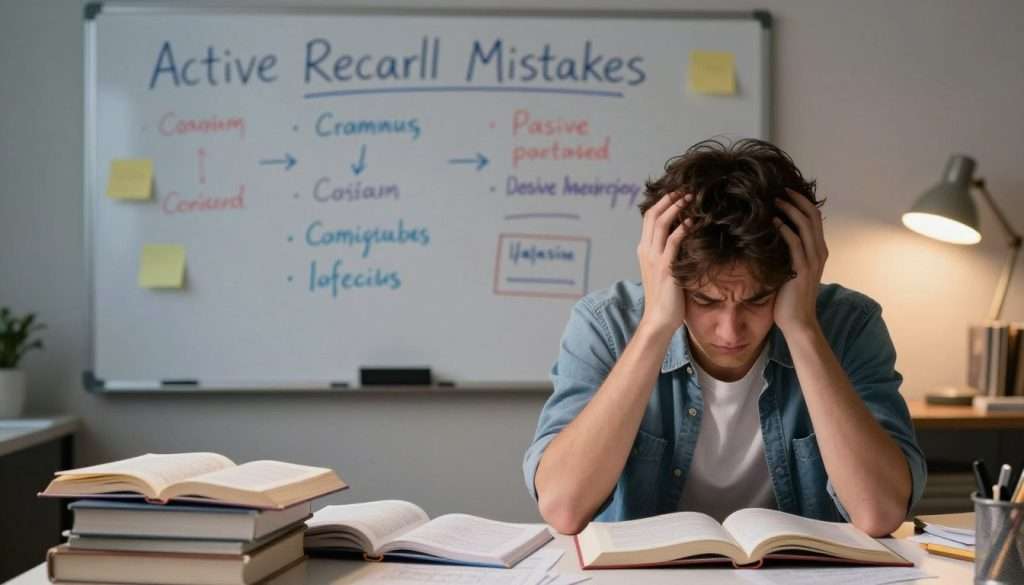
Common Active Recall Mistakes That Sabotage Your Progress
Active Recall is a great study technique, but it has its pitfalls. Knowing these can help you study better and get better results.
Let’s look at some common mistakes in Active Recall. We’ll also talk about how to avoid them to improve your study sessions.
Testing Yourself Too Soon After Initial Learning
One big mistake is testing yourself too soon after learning something new. It’s tempting to quiz yourself right away. But this can lead to just memorizing for a short time, not really learning it.
Wait a bit before testing yourself. This lets your brain really absorb the information. This way, you’ll remember it better when you need to.
Looking at Answers Too Quickly
Another mistake is looking at answers too fast when practicing Active Recall. The goal is to really remember the information, not just go through the motions.
Looking at answers too soon doesn’t let your brain fully work on the material. Try not to look at answers right away. Instead, take your time and really think about the question.
Not Embracing Productive Struggle
Active Recall isn’t always easy, and it’s okay to struggle. But some students don’t see this as a chance to get better. When you find something hard, don’t get down. See it as a way to learn and get stronger.
- Be patient with yourself
- Persevere through challenging moments
- Use difficulties as a chance to learn and improve
Neglecting to Track Your Progress
Lastly, not tracking your progress is a common mistake. Without keeping an eye on how you’re doing, it’s hard to know where to improve.
Keep a record of your Active Recall sessions. Note what you got right, wrong, and what was hard. This helps you tailor your study plan and get the most out of your efforts.
By avoiding these mistakes, you can make Active Recall more effective. This will help you study more efficiently.
Subject-Specific Active Recall Strategies
Active recall isn’t a one-size-fits-all technique; it needs to be adapted to different subjects for maximum effectiveness. Different subjects have unique demands and requirements. Understanding how to tailor active recall to these needs can significantly enhance your learning experience.
Active Recall for Mathematics and Sciences
Mathematics and sciences often require problem-solving skills and the application of formulas and concepts. To effectively use active recall in these subjects, you need to focus on practicing problems and recalling key concepts.
Problem-Solving Without Formula Sheets
One effective method is to practice solving problems without referring to formula sheets or notes. This strengthens your ability to recall and apply formulas and concepts under exam conditions. Try to solve a variety of problems from memory, and then check your answers to identify areas for improvement.
Concept Mapping from Memory
Another technique is to create concept maps or diagrams from memory. This involves recalling key concepts and their relationships, which helps to solidify your understanding and improve retention. Start by trying to draw a concept map without looking at your notes, and then review your work to fill in any gaps.
Active Recall for Languages and Literature
For languages and literature, active recall can involve recalling vocabulary, grammar rules, and literary analysis. Flashcards can be useful for vocabulary, while summarizing literary works from memory can help reinforce your understanding.
To practice vocabulary recall, create flashcards with words on one side and their meanings or translations on the other. Test yourself by covering the answer side and trying to recall the meaning. For literature, try summarizing key works or characters from memory, and then review your summaries to ensure accuracy.
Active Recall for History and Social Sciences
In history and social sciences, active recall can be used to remember key dates, events, and concepts. Creating timelines or concept maps can be effective ways to organize and recall this information.
Try creating a timeline of major events from memory, and then check your notes or other resources to fill in any gaps. You can also use active recall to test your understanding of historical or social science concepts by summarizing key points or arguments from memory.
Advanced Active Recall Techniques for Serious Students
For serious students, advanced Active Recall techniques can change the game. We have powerful methods to share. They can help deepen your understanding and keep information longer.
Once you master the basics of Active Recall, it’s time to get better. Using these advanced techniques will boost your learning and keep you ahead.
Interleaving Different Topics During Recall Sessions
Interleaving means switching between different topics in one study session. It helps you tell different concepts apart and use them right. For example, studying for a history exam might mean mixing up different periods or themes.
This way, you’ll make connections between unrelated ideas. You’ll understand your subject better.
Progressive Difficulty Layering
Progressive Difficulty Layering means making your Active Recall exercises harder as you get better. Start with simple questions and add harder ones as you go. Or, add more challenging topics to your study sessions.
This method lets you push your knowledge to the next level. You’ll understand the material more deeply.
Teaching Others as Active Recall Practice
Teaching others is a great way to learn and remember. Explaining what you’ve learned to someone else makes you clarify your own thoughts. It helps you find any knowledge gaps.
Try teaching a friend or family member what you’ve learned. Or, explain it to yourself out loud. This is a fun way to boost your learning with Active Recall and remember better.
Conclusion
We’ve reached the end of this ultimate guide to Active Recall. We hope you’re now ready to change your study routine. Active Recall is a powerful way to learn.
By using Active Recall every day, you’ll remember more and feel more confident. It helps you reach your academic goals. It’s great for exams or learning new things.
Keep up the good work as you learn more. Being consistent with Active Recall will show you amazing results. So, start using Active Recall today and see your grades improve!