

Ever feel like your brain is a leaky bucket? You spend hours cramming for a test, only to forget everything by the next morning. It’s not your fault! Your brain is wired to forget what it thinks is not important.
Instead of fighting this, we can work with it. By using a smart, efficient habit, you can stop the cycle of last-minute panic. We’ll show you how to make what you study stick for good.
We’ll explore how the spaced repetition technique makes studying easy. With spaced learning, you’ll learn new topics fast. Let’s see how Spaced Repetition can make you a better learner today!
Key Takeaways
- Your brain naturally forgets information, but you can hack this process.
- Cramming is ineffective and leads to quick memory loss.
- Working with your brain’s natural rhythm creates lasting results.
- Small, consistent study sessions outperform long, stressful marathons.
- You can transform studying from a chore into an enjoyable habit.
The Science Behind Spaced Repetition
Ever wondered why your memory is like a leaky bucket? We’ve all spent hours cramming for exams, only to forget it all soon after. This is because our brains favor new experiences over old, unused data.
By using Spaced Repetition, we can work with our brains instead of against them. This way, we make sure information stays with us for good.
Understanding the Forgetting Curve
In the late 19th century, Hermann Ebbinghaus discovered something key about memory. He found the “Forgetting Curve,” showing how fast we forget information after learning it.
Without review, our brains clear out what they think we don’t need. To fight this, we need to find the optimal spacing for learning to stop this forgetting. Here’s why your memory fades so quickly:
- Lack of active engagement with the material.
- The absence of meaningful connections to existing knowledge.
- The natural tendency of the brain to prioritize efficiency over storage.
How Neural Pathways Strengthen Through Intervals
Your brain is like a muscle that needs the right workout to grow. When you review a topic just before forgetting it, your brain has to work harder to remember.
This active recall strengthens neural pathways. Every time you remember something, the connection in your brain gets stronger and lasts longer.
By carefully planning these intervals, you turn temporary knowledge into a lasting part of your mind. This is the power of Spaced Repetition; it makes remembering a smart habit.
Preparing Your Study Materials for Success
Think of your study materials as the foundation of a house. If they are messy, your learning will be shaky. Before diving into your daily routine, make sure your resources are ready. Proper preparation is the secret sauce for spaced learning success.
Selecting High-Quality Source Material
Not all information is created equal. Choose your source material wisely to focus on the most relevant facts. Avoid cluttering your brain with unnecessary information.
Using high-quality textbooks or verified notes saves time. Quality over quantity is key. If your source is accurate and clear, your retention rates will increase.
“Give me six hours to chop down a tree and I will spend the first four sharpening the axe.”
Breaking Down Complex Topics into Atomic Units
Massive, intimidating topics can feel impossible to master all at once. We recommend breaking these subjects into smaller atomic units. This makes them easier for your brain to digest.
By isolating single concepts, you allow your memory to focus on specific details. This avoids feeling overwhelmed. Use the table below to see how you can transform your study approach.
| Study Method | Complexity Level | Retention Strategy |
|---|---|---|
| Large Chapters | High | Passive Reading |
| Atomic Units | Low | Active Recall |
| Mixed Notes | Medium | Periodic Review |
Once you have broken your topics down, you are ready to build your system. Remember, consistency is the key to mastering any subject. By refining your materials now, you set yourself up for success in every future spaced learning session.
Choosing the Right Spaced Repetition Software
Let’s look at how the right software can make learning easier and save time. Technology boosts your learning by keeping you on track. With a spaced repetition software, you don’t have to plan your study time.
These tools automatically decide when to review cards. This way, you focus on learning, not organizing. Finding the perfect fit means matching the software to your learning style and goals.
“The secret of getting ahead is getting started. The secret of getting started is breaking your complex overwhelming tasks into small manageable tasks, and then starting on the first one.”
Evaluating Anki for Advanced Users
Anki is great for those who like to customize. It’s a top choice for Spaced Repetition with its deep customization options. It might look old, but it handles lots of cards well, making it popular among medical students and language learners.
Using Quizlet for Visual Learners
Quizlet is easy to use and perfect for visual learners. It’s great for creating sets fast, using images and diagrams. This spaced repetition software is easy to start with, no need for a manual.
Exploring Brainscape for Mobile Efficiency
Brainscape is great for studying on the go. It has a unique system that lets you rate your confidence in answers. This makes it perfect for turning your commute or coffee break into learning time.
- Anki: Best for deep customization and massive card libraries.
- Quizlet: Ideal for visual learners and quick, easy deck creation.
- Brainscape: Perfect for mobile users who want efficient, confidence-based reviews.
Step One: Creating Effective Spaced Repetition Flashcards
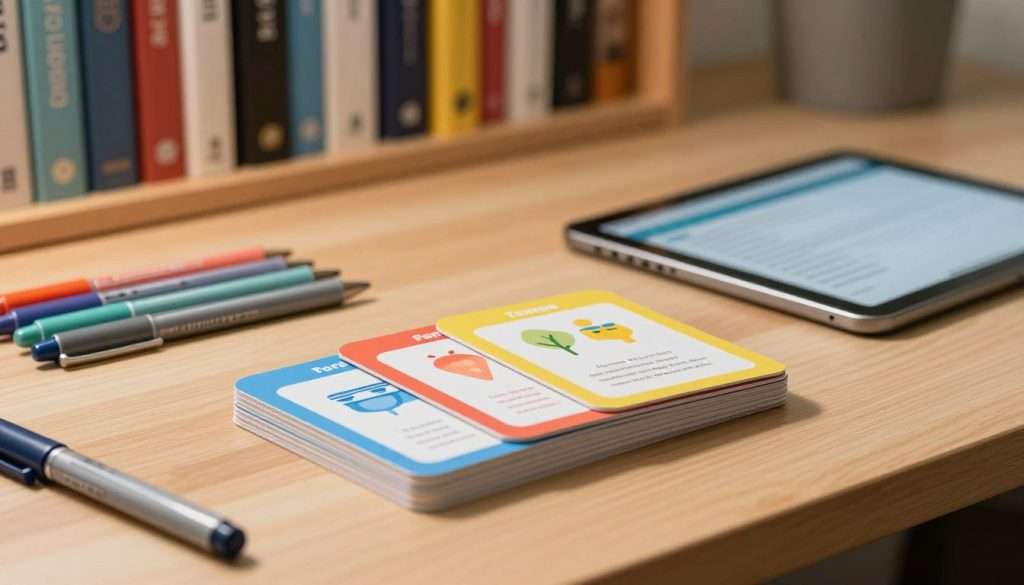
Let’s explore how to make spaced repetition flashcards that really help. Not all study tools are created equal. We aim to make yours the best. By focusing on card design, you can turn studying into a fun, engaging activity.
The Principle of Atomicity in Card Design
Success lies in simplicity. The principle of atomicity means each card should cover one single idea. Too much info on a card confuses your brain, making recall harder.
Think of cards as building blocks. Small, focused cards help you tackle complex topics bit by bit. This is key to the spaced repetition technique for a stronger memory.
Incorporating Images and Mnemonics
Studying doesn’t have to be dull. Add images or fun mental tricks to your cards. Our brains remember images better than text, so get creative.
Use a funny picture or a silly rhyme to help remember tough concepts. These mnemonics serve as memory hooks. Enjoying the process makes sticking to it easier.
Avoiding Common Pitfalls in Card Creation
Don’t fall into the trap of just memorizing without understanding. Phrase your questions to make you explain the “why” behind a concept. Guessing means your card is too vague.
Strive for clear, precise wording in your cards. If a card is confusing or takes too long to answer, break it down further. Refining your cards keeps your study sessions effective.
Step Two: Establishing Your Initial Review Schedule
Starting your learning journey is exciting but can feel a bit uncertain. It’s normal. This process is meant to be flexible. You’re in charge of your learning pace, making it fit your lifestyle.
Determining the First Interval
When using spaced repetition flashcards, you might wonder how long to wait before reviewing again. A good start is to review a card after one day, then three days, and a week later. Don’t be afraid to experiment until you find a rhythm that feels right.
“The secret to long-term memory is not how much you study at once, but how strategically you space out your reviews over time.”
If you forget too much, shorten the interval. If it’s too easy, wait longer before reviewing again. This trial-and-error helps you find the optimal spacing for learning that suits you.
Managing the Load for New Information
It’s tempting to add many cards at once, but it can lead to burnout. Start small to keep your daily reviews manageable. Consistency is more important than how much you study at once.
To make studying less stressful, try these tips:
- Limit new cards: Start with 5 to 10 new cards each day.
- Prioritize quality: Focus on understanding the material, not just rushing through.
- Listen to your brain: If you feel overwhelmed, take a day off to catch up on reviews.
Keeping your daily load light makes studying enjoyable. Remember, you’re building a system for years to come. Take your time and enjoy the journey!
Step Three: Mastering the Algorithm of Active Recall
Active recall is the key to becoming a top learner. It’s like the engine of your study process. When you make your brain work to remember, you build strong memories. This is how you get optimal spacing for learning every day.
Why Active Recall Outperforms Passive Reading
Many of us just re-read our notes or highlight books. But this doesn’t really help. You might think you know the material because you recognize the words.
But recognizing words is different from actually remembering them. Testing yourself strengthens your brain’s connections. Active recall makes your brain work, which helps memories last longer.

Balancing Difficulty and Retention Rates
Finding the right challenge is key to keeping your brain sharp. If a task is too easy, you don’t learn anything new. If it’s too hard, you might get discouraged.
The goal is to find a balance. You want the task to be challenging but not too hard. By adjusting your questions, you keep your optimal spacing for learning effective.
It’s okay to get some answers wrong. See mistakes as chances to learn and improve. They help you get better for the next time.
Step Four: Optimizing Spaced Repetition for Long-Term Retention
You’ve laid a strong foundation. Now, it’s time to refine your learning for the long term. Move from beginner to expert by tuning into your brain’s needs. The spaced repetition technique makes your study sessions both efficient and effective.
Adjusting Intervals Based on Performance
Your brain is special, and so should your study plan. If you find it too easy, your intervals might be too short. Adjust your software to extend these dates, ensuring you learn without wasting time on what you already know.
If recalling information is tough, don’t hesitate to shorten your intervals. Consistency is key, but not at the cost of frustration. Adjusting these gaps keeps your retention high while keeping your daily tasks manageable.
Handling Difficult Cards and Leech Management
Some cards just won’t stick in your memory. In flashcard terms, these are “leeches” that waste your time. When a card keeps coming back, it’s time to act.
Don’t let these cards overwhelm you. Try to simplify the content. Break it down into smaller bits or add a memorable image or story. Sometimes, a simple trick is all you need to make a tough card easy.
Keep your learning flow going. Tackling leeches early keeps your optimal spacing for learning on track. Be patient, and even the hardest topics will become second nature.
Step Five: Integrating Spaced Learning into Your Daily Routine
Imagine turning boring gaps in your day into chances for growth. You don’t need to spend hours in a library to see results. By using spaced learning, you can make any spare minute useful and fit your lifestyle.
Finding Micro-Moments for Review
We all have small pockets of time that often go to waste. Whether waiting for coffee or on the bus, these moments are great for learning. Just pull out your phone and review a few spaced repetition flashcards.
Think of these moments as hidden gems in your schedule. A mobile app can help you keep learning without needing a desk. It’s all about being ready to learn whenever you can.
Maintaining Consistency During Busy Periods
Life can get busy, making study goals seem overwhelming. The key is to set small, achievable daily goals. You don’t need to do a huge amount every day to see significant improvement.
Try habit stacking by linking your reviews to daily activities like brushing your teeth or eating lunch. This makes learning feel like a natural part of your day, not a chore. Even just five minutes a day can help build long-term memory.
Remember, the goal is to make learning a joyful habit, not a source of stress. If you miss a day, don’t worry. Just start again and keep going with your spaced learning journey.
Advanced Techniques for Rapid Skill Acquisition
Want to master skills faster? It’s time to explore beyond basic review methods. By combining different learning strategies, you can change how your brain handles complex info. The best learners keep improving their methods to stay ahead.
Combining Spaced Repetition with Interleaving
Interleaving mixes different topics or problems in one study session. This keeps your brain engaged and sharp. It builds strong neural connections by making your mind distinguish between patterns.
Adding spaced repetition software to interleaving creates a powerful learning cycle. It’s not just about memorizing facts. It’s about training your brain to recall information correctly. This stops the “illusion of competence” from studying one topic too long.
Using Spaced Repetition for Language Learning
Learning a new language is a long journey. Use spaced repetition flashcards for high-frequency words and phrases. Include audio clips to practice listening and reading together.
Make cards that require you to speak the language, not just recognize it. This boosts your active fluency. It’s great for mastering tricky grammar rules that usually take months.
Applying the Technique to Professional Certification
Preparing for a big professional exam needs a solid plan. Break down complex material into simple parts. Schedule reviews to keep important info fresh until your exam.
Consistency is key when the stakes are high. Use your platform to track your progress and focus on weak areas. View your prep as a long-term project, not a last-minute rush. This boosts your confidence and readiness to pass.
Overcoming Challenges and Plateaus
Feeling like you’ve hit a wall is normal. But we have a plan to get you back on track. Even the most committed learners face times when spaced learning seems tough. It’s not a failure; it’s just a natural part of your journey.
Dealing with Review Backlogs
Life can get in the way, making your flashcard pile seem overwhelming. The key is to stop panicking and focus on what’s important. You don’t have to tackle every card at once.
Try setting aside a specific time each day, like twenty minutes. Start with the most critical cards and save the rest for tomorrow. This spaced repetition technique keeps your brain active without exhausting you.
Staying Motivated When Progress Slows
Motivation can wane when you don’t see quick results. Learning is ongoing, even when it feels like you’re not making progress. Be kind to yourself during these times.
Change your study spot or try new materials to keep things interesting. Remember why you started. Viewing spaced repetition technique as a long-term investment helps you stay motivated. You have the tools to succeed; just keep going at your own pace.
Conclusion
You now have the tools to learn smarter. By using Spaced Repetition, you can create a learning system that suits you. It’s all about finding what works best for your brain.
Being consistent is key. Small, regular study sessions are better than long, stressful cramming. You can make studying a fun, lifelong habit.
We encourage you to take charge of your learning. Use apps like Anki or Quizlet to keep your study sessions effective. Each session brings you closer to mastering your subjects.
Don’t be afraid to try new things and see what works for you. Stay curious about how your brain learns. Enjoy the journey of becoming a better learner every day!
What subject will you start with using Spaced Repetition? Share your goals with us and begin your path to effortless learning today.