
We’re excited to make your study sessions easier. If you’ve ever felt stuck with a textbook, this bloom taxonomy guide is for you.
This framework changes how you see learning. It breaks down thinking into simple steps. This helps you improve your skills.
We’ll cover the basics so you can enjoy your assignments. You’ll feel like a pro soon. It’s all about making learning personal, effective, and fun!
With this approach, you’ll learn new topics with confidence. Let’s explore how bloom taxonomy can improve your study habits.
Key Takeaways
- Understand the core levels of cognitive development.
- Learn how to move from basic recall to deep analysis.
- Discover practical ways to improve your study efficiency.
- Turn complex subjects into manageable learning goals.
- Gain confidence by mastering your own unique learning style.
The Origins and Evolution of Bloom Taxonomy
Did you know that today’s learning systems started with a simple meeting? In 1948, Benjamin Bloom brought together a group of educators. They aimed to create a clear model for understanding learning depth.
This meeting was the start of the bloom’s taxonomy cognitive domain. It was a big step towards organizing the complex world of learning.
Benjamin Bloom and the 1956 Framework
The 1956 framework was a game-changer for classrooms. It introduced a hierarchy of bloom’s taxonomy levels. This hierarchy showed that learning is more than just memorizing for tests.
It encouraged a progression of skills. This progression helps us grow from beginners to experts in a subject.
The 2001 Revision by Anderson and Krathwohl
Over time, education changed, leading to the bloom’s taxonomy revised model in 2001. Lorin Anderson and David Krathwohl, Bloom’s former students, updated the framework. They changed the nouns to active verbs, making it more practical for today’s learning.
This change made the bloom’s taxonomy revised framework more useful. It focuses on what you can do with what you know, not just storing information.
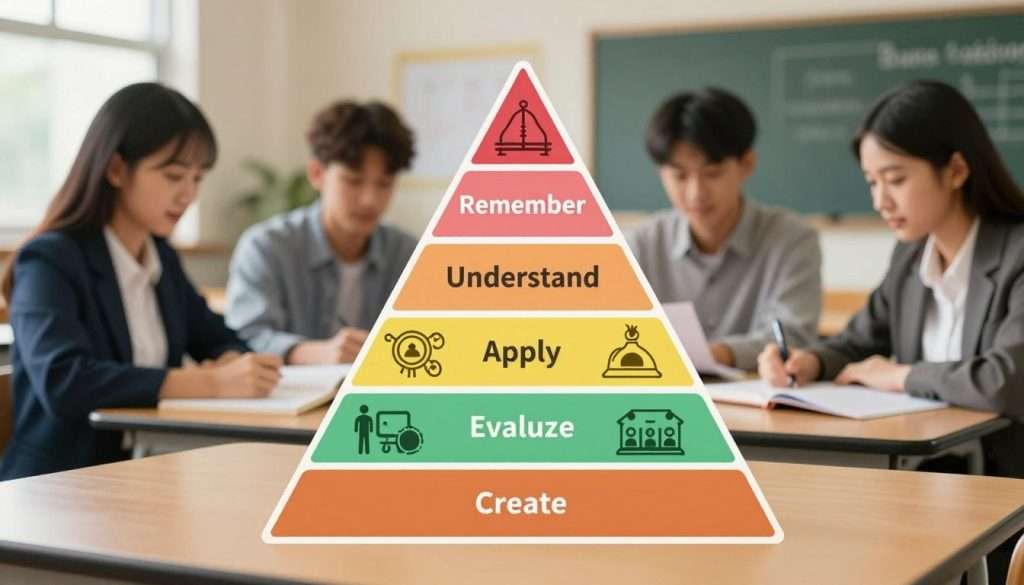
Understanding the Bloom Taxonomy Pyramid
Think of the bloom’s taxonomy pyramid as a ladder for your brain’s growth. Just like climbing stairs, you need to start at the bottom before reaching the top.
This structure is more than a chart; it’s a dynamic roadmap for your learning journey. It shows how you process information and where your study habits fit in.
Visualizing the Cognitive Hierarchy
The bloom’s taxonomy cognitive domain organizes learning into a clear hierarchy. It starts with basic skills like remembering facts and moves to higher-order thinking like creating original work.
The bloom’s taxonomy revised model shows each level builds on the one below. You can’t evaluate or create something new without first understanding the basics.
Why the Pyramid Structure Matters for Educators
This visual framework is a game-changer for teachers. It helps them design better lessons that go beyond memorization. It encourages you to think critically and apply what you learn.
When you understand this structure, you get a big advantage in your studies. You can see which level of thinking an assignment requires. This lets you adjust your effort and strategy to meet the goal. It makes learning a clear, manageable process that you can master at your own pace.
Level One: Remembering
To build a strong foundation of knowledge, you start with Remembering. It’s the first step in learning, helping you store and recall information easily. It might seem simple, but it’s crucial for understanding any subject.
Defining the Foundation of Knowledge
At this stage, your brain is like a library. You’re filing away facts, dates, and definitions for later use. This is the base of the bloom’s taxonomy levels.
Without remembering basic information, you can’t move on to harder tasks. It’s like learning the alphabet before writing a novel. You’re gathering the basics for deeper learning.
Common Bloom Taxonomy Verbs for Recall
Teachers use specific verbs to test your memory. These bloom’s taxonomy verbs show what’s expected in assessments. You’ll often see tasks that ask for quick, direct answers.
- List: Writing down items in a series.
- Define: Giving the precise meaning of a term.
- Identify: Picking out the correct answer from a group.
- Recall: Bringing a specific fact back to mind.
Examples of Remembering in the Classroom
Let’s look at bloom taxonomy examples in the classroom. These tasks make sure you have the basics before moving on to harder topics.
| Subject | Task Type | Student Action |
|---|---|---|
| History | Recall | List the dates of the Civil War. |
| Science | Definition | Define the term photosynthesis. |
| Math | Identification | Identify the formula for area. |
| Literature | Recognition | Name the main character in the book. |
Mastering these simple tasks sets you up for success. You’re building a mental map for easier learning. Keep practicing, and you’ll be ready for the next level soon!
Level Two: Understanding
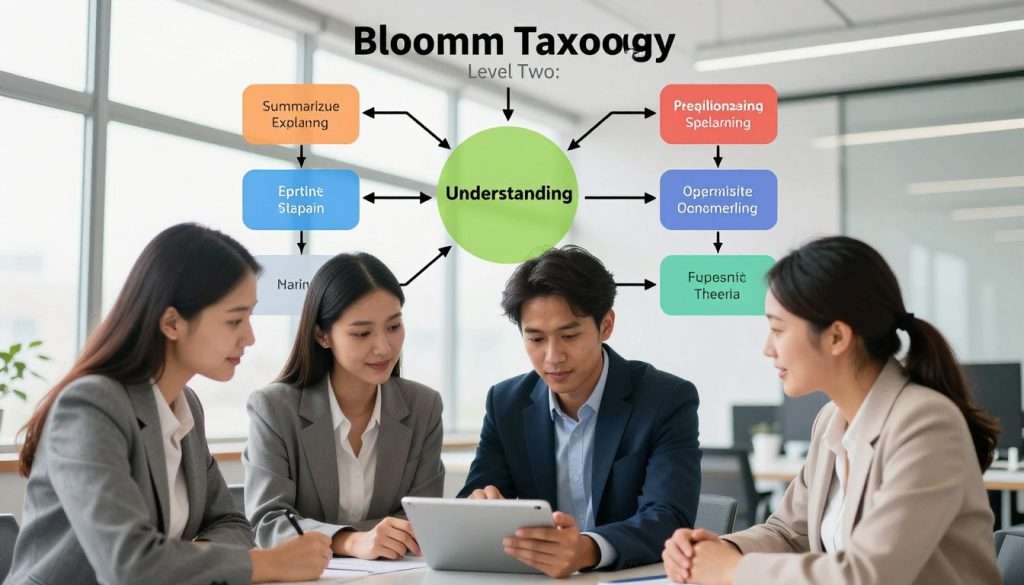
Learning goes beyond just memorizing. Once you know the basics, you start to understand the information in a personal way. This stage is about grasping the meaning instead of just repeating words.
Moving Beyond Simple Memorization
This stage is exciting because you start explaining ideas in your own words. When you really get a concept, you can share it in your own words. It’s a big step that makes studying more meaningful and effective.
Strategies for Demonstrating Comprehension
To get better at this level, engage actively with your study materials. Try summarizing a chapter in three sentences or drawing a diagram. Using bloom’s taxonomy verbs like “classify,” “summarize,” or “explain” helps frame your study sessions well.
Teaching a concept to a friend or even a pet is a great way to check if you understand it. If you can explain a complex topic simply, you’ve moved beyond simple recall. Here are some common bloom taxonomy examples to practice this skill:
| Action | Study Strategy | Goal |
|---|---|---|
| Summarize | Write a short paragraph | Capture the main idea |
| Classify | Group items by type | Identify patterns |
| Explain | Teach a peer | Verify your logic |
Bloom Taxonomy Questions for Testing Understanding
Asking the right questions is key to checking your progress. When reviewing your notes, use bloom’s taxonomy questions to challenge yourself. Ask, “How would I explain this to a friend?” or “What is the main idea here?”
These questions help you see the big picture, not just details. By using these bloom’s taxonomy verbs regularly, your ability to retain and use information will grow. Keep pushing to understand the why behind the what!
Level Three: Applying
This is where the magic happens: taking what you have learned and putting it to work. You are moving beyond just knowing facts or understanding concepts to actually using them in your daily life.
It is the most exciting part of the journey because you are solving real problems. Whether you are practicing a new skill or using a formula in a fresh context, you are proving that you really get it.
Using Information in New Situations
When you reach this level, you stop being a passive observer of information. You start to look at your knowledge as a toolkit that you can carry into any situation.
Think of it like learning to ride a bike. You can read about balance and steering all day, but you only truly learn when you get on the bike and start pedaling. Using bloom’s taxonomy verbs like “implement,” “solve,” or “demonstrate” helps you identify when you are successfully putting your knowledge into action.
Bridging the Gap Between Theory and Practice
We often find that the biggest hurdle in learning is the distance between a textbook and the real world. Applying is the bridge that closes this gap.
It turns abstract ideas into tangible results. By testing your understanding in different environments, you solidify your grasp on the material and make it your own.
Practical Scenarios for Application
To help you visualize this, let’s look at how different subjects move from theory to application. These bloom taxonomy examples show how you can turn knowledge into a practical skill.
| Subject | Theoretical Knowledge | Practical Application |
|---|---|---|
| Mathematics | Memorizing formulas | Calculating a home budget |
| Language | Learning grammar rules | Writing a persuasive email |
| Science | Understanding physics laws | Building a simple circuit |
| Cooking | Reading a recipe | Adjusting ingredients for taste |
Level Four: Analyzing
Welcome to the fourth level of our journey. Here, you start to dissect facts instead of just absorbing them. You become a detective for your own learning. You no longer accept information without questioning it; you seek the hidden structure beneath.
Breaking Down Complex Concepts
At this level, you take a big topic and break it down into smaller parts. It’s like taking apart a complex machine to see how it works. By doing this, you get a clearer view of the whole.
This method helps you understand the logic behind the information. You become the master of your study material, not overwhelmed by data.
Identifying Patterns and Relationships
After breaking down the information, you look for how the pieces fit together. You seek connections that make the system work. Do ideas cause each other? Are there themes that link different parts together?
“Critical thinking is the ability to think about your thinking in such a way as to recognize the strengths and weaknesses in your reasoning.”
Developing Analytical Thinking Skills
To improve your thinking, ask yourself bloom’s taxonomy questions. Ask, “What evidence supports this claim?” or “How do these parts relate to one another?” These questions push your thinking beyond simple recall.
By doing this regularly, you build sharp thinking skills. It’s a deep dive that helps you truly understand the material, not just memorize it for a test.
| Thinking Level | Primary Goal | Key Action |
|---|---|---|
| Remembering | Recall facts | List or define |
| Understanding | Explain ideas | Summarize or classify |
| Analyzing | Break down concepts | Compare and contrast |
Using these bloom’s taxonomy questions regularly will change your study sessions. You’ll find you can handle even the toughest subjects with confidence and ease.
Level Five: Evaluating
It’s time to go beyond just knowing facts. You start to judge their real value. You move from just watching to actively judging information.
Making Judgments and Justifying Decisions
Evaluating means standing up for your opinions with solid reasoning. You become a critic by asking bloom’s taxonomy questions. You question, “Does this really make sense?”
This process helps you compare views and pick the best one. It builds genuine confidence in your choices. You’re making a strong case for your viewpoint.
“Critical thinking is the ability to think about your thinking in such a way as to recognize the strengths and weaknesses of your own thought processes.”
The Role of Critique in Learning Outcomes
Critique drives this level of learning. It challenges ideas, revealing biases and gaps. This sharpens your understanding.
Using bloom’s taxonomy questions helps defend your ideas. You justify your choices with evidence, not just feelings. This turns your knowledge into wisdom.
Criteria for Effective Evaluation
To evaluate well, you need standards. Think of these as your personal guide for truth and quality. The table below shows how to measure an argument or concept’s value.
| Criteria | Focus Area | Goal |
|---|---|---|
| Consistency | Internal Logic | Ensure no contradictions exist. |
| Evidence | Data Support | Verify facts back the claims. |
| Relevance | Context | Check if it fits the situation. |
| Clarity | Communication | Confirm the message is precise. |
Level Six: Creating
Welcome to the top of your learning journey. You’ve moved from learning facts to creating something new. Now, it’s time to build something entirely your own.
The Pinnacle of Cognitive Development
You’ve gone beyond just knowing and applying information. You’re now the master of your learning. Creating means making something new that shows your unique view.
This is your biggest test. When you reach this level, you’ve mastered all previous steps. You can mix them into something fresh and meaningful.

Encouraging Original Thought and Synthesis
Synthesis is key at this level. It’s when you combine different information into something new. You’re not just repeating what you’ve heard; you’re adding your own voice.
We love it when students take risks here. Whether it’s writing, designing, or solving problems, you’re showing you can think for yourself. This is where your creativity really comes out.
Project-Based Learning and Creation
Project-based learning is perfect for this level. It lets you apply your skills to real-world problems. By working on a project, you turn ideas into real results.
| Project Type | Goal | Outcome |
|---|---|---|
| Research Paper | Synthesize data | Original argument |
| App Design | Solve a problem | Functional prototype |
| Artistic Piece | Express concepts | Unique creation |
| Business Plan | Strategic thinking | Viable model |
Remember, the goal is to feel empowered by your work. You’re no longer just a consumer of knowledge; you’re a producer of ideas. Keep pushing your limits and enjoy making something new!
Bloom Taxonomy in Modern Educational Objectives
Ever felt like some lessons just click, while others don’t? It’s amazing how bloom taxonomy shapes today’s learning. It ensures what we teach matches what you need to do.
Aligning Curriculum with Cognitive Domains
The bloom’s taxonomy revised framework changed in 2001. Anderson and Krathwohl added a new layer, the knowledge dimension. This update helps teachers sort learning into different types.
Aligning curriculum with these domains helps teachers guide you better. It’s essential to match tasks with the right challenge. This way, you learn deeply, not just memorize.
Designing Effective Learning Outcomes
Creating a great learning experience is like building a house. You need a solid plan. Using bloom’s taxonomy educational objectives turns vague goals into clear actions. This makes tracking your progress easier.
By focusing on bloom’s taxonomy learning outcomes, we prioritize what’s important. It ensures your hard work leads to real results. Knowing your goals helps you focus your efforts.
Practical Applications for Students and Teachers
Ever wonder why some study sessions feel easy while others are tough? It often comes down to how you match your effort to the task. By looking at your assignments in a new way, you can work smarter instead of just harder.
Study Strategies Based on Learning Levels
When you study, first figure out what the assignment asks. If it’s just about memorizing facts, don’t try to make complex theories. Use flashcards or repetition to get the basics of the bloom’s taxonomy pyramid down.
If you need to analyze or evaluate, change your strategy to critical thinking. Try explaining the concept to a friend or debating the pros and cons. Changing your approach based on the task makes studying more efficient.
How Teachers Use Bloom Taxonomy to Differentiate Instruction
Teachers are also using bloom’s taxonomy educational objectives to help students. They design lessons that meet you where you are. This way, no one feels left behind or bored by easy material.
When teachers plan their bloom’s taxonomy learning outcomes, they create a clear path for success. They might offer different assignments, letting you choose one that fits your strengths. It’s a win-win situation when you and your teacher are on the same page.
Conclusion
You now have the power to reach your full potential as a student. Seeing the bloom’s taxonomy pyramid as a roadmap makes learning easier. You can change how you learn every day.
This guide shows that learning is a personal journey. By setting clear goals, you can make every study session a success. You’re moving from just memorizing to truly mastering your subjects.
Use these tips in your favorite subjects today. You’ll see your confidence grow as you achieve more. Keep exploring and enjoy the journey of becoming a lifelong learner.
What’s the first topic you’ll tackle with these new skills? Share your goals with us or start your next study session with a new view. Your journey to academic success begins here!