

Your brain may feel like a sieve. You use your mind each day to learn names, prepare for exams, and manage work tasks. To improve memory, learn how the brain handles encoding, storage, and retrieval.
You may think only gifted people have a photographic mind. In reality, you can learn exactly how to memorize faster by copying world-class memory champions. These memory techniques can turn studying into a fun mental workout.
Your brain needs fuel: regular exercise, healthy food, low stress, and enough sleep support long-term memory. For more help, my free book How to Become the Smartest Student in the Classroom gives you a full system of strategies that stick. Get your free copy here—no cost, no catch!
Key Takeaways
- Understand the three pillars of memory: encoding, storage, and retrieval.
- Adopt proven strategies from experts to boost your daily learning efficiency.
- Prioritize physical health, including sleep and nutrition, to support brain function.
- Reduce stress levels to improve your ability to recall information clearly.
- Transform your study routine into an enjoyable and effective experience.
How to Memorize Faster: 8 Memory Techniques Used by Memory Champions
If you want to improve memory skills, stop treating your brain like a bottomless storage bin. Many students struggle because they try to absorb an entire textbook in one sitting. Instead, use a smarter approach that makes studying more focused and effective.
Step 1: Prepare Your Brain for Faster, More Reliable Memorization
Choose one specific learning target instead of studying everything at once
Trying to learn everything at once can cause burnout. Choose one small, manageable topic to master first. This focus builds a strong foundation without making you feel overwhelmed.
Remove distractions and set a short, focused practice period
Your brain needs focus, but it struggles with multitasking. Put your phone in another room and set a timer for 25 minutes. You may be surprised by what you accomplish without digital noise.
Connect new information to a clear purpose or real-world application
Information sticks better when it feels useful. Ask how a formula or historical date connects to your life or future goals. When your brain has a reason to care, it remembers more effectively.
Step 2: Use Active Recall to Strengthen Retrieval
If you want to learn more, my free book How to Become the Smartest Student in the Classroom presents memorization strategies that stick. You can grab your free copy here.
Close the book and reproduce the information from memory
Passive reading slows your progress. After reading a page, close the book and explain its main points aloud. This effort strengthens your ability to improve memory skills.
Turn headings, definitions, and concepts into practice questions
Do not just read the text; challenge yourself. Before a chapter, turn its headings into questions. For example, ask, “What were the primary causes of the Civil War?”
Check your answer immediately and correct gaps without rereading passively
Feedback makes learning stronger. After answering, check your notes immediately to find what you missed. This process reveals gaps so you can fix them at once.
Apply active recall to vocabulary, names, formulas, and lecture material
You can use these memorization strategies for almost anything. Here is how to use them well:
- Vocabulary: Write the word on one side of a card and the definition on the other.
- Formulas: Write the formula from memory and check it against your textbook.
- Names: Repeat the name back to the person and link it to a visual feature.
- Lecture Material: Summarize the main points on a blank sheet of paper right after class.
Learning how to memorize faster is a skill you can build with practice. By replacing passive review with active study, you make your brain a stronger tool for success.
Use Spaced Repetition to Make Learning Stick
If you want to know how to memorize faster, stop fighting your brain and work with it. Most people cram information into one long, painful session. Sadly, the brain can dump that information as quickly as we put it in.
Instead of cramming, use a method called spaced repetition. This memory training strategy spreads study sessions over time. Reviewing material at set intervals tells your brain to keep important information for the long term.
Step 3: Schedule Reviews Before You Forget
Review your notes just before you are about to forget them. This forces your brain to retrieve data, making the memory stronger. This process helps boost memory performance and makes your hard work pay off.
Review new material shortly after the first study session
Review new material within 24 hours of learning it. This quick check prevents the initial “forgetting curve” from erasing your memory. It gives your brain a safety net.
Increase the time between successful reviews
After mastering a concept, you do not need to review it daily. Stretch gaps to two days, then a week, and finally a month. This keeps information fresh without wasting precious time.
Use flashcards that require recall rather than recognition
Many students only read flashcards. To truly boost memory performance, force yourself to answer before flipping the card. If you only recognize an answer, you have not learned it yet.
Prioritize difficult cards while reducing unnecessary repetition
Do not waste time on facts you already know by heart. Focus on cards that trip you up. Spending more time on tough material makes your memory training more efficient.
Build a practical review schedule for exams, languages, and long-term learning
Consistency is the secret here. Use a simple calendar or app to track your progress. My free book, How to Become the Smartest Student in the Classroom, offers memory techniques and study routines.
It also gives you a full system and strategies that actually stick. No cost, no catch. Grab your free copy here → https://www.studyingmachine.com/free-books/.
Remember, sleep is your best friend during this process. Your brain consolidates memories while you rest, so do not skip your Z’s! Combine spaced review with good sleep, and you will learn how to memorize faster than ever thought possible.
Build a Memory Palace With the Method of Loci
One of the most effective memory techniques turns familiar spaces into mental storage units. With the ancient Method of Loci, a walk through your home becomes a powerful recall tool.
Step 4: Turn Familiar Places Into Mental Storage Systems
Your brain naturally remembers locations better than abstract lists. When you connect information to room locations, you create a mental map that is hard to forget.
Select a familiar route with a fixed sequence of locations
Choose a path you know well, such as your morning walk to the kitchen or route through your dorm. Mark fixed spots along it, such as the front door, coat rack, or favorite chair.
Place vivid, exaggerated images at each location
The secret to these techniques for better memory is making mental images stand out. Instead of a boring textbook, picture a giant, neon-colored version of the concept dancing on your kitchen table!
Link each image to one fact, idea, or item
Assign one specific piece of information to each location you choose. The more bizarre and sensory-rich the image is, the easier it is for your brain to recall later.
Walk through the route mentally to retrieve information in order
When you need to recall your list, close your eyes and take that mental stroll again. As you pass each location, its vivid image will return and reveal the stored fact.
Use a memory palace for speeches, presentations, lists, and complex study topics
This method keeps your thoughts organized during a big presentation. For more strategies, read my free book How to Become the Smartest Student in the Classroom. It gives you a full system of memory techniques and study routines that actually stick. Get your free copy here → https://www.studyingmachine.com/free-books/.
Avoid overcrowding one location with too many unrelated details
Keep your palace tidy by limiting each spot to one or two items. Too many details can turn one location into a cluttered junk drawer instead of a useful filing system.
Chunk Information Into Meaningful Groups
Long strings of data can feel like drinking from a firehose. A mountain of facts can overwhelm your brain. Chunking can improve memory skills by turning that flood into a gentle stream.

Step 5: Reduce Cognitive Load With Strategic Grouping
Cognitive load means the mental effort you use at one time. Grouping information lowers that effort. These effective memorization strategies help you process complex data without burnout.
Divide long numbers, terms, and lists into smaller units
Think about remembering a phone number. You may split it into three parts instead of ten separate digits. Use this method for any long list or technical term.
Group facts according to category, function, sequence, or pattern
Organizing information can greatly improve retention. Sort your study notes by category or function. Clear patterns help your brain store information for the long term.
Create meaningful chunks instead of memorizing isolated details
Isolated facts can be slippery and hard to remember. Connecting them creates a mental anchor. Then studying feels less like a chore and more like solving a puzzle.
Use examples such as phone-number patterns, anatomy systems, and historical timelines
Real-world examples help these techniques stick. Group human hand bones by function, or place historical events on a timeline. These structures provide a natural roadmap for memory.
Test each chunk separately before connecting the full set
Do not swallow the whole elephant at once. Master one small chunk, test yourself, and move to the next. Then connect each piece to form the complete picture.
For deeper study, my free book How to Become the Smartest Student in the Classroom offers a full system of memorization strategies that actually work. It costs nothing, and there is no catch. Get your free copy here → https://www.studyingmachine.com/free-books/.
Use Linking and Peg Systems for Ordered Information
When you need to remember a sequence, do not treat each fact like a lonely island. Use effective memory techniques to connect facts in a story your brain can easily follow.
Step 6: Create Strong Associations Between Items
The key to keeping information in order is building a bridge between each point. Instead of rote memorization, create a mental chain where one item triggers the next.
Connect each item to the next through a bizarre visual story
Your brain loves strange and unexpected ideas. To remember a grocery list, imagine a giant banana dancing with a loaf of bread. The more bizarre the story, the easier it is to recall.
Use a consistent number-rhyme or number-shape peg system
A peg system works like a mental coat rack. You can use rhymes (like “one is a bun”) or shapes (like “two looks like a swan”) to hang information. This form of memory training gives every list a lasting structure.
Make images active, emotional, colorful, and unusual
Static images fade quickly, but active images stay. Add bright colors, loud sounds, or strong emotions to your mental pictures. To remember a name, connect it to a vivid image of that person doing something silly.
Attach abstract terms to concrete objects or memorable actions
Abstract concepts can slip away, so give each one a physical form. To remember “justice,” picture a giant, glowing scale tipping over. Turning ideas into concrete objects makes them tangible and easier to store.
Practice recalling the sequence forward, backward, and from random points
True mastery means accessing your data from any angle. Try starting from the middle of your list or jumping to the end. This simple habit will significantly boost memory performance and make recall more flexible.
For deeper study, my free book How to Become the Smartest Student in the Classroom gives you a complete system. It covers study routines and strategies that stick. It costs nothing and has no catch, so grab your free copy here.
Apply Elaboration to Understand and Remember Difficult Ideas
Have you ever understood a topic well, then blanked when a test began? This happens when we mistake recognition for true comprehension.
Passive reading can create an illusion of familiarity. These techniques for better memory break that cycle by making your brain process information more deeply.
Step 7: Explain New Information in Your Own Words
Elaboration makes learning more effective. Instead of memorizing definitions, build a mental web connecting new facts to what you know.
Ask how, why, when, and what-if questions about each concept
Look beyond the surface of each concept. When studying history, ask why an event happened and what if its outcome had changed.
These memorization strategies turn static facts into a story that is easier to recall.
Relate unfamiliar information to knowledge you already have
Your brain loves patterns. Link a new scientific concept to a hobby or daily activity you enjoy.
When you connect new data to existing memories, you create a stronger path for retrieval.
Explain the idea as if teaching it to a beginner
If you cannot explain an idea simply, you may not understand it well enough. Pretend to teach a friend who knows nothing about it.
This forces you to remove jargon and focus on the main logic.
Use examples, comparisons, and cause-and-effect connections
Analogies are powerful tools for your mental toolkit. Compare a complex system to something simple, such as plumbing or a game.
This makes abstract ideas more concrete.
Separate genuine understanding from the illusion of familiarity
Stop rereading your notes and test your ability to explain them. If you stumble, revisit the material.
This active process works far better than passive review.
| Learning Method | Mental Effort | Retention Quality |
|---|---|---|
| Passive Rereading | Low | Weak/Short-term |
| Active Elaboration | High | Strong/Long-term |
| Teaching Others | Very High | Mastery Level |
If this article helped, my free book How to Become the Smartest Student in the Classroom gives you a full system. It includes memory techniques, study routines, and strategies that stick.
It costs nothing, with no catch; grab your free copy here → https://www.studyingmachine.com/free-books/.
Combine Words and Images With Dual Coding
Have you noticed how your brain recalls a sunset better than a dry paragraph about light refraction? Words and images create two separate paths for retrieving information later. These techniques for better memory help students master complex subjects without the usual burnout.
Step 8: Give Important Information More Than One Retrieval Path
A dual-track system gives your brain two ways to recall information. This approach is one of our favorite memory improvement tips because it makes reading active and creative.
Pair concise notes with diagrams, timelines, symbols, or spatial layouts
Instead of writing dense sentences, turn your notes into simple diagrams or timelines. Symbols and spatial layouts help your brain organize information naturally.
Draw a process instead of copying a paragraph word for word
When you find a complex process, stop copying text. Sketching the steps makes you understand the logic instead of memorizing words.
Label visual elements with precise language
Visuals work best when you label them clearly. Use accurate terms so your brain links each image with its concept.
Recreate the diagram from memory before reviewing the original
This method tests your knowledge. Draw the diagram on blank paper from memory, then compare it with your notes to find gaps.
Use dual coding without adding decorative visuals that create distraction
Keep visuals useful rather than artistic. Avoid extra colors or doodles that lack a learning purpose and can weaken your focus.
| Method | Primary Benefit | Best Used For |
|---|---|---|
| Text-Only Notes | Detailed definitions | Initial reading |
| Dual Coding | Stronger retention | Complex processes |
| Handwritten Sketches | Deep engagement | Conceptual mapping |
If this article resonated with you, my free book How to Become the Smartest Student in the Classroom offers a full system. It covers memory techniques, study routines, and strategies that actually stick. There is no cost or catch. Grab your free copy here.
Train With Interleaving and Deliberate Memory Practice
Most people study in straight lines, but top learners mix skills to master them. When routines become predictable, your brain works harder, which helps memory champions build strong abilities. Deliberate practice turns passive reading into an active workout for your mind.
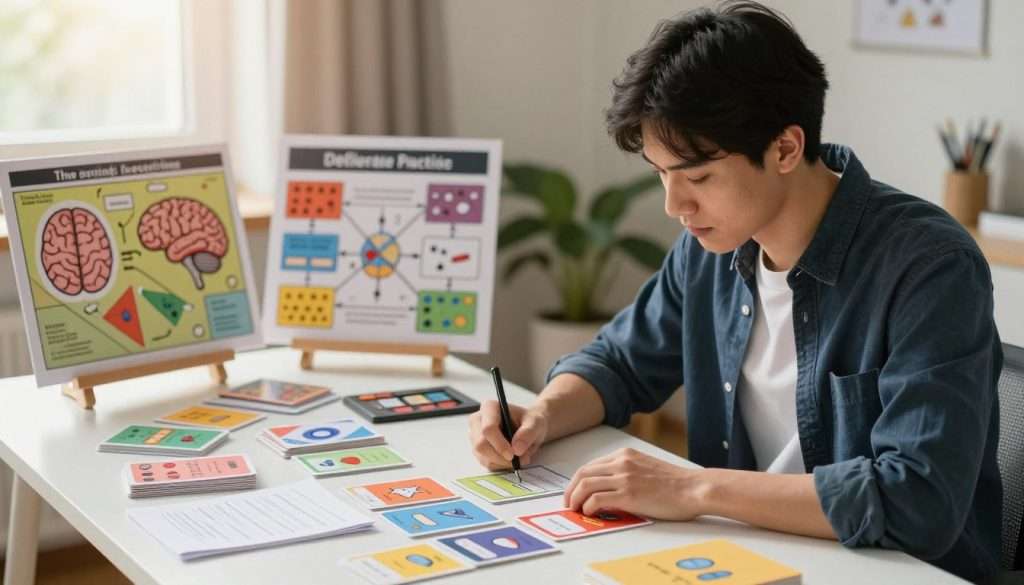
Step 9: Mix Related Skills to Improve Flexible Recall
To truly improve memory skills, move beyond repetitive, mindless drills. Like a muscle, your brain grows stronger when it faces varied challenges.
Alternate problem types instead of completing one identical batch
Instead of solving ten math problems of one type, mix different formulas in one session. This forces your brain to find the correct strategy for each problem instead of repeating a pattern.
Mix old and new material during practice sessions
Do not focus only on what you learned today. Add concepts from last week to keep your long-term retention sharp and ready.
Change the order, format, and context of recall practice
Study in different rooms or switch between flashcards and verbal explanations. Change the environment to boost memory performance by stopping your brain from relying on outside cues.
Track which errors come from weak knowledge, confusion, or careless retrieval
Be honest when you get an answer wrong. Did you forget the fact, or mix up two similar ideas? Finding the cause makes your memory training more efficient.
Combine memory techniques with sleep, movement, hydration, and focused study breaks
Your brain needs fuel and rest to work well. A quick walk or glass of water can refresh your focus during a long session.
Measure progress by accurate recall, not by time spent reviewing
Sitting at a desk for hours can feel productive. Real growth happens when you retrieve information on demand, no matter how long you study.
| Practice Method | Focus | Outcome |
|---|---|---|
| Blocked Practice | Single topic repetition | Short-term fluency |
| Interleaved Practice | Mixed, varied challenges | Long-term mastery |
| Deliberate Review | Identifying specific errors | Targeted improvement |
If you want to explore these systems, my free book How to Become the Smartest Student in the Classroom gives you a full roadmap. It covers everything from study routines to advanced memory techniques that actually stick. Get your free copy here → https://www.studyingmachine.com/free-books/.
Conclusion
Focus your targets, retrieve information actively, and space reviews to build a strong learning foundation. These memory improvement tips work best when you start with one or two. Avoid changing your entire study routine overnight.
Your physical health strongly affects how well these techniques work. Quality sleep, nutritious food, and regular exercise keep your brain ready for new challenges. Managing stress helps you stay calm during intense study sessions.
These habits help you boost memory performance over the long run.
Test these methods to find what fits your unique style. Consistent practice turns strange mental tricks into powerful habits that last a lifetime. Soon, complex topics will become much easier to digest.
Ready? My free book, How to Become the Smartest Student in the Classroom, provides a complete system for your success. It covers advanced study routines and memory strategies that actually stick; grab your free copy here at https://www.studyingmachine.com/free-books/ to start your journey.