
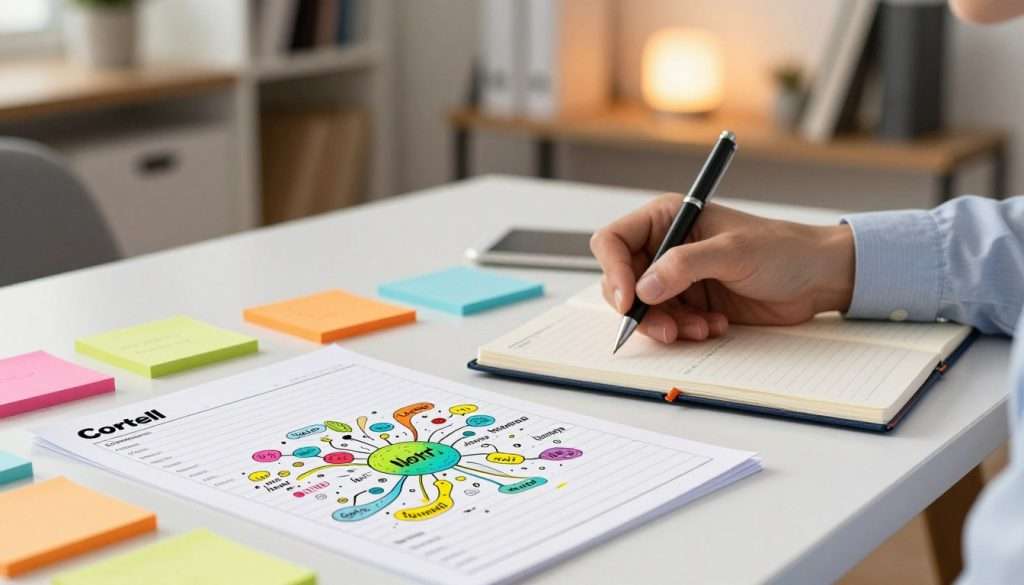
Ever feel like a human stenographer during lectures? If you transcribe every word your professor says, you miss the point. Effective learning is not about making a transcript; it means processing ideas so they stay in your brain for the long haul.
Research suggests that handwriting your thoughts often beats typing on a laptop because it makes you synthesize information in real-time. The best strategy fits your unique brain, whether you choose the structured Cornell method, creative mind maps, visual diagrams, or simple outlines.
We view these techniques as flexible tools, not rigid rules. For a complete system for memory and study routines, grab your free copy of How to Become the Smartest Student in the Classroom right here. Let’s turn your study sessions into a powerhouse of productivity!
Key Takeaways
- Effective note-taking focuses on understanding concepts rather than verbatim transcription.
- Handwriting information often improves memory retention compared to digital typing.
- Use diverse methods like outlines or diagrams based on your specific learning needs.
- Treat study techniques as flexible tools, not as strict, one-size-fits-all mandates.
- Active engagement during lectures is the secret to better exam preparation.
How to Take Notes That Actually Help: Cornell, Mind Maps, and More
Your notebook does not need to look perfect to help your brain. Many people copy every word, then find notes become a messy storage bin. Instead, treat note-taking as a strategic process that makes learning easier.
Define the job your notes need to do
Before picking up a pen, ask what your notes should accomplish. Will you memorize complex definitions, compare two competing theories, or map a step-by-step process? Knowing the goal helps you choose the best note-taking strategies and work efficiently.
Focus on understanding, retrieval, and later review
The best notes help your future self. If you only capture information, you miss the purpose of learning. Build notes around three main pillars:
- Understanding: Processing the material in your own words.
- Retrieval: Creating cues that trigger your memory later.
- Review: Organizing content so you can revisit it without feeling overwhelmed.
Choose a note-taking format based on the material
Each lecture or reading session may need a different format. For structured, hierarchical information, the cornell method keeps thoughts organized and ready for active recall. For visual or connected topics, mind mapping shows the big picture and links between concepts.
Remember, the goal is more effective study time, not more stress. My free book How to Become the Smartest Student in the Classroom gives a full system of memory techniques. It also offers study routines that actually stick. Grab your free copy here.
Prepare Before the Lecture, Class, or Reading Session
You would not start a marathon without stretching, so do not start studying without a plan. A few minutes of preparation can greatly improve your effective note-taking journey. Knowing what comes helps you engage deeply instead of playing catch-up.
Preview the topic, learning objectives, and key vocabulary
Before the professor speaks or you open your textbook, scan the topic quickly. Review chapter headings, bold terms, and summary questions at the section’s end. This mental map helps you expect the main concepts you need to understand.
Finding the learning objectives early gives your brain a clear target. This habit can improve study skills by turning much information into a manageable path.
Set up a page structure that leaves room for questions
Do not use a blank sheet and begin writing in the top left corner. A structured layout gives your thoughts a container and keeps notes organized from the start.
Leave wide margins or sections for questions that arise during the session. My free book How to Become the Smartest Student in the Classroom gives you a complete roadmap. It covers memory techniques and study routines, and you can grab your free copy here.
Remove distractions without trying to record every word
Your goal is to understand the material, not record every word like a stenographer. Capturing every word in a lecture can cause burnout and confusion.
Silence your phone, close extra browser tabs, and focus on the big ideas. When you stop transcribing everything, you free mental energy to think about what you learn. This focus helps anyone who wants to master their coursework.
Step 1: Capture the Main Ideas Instead of Transcribing Everything
You don’t need to be a human stenographer to earn great grades. Trying to record every word can block real learning. When you focus on speed, you cannot process what your instructor says in real time.
Effective study techniques shift your mindset from recording information to understanding it. My free book How to Become the Smartest Student in the Classroom offers memory techniques, study routines, and strategies that stick. It costs nothing, so grab your free copy here.
Listen for definitions, explanations, examples, and repeated points
Your instructor usually gives clues about what matters most. Pay close attention when they define a term, give an example, or repeat a concept. These points build your exam preparation.
Use short phrases, abbreviations, and symbols consistently
Develop consistent shorthand, one of the best note-taking tips. Instead of writing “because,” use “b/c.” Use arrows for cause and effect, or a star for a critical concept; keep a key at the page’s top.
Separate essential information from interesting but unnecessary details
Not every anecdote or side story belongs in your notes. If a detail does not support a main definition or core theory, it is likely filler. Focus your energy on concepts that will appear on your next test.
Mark confusing points for clarification instead of interrupting your flow
If you hit a wall, don’t stop the lecture to ask for a repeat. Place a large question mark beside the confusing section and keep moving. Later, check your textbook or ask your instructor after class.
| Feature | Transcribing Everything | Capturing Main Ideas |
|---|---|---|
| Mental Effort | Low (Passive) | High (Active) |
| Retention | Poor | Excellent |
| Review Time | Very Long | Efficient |
| Focus | Word-for-word | Conceptual |
Step 2: Use the Cornell Method for Organized, Reviewable Notes
If you feel lost in your notes, the cornell method can help. It gives each piece of information a clear place, so reviewing feels easier. This simple structure replaces messy scribbles with organized notes.
Divide the page into the notes, cue, and summary sections
Start with a blank sheet of paper and draw a few lines. Make a wide right column for main notes, a narrow left column for cues, and a small bottom space for your summary. This intentional layout helps you organize your thoughts from the start.
Record class or reading notes in the main notes area
During a lecture or reading session, use the large right column for core information. Do not worry about making it perfect yet. Focus on recording the main ideas, definitions, and examples in a clear way.
Turn major ideas into questions in the cue column
After your session, review your notes. In the left cue column, write questions about the information you recorded. This step changes passive notes into active prompts for your brain.
Write a concise summary that explains the page in your own words
At the bottom, write a short summary of the entire lesson. Explaining the material in your own words strengthens your understanding and speeds up future reviews. The cornell method helps you grasp concepts instead of only memorizing facts.
Use Cornell notes for active recall during study sessions
When it is time to study, cover the main notes area with paper. Read the cue questions and answer them out loud. If you get stuck, check your notes for accuracy.
This active recall technique helps information stay in your memory for a long time.
If this article resonates with you, my free book How to Become the Smartest Student in the Classroom gives you a full system. It includes memory techniques, study routines, and strategies that actually stick. There is no cost and no catch. Grab your free copy here.
Step 3: Build Mind Maps for Connected and Visual Topics
Have you noticed how strong ideas branch from one thought? Standard lists may not show how your brain works. Mind mapping uses visuals to show connections and reveal the big picture without a sea of words.
Place the central concept in the middle of the page
Write your main topic in the center of the paper. Turn the page sideways to make more room as your mind mapping grows. This central anchor is the heart of your notes and keeps your ideas focused.
Create branches for major themes and supporting ideas
Draw thick branches from the center for your main themes. Add thinner branches for details and examples. This structure follows how your brain sorts information, making ideas easier to recall later.
Connect related concepts with labels, arrows, and examples
Draw lines between branches when you spot a connection. Use arrows to show cause and effect, or labels to explain why two ideas are related. These cues turn a still page into a lively map of your understanding.
Use color and simple sketches to clarify relationships
Add color or a quick doodle to make your notes stand out. Our brains love images, while using different colors for themes organizes information at a glance. You need not be an artist; a stick figure or basic shape can make a concept stick in your memory.
Know when mind mapping works better than linear notes
While mind mapping helps with brainstorming and relationships, it does not fit every situation. If you face a strict timeline or a massive amount of dry, fact-heavy data, linear notes may be safer. Use mind mapping to combine complex ideas or prepare for a creative project.
If this article resonates with you, my How to Become the Smartest Student in the Classroom gives a full system. It includes memory techniques, study routines, and strategies that actually stick. It costs nothing and has no catch, so grab your free copy here.
Step 4: Match Your Note-Taking Strategy to the Subject
Think of your notebook as a toolbox. The best tool depends on the job. Effective note-taking strategies begin by examining the material before you write.

Use a structured outline for lectures with clear hierarchies
When a professor shares clear main points and sub-points, an outline works well. This format helps you see the hierarchy of the topic. Indentation shows how details support the main argument.
Use comparison charts for theories, processes, and competing ideas
Sometimes you need to compare two or more concepts. A comparison chart places shared features side-by-side. It helps you find the strengths and weaknesses of different theories or historical events.
Use flowcharts for sequences, systems, and cause-and-effect relationships
If a process moves from point A to point B, linear notes may not work. A flowchart uses arrows and boxes to show how information moves. It makes complex systems more intuitive and easier to remember.
Use question-and-answer notes for facts and exam preparation
When preparing for a test, turn your notes into a quiz. Write a question on the left and its answer on the right. This approach makes your brain use active recall instead of passive reading.
Combine formats when one page contains different kinds of information
Do not use one style for an entire page. Combine these note-taking strategies when a lecture includes a definition, comparison, and process. Your notes should support your learning, not control it.
“The secret to effective learning is not just working hard, but working with the right tools for the specific challenge you face.”
If this article resonates with you, get my free book, How to Become the Smartest Student in the Classroom. It offers memory techniques, study routines, and strategies that actually stick. It costs nothing, with no catch, so grab your free copy here.
Step 5: Make Notes More Accurate, Clear, and Useful
Have you looked back at your notes and felt like you were reading a foreign language? This happens when you transcribe words without thinking. To master effective note-taking, turn raw information into ideas your brain can understand.
Paraphrase ideas rather than copying textbook or lecture language
Copying text word for word puts your brain on autopilot. Instead, try to rephrase concepts in your own voice. This makes you process information deeply, helping you remember it for a long time.
Distinguish facts, examples, questions, and personal observations
Your notes should tell a story, not just list data. Use a clear system to separate key facts from helpful examples. When a thought or question appears, write it in a different color or margin so it stands out.
“The goal of education is not to learn facts, but to train the mind to think.”
Leave space for missing information and later corrections
Do not crowd your page. White space lets you add details when you review or compare notes with a textbook. Your notebook can grow as your understanding deepens.
Label sources, page numbers, dates, and important terminology
Your future self will thank you for staying organized. Write the date, source, page numbers, and important terminology at the top of your notes. This saves you from hunting for information during exam season.
Use consistent formatting so important details are easy to find
Whether you use digital apps or pen and paper, effective note-taking depends on consistency. Use the same style for headings, definitions, and warnings every time.
If this article resonates with you, get How to Become the Smartest Student in the Classroom free. It covers memory techniques, study routines, and strategies that actually stick, with no cost and no catch.
Step 6: Turn Notes Into Study Material Within Twenty-Four Hours
Notes lose value quickly after class, like fresh produce. If you wait until the weekend, your brain must solve a mystery without clues. Effective study techniques within twenty-four hours help you retain information while the lesson remains fresh.

Rewrite unclear sections while the lesson is still fresh
We have all seen a lecture scribble and wondered what it means. Fix these spots immediately. Waiting lets the instructor’s explanation fade and leaves you with a confusing mess.
Answer your Cornell cue questions without looking at the notes
Test yourself by recalling the answers to questions from your cue column. This active recall method makes your brain work harder. If you cannot answer a question, revisit the material.
Explain mind-map branches aloud from memory
Explain your mind map aloud to test your understanding. If you can describe branch connections from memory, you own the material. It changes a static drawing into a dynamic mental model.
Convert major points into flashcards, practice questions, or summaries
Do not let your notes sit unused. Turn them into tools for self-testing, such as flashcards, practice questions, or summaries. These study techniques help you combine information into a format you can review later.
Identify gaps that require a textbook, instructor, or reliable source
If you find a gap in your knowledge, do not guess. Be proactive by checking your textbook or asking your instructor for clarification. Finding gaps early helps successful students improve.
| Action | Passive Approach | Active Approach |
|---|---|---|
| Review Timing | Days later | Within 24 hours |
| Note Usage | Rereading | Self-testing |
| Knowledge Gaps | Ignoring them | Seeking answers |
| Study Techniques | Highlighting | Active recall |
If this article resonates with you, get my free book How to Become the Smartest Student in the Classroom. It offers a full system with memory techniques, study routines, and strategies that stick. It costs nothing and has no catch. Grab your free copy here.
Step 7: Review Notes With Retrieval and Spaced Practice
Most students stop when the ink dries, but real learning begins during review. To improve study skills, replace passive reading with active engagement. Think of your brain as a muscle that grows stronger through steady, challenging workouts.
Use closed-note recall before rereading the page
Before looking at your notes, explain the main ideas out loud. Close your notebook and make your brain retrieve the information from scratch. Draw a quick diagram or solve a practice problem to check what you remember.
Schedule short reviews across several days and weeks
Do not cram everything into one long session. Instead, revisit your notes in a simple rhythm across several days and weeks. This spaced practice helps ensure knowledge does not vanish after the first quiz.
Mix old and new topics to strengthen long-term memory
Sticking to one subject may seem easier, but mixing topics works better. Alternate older topics with new material to make your brain distinguish between concepts. This proven method can improve study skills and keep your memory sharp.
Practice applying concepts instead of recognizing familiar wording
Recognizing information is not the same as understanding it. Familiar sentences can make you feel prepared when you read your notes. Apply the same ideas to fresh examples or scenarios you have not seen before.
Measure progress by what you can explain without your notes
To measure mastery, see how much you can teach someone else. If you can explain a complex topic clearly without your notebook, you own that information. This honest assessment is the ultimate test of learning.
If this article resonates with you, my free book How to Become the Smartest Student in the Classroom gives you a full system of memory techniques, study routines, and strategies that actually stick. No cost, no catch. Grab your free copy here.
Fix Common Note-Taking Problems and Choose Helpful Tools
Sometimes, the main barrier to learning is not the subject. It is how we capture information and review it. These note-taking tips can turn study problems into powerful learning opportunities.
Stop producing beautiful notes that you never review
Beautiful pages can distract you from learning. Colorful pens and perfect layouts look great on social media, but they may not improve learning. If decorating takes more time than thinking, you miss the purpose of effective study.
Avoid writing too much, too little, or without clear organization
Many students transcribe every word, leaving little time to process information. Writing too little creates gaps that make review difficult. Seek balance: capture the core concepts and leave room for your insights.
Decide between handwritten, typed, and hybrid note-taking
Choosing the right medium is one of the most useful note-taking tips. Typing is fast, but research suggests handwriting helps your brain process information more deeply. Many students find a hybrid approach works best: write by hand during class and type summaries later.
| Method | Best For | Key Advantage |
|---|---|---|
| Handwritten | Memory retention | Forces synthesis |
| Typed | Speed and volume | Easy to search |
| Hybrid | Deep understanding | Combines recall and organization |
Use digital folders, searchable headings, and consistent file names
If you choose digital notes, keep your files tidy. Use clear, descriptive names for every document, so you can find them quickly. A consistent folder structure prevents lost work before an exam.
Protect your attention by limiting notifications and unnecessary formatting
Your focus is your most valuable asset. Turn off non-essential notifications while working to keep your brain focused. Avoid excessive formatting, which can distract you from the content you need to master.
Want to go deeper? Get the free book How to Become the Smartest Student in the Classroom for memory techniques, study routines, and strategies that actually stick
If this article helps you, our free book offers a complete system for mastering your studies. It covers memory techniques and routines that make learning feel natural. There is no cost and no catch involved in this offer.
Use the no-cost, no-catch offer and claim your copy at studyingmachine.com/free-books/
We want to help transform your academic life. Get your free copy today and apply these proven note-taking tips to your daily routine!
Conclusion
You now have a toolkit for turning passive listening into active mastery. The best notes capture meaning, create chances to retrieve information, and improve with regular review. Use Cornell notes, mind maps, charts, outlines, or a mix to make information stick.
No single method works best for every subject. Test these techniques to find what fits your classes. Try one new format during an upcoming lecture or reading session.
Review your work within twenty-four hours to lock in new connections.
Learning how to take notes that actually help: Cornell, mind maps, and more is a skill for life. My free book How to Become the Smartest Student in the Classroom provides a full system for these habits.
It covers memory techniques, study routines, and strategies that actually stick. There is no cost and no catch; grab your free copy here at https://www.studyingmachine.com/free-books/ to build your academic edge today.